A high-strength bolt is easy to describe badly. A purchase order may say “M20, grade 10.9, zinc coated,” yet leave unanswered the questions that decide whether the installed joint will behave as intended. Which dimensional standard and edition applies? Is the bolt ordered as an individual component or as a matched assembly? What heat-treatment route is controlled? Which coating system, thickness, sealer and lubricant are required? How will the supplier connect a test result to the cartons that arrive at the buyer’s warehouse?
This guide is for importers, project buyers, distributors, fabricators and OEM teams that need a repeatable way to qualify a high strength bolt supplier. It is not a structural design manual and it does not replace the governing drawing, project specification, applicable standard or approval by the responsible engineer.Its job is more practical: to turn a vague sourcing conversation into an auditable package of requirements, samples, records and release points.
The most useful supplier is not the one that answers every question with “yes.” It is the one that identifies conflicts early, states what can be verified, separates standard requirements from optional buyer controls, and preserves traceability after goods leave the factory. That discipline reduces three expensive outcomes: a technically unsuitable fastener, a conforming fastener without usable evidence, and a late discovery that two parties interpreted the same short specification differently.
Send Your High-Strength Bolt RFQ →
The quick answer: what should a buyer check first?
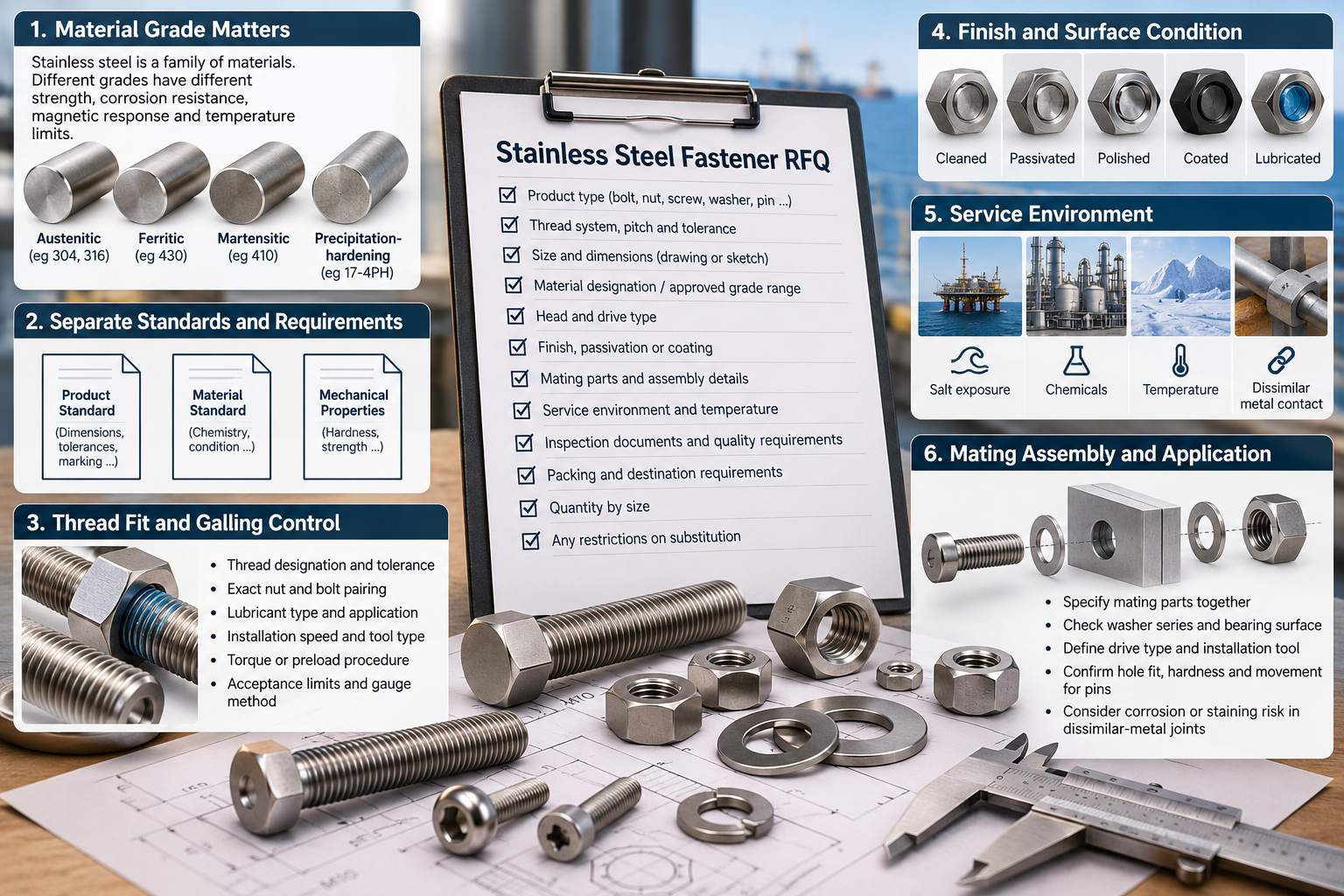
Start with the joint and the governing document, not the coating color or the unit price.A professional first review should establish seven things before quotation is treated as comparable:
- the application and design authority;
- the exact product standard, project specification and revision;
- diameter, length, thread, tolerance and geometry;
- material and required mechanical property class or grade;
- heat treatment and any special-process controls;
- finish, corrosion target, friction or installation requirements;
- inspection, documentation, lot marking, packaging and delivery terms.
If any of those items are missing, the supplier should issue a clarification list. A quick price based on silent assumptions is not a complete quote. For high-load assemblies, the commercial comparison is meaningful only after the technical basis is aligned.
Why the words “high strength” are not a complete specification
“High strength” describes an expectation, not a universally interchangeable product. Metric property classes, ASTM structural grades and project-specific fasteners use different systems. Head markings, dimensional series, nut compatibility, washer requirements, thread lengths and test methods can differ.I would not approve an interchange from tensile strength alone; the assembly, installation method and governing code still have to match.
The phrase also hides several independent variables. Steel chemistry affects hardenability. Forming and thread production affect geometry and surface condition. Heat treatment establishes the required mechanical properties but can introduce distortion or decarburization if poorly controlled. Cleaning and electroplating may introduce hydrogen. A topcoat or lubricant can change the torque–tension relationship. Packaging can allow corrosion before installation. Each variable needs an owner and an acceptance method.
For metric carbon and alloy steel fasteners, ISO 898-1:2013 is an important reference for mechanical and physical properties of bolts, screws and studs within its stated scope. The ISO abstract also makes a boundary clear: the standard does not by itself specify corrosion resistance, torque/clamp-force performance or fatigue resistance. A buyer therefore should not treat a property-class callout as a complete service-condition specification.
First decision: identify the governing system
A qualification project becomes much easier when the buyer names the governing system in the RFQ. The table below is a routing tool, not a substitute for reading the applicable documents.
| Question | Why it matters | Evidence to request |
|---|---|---|
| Is the product metric or inch series? | Thread form, dimensions, grade identification and gauges differ. | Drawing, standard number, edition and thread designation |
| Is it a general-purpose machine fastener or a structural assembly? | Structural joints can add assembly, installation and lot requirements. | Project specification and approved bolt/nut/washer combination |
| Is a national, international or customer standard controlling? | Similar-looking standards may contain different dimensions and tests. | Order-of-precedence statement for conflicting documents |
| Is the part standard or drawing-controlled? | A custom head, thread length or transition radius may require dedicated tooling. | Controlled drawing with revision and approved deviations |
| Is installation torque, tension control or turn-of-nut used? | Coating and lubrication affect installation behavior. | Installation method and required qualification/test plan |
For structural steel joints in North American practice, the 2020 RCSC Specification is a useful primary reference for the design, installation and inspection context of high-strength bolted joints. The procurement team should use the edition and documents required by its contract; it should not assume that a supplier’s general product certificate replaces project-specific compliance.
Build an order-of-precedence rule before asking for price
Drawings, standards, purchase specifications and project notes sometimes conflict. A drawing may state one finish while a bill of materials lists another. A customer standard may require a tighter dimensional tolerance than the referenced product standard. Without an order-of-precedence rule, the supplier has to guess which requirement wins.
A practical RFQ can state: “Unless otherwise approved in writing, the controlled drawing governs dimensions; the purchase specification governs inspection and documentation; the referenced product standard governs unspecified features.” The exact wording depends on the buyer’s quality system, but the principle matters.Conflicts must become written questions and approved deviations, not production-floor interpretations.
Revision control belongs in the same conversation. Put the drawing revision, specification edition and any approved concession number on the purchase order. A file name such as “final-bolt-new.pdf” is not revision control. The supplier’s quotation should repeat the revision so both parties can see what was priced.
Translate the application into supplier-readable requirements
A supplier does not need confidential design calculations to quote responsibly, but it does need the constraints that affect product and process selection. Useful application information includes:
- joint type and whether slip, separation or fatigue is a concern;
- indoor, outdoor, marine, chemical or temperature exposure;
- installation tool and tightening method;
- expected mating nut, washer and connected material;
- restricted substances, finish-color limits or cleanliness needs;
- service market and any mandatory regulatory or customer approval;
- whether replacement parts must match installed field stock.
If the drawing is sensitive, share a redacted interface first and put a mutual NDA in place before releasing the full file. A competent supplier can work from boundary dimensions and performance requirements during early feasibility, then move to controlled documents after commercial alignment.
Property class, grade and material are separate lines
One of the most common RFQ errors is treating material and performance as the same thing. “Alloy steel” is not a property class. “10.9” is not a complete chemical composition. A material specification controls allowable chemistry and sometimes processing; a property class or grade controls mechanical outcomes and other defined requirements. On many orders, the purchase order needs both.
Give material designation, mechanical grade/property class, governing standard, heat-treatment condition and required testing their own RFQ lines. When alternatives are allowed, name the proposed steel in the quotation and show how it meets the required properties under the applicable standard. Substitution should never be hidden behind a generic phrase such as “equivalent steel.”
Also distinguish fastener body hardness from core hardness, surface hardness and decarburization requirements where applicable. A single hardness number without a location, method, scale and acceptance rule can be misleading. The inspection plan should point to the correct standard and sampling rule.
Heat treatment: qualify the process, not only the final number
For quenched-and-tempered fasteners, heat treatment is a special process because product quality cannot be established by a casual visual check. Final mechanical tests matter, but process discipline explains whether results will be stable from lot to lot.
During qualification, ask how the supplier or approved subcontractor controls furnace identification, recipe, temperature uniformity, atmosphere, quench medium, load pattern, tempering, time and record retention. The buyer usually does not need every proprietary parameter. It does need confidence that batches are identified, recipes are controlled, deviations are handled, and test specimens represent the released lot.
Questions worth asking include:
- How is a heat-treatment lot defined?
- Can a shipment contain multiple heat-treatment lots, and if so, how are they separated?
- How are furnace charts or digital records linked to the lot?
- What controls address decarburization and surface condition?
- How are reheat-treatment or rework events authorized and recorded?
- Is the special-process provider included in the approved supply chain?
A supplier may protect detailed process know-how while still providing a certificate that identifies the processor, lot, route, date, acceptance results and authorization status. Traceability does not require publishing a confidential recipe.

Threads and geometry deserve their own control plan
High-strength performance does not excuse dimensional nonconformance.Thread pitch diameter, major diameter, minor diameter, lead, flank condition and gauging influence assembly. Head dimensions, bearing surface, underhead fillet, shank diameter and thread runout can affect fit and stress distribution. A bolt may pass a simple length check and still create installation trouble.
Define whether threads are cut or rolled, and whether they are produced before or after heat treatment when the standard or drawing makes that relevant. Identify the required thread tolerance class, gauge system and coating allowance. Coating adds thickness; an unplanned deposit can turn an acceptable bare thread into a tight coated thread. The supplier’s route should account for that before mass production.
For drawing-controlled parts, mark critical dimensions and functional interfaces. Avoid labeling every dimension critical. An overloaded control plan can dilute attention and increase cost without reducing risk. Critical-to-function features should receive capable processes, appropriate gauges and a clear sampling or 100% inspection decision.
Coating selection starts with the service environment
Finish decisions should answer four different questions:
- What corrosion mechanism and exposure must be addressed?
- What appearance or color is required?
- What dimensional allowance is available, especially on threads?
- What friction or installation behavior must be controlled?
“Zinc plated” is rarely enough. State the coating process, designation, thickness range or class, conversion layer, sealer/topcoat, color if important, areas to mask, corrosion test requirement, appearance criteria and any lubrication. A lone salt-spray-hour target should trigger two follow-up questions: which coating system, and what exactly counts as failure?
ISO 4042:2022 addresses electroplated fastener coating systems and gives recommendations aimed at reducing hydrogen-embrittlement risk. It now has Amendment 1:2026, so buyers should identify the contractually applicable edition. The standard is a reference framework; it does not remove the need for product-specific risk review and process controls.
Hydrogen embrittlement cannot be solved by a vague “baking” note
High-strength steel can be vulnerable to hydrogen-related delayed failure depending on hardness, stress, processing and environment. Acid cleaning and electroplating are among the routes that may introduce hydrogen. Post-plating heat treatment is one control, but it is not a universal guarantee and it cannot replace prevention, timely processing, qualified parameters and risk-appropriate testing.
At this point, it is worth asking whether the specified coating route is the right one. ISO 10683:2018 addresses non-electrolytically applied zinc-flake systems; its scope calls out high-strength fasteners where avoiding internal hydrogen-embrittlement risk is important. That is a route to evaluate, not a blanket approval. Thickness, thread fit, curing temperature, corrosion target, friction and assembly behavior remain part of the validation.
Have the proposed supplier map the coating steps and explain, in writing, how hydrogen risk is controlled for this grade and part. If a critical application requires process audit, delayed-fracture testing or an approved applicator, state that before quote. Do not add such requirements after production and expect the original price and lead time to remain valid.
Coating and lubrication are part of the bolted assembly
Torque is an input; clamp force is the engineering outcome that often matters. Thread and bearing-surface friction consume much of the applied torque. Coating, sealer, lubricant, mating parts, tool speed and reuse can change that relationship. Therefore a torque value copied from a generic chart may be unsafe or simply unsuitable for the real assembly.
ISO 16047:2005, with its 2012 amendment, provides conditions for torque/clamp-force testing of threaded fasteners and related parts. A buyer using torque-controlled installation should define the exact assembly tested: bolt, nut, washer, coating, lubricant, tightening speed and reuse condition. A coefficient range without the test configuration is incomplete.
The supplier quotation should state whether lubricant is integrated in the topcoat, applied separately or absent. Packaging must preserve that condition. Oily residues, excessive lubricant migration, mixed surface conditions or contamination can make field behavior inconsistent even when dimensional and tensile tests pass.
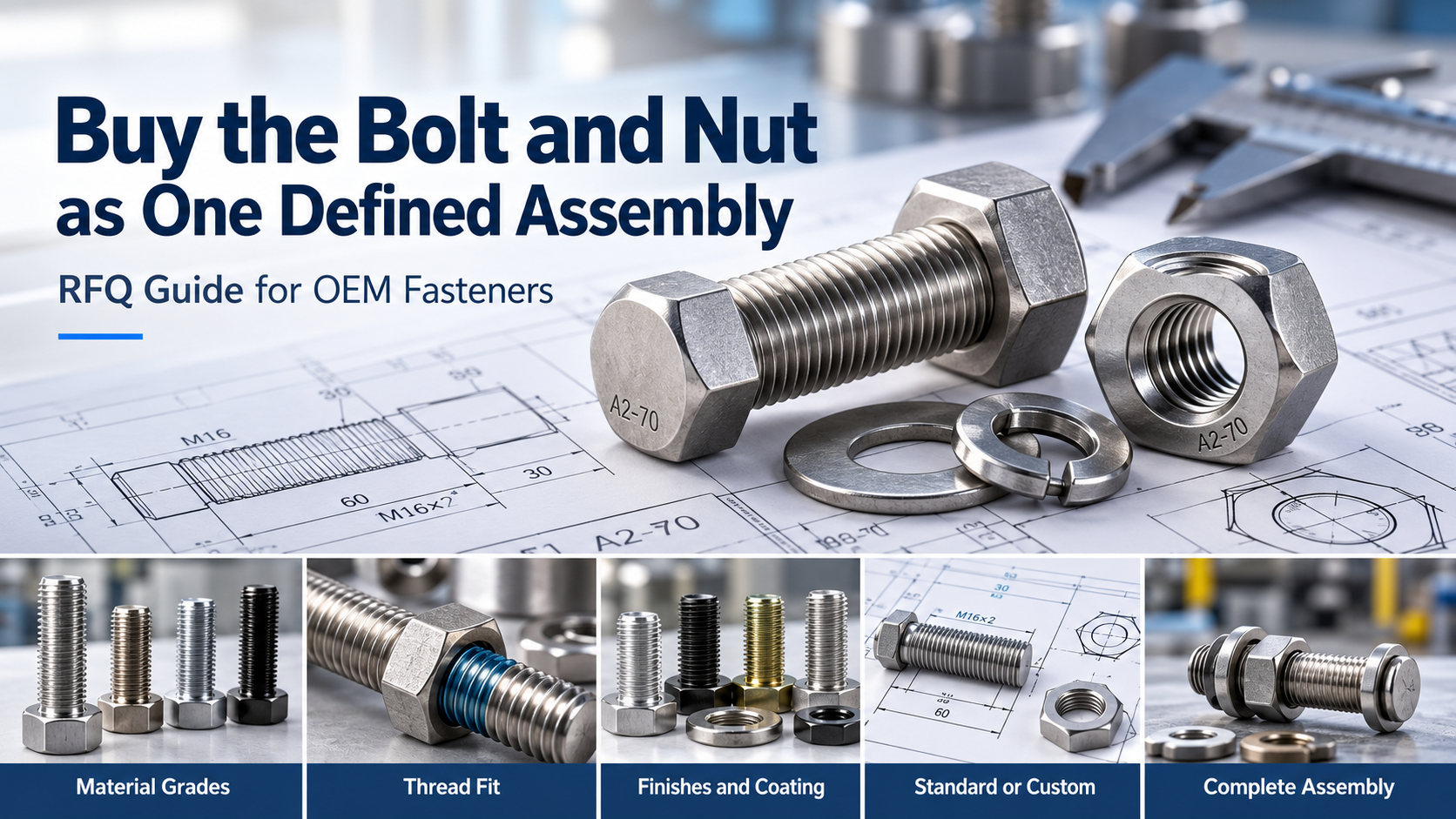
Treat the bolt, nut and washer as a system
The strongest individual component does not automatically create the best assembly. Nuts need the correct property class or grade, thread fit and proof capability.Washers need the specified type, hardness and dimensions. Coatings on all components must allow assembly without seizure or interference. Structural systems may require components supplied and identified together.
Ask these questions before approving a source:
- Who supplies or manufactures each component?
- Are components qualified as a set or only separately?
- Can the supplier prevent mixing of visually similar grades?
- Are nut proof-load and washer-hardness records available where required?
- Does the coating/lubricant system apply to all mating surfaces?
- How are replacement components controlled?
When bolts are sold as assemblies, packaging should keep the intended components together or use unmistakable matched labeling. A buyer should not have to reconstruct a qualified assembly from anonymous cartons after arrival.
Create an inspection plan that follows the failure risk
Inspection is most effective when tied to credible failure modes. A decorative dimension and a thread pitch diameter should not automatically receive the same attention. Start with design and process risk, then assign characteristics, methods, frequency, responsibility and records.
| Risk or requirement | Practical control | Typical record |
|---|---|---|
| Wrong material | Approved material source and heat traceability | Mill/material certificate linked to incoming heat |
| Incorrect mechanical properties | Defined lot tests to applicable standard | Tensile, proof load, hardness or wedge test report as applicable |
| Heat-treatment variation | Controlled recipe,lot and furnace records | Heat-treatment certificate and lot traveler |
| Thread nonconformance | Calibrated gauges and coating allowance | In-process/final gauge result |
| Coating inconsistency | Approved applicator and defined system | Coating thickness/corrosion/process certificate |
| Hydrogen-related risk | Preventive route and approved controls | Process declaration, timing/bake record,specified test if required |
| Assembly mismatch | Kitted or lot-linked component control | Assembly list and packaging verification |
| Shipping mix-up | Lot label and carton/pallet reconciliation | Packing list and release checklist |
Sampling must come from a specified standard or an agreed inspection plan. “Random inspection” is not a plan. Define lot size, sample size, acceptance criteria, reaction to failure and whether retest is allowed. Critical applications may need enhanced controls, but 100% testing of destructive properties is impossible; risk must be managed through qualified processes plus statistically meaningful verification.
What a meaningful material certificate should contain
A material certificate becomes valuable when it is connected to the shipped goods.At minimum, review the producer or certifying party, material designation, heat number, chemical analysis, applicable specification, product form, test results and authorization. The certificate number or heat identity should flow into the supplier’s incoming record and production traveler.
A PDF with plausible chemistry but no connection to the bolt lot is only background information. The buyer should be able to follow this chain:
mill heat → received raw material → production batch → heat-treatment lot → coating lot → final inspection lot → carton/pallet label → packing list.
That chain may use one internal lot number plus cross-reference tables. The exact database is less important than the ability to retrieve the relationship quickly. During audit, ask the supplier to select one packed carton and walk backward to the source heat and test results, then select one test report and walk forward to the affected cartons.
Mechanical test reports need context
An acceptable report should state the part or lot identity, standard and edition, specimen or fastener condition, method, equipment status where required, results, units, acceptance criteria, test date and approval. Values without criteria force the buyer to interpret the report; pass/fail words without values prevent meaningful review.
Depending on product and standard, the evidence may include tensile strength, yield or stress at non-proportional elongation, proof load, elongation, reduction of area, wedge tensile result, hardness, decarburization, head soundness or impact performance. Do not demand every possible test. Demand the tests required by the governing product standard, drawing, project specification and risk plan.
If third-party testing is required, specify the laboratory approval, witnessing rules, sample selection and report recipient. The supplier should not select polished samples from outside the production lot. Chain of custody matters when independent evidence is part of acceptance.
Lot definition is the center of traceability
Buyers often request “full traceability” without defining a lot. The supplier then provides an internal batch number whose scope is unclear. A useful lot definition states which common factors bind pieces together—such as part number, dimension, material heat, manufacturing route, heat-treatment batch, coating batch and inspection period.
Overly broad lots hide variation. Excessively narrow lots create administrative cost and fragmented testing. The right definition follows the process and the governing standard. If one sales order contains several lots, reports and labels should show the separation. Mixing lots into one unlabeled bin before packing defeats good upstream records.
Traceability should survive repacking by the distributor. If small boxes are separated from the master carton, each salable unit may need part number, description, grade/property class, finish, quantity, lot and country-of-origin information as agreed. Barcode format and label language should be specified in the RFQ, not improvised after the goods are ready.
Packaging is a quality-control process
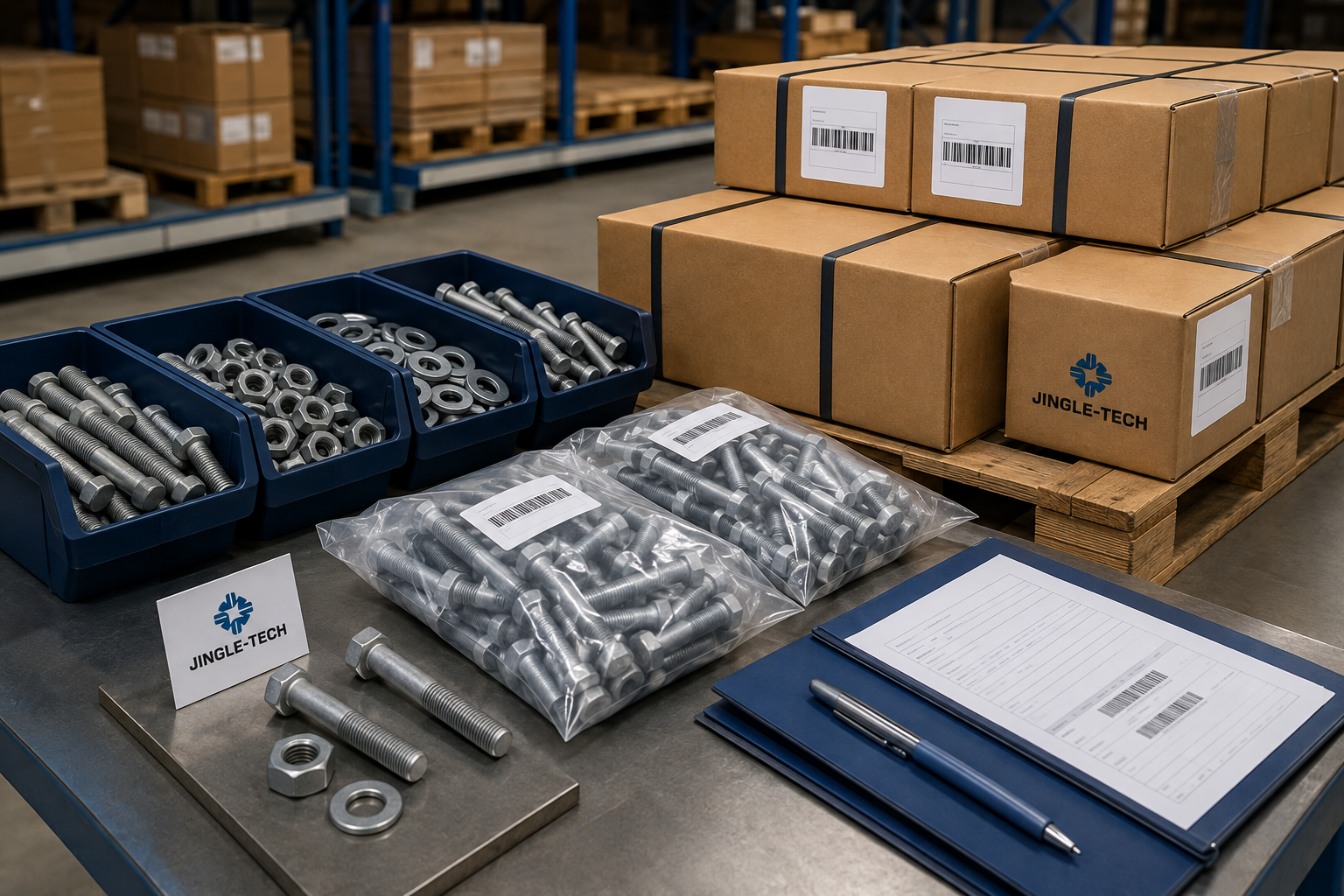
Fasteners are compact and heavy. A carton that looks adequate when empty can fail after stacking, forklift handling, humidity exposure or repeated warehouse movement. Packaging validation should consider gross weight, inner containment, carton strength, pallet pattern, edge protection, strapping, moisture protection and handling marks.
The pack specification should answer:
- units per bag or small box;
- boxes per master carton;
- net and gross weight limits;
- whether parts are oiled, dry or individually protected;
- desiccant or barrier requirements;
- label content and barcode type;
- pallet dimensions and maximum height;
- mixed-SKU rules and separation;
- treatment/marking of wood packaging where ISPM 15 applies;
- photo approval and pre-shipment packing audit.
Buyers planning automated receiving should provide label samples and scanning rules early. A technically conforming bolt with an unreadable barcode or wrong pack quantity still causes a receiving failure.
Supplier capability evidence: ask for a route, not a brochure
A factory presentation can establish context, but process evidence establishes capability. Request a product-specific route from material receipt through packing. It should identify which processes are internal, which are subcontracted, and which inspection gate releases the next step. This is where a serious high strength bolt supplier becomes distinguishable from a trader of anonymous inventory.
For a high strength bolt supplier, useful capability evidence may include forming range, thread-making route, heat-treatment control, surface-treatment partners, gauge list, mechanical testing access, calibration program, nonconformance system, lot-trace method and export packaging experience. A supplier need not own every machine. It must control every process affecting conformity, including outsourced heat treatment and coating.
Avoid turning qualification into a photograph contest. A machine photo does not prove capability, maintenance or correct use. Pair visual evidence with recent records, a sample traveler, calibration status and one completed lot trace exercise.
A two-stage sample plan prevents false confidence
One attractive hand-selected sample cannot validate a production system. Use two stages:
Stage 1: feasibility samples. Confirm drawing interpretation, tooling approach, geometry, assembly and appearance. These may be made using prototype methods, so the supplier must disclose any difference from mass production.
Stage 2: production-representative samples. Use the intended material source, tooling, heat-treatment route, coating applicator, inspection flow and packaging. Approve these only with the required records.
If the first article is destructive-tested, retain control samples from the same lot.Mark approved samples and record deviations. Golden samples help with appearance and fit, but they do not override dimensions or performance requirements.
Run a disciplined first-article review
A first-article package should be scaled to risk. It may include a ballooned drawing, dimensional results, material certificate, heat-treatment evidence, mechanical tests, coating results, thread-gauge results, marking photos, packaging proof and an approved-deviation list.
Review the package as a system. If the drawing calls for a coating thickness but the dimensional report measures only before coating, the review is incomplete. If tensile tests identify one lot while the cartons use a different numbering scheme with no cross-reference, traceability is incomplete. If a nut from the final assembly was not included in fit or torque testing, assembly evidence may be incomplete.
Close every open item before authorizing mass production. “Will fix in production” should have an owner, corrected evidence and written approval. Conditional approval is useful only when conditions are visible and enforced.
Production release gates reduce late surprises
A practical control plan uses release gates rather than waiting for the pre-shipment inspection:
| Gate | Minimum decision evidence | Buyer action |
|---|---|---|
| Technical review | Clarification list closed; drawing/standard revisions aligned | Approve quotation basis |
| Tooling/route review | Process flow and subcontractors identified | Authorize tooling or sample run |
| First article | Dimensions, material, mechanical and finish evidence complete | Approve production-representative sample |
| Mass-production start | Approved sample and documents released to production | Authorize batch |
| Pre-shipment | Final inspection, lot reconciliation and packaging complete | Release shipment |
These gates are especially helpful on new parts, new coatings or a new production site. Mature repeat orders can use a reduced plan if change control and historical performance justify it.
Change control belongs in the purchase agreement
A sample approval is meaningful only if the process remains stable.Require advance notice for changes to material source, production location, tooling concept, heat-treatment provider, coating applicator, coating chemistry, lubricant, inspection method or packaging where those changes may affect conformity.
Not every change needs a complete requalification. The supplier should describe the change, risk, affected lots and proposed validation. The buyer then decides whether document review, samples, partial testing or full reapproval is needed. Emergency changes still require disclosure; shipment urgency is not permission to conceal them.
Also define retention periods for records and samples. Project liability and replacement cycles may extend beyond the supplier’s default retention. A clear period written before order is easier to price and maintain than a request made years later.
How to compare quotations without rewarding hidden exclusions
Normalize each quote into the same commercial model. Separate unit price, tooling, sample/test charges, third-party inspection, special packaging, document fees, freight and duties. Record the Incoterm and named place. Note whether the price assumes one lot, one delivery or an annual blanket order.
| Quote element | Supplier A | Supplier B | Buyer’s normalized basis |
|---|---|---|---|
| Standard/revision | Stated? | Stated? | Must match approved RFQ |
| Material and grade | Exact or “equivalent”? | Exact or “equivalent”? | Written approved designation |
| Finish system | Full system or color only? | Full system or color only? | Same coating stack and test basis |
| Test/document package | Included or extra? | Included or extra? | Required evidence list |
| MOQ and lot count | One size or combined? | One size or combined? | Forecasted purchasing pattern |
| Packaging | Bulk,small box or private label? | Same? | Approved pack specification |
| Lead time | From deposit, drawing or sample approval? | Same? | Same start and completion point |
The cheapest number can become the highest landed-risk option if it excludes coating validation, inspection evidence or usable packaging. Ask suppliers to list exclusions. Silence should not be treated as inclusion.
Lead time should be a route map
“Thirty days” is not informative unless the starting event and milestones are defined. A realistic schedule separates technical review, tooling, material, sample production, testing, approval, mass production, coating, final inspection, packing and booking.
The schedule often stalls at ordinary handoffs: special steel is not released, the heat-treatment slot moves, the coating line is full, or a laboratory cannot start until next week.Buyers can help by sending complete files, closing questions quickly and approving packaging before production finishes.
Ask for an earliest credible plan and a normal repeat-order plan. Do not force an optimistic date that assumes every approval happens instantly. A supplier willing to show dependencies gives the buyer better control than one offering an unexplained promise.
Red flags during qualification
Pause and investigate when you see any of the following:
- the quotation omits the referenced standard or revision;
- “equivalent material” is proposed without a comparison;
- a generic certificate is reused for unrelated sizes or lots;
- the supplier cannot explain the link between material heat and finished carton;
- coating is described only by color or salt-spray hours;
- hydrogen risk is dismissed with “we always bake” but no route or record;
- torque values are provided without assembly and test conditions;
- the first article uses a different process from production without disclosure;
- outsourced special processes are unidentified or uncontrolled;
- marking and labels do not match the reported lot;
- a failed test is replaced by a new report without a documented investigation;
- the supplier refuses to state exclusions or assumptions.
A red flag is not automatic proof of misconduct. It is a reason to request evidence, narrow the scope or choose another source.
A buyer-ready RFQ template
The following fields produce a much stronger request than “Please quote high-strength bolts.”
| RFQ field | What to enter |
|---|---|
| Buyer/project reference | Internal part number,project and confidentiality status |
| Controlled documents | Drawing number/revision; standard number/edition; specification hierarchy |
| Product | Bolt/screw/stud type; dimensions; thread; tolerances; marking |
| Material | Exact designation or approved alternatives process |
| Mechanical requirement | Grade/property class and applicable test standard |
| Manufacturing restrictions | Thread route, heat treatment, special processes if specified |
| Finish | Coating stack,thickness/class,color, sealer, lubricant, masking |
| Assembly | Nut, washer, mating finish and installation method |
| Inspection | Characteristics, sampling, acceptance and third-party needs |
| Documents | Material, heat treatment, mechanical, coating and final inspection records |
| Traceability | Lot definition, markings, label and retention period |
| Quantity | Prototype, first article, MOQ and annual volume ladder |
| Packaging | Unit pack, carton, barcode,pallet and moisture protection |
| Delivery | Incoterm, named place, destination and milestone dates |
Attach editable drawings where possible and a PDF for visual control. State whether the supplier may suggest manufacturability improvements. Request that every deviation be listed in the quotation rather than buried in email.
Request a Technical RFQ Review →
An illustrative qualification example
The following is a hypothetical example, not a claim about a specific JINGLE customer or completed project.
A fabricator requests a large metric bolt assembly for outdoor equipment. The initial note specifies property class 10.9 and “silver zinc.” The first supplier review produces four blunt questions: Must it be electroplated? Will installers control torque? Which nut and washer are in the set? What corrosion test governs acceptance? The buyer confirms that appearance is secondary, a defined torque window is important, and a non-electrolytic coating may be considered.
The teams compare coating options, identify the intended nut/washer assembly, set a production-representative sample run and agree on torque/clamp-force testing for the complete coated assembly. The final order includes lot-linked material, heat-treatment, mechanical and coating evidence. Carton labels show the assembly part number and lot, while a cross-reference links component batches.
The important result is not a particular coating recommendation. It is the sequence: uncover the real constraint, evaluate an option with the responsible engineer, test the representative assembly, approve records and preserve identity through packing.
Working with a coordinated OEM supply partner
Some buyers need one supplier for a single standard fastener. Others need a coordinated package: bolts, custom screws, nuts, washers, anchors, clamps and machined interfaces. A multi-category source can reduce communication and consolidation work, but only if technical ownership remains visible.
JINGLE-TECH supports drawing-, sample-, material-, finish- and packaging-based sourcing for industrial hardware, with export coordination from Ningbo.The exact manufacturing site, test package, certification scope and commercial entity should be confirmed for each RFQ and purchase order. That transparency is more useful than a blanket claim that every product follows the same route.
Buyers exploring adjacent categories can use these focused resources:
| Requirement | JINGLE buyer resource |
|---|---|
| Drawing-controlled industrial fasteners | custom fastener manufacturer |
| Nonstandard screws and drive/head combinations | custom screw manufacturer |
| Structural bolting supply programs | structural bolt manufacturer |
| Mechanical and concrete anchoring | concrete anchor manufacturer |
| Special nuts, washers, rods and pins | custom nut manufacturer |
| Worm-drive and application-specific clamps | hose clamp manufacturer |
| Precast lifting systems | lifting anchor manufacturer |
| Sockets, inserts and related precast items | precast concrete accessories manufacturer |
| Drawing-controlled turned and milled parts | precision CNC machining parts manufacturer |
| Mixed fastener and machining RFQ programs | OEM fastener and machined parts supplier |
Internal links should help a buyer move to a relevant next decision. They are not a claim that one qualification automatically approves every category.
Frequently asked buyer questions
What information is needed for an accurate high-strength bolt quote?
Provide the controlled drawing or standard and edition, dimensions and thread, material, grade/property class, heat treatment, finish system, mating nut/washer, installation method, required tests and documents, quantity ladder, packaging, Incoterm, destination and requested schedule. If something is undecided, label it as an open point and request options.
Can a supplier quote from a sample only?
A sample can support reverse engineering, but it rarely reveals material chemistry, heat-treatment history, coating stack, mechanical grade or acceptance standard. Use the sample for geometry and interface review, then approve a drawing and performance specification before production. Destructive analysis may be useful, but it still does not establish the original design intent.
Is a property class such as 10.9 enough?
No. It is an essential mechanical designation within an applicable system, but the order still needs dimensions, product standard, material/processing constraints where required, finish, assembly components, testing, documentation and service-related requirements.
Does a material certificate prove the finished bolts comply?
It proves selected information about the starting material when authentic and correctly linked. Finished-fastener compliance also depends on forming, threading, heat treatment, coating, dimensions and required mechanical tests. The material certificate must connect to the finished lot through traceability records.
Should buyers always request third-party inspection?
Not always. Use risk, application criticality, supplier history, project rules and consequence of failure to decide.A focused independent verification can be valuable for a new source or critical order, but it does not replace the supplier’s controlled process and full lot records.
Which coating route belongs on this bolt?
No single finish wins in every application. The decision depends on grade/hardness, environment, geometry, thread fit, installation friction, appearance, temperature and applicable standards. Evaluate hydrogen risk and assembly performance. Obtain approval from the responsible engineer when changing from a specified system.
Do salt-spray hours predict outdoor life?
No direct conversion should be assumed. Accelerated corrosion tests are useful for checking a defined coating system and process consistency under stated conditions. Field performance depends on real exposure, design, damage, contact materials, maintenance and other factors.
May the bolt, nut and washer come from separate plants?
They can, if the supply chain and assembly qualification allow it. The coordinating supplier must control specifications, lot identity, compatibility, testing and change notification. Structural or project requirements may impose stricter assembly sourcing and packaging rules.
How long does sampling take?
It depends on material availability, tooling, heat treatment, coating, laboratory tests and document review. Ask for a milestone schedule starting from approved technical documents, not a single number starting from an unclear date.
What should be printed on the package label?
Agree the label fields in advance. A receiving team usually needs the buyer part number, description, dimensions, grade/property class, finish, quantity and traceable lot; supplier identity, weights, origin and barcode may also be required. Mandatory legal or customer-specific fields vary by destination and channel.
How should nonconforming test results be handled?
The supplier should contain affected lots, document the result, investigate cause, assess scope, obtain disposition authorization and provide corrected evidence. Retesting rules must follow the governing standard and agreed quality plan. Quietly replacing a failed report is unacceptable.
What does JINGLE-TECH need to begin a review?
Send the drawing or standard, application summary, material/grade, finish, assembly details, annual and first-order quantities, required quality documents, packaging and delivery destination.The team can then issue clarification questions and define what capability and evidence need to be confirmed for the specific item.
Final procurement checklist
Before issuing the purchase order, verify that:
- the controlled drawing, standard editions and precedence rule are written;
- material and mechanical grade are separate, exact requirements;
- heat-treatment and outsourced special processes are identified;
- coating, thickness/class, sealer and lubrication are complete;
- hydrogen-related risk has been reviewed for the chosen process;
- the bolt, nut and washer are treated as the intended assembly;
- inspection characteristics, sampling and reaction plans are agreed;
- material and test records link to an explicit production lot;
- first articles represent the mass-production route;
- packaging protects heavy parts and preserves lot identity;
- quotation exclusions, tooling, tests and Incoterm are normalized;
- lead time begins from a defined approval milestone;
- change notification and record retention are part of the order.
Send a complete RFQ, not a guess
Most high-strength fastener problems are cheaper to stop while the quotation is still being discussed. With a clear technical package, the supplier can flag process risk, select a defensible route, price the evidence and show a schedule the buyer can actually manage. The same package makes competing offers easier to compare.
JINGLE-TECH can review standard and drawing-controlled bolt inquiries together with mating hardware, coating, documentation, traceability, private-label packing and export-delivery requirements. Capability, standards, certifications and test scope are confirmed against the actual part and order rather than assumed across every product.
When you contact us, attach the latest drawing and include grade/property class, finish, mating nut/washer, quantity ladder, required reports, pack format, destination and target delivery window. If a requirement is still open, explain the service condition and decision constraint so the technical review can propose questions or options.
Get a High-Strength Bolt Quotation →
Editorial note: This procurement guide provides general sourcing and quality-planning information. Product selection, joint design, installation and acceptance must follow the controlled engineering documents, applicable standards and approvals for the specific application.