A heavy-looking clamp is not automatically the right clamp

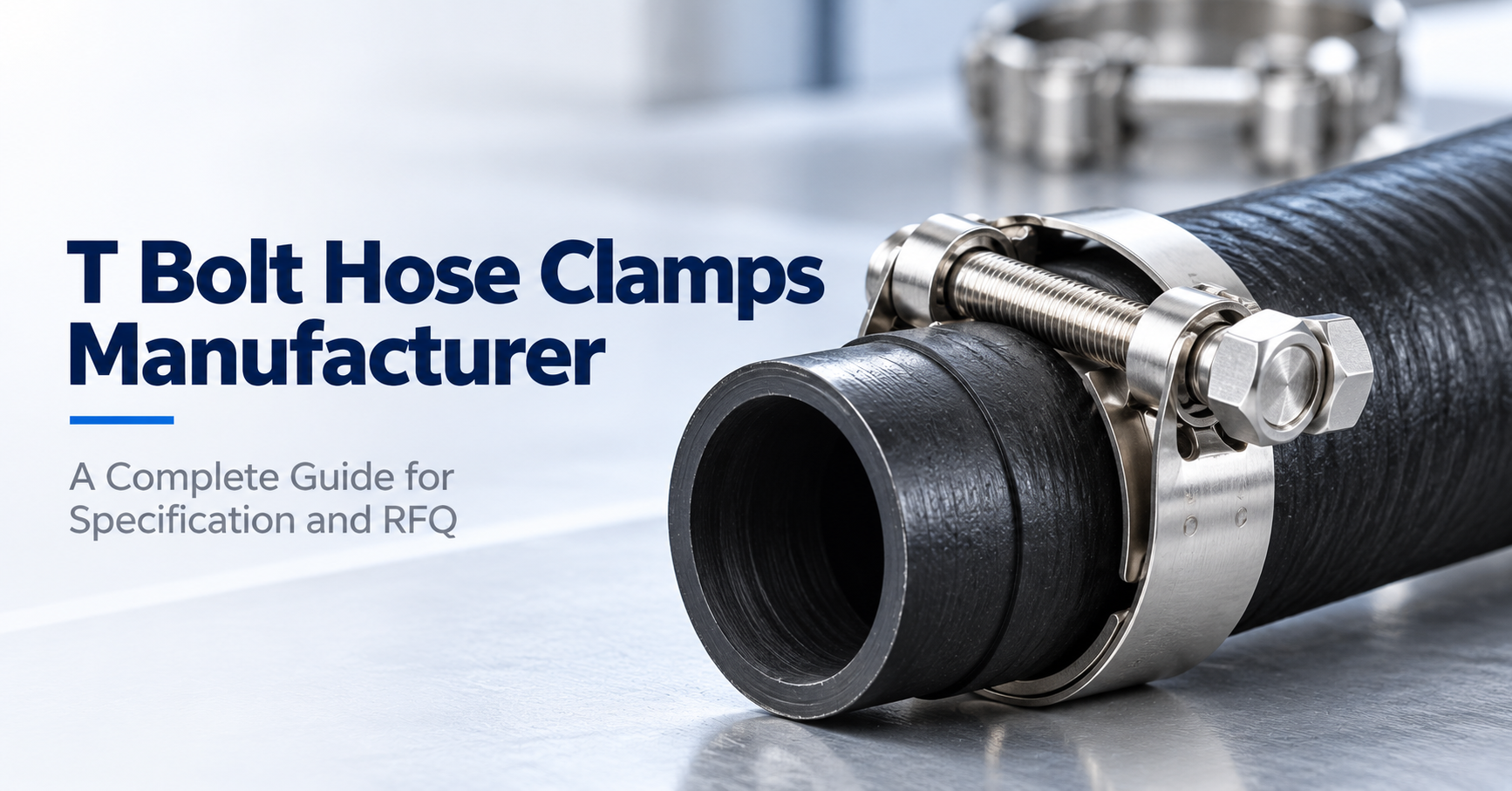
T bolt hose clamps are commonly considered for assemblies that need a robust band and a bolted tightening mechanism. That description is useful, but it is not a specification. The clamp must still fit the real hose and fitting, sit in the correct location, tighten through the required range and survive the application's pressure, vibration, temperature and chemical exposure. This is why a T bolt hose clamp manufacturer needs more than a nominal hose diameter. Send the installed outside-diameter range, hose construction, wall behaviour, fitting geometry, available band seat, fluid, temperature, pressure or vacuum conditions, vibration, assembly tool and required validation. If the design uses a formed bridge, trunnions, springs or a special band profile, include a drawing or approved sample. The goal is not to purchase the strongest-looking hardware. It is to buy a controlled clamp assembly whose geometry and installation match the connection.
Send JingleFix your T bolt clamp application and RFQ details
Keep T bolt clamps separate from worm-drive clamps
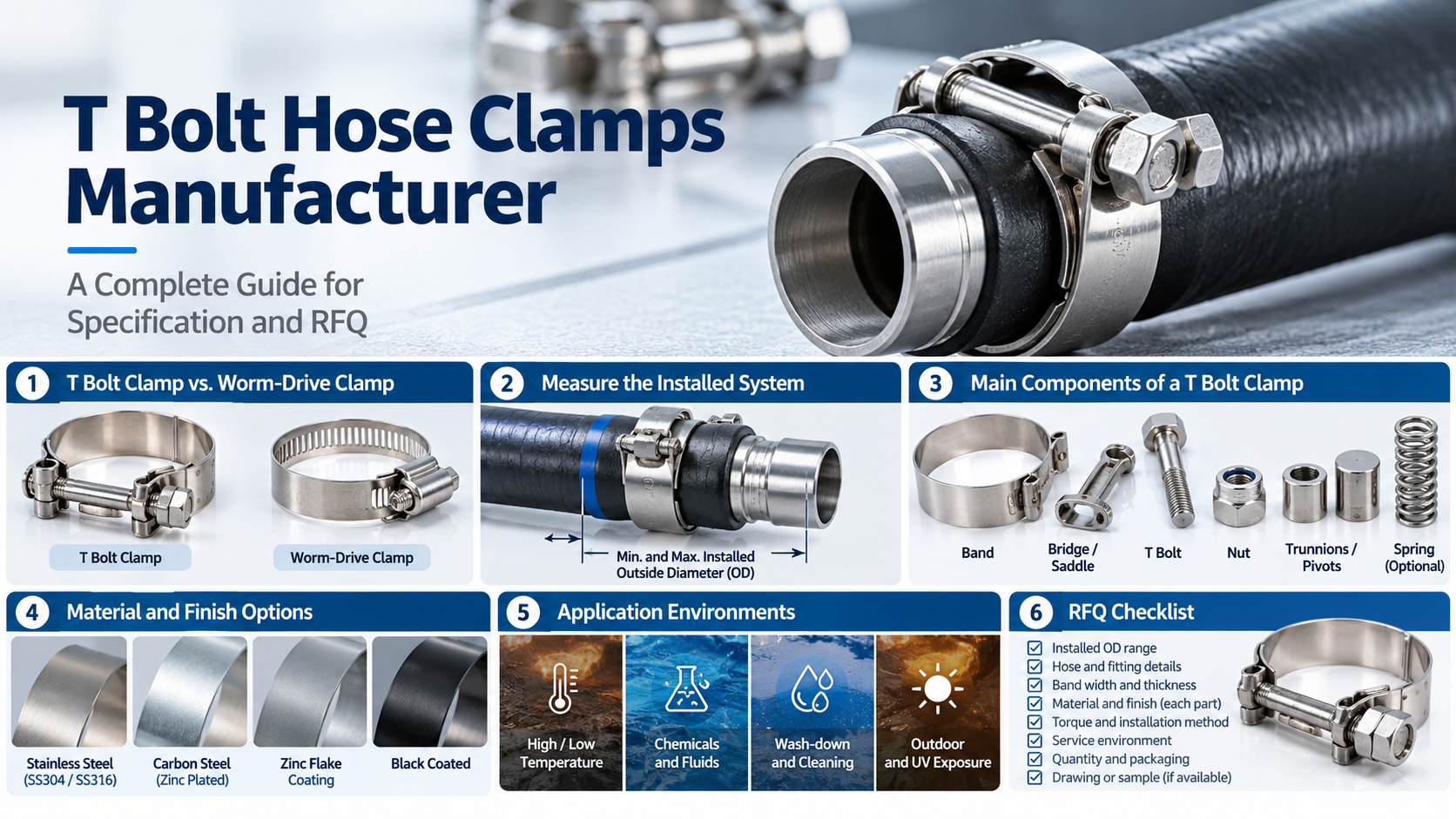
A T bolt clamp and a worm-drive clamp use different tightening arrangements and should not be merged into one product description. A worm-drive design uses a screw engaging slots or a formed thread in the band. A T bolt design typically uses a bolt, nut and trunnion or bridge arrangement to draw the band ends together. Their band profiles, installation tools and performance characteristics can differ. When replacing an existing clamp, identify the original construction rather than sending only a size. Record the band width and thickness, inside surface, edge treatment, bridge geometry, bolt diameter and thread, nut style, trunnion details and any spring element. If a change is proposed, review tool access, adjustment range, hose loading and clearance around the assembly. SAE J1508_202301 is one published hose clamp specification covering multiple clamp types used on certain OEM fluid and emission systems. It may be relevant to a project, but it is not a universal approval for every T bolt clamp or application. The buyer must state the applicable standard, drawing and validation requirements.
Measure the installed system, not just the loose hose
The outside diameter of an uninstalled hose can differ from the diameter after it is placed over a fitting. Beads, barbs, wall compression, reinforcement, sleeves and manufacturing variation all affect the clamping range. Measure representative production parts in the assembled condition. Provide the minimum and maximum installed outside diameters, not only a catalogue hose size. State where the band will sit relative to any bead or barb. If the fitting is oval, out of round or made from a flexible material, tell the supplier. A clamp selected from a nominal diameter alone may reach the thread limit before the joint is secure or may have insufficient adjustment for production variation. The band must also fit the available axial space. A wider band can distribute force differently, but it may interfere with a fitting shoulder, adjacent component or bend. The design authority should approve the band position and width.
Define every part of the clamp assembly
T bolt clamps are assemblies rather than single-material rings. A complete RFQ separates the important components:
- Band: material, width, thickness, inside profile, edge condition and surface finish.
- Bridge or saddle: shape, bearing area, alignment and contact with the hose.
- T bolt: diameter, thread, length, material, property requirement and coating.
- Nut: style, thread, locking feature, material, finish and lubrication.
- Trunnions or pivots: geometry, material, forming and freedom of movement.
- Optional spring: type, travel, material and purpose in the validated assembly.
Do not assume that "all stainless" identifies the same grade for every component. Some designs intentionally combine different materials or finishes. Require the supplier to list the material of each critical part and to declare any proposed change.
Material selection follows the environment
The clamp sees more than the fluid inside the hose. It may be exposed to road salt, wash chemicals, fuel vapour, engine heat, outdoor weather, condensation or cleaning agents. The band, bolt, nut and bridge may not experience identical conditions, especially at crevices and contact points. Define the environment in practical terms. Include normal and peak temperature, wet or dry cycling, chemicals outside the hose, expected service life and any appearance requirement. If the joint involves dissimilar metals, consider galvanic interaction and staining. If a corrosion test is required, specify the method and acceptance criteria rather than requesting an undefined number of hours. Stainless steel is not a single performance level. Carbon-steel components with protective coatings also vary by process. A T bolt hose clamp manufacturer should return the exact offered material and finish for each component, not a portfolio-wide corrosion claim.
Installation torque is a process input, not a universal rating
Torque applied to the nut is affected by thread geometry, coating, lubrication, prevailing torque and tool accuracy. It does not convert into one universal band load. The hose and fitting also deform as the clamp tightens. For that reason, a torque value taken from another clamp cannot be copied safely to a new assembly without validation. The buyer should define the installation tool, socket access, speed, target method and recheck policy. If torque is the production control, validate it on representative hoses, fittings and clamps at the relevant temperatures. Record whether threads are dry or lubricated and whether the nut contains a locking feature. Inspect the assembled joint for band alignment, bridge seating, thread engagement, local hose damage and clearance. A torque wrench reading alone does not show that the clamp was positioned correctly.
Validation belongs to the complete connection
Useful validation starts with the failure modes of the actual system. Depending on the application, a plan may include leak or pressure testing, vacuum testing, thermal cycling, pressure pulsation, vibration, pull-off checks, corrosion exposure, installation abuse or dimensional inspection. The responsible engineer should select the tests and acceptance criteria. Clarify whether a test is a design validation, supplier qualification, production audit or batch release. These activities use different samples and answer different questions. A report on one size, one hose and one fitting should not be presented as proof for every diameter and material. Ask the supplier to identify the sample construction, lot and test conditions. If a third-party laboratory is required, agree the laboratory, witnessing, specimen selection, cost and timing before production.
A practical T bolt clamp RFQ table
| RFQ block | Details to provide | Why it matters |
|---|---|---|
| Connection | Hose type, fitting drawing, bead or barb, installed OD range and band position. | Controls size range, band seat and adjustment. |
| Clamp geometry | Band width and thickness, bridge, bolt, nut, trunnion and optional spring. | Prevents substitution based only on diameter. |
| Materials | Requirement for each component, finish, lubrication and appearance. | Supports corrosion and assembly review. |
| Service | Fluid, temperature, pressure or vacuum, vibration and external exposure. | Defines the validation environment. |
| Installation | Tool, access, torque method, position and inspection. | Makes production assembly repeatable. |
| Quality | Drawing, critical dimensions, sampling, tests, certificates and traceability. | Creates a measurable acceptance plan. |
| Commercial | Quantity by size, releases, packaging, labels, destination and Incoterm. | Allows a comparable quotation. |
Sampling and first production approval
For a new design, request samples built to a controlled drawing. Use production-representative hoses and fittings rather than a smooth steel mandrel alone. Record the installed diameter, clamp position, tool, torque method and test conditions. Photographing the final assembly can help later operators, but the image should support rather than replace written criteria. Check range at both limits. At the small end, confirm that the bolt, nut and bridge do not bottom out or interfere. At the large end, confirm adequate thread engagement and component alignment. Review sharp edges, burrs, band overlap, weld or joint quality where applicable, and marking. The first production lot may need additional checks if samples were made with different tooling or manual processes. Agree that bridge before placing the bulk order.
Inspection and lot control
Incoming inspection should verify clamp identity and range before destructive testing. Measure the agreed critical features, check thread function, review finish and confirm assembly. If the project uses an installation audit, use a calibrated tool and the approved hose and fitting combination. Define a lot in the purchase order if traceability matters. The lot may need to link band material, bolt and nut source, coating batch, assembly date and final packing. The required depth should match risk; it should not be left as the vague phrase "full traceability." Packaging should prevent deformation, thread damage and mixed sizes. Labels can include the buyer part number, clamp range, material or finish, lot, quantity and barcode. For private-label programs, retain the technical lot code even when the retail face changes.
Frequent sourcing errors
- Ordering from a loose-hose diameter instead of the installed OD range.
- Treating every heavy-duty clamp as the same T bolt design.
- Writing "stainless steel" without identifying each component.
- Copying an installation torque from another clamp or finish.
- Using a pressure claim without naming the tested hose, fitting, size and conditions.
- Approving appearance without checking range, seating and tool access.
- Changing lubrication or coating after validation without review.
Questions from industrial buyers
Is a T bolt clamp always better than a worm-drive clamp?
No. The correct design depends on the connection, available space, load distribution, adjustment range, installation process and validation. The two clamp families should be evaluated for the specific application.
What size information should I send?
Send the minimum and maximum installed outside diameters, hose and fitting details, band position and available axial space. A nominal hose size alone is not enough.
Can all clamp components be stainless steel?
Material options can be evaluated for the specific design. The quotation should identify every critical component and grade. Suitability still depends on forming, strength, thread behaviour, corrosion environment and cost.
Can one test report cover every clamp size?
Not automatically. Report applicability is limited by the tested size, materials, construction, hose, fitting and test conditions. Define any family-validation logic with the responsible engineer.
Can JingleFix support custom T bolt clamps?
Drawing-based or sample-based projects can be evaluated. Feasibility, tooling, material, inspection, quantity, packaging and production route are confirmed for the actual enquiry.
Give the manufacturer a complete connection to review
A clear T bolt clamp RFQ describes the hose, fitting, clamp assembly, environment, installation and evidence as one system. That information helps the supplier quote the right construction and helps the buyer avoid approving a clamp that fits the spreadsheet but not the connection.
Contact JingleFix with your installed diameter range, drawings and validation needs
Technical reference
For one published industry reference covering multiple hose clamp types, see SAE J1508_202301. The applicable standard and product scope must be confirmed for each project.