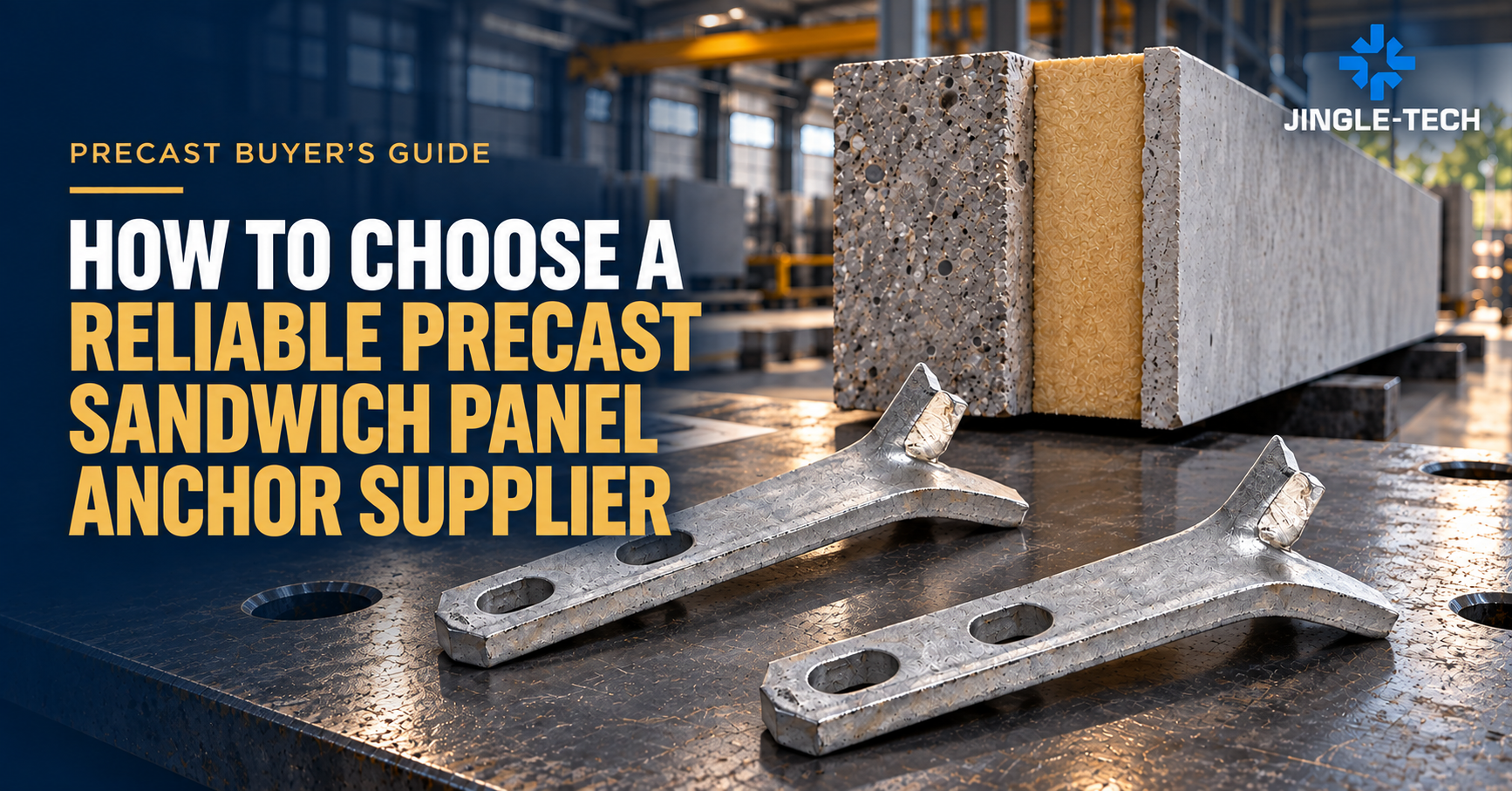
A lifting anchor is inexpensive beside the concrete element it moves. A wrong one is not. If an anchor, clutch, recess former, reinforcement detail, or lifting plan is mismatched, the cost can appear as a rejected casting, a delayed erection, or a serious lifting hazard.
That is why a search for precast concrete lifting anchor manufacturers should not end with ten company names and a request for the lowest unit price. The useful question is: which supply route can provide a complete, documented system for this element, this lifting sequence, and the rules that apply at the destination?
This shortlist compares established system brands, regional manufacturers, and an export-oriented OEM option. It does not declare any anchor safe for a particular job. Final selection belongs in the project’s engineered lifting design and the chosen manufacturer’s current instructions.
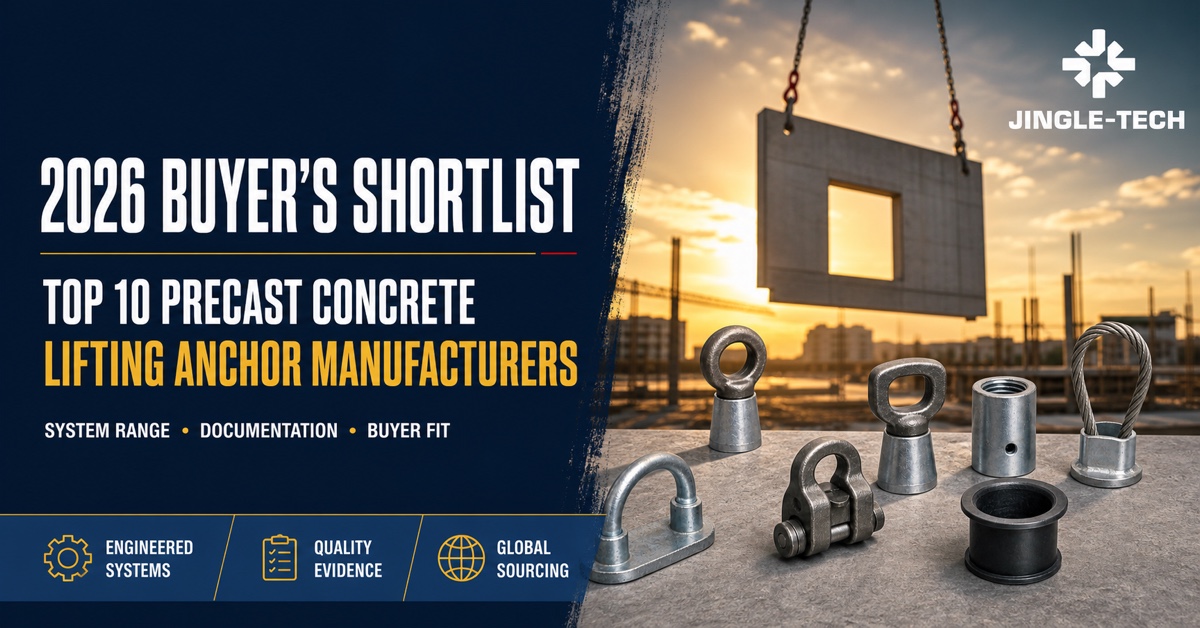
Disclosure: JINGLE publishes this guide and is included in the shortlist. Every company was reviewed against the same public-information criteria. The sequence helps readers navigate the market; it is not a universal performance ranking. The other listed companies did not pay for inclusion.
First, clarify what “manufacturer” means in this market
The term covers several business models. A system owner develops a named family of anchors, lifting devices, formers, and accessories, then publishes design and installation information. A manufacturer-distributor may make selected products and stock others. A regional precast lifting systems supplier emphasizes local inventory, technical help, and compatibility with the market’s usual practices. An OEM precast accessories manufacturer may produce to a buyer’s drawing or specification and export under the buyer’s brand.
Those models are not interchangeable. Nor is an anchor a standalone commodity. The cast-in part, reusable clutch or lifting key, recess geometry, added reinforcement, concrete strength at lift, edge distances, sling arrangement, and load direction all affect the system decision.
If you need the product basics before comparing suppliers, start with this guide to what precast concrete lifting anchors are, then use the separate lifting-anchor selection guide for element-level questions. This page stays focused on manufacturer and sourcing-route comparison.
VDI/BV-BS 6205 is a German engineering guideline covering the manufacture, placing on the market, planning, and use of lifting inserts and lifting-insert systems for precast concrete elements. Safe Work Australia’s current Guide to managing risk in construction: Prefabricated Concrete provides national guidance for building work, but Safe Work Australia is not the regulator and the guide excludes civil construction. Confirm the applicable law, project specification, current standard, and engineering responsibility in the actual jurisdiction.
The shortlist below helps procurement teams compare precast concrete lifting anchor manufacturers without treating every supplier as interchangeable.
Quick comparison of the 10 shortlisted suppliers
| Company | Main supply mode | Public system signal | Best starting fit |
|---|---|---|---|
| Leviat | Engineered brand network | HALFEN DEHA and FRIMEDA systems | Multi-region engineered projects |
| PFEIFER | System manufacturer | Thread, spherical-head, wire-loop families | Buyers wanting broad technical depth |
| Peikko | System manufacturer | JENKA, KK, RR, and WRA families | Projects using coordinated design data |
| Dayton Superior | Manufacturer and distribution network | Fleet-Lift, Swift Lift, Utility Anchor | North American precast operations |
| Terwa | System manufacturer | Threaded and strip-anchor systems | European and export projects |
| PHILIPP | System manufacturer | Threaded, spherical-head, hole, loop systems | Plants needing multiple system formats |
| Reid (ITW Concrete Systems) | Regional system brand | SwiftLift face and edge lifting | Australia and New Zealand |
| ALP Supply | Manufacturer-distributor | Lifting Pin, QuikLift, Utility Anchor System | North American plants needing stocked breadth |
| PSA (Plastic Solutions Australia) | Regional manufacturer-distributor | LiftMX, foot/eye anchors, clutches | Australian precast and tilt-up work |
| JINGLE (JingleFix) | Export-oriented precast accessory supplier | Lifting, threaded socket, spread, and coil ranges | OEM, customization, and category consolidation |
How this shortlist was built—and what the order means
This is a buyer’s shortlist, not a laboratory ranking. The companies were included because an official website showed a relevant cast-in lifting system or a clearly identified range for precast handling when this article was checked. We also looked for public evidence of system breadth, technical literature, installation guidance, regional availability, or a credible OEM sourcing route.
The order starts with broadly documented, multi-market businesses, moves through regional options, and ends with an export/OEM route. It does not rank failure resistance, quality, price, or delivery. Those conclusions require product-specific evidence and, where appropriate, an audit or independent test review.
One more boundary matters. HALFEN and FRIMEDA are treated under Leviat, rather than counted as separate manufacturers. A familiar trade name does not justify listing the same corporate supply group twice.
Top 10 precast concrete lifting anchor manufacturers and suppliers
1. Leviat
Official source: HALFEN FRIMEDA TPA lifting anchor system
Region and supply model: Leviat presents a multi-region portfolio of engineered construction connections and lifting products. Its public lifting material includes HALFEN-branded spherical-head, socket, and flat-anchor systems; the FRIMEDA TPA page describes a system made up of flat-steel anchors and a matching ring clutch.
Best fit: Consider Leviat when the team wants an established named system, technical resources, and product specialists in a supported region. It is especially relevant when several precast shapes must be handled within one documented ecosystem.
Buyer must verify: Product availability and documentation can vary by country. Ask the local Leviat entity to identify the exact anchor, clutch, former, reinforcement detail, governing document revision, and declaration applicable to the destination. Do not assume that every HALFEN or FRIMEDA item visible in another country is stocked or approved locally.
2. PFEIFER
Official source: PFEIFER lifting anchor systems
Region and supply model: PFEIFER is a German system manufacturer with international activity. Its official range groups threaded, manhole, thin-wall “Super,” spherical-head, wire-loop, and other application-specific lifting systems. The site also points users to operating manuals, catalogues, downloads, and design tools.
Best fit: PFEIFER deserves a close look when engineering depth and a choice between distinct load-transfer or connection formats matter more than buying one generic anchor. A plant handling frames, stairs, balconies, walls, or civil units can investigate a system family rather than forcing one interface into every mould.
Buyer must verify: Confirm the complete component set and use the current local manual. Ask who will review unusual geometry, early-age strength, turning operations, or non-standard reinforcement. Similar names and dimensions from another source are not proof of interchangeability.
3. Peikko
Official source: Peikko precast products and lifting systems and the JENKA threaded lifting system
Region and supply model: Peikko offers several named lifting families within a wider precast construction portfolio. Its public pages list JENKA threaded inserts and keys, KK rapid-coupling products, RR inserts, and WRA lifting products. Technical manuals, installation instructions, declarations, and design resources are visible for the JENKA family.
Best fit: Peikko suits design-led projects where engineers want options for long, short, thin-element, or special conditions and value digital detailing resources. It may also suit buyers already coordinating other precast components through Peikko.
Buyer must verify: Peikko explicitly notes that technical information can be country-specific. Require the destination-country manual and identify the precise insert and lifting key in the RFQ. Verify concrete conditions, load direction, reinforcement, installation accessories, and how reusable keys will be inspected. A family name alone is not an approved lifting schedule.
4. Dayton Superior
Official source: Dayton Superior Fleet-Lift system
Region and supply model: Dayton Superior supplies the North American concrete construction market through product systems and distribution. Its public precast resources cover Fleet-Lift, Swift Lift, and Utility Anchor approaches. Fleet-Lift is presented as an anchor, recess plug, and ring-clutch system; the selection page identifies element size, rigging, concrete strength, embedment, spacing, edge distance, load direction, and reinforcement as decision inputs.
Best fit: Invite Dayton Superior when a North American plant wants local commercial access and system-specific resources. Its families let buyers compare a dedicated clutch interface with utility-oriented handling rather than treating every pick identically.
Buyer must verify: Establish which Dayton family the existing plant hardware belongs to. Check current anchor and clutch markings, the applicable handbook, inspection requirements, and whether the proposed lift falls within published conditions. If a distributor offers a substitution, require written confirmation of system compatibility and design responsibility before accepting it.
5. Terwa
Official source: Terwa lifting systems
Region and supply model: Terwa provides precast lifting, fixing, and connection products, with official literature for threaded-anchor and strip-anchor lifting systems. Its product pages and technical-document area expose individual configurations, accessories, and RFQ routes rather than only a generic catalogue statement.
Best fit: Terwa belongs on inquiries needing a choice between threaded and flat/strip concepts, including thin elements and specialized geometries. Buyers can start with a system category, then narrow it against the actual lift.
Buyer must verify: Use the current document for the exact product. Terwa’s 2026 technical-document update distinguishes lifting design values from permanent-fixing values; the two are not interchangeable. Confirm marking, material, accessories, lifting device, reinforcement, and destination requirements. Ask whether items are stocked, made to order, or being replaced.
6. PHILIPP
Official source: PHILIPP transport anchor systems
Region and supply model: PHILIPP is a German provider of transport-anchor and precast connection technology. The official portfolio separates threaded systems, spherical-head systems, hole anchors, cast-in lifting hoops, and further specialized products. Product pages link to instructions, downloads, CAD data, and technical contact channels.
Best fit: PHILIPP is useful for plants assessing several system architectures with one technical supplier. Its range covers ordinary slabs, beams, and walls, plus thin components that may not suit a standard foot anchor.
Buyer must verify: Match every cast-in anchor to the stated PHILIPP lifting device and accessories. The company’s public FAQ warns against modifying transport anchors and explains why lifting anchors and permanent fixing anchors have different technical bases. Ask the engineer to lock the system, load case, concrete assumptions, reinforcement, and drawing revision before purchase. Confirm inspection and discard rules for reusable devices separately from the embedded anchors.
7. Reid (ITW Concrete Systems)
Official source: Reid SwiftLift general lifting systems and SwiftLift clutches
Region and supply model: Reid serves the Australian and New Zealand construction market with concrete lifting and related systems. Its SwiftLift page groups cast-in foot, eye, and combination anchors with void formers and fitted clutches. Separate edge-lifting products are also listed on Reid’s concrete lifting pages.
Best fit: Reid is a natural shortlist choice for Australian projects where local standards, local concrete practice, installation guidance, and regional technical support need to line up. It is also relevant to buyers managing both face lifting of precast units and edge lifting or rotation of panels.
Buyer must verify: Obtain the current compliance document and installation guide, not an old PDF or generic “SwiftLift-style” description. Check the cited standard revision, clutch compatibility, anchor identification, void former, orientation, reinforcement, and inspection. Reid states that its clutches are not designed for other manufacturers’ products and does not guarantee cross-brand compatibility. Do not transfer Australian ratings to New Zealand or another market without review.
8. ALP Supply
Official source: ALP Supply lifting and handling products
Region and supply model: ALP Supply combines manufacturing, technical support, stocking, and distribution for the North American precast market. Its public range includes Lifting Pin, QuikLift, Utility Anchor System, R-anchor and lift-loop, and coil-related products, with item pages and technical-data links for many components.
Best fit: Compare ALP when plant availability and a broad basket of precast accessories matter. It may suit repeat North American production needing anchors, reusable hardware, inserts, shims, and consumables through one channel.
Buyer must verify: Breadth makes part control more important, not less. State the intended ALP system and disallow unapproved cross-family substitutions. Ask which items ALP manufactures and which it distributes; request the responsible technical documents for both. Confirm stock status by location, batch identification, inspection guidance for reusable lifting eyes, and the exact boundaries for face, edge, and utility applications.
9. PSA (Plastic Solutions Australia)
Official source: PSA lifting systems
Region and supply model: PSA says it designs, manufactures, and distributes precast products and accessories in Australia. Its lifting page presents LiftMX edge-lifting systems, foot and eye anchors, spherical-head clutches, and technical downloads for precast and tilt-up work.
Best fit: PSA should enter the comparison for Australian precast or tilt-up panels, particularly where a regional supplier can discuss edge and face lifting within local practice. The focused range may be easier for a plant team to standardize than a very large international catalogue.
Buyer must verify: Request the current document and component schedule. Verify the Australian standard edition, panel geometry, concrete strength, edge distances, reinforcement, and rotation. Confirm where components are made, how they are marked, and what stock or lead time the quote commits.
10. JINGLE (JingleFix)
Official source: JingleFix precast accessories
Region and supply model: JingleFix presents an export-oriented precast accessories catalogue from Ningbo, China. Public categories include a lifting anchor system, threaded socket system, spread anchor system, and coil tie and coil inserts. The catalogue also shows products such as bolt anchors, double-head anchors, cast-in loops, coil lifting inserts, and ferrules.
Best fit: JingleFix is a comparison candidate for importers, private-label buyers, and precast businesses that want to consolidate several accessory categories or discuss drawing-based supply. It gives procurement teams a different route from buying a closed, named system through a regional engineering network.
Buyer must verify: Treat the website as a range map, not technical approval. Before sampling, establish whether JingleFix manufactures each quoted line or sources part of it. Require controlled drawings, materials, dimensions and tolerances, process and test records, traceability, marking, packaging, compatible hardware, and proof relevant to the destination. Do not describe an OEM item as interchangeable with a branded system until the responsible system owner or engineer has documented that conclusion.
Which supply route fits your project?
Company size is a poor proxy for the right sourcing route. The control points on the job tell you more.
For a one-off, complex, or high-consequence element, call the system supplier while the lifting designer still has room to change the detail. An off-centre mass, two rotations, a narrow edge, a large opening, or a very early strip can turn a familiar-looking anchor into a project-specific choice.
For a repeat production line, consider standardization. Fewer, clearly separated anchor families reduce mould hardware, spare-clutch, training, and identification problems. Preserve a formal change process; repeated purchasing is where an unnoticed substitution can spread through many castings.
For North American stock and plant support, Dayton Superior and ALP Supply are obvious first inquiries. For Australia or New Zealand, Reid and PSA bring region-focused systems to the table. On an Australian RFQ, write down the work category before the standard number: AS 3850.1:2024 addresses general requirements and products, AS 3850.2:2024 addresses building construction, and AS 3850.3:2026 addresses civil construction. A standard does not become law merely by existing. Record the legislation, contract clause, or project-specification clause that makes it applicable. For European documentation and multiple system architectures, compare Leviat, PFEIFER, Peikko, Terwa, and PHILIPP in the countries where they support the project.
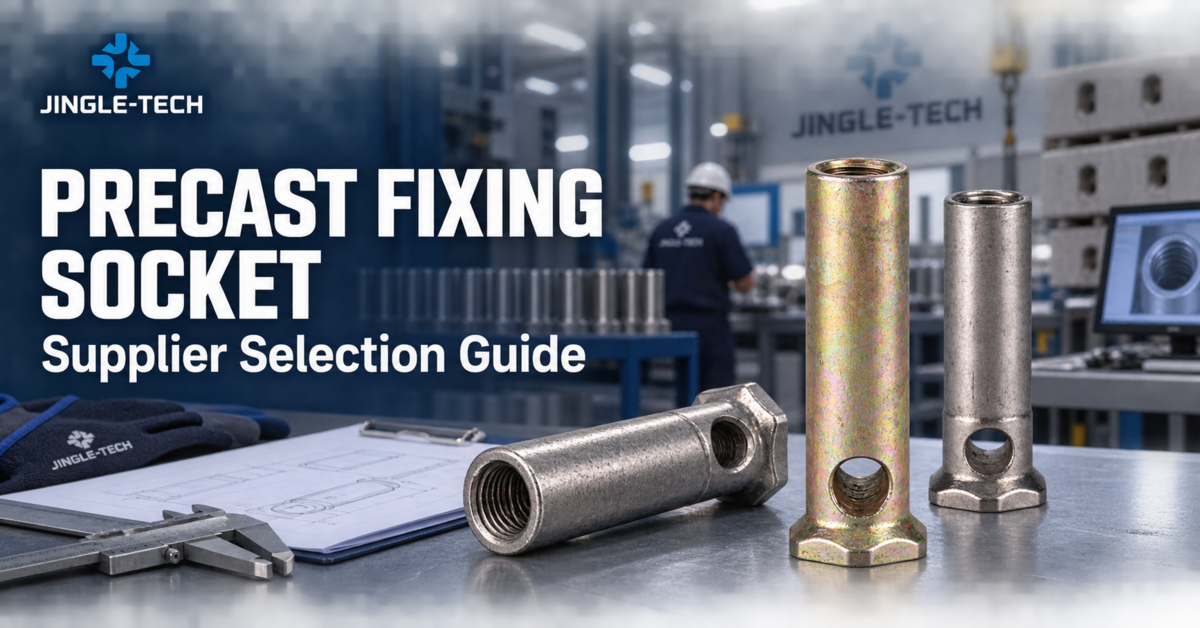
For OEM, private label, or accessory consolidation, an export supplier such as JingleFix may add commercial flexibility. This moves more verification work to the buyer. Budget for samples, document review, traceability, inspection, and compatibility testing. Buyers comparing threaded formats can also review this practical guide to threaded lifting sockets and the available recess formers for lifting anchors.
Send a controlled RFQ, not a one-line price request
A useful RFQ lets every supplier price the same technical requirement. Issue it with a revision number, response deadline, named technical contact, and a deviation schedule. Include at least the following:
- Element data: drawing, dimensions, mass, center of gravity, concrete mix designation, specified strength at each lift, reinforcement, openings, edge rebates, and sandwich layers.
- Complete handling sequence: demould, tilt or rotate, yard moves, transport, unloading, and erection. State every load direction, rigging arrangement, sling angle, lifting point, and any unequal-load assumption defined by the designer.
- System scope: embedded anchor or insert, lifting clutch/key/loop, recess former, fixing accessories, caps, identification items, and required supplementary reinforcement. Ask the supplier to flag anything missing.
- Rules and design responsibility: project country, building or civil scope, governing standard part and edition, required design review, and the party responsible for approving the lifting plan. Ask for document titles and revision dates, not a bare “compliant” answer.
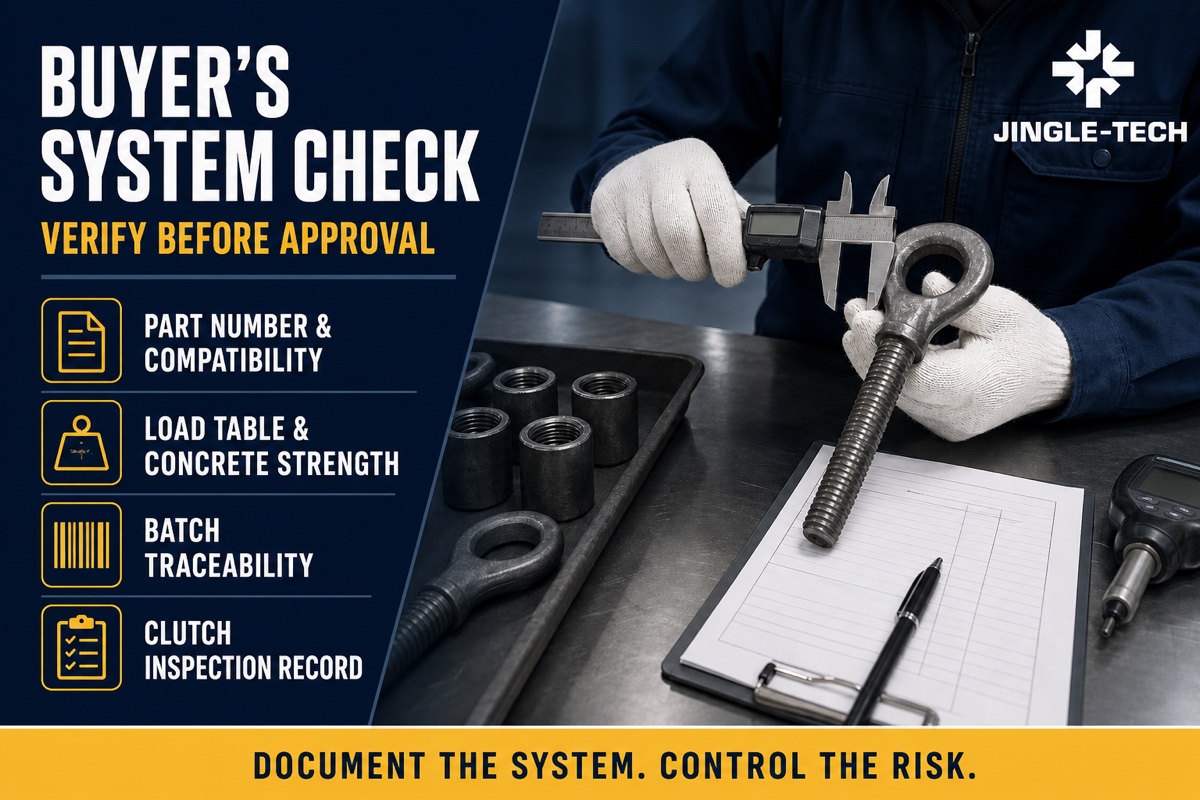
- Product definition: controlled drawing, part number, material specification, finish, critical dimensions and tolerances, manufacturing route, marking, and batch or heat traceability appropriate to the requirement.
- Evidence pack: declaration where applicable, manufacturer’s technical manual, installation instructions, test basis, inspection documents, material certificates, and records required by the buyer’s quality plan. State who may approve deviations.
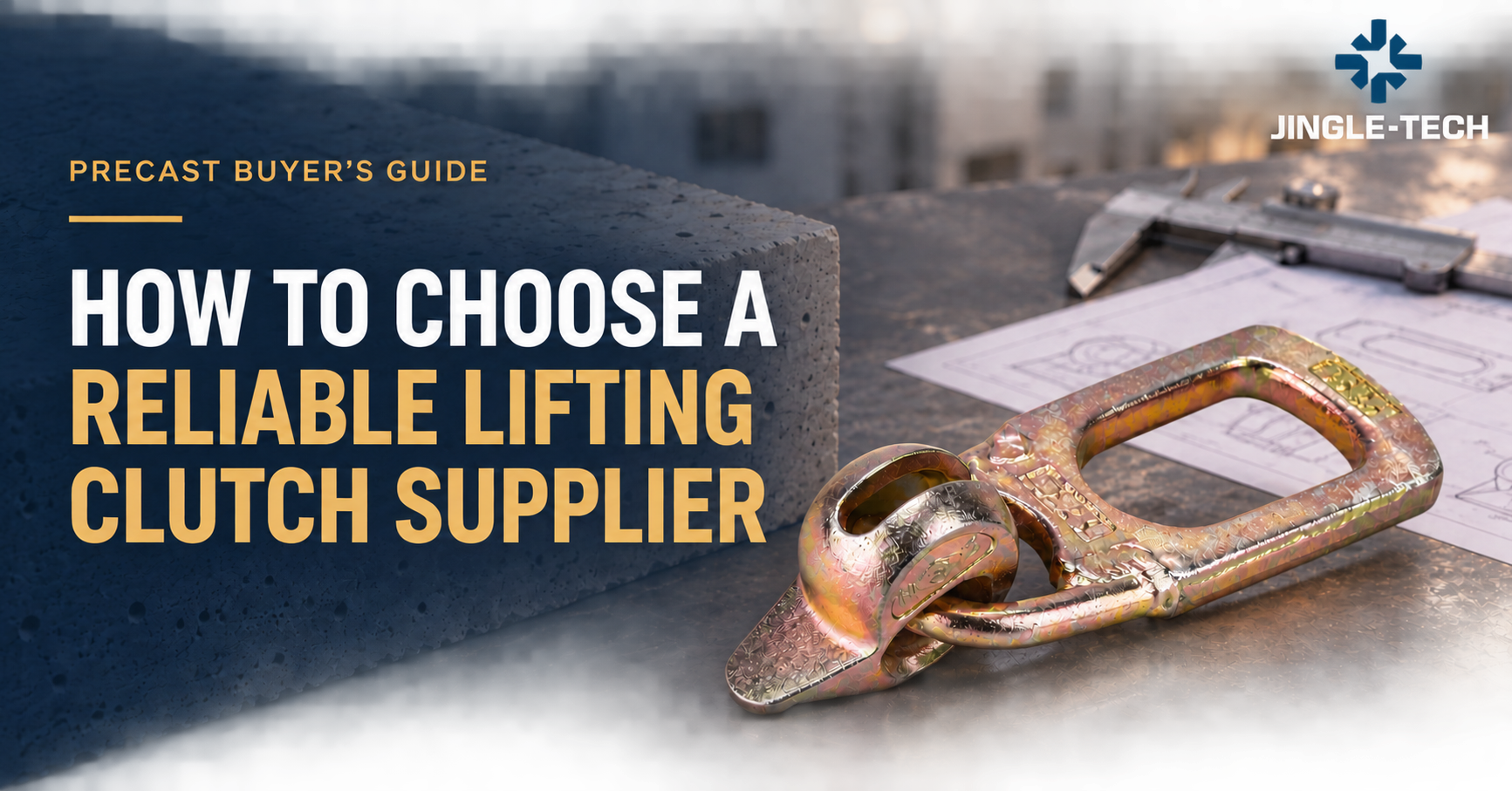
- Compatibility statement: exact reusable device and former for each anchor. Require the supplier to identify prohibited combinations and never accept “looks the same” as evidence. JingleFix’s lifting-clutch compatibility guide explains why matching by appearance or nominal capacity is not enough.
- Quality controls: say which lots are sampled, where the hold points sit, what happens to a nonconformance, how long records remain available, and whether the buyer or a third party will witness any test.
- Commercial detail: ask each supplier to separate price breaks, MOQ, samples, tooling, Incoterm, packing, stock status, production time, transit assumption, quotation validity, and warranty. That makes hidden scope differences easier to spot.
- Pilot approval: write the acceptance route before samples arrive—dimensional review, mating-component fit, document sign-off, and any project-authorized tests—and block volume release until it is closed. A passed sample does not permit later material or process changes without notice.
Compare replies in a compliance matrix. A low price with five unanswered technical lines is not the lowest evaluated bid; it is an unresolved risk.
Why compare JingleFix rather than add it automatically?
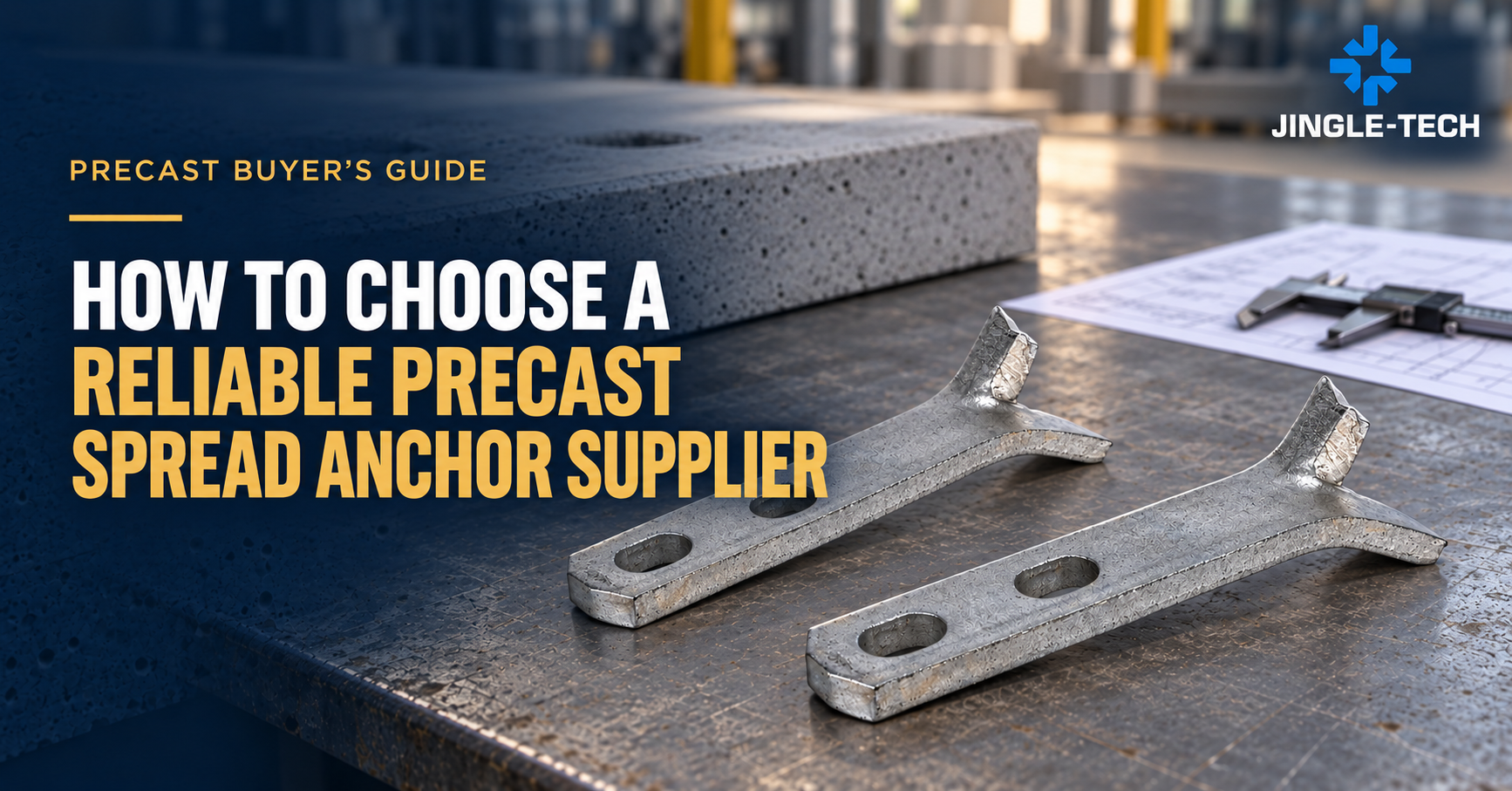
JingleFix is relevant because its public precast accessories range spans more than one lifting format. Buyers can review dedicated categories for lifting anchors, threaded sockets, spread anchors, and coil inserts, then ask whether adjacent accessory lines can ship under one controlled order.
That breadth can reduce vendor fragmentation. It can also hide important differences between true system components and general precast inserts if the RFQ is vague. The sensible next step is a documented comparison: send the element data and required product schedule, request the exact evidence pack, and place a sample order only after the technical gaps are visible. JingleFix should win business on a compliant, traceable response—not on an untested assumption that a catalogue image equals an approved equivalent.
Questions buyers ask before releasing a purchase order
Is there one best lifting anchor manufacturer?
There is no universal winner. “Best” may mean destination-country documentation, a system for a difficult panel, local stock, engineering support, OEM control, or total landed cost. First eliminate suppliers that cannot meet the technical and regulatory requirement. Then compare commercial fit among the compliant options.
How should I compare prices for precast concrete lifting anchors?
Normalize the scope. One quote may include only the anchor; another may add formers, reusable devices, caps, review, and certificates. Add tooling, samples, inspection, freight, duty, spare clutches, training, and plant inventory cost. Compare unit prices only after resolving those differences.
What MOQ should I expect?
There is no meaningful MOQ without a part definition. A stocked anchor, a made-to-order variant, and a custom drawing can each have a different threshold; material, finish, marking, packing, and document requirements move it again. Ask for three figures: sample quantity, standard-product MOQ, and custom-production MOQ. Do not invent a planning number from a supplier’s unrelated product page.
What is a realistic lead time?
No single lead time applies. Request dates for technical clarification, samples, approval, volume manufacture, document release, and transport. Confirm whether timing begins at purchase order, drawing approval, deposit, or sample sign-off. Record capacity and shipping assumptions.
Can I use one manufacturer’s clutch with another manufacturer’s anchor?
Not on appearance or nominal load class alone. Interfaces, tolerances, recesses, markings, materials, and system test bases may differ. Use only combinations documented as compatible by the responsible manufacturer and accepted by the project’s competent designer. This rule should be written into purchasing, receiving, storage, and pre-lift checks.
How can a buyer verify quality before volume production?
Start with document identity: drawing revision, material specification, process route, marking, and traceability. Review test and inspection records against the actual quoted part. Inspect samples dimensionally and verify fit only with the authorized mating components. Where project risk or contract terms warrant it, use a qualified factory audit or independent testing body. Keep approval samples and make supplier change notification contractual.
What should an OEM or private-label agreement cover?
Define ownership of drawings, tooling, marks, test data, and improvements. Share a design only when your company owns it or has permission to disclose it. Put confidentiality in writing. If subcontracting is restricted, say so. Treat any change to a material source, manufacturing location, process, dimension, marking, or package as an approval event. A signed IP clause will not make an unverified anchor fit for use; the commercial and engineering controls must both close.
Are lifting anchors also permanent fixing anchors?
Do not assume so. A component intended for temporary lifting and movement has a different use case and technical basis from an anchor used for a permanent structural connection. If the design calls for both functions, require a specific engineered solution and documentation that explicitly covers them. Never infer dual use from a similar thread or shape.
Build the shortlist around evidence
The names above give you ten sensible doors to knock on. They do not choose the anchor for you. Start with the precast element, concrete condition, and complete handling sequence. Decide which regional rules apply. Then ask each lifting anchor manufacturer or supplier to quote the same controlled system scope and show the same categories of evidence.
If you are evaluating an export or OEM route, request a lifting anchor quotation and send JingleFix your controlled drawing set and RFQ matrix. Ask for a technical response, declared deviations, sample plan, and commercial offer. You can review the precast accessories product range before sending the schedule. That creates a comparison your engineer and purchasing team can actually use.
Research basis and editorial notes
This article was fact-checked against public first-party pages available on August 16, 2026, including the official product sources linked in each company entry. The selection framework also refers to VDI/BV-BS 6205, Safe Work Australia’s prefabricated-concrete risk guide, and PFEIFER’s public explanation of lifting anchor systems.
Inclusion is not certification, endorsement, or evidence of suitability for a specific lift. Product ranges, ownership, documents, and local availability can change. Verify the latest official information with the supplier and the competent project team before specifying, buying, installing, or using any lifting component.