Buy the bolt and nut as one defined assembly

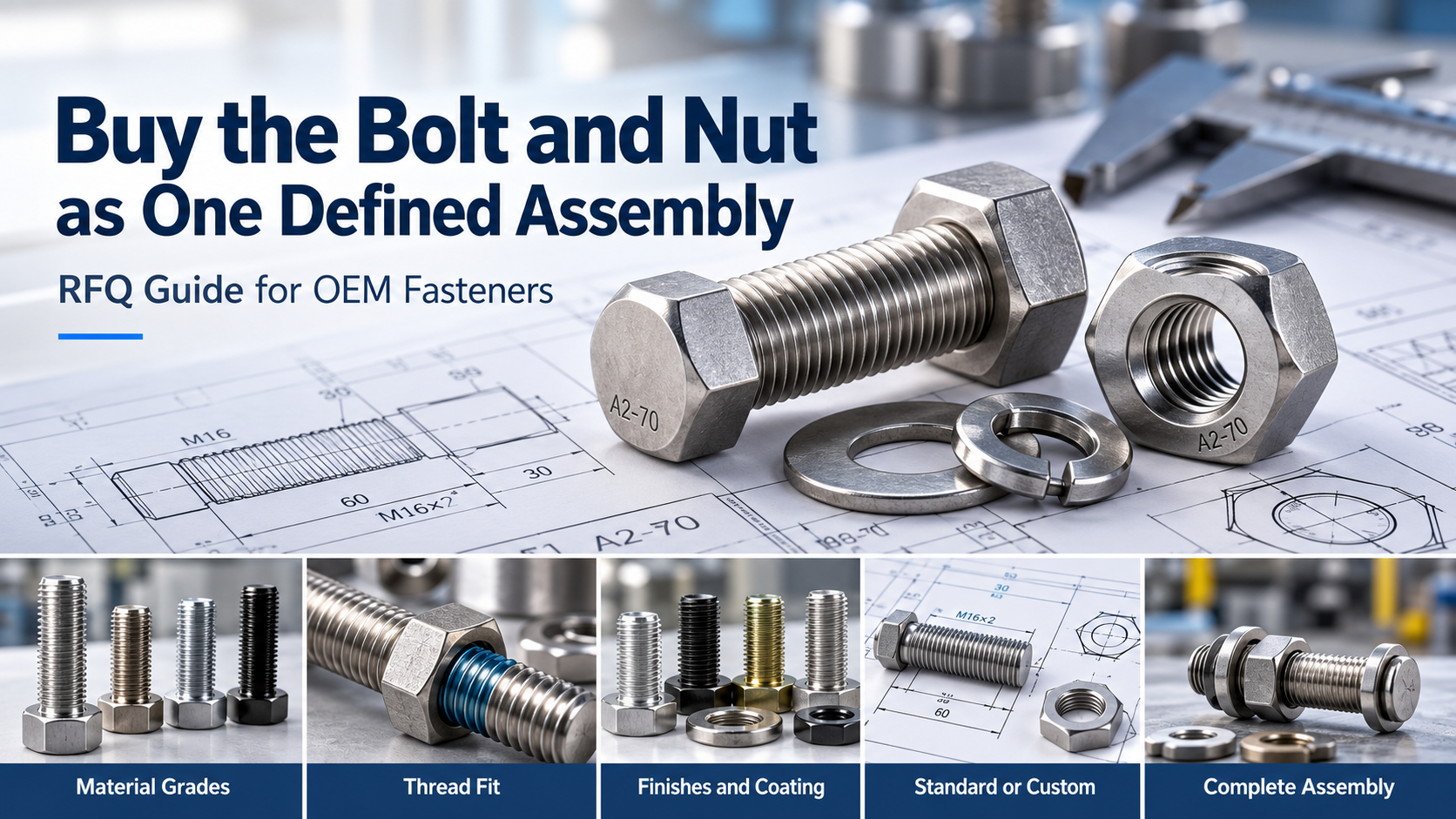
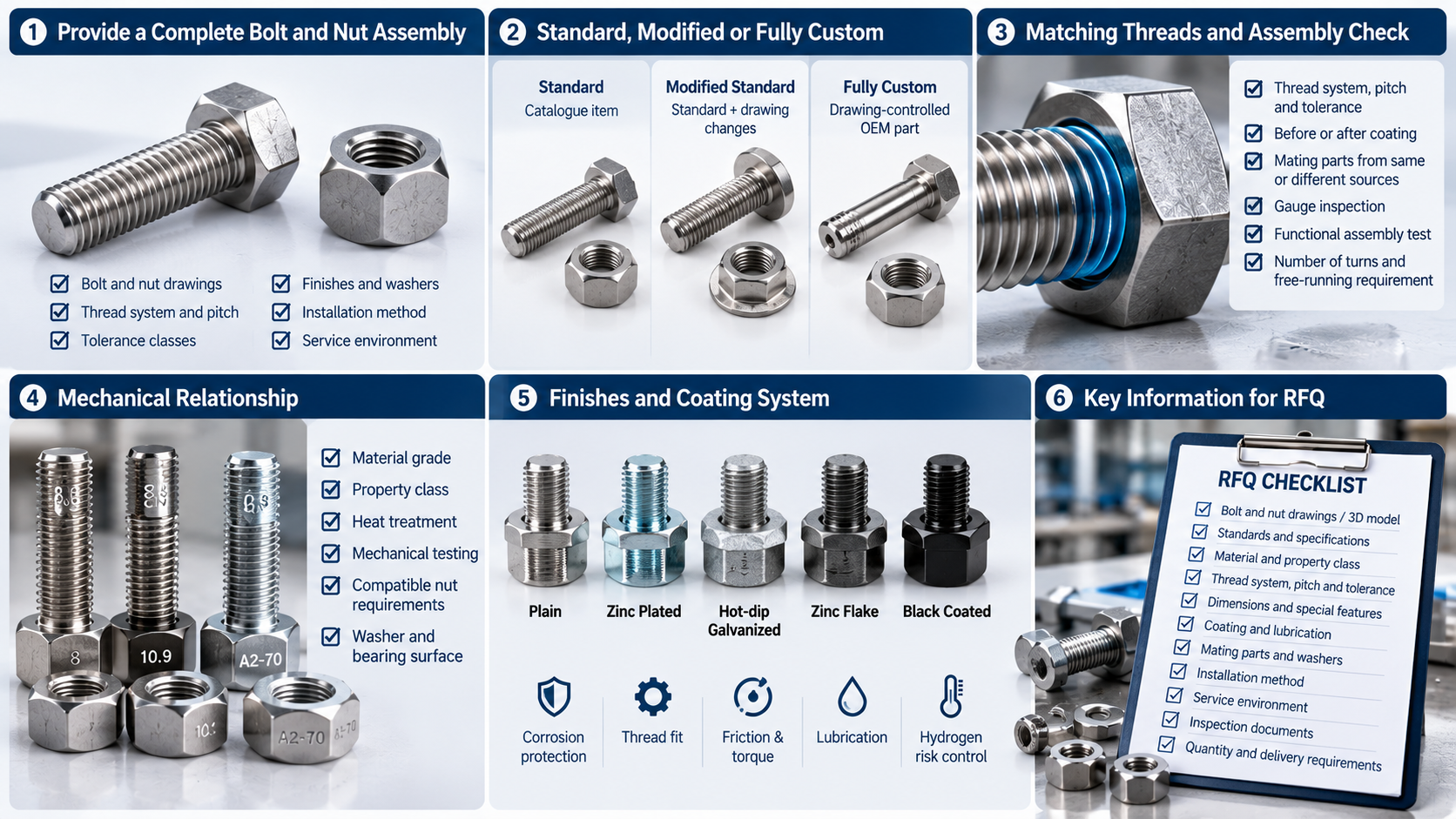
OEM buyers often send separate lines for bolts and nuts, then discover the parts were quoted from different assumptions. The thread may be nominally the same while the tolerance, coating, strength relationship or finish condition differs. Each component can pass a basic incoming check and still produce a poor assembly result. An OEM bolts and nuts supplier needs the complete pairing. Send the bolt and nut drawings, thread system and pitch, tolerance classes, dimensional standards, mechanical requirements, finishes, washer information, installation method and service environment. If the parts come from different approved sources, define the cross-source fit and evidence required. This approach is especially important for drawing-controlled or modified standard parts. A familiar head shape or nut style does not establish the unthreaded shank, thread length, bearing surface, chamfer, locking feature or marking. The quotation should identify every departure from a published standard.
Send JingleFix your bolt and nut drawings for an RFQ review
Separate the product standard from the custom requirement
Many OEM fasteners begin with a recognised bolt or nut family and add one or two changes. The buyer may need a special length, restricted head height, captive washer, drilled feature, controlled thread length, flange geometry or nonstandard finish. Mark the item as a modified standard and show the changes on a controlled drawing. Do not write "similar to" a standard without explaining which clauses still apply. State the standard and edition for dimensions that remain standard, then list the drawing requirements that override it. If a fully custom design controls all geometry, use the drawing as the primary source and cite standards only for defined features such as threads or mechanical properties. The supplier should return a drawing or specification acknowledgement before tooling. That review is the right time to find an impossible tolerance, missing datum or conflict between a 2D drawing and 3D model.
Matching threads require more than a diameter and pitch
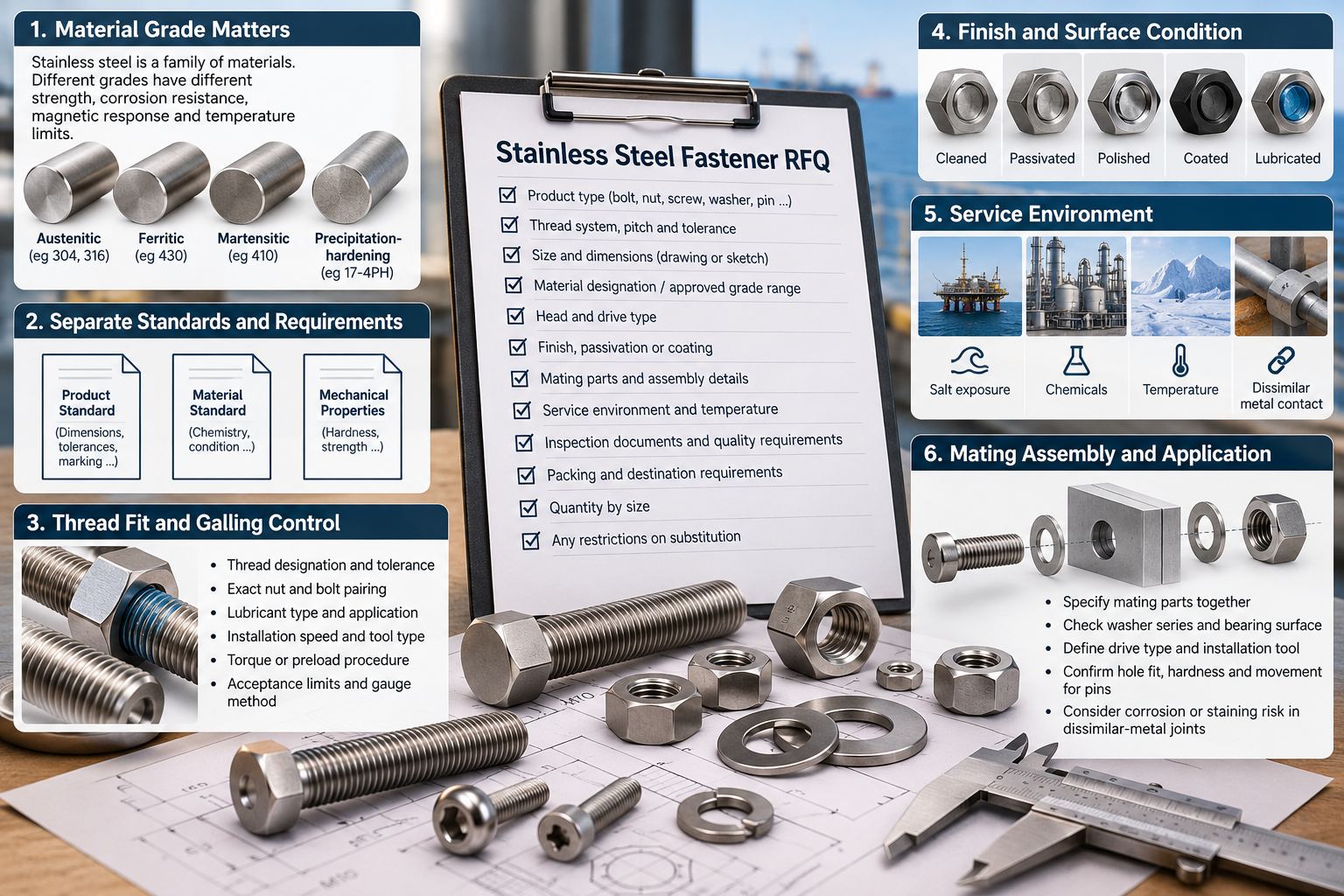
Thread designation includes the system, nominal diameter, pitch, tolerance and often the condition after coating. The RFQ should state whether thread inspection applies before or after the final surface process. Thick coatings can change fit, and some product standards use allowances or special practices that must be understood before production. Specify the intended mating parts. If the supplier provides both bolt and nut, request assembly checks from the production lots. If the nut will mate with a bolt from another source, provide the applicable standard, tolerance and finish or send representative pieces for evaluation. Gauges are important, but functional assembly can reveal issues that a single gauge does not. The approval plan may include hand engagement, power-tool assembly, locking-feature behaviour, under-head seating and disassembly. Define the number of turns, any free-running requirement and the condition of the mating thread.
Set the mechanical relationship between bolt and nut
Material names and mechanical property classes are different pieces of information. A steel grade or alloy designation does not by itself prove the finished bolt or nut meets the required performance. Forming, heat treatment, geometry and testing all contribute. The design authority should define the required bolt property class or mechanical specification and the compatible nut requirement. The supplier should not choose the nut only because its finish and thread match. For a complete joint, washers, bearing surfaces and tightening method may also affect suitability. When special mechanical tests are required, identify the method, specimen relationship, frequency and acceptance values. Ask how the report connects to the shipped lot. A test report from another size or batch may be useful background but is not batch-specific evidence.
Coating is part of the mating system
Bolts and nuts can be supplied plain, plated, hot-dip galvanised, zinc-flake coated, phosphated, passivated or with another specified finish. The correct system depends on corrosion exposure, mechanical requirement, thread fit, friction and appearance. Specify both components together. A coated bolt paired with an uncoated nut can behave differently from a matched coated set. Topcoats and lubricants can change the torque-preload relationship. For high-strength parts, the process route may also require controls for hydrogen-related risk. These questions must be reviewed for the exact part and governing specification; a coating name alone is not a universal approval. If the joint uses a controlled tightening procedure, freeze the finish and lubrication condition during sample approval. Treat any later change as an engineering and quality review.
Decide whether the item is standard, modified or fully custom
This classification affects tooling, samples, evidence and repeat orders.
| Item type | Typical control | Buyer should verify |
|---|---|---|
| Standard catalogue item | Complete product designation and current standard. | Size, material, property class, finish, marking and documents. |
| Modified standard | Base standard plus controlled drawing changes. | Which clauses remain valid and which dimensions override them. |
| Drawing-controlled OEM part | Buyer drawing, model, specification and approved process. | Datums, tolerances, critical features, material and change control. |
| Sample-based replacement | Reverse-engineered drawing approved by the buyer. | Wear on the sample, unknown material, hidden functions and legal rights. |
Never use a worn sample as the only production definition. Measure it, identify uncertainty and issue an approved drawing. If the buyer does not own the design, confirm that the sourcing project respects the applicable intellectual-property and contractual restrictions.
Choose a manufacturing route that fits the part
OEM bolts and nuts may involve cold forming, hot forging, machining, thread rolling, tapping, heat treatment, coating, sorting and packing. Not every operation needs to be performed at one facility, but the quotation should make the responsible route visible when traceability or approval requires it. Ask whether samples and production use the same process. A machined prototype can verify geometry while a cold-formed production bolt may have different tooling and process characteristics. Record temporary routes and plan a production-intent approval before the bulk release. For custom parts, discuss annual demand and release quantities as well as the first order. Tooling and process choices should reflect the expected programme, but no supplier should promise a quantity, lead time or tooling route until the drawing and commercial assumptions have been reviewed.
Build a quote-ready RFQ
| RFQ block | Buyer input | Supplier return |
|---|---|---|
| Identity | Part numbers, titles, drawings, revisions and applicable standards. | Quoted items, assumptions and line-by-line deviations. |
| Geometry | Threads, head and nut style, shank, bearing faces and critical tolerances. | Manufacturing drawing, tooling notes and inspection method. |
| Mechanical | Materials, property requirements, heat treatment and mating relationship. | Proposed route, test scope and certificate linkage. |
| Surface | Coating, thickness, colour, lubricant, corrosion test and masking. | Exact finish system, process source and thread-fit effect. |
| Approval | Prototype, first article, functional assembly and release authority. | Sample plan, report format and open production differences. |
| Quality | Critical dimensions, gauges, sampling, documents and traceability. | Inspection plan and lot definition. |
| Commercial | Quantity by item, annual demand, releases, packaging and destination. | Price basis, tooling, timing assumptions and packing proposal. |
Ask for a validity period and identify raw-material, tooling or special-test assumptions. If several sizes share tooling or materials, request that relationship in the quote rather than inferring it from a combined price.
Use samples to check the real joint
The sample plan should name the question each sample answers. A dimensional first article checks the drawing. A functional sample checks assembly. A finish sample may check appearance, thread fit and installation. A packaging sample checks labels, count and warehouse handling. Use representative mating parts and the intended installation tool. Record the bolt and nut lot, coating, lubrication, tool setting and observations. If tightening performance is important, the responsible engineer must define the method and acceptance criteria for the complete joint. Do not approve a production programme from an undocumented golden sample. Keep the signed drawing, report and approved deviations as the baseline. A retained physical sample can support those records but should not replace them.
Inspection evidence should be planned, not collected later
The required package may include dimensional results, material documents, hardness or mechanical tests, coating records, first-article reports and lot-to-carton traceability. The exact list depends on the part and application. Define it before production so the supplier can preserve the necessary links. For outsourced heat treatment or coating, confirm how subcontractor batches connect to the final fastener lot. If third-party inspection is required, state the inspection body, scope, sampling, timing, report and cost responsibility in the RFQ. A certificate is useful only when its identity matches the supplied part. Buyers should check part number, size, material, lot, test method and date rather than filing a document by title alone.
Packaging protects identity as well as the part
Matched bolts and nuts may be packed separately for automated assembly or together as kits. Define which arrangement the production line needs. State inner quantity, bolt-to-nut ratio, spare policy, bag or box type, label, barcode, master-carton limit and pallet requirements. Prevent mixed sizes and mixed finishes. Similar fasteners can be difficult to separate visually after a carton is opened. Keep the technical lot and buyer part number on inner packs, especially when a distributor applies private branding. If corrosion protection or cleanliness depends on packaging, specify the approved method and storage conditions. Do not assume a generic export carton provides the required protection.
Control repeat orders and changes
Repeatability requires more than placing the same purchase order number. The supplier should retain the approved drawing, process route, tooling, finish, inspection plan and packing specification. The buyer should identify changes that require notification or reapproval. Examples include a new material source, heat-treatment facility, coating source, manufacturing process, tool revision or inspection method. Not every change has the same risk, so define the approval path rather than banning all change in a vague sentence. Review complaints and concessions by lot. If parts are reworked or sorted, preserve their traceability and issue updated records. A commercial replacement does not close the technical cause.
Common sourcing mistakes
- Quoting the bolt and nut independently without a mating specification.
- Using a photo or worn sample as the only product definition.
- Calling a modified standard part fully standard.
- Specifying material but omitting the finished mechanical requirement.
- Changing coating or lubricant after assembly approval.
- Accepting a certificate that cannot be linked to the shipment lot.
- Writing "same as last order" without preserving the approved revision.
Questions from OEM buyers
Can one supplier provide matched bolts and nuts?
Yes, this can be evaluated for the specified parts. The quotation should identify the exact bolt and nut requirements, manufacturing route, assembly checks, documents and any separate production sources.
Can a standard nut be used with a custom bolt?
Possibly, but the thread, mechanical relationship, finish, geometry and joint design must be reviewed. The responsible engineer should approve the pairing.
Can you manufacture from a physical sample?
Sample-based projects can be reviewed, but the sample should be measured and converted into a buyer-approved drawing. Material, tolerances, wear and hidden functional requirements must be resolved.
Which documents should accompany an OEM order?
Request the records needed to prove the purchase specification. These may include dimensional, material, mechanical, coating and traceability documents, but their exact type and batch scope must be agreed.
Is there one MOQ for all custom bolts and nuts?
No universal quantity should be assumed. The commercial minimum depends on size, material, tooling, process, finish, testing and packaging. It is confirmed for the actual drawing and order plan.
Make the quotation the start of production control
A strong OEM bolt and nut programme begins with a matched technical baseline. Drawings, thread fit, mechanical requirements, coatings, samples, documents and packaging all belong in the quotation. When those decisions are recorded early, repeat orders are easier to compare and much harder to misunderstand.
Contact JingleFix with your bolt and nut drawings, quantities and inspection needs