Structural Bolt Manufacturer: Project Sourcing Guide
Buying structural bolts is not the same as buying an ordinary catalog fastener. A line item that looks simple—diameter, length, grade and finish—sits inside a connection system governed by project documents, a standard edition, compatible nuts and any required washers, installation rules, inspection criteria and records that must remain linked to the delivered lot. If any one of those elements is left vague, two quotations can describe materially different supplies while appearing comparable on a spreadsheet.
This guide is for structural-steel fabricators, infrastructure contractors, OEM sourcing teams, distributors and project buyers who need to turn an engineering requirement into an auditable purchase order. It explains how to brief a structural bolt manufacturer, compare offers on the same basis and ask for evidence before production starts. It also separates procurement questions from joint design: the responsible engineer defines the connection, while the buyer protects that intent through disciplined specifications, approvals and records.
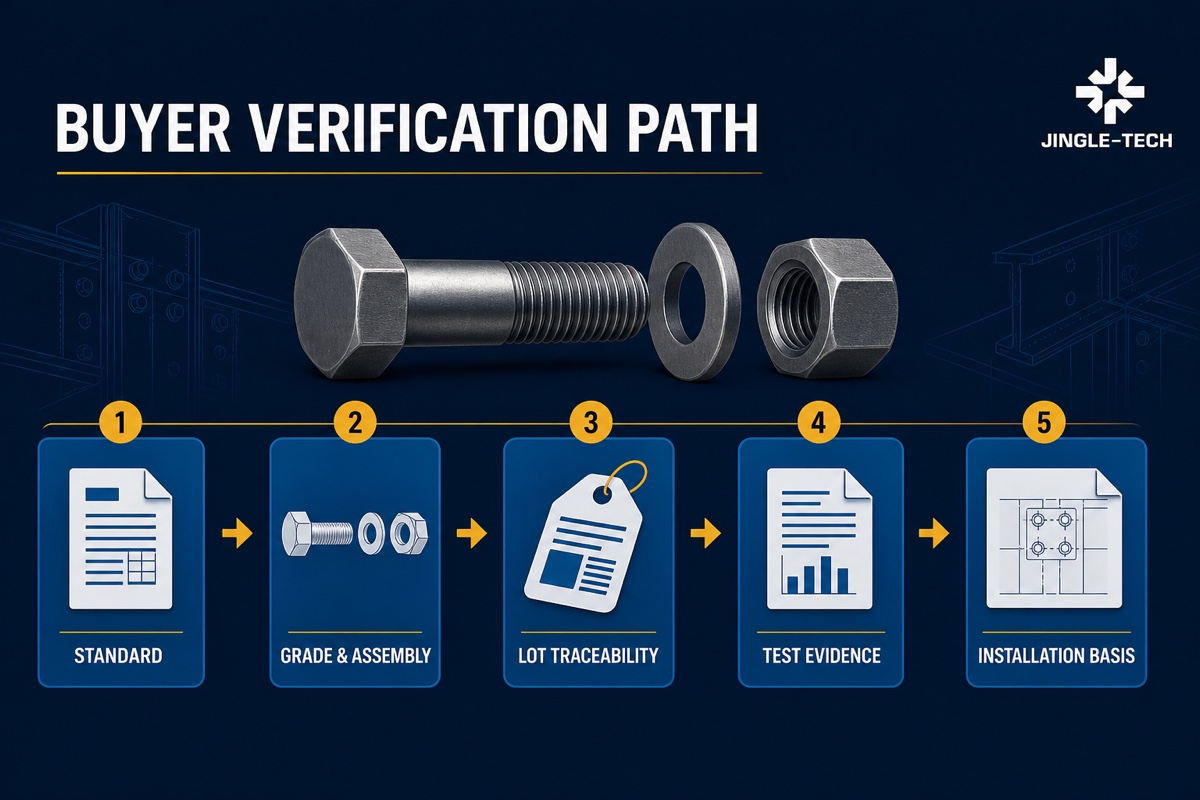
The practical goal is a clean chain from contract requirement to approved assembly, manufacturing lot, test evidence, packaging identity and site receipt. That chain reduces avoidable clarification cycles and helps the project team identify exceptions before they reach erection or inspection.
JINGLE publishes this buyer guide. It is not a project design, approval, or product-specific performance claim. Final grade, assembly, coating, pretensioning method, inspection, and compliance must be confirmed against the current contract documents by the responsible engineer and qualified project team.
1. What project buyers are actually purchasing
A structural-bolting purchase combines the physical assembly—bolt, nut and any washers, direct-tension indicators or other components required for the connection—with its technical definition: standard, grade or property class, dimensions, thread, configuration and coating. It also carries an evidence trail that links lot identity to inspection documents, test reports, contract-required certificates and approvals. Storage, lubrication where relevant, installation, pretensioning and inspection belong in the same procurement conversation because they affect how the specified assembly is delivered and used.
A good quotation addresses each layer or marks what remains open. A weak one offers a unit price for “high-tensile bolts” and leaves the buyer to infer the rest. The lowest visible price can therefore create the highest coordination risk. Before comparing price, compare scope.
| Decision layer | Buyer must define | Useful supplier response |
|---|---|---|
| Assembly | Every included component and required configuration | Line-by-line assembly scope and stated exclusions |
| Technical basis | Current contract standard, grade, size, thread, finish and drawings | Compliance matrix and deviations list |
| Evidence | MTC, test report, lot marking and inspection-document expectations | Sample document set and lot-to-record mapping |
| Field interface | Installation and inspection basis from project documents | Assembly condition, packaging and handling information |
If you already have the contract specification and bill of quantities, share the governing specification, bill of quantities and open questions for an initial scope review. Keep unresolved points visible instead of silently converting them into assumptions.
2. Start with the governing standard system—not a familiar grade name
ASTM structural-bolting projects
For North American structural joints, contract documents may pair ASTM product standards with the Research Council on Structural Connections (RCSC) specification. ASTM F3125/F3125M-26 continues a specification originally issued to consolidate and replace six standards—A325, A325M, A490, A490M, F1852 and F2280—while carrying familiar designations into one specification organized by grade, type and style. ASTM listed the 2026 edition as active when checked on 19 August 2026. That status does not override an edition named in the contract; resolve any mismatch with the responsible project authority before ordering.
The RFQ should state the contract edition, F3125 grade, type where applicable, style (Heavy Hex or Twist-Off), thread series, finish and any supplementary requirements. Because standards change, compare the project documents with ASTM’s current fastener-standards listing before placing the order.
Metric property classes are not a complete structural connection specification
ISO 898-1:2013 covers mechanical and physical properties for carbon- and alloy-steel bolts, screws and studs that meet its defined thread, size and test-temperature conditions. Property classes such as 8.8, 10.9 and 12.9 are useful within that scope. On their own, however, they do not define a preloaded structural-bolting system, compatible assembly, corrosion protection, installation and inspection requirements, or joint design.
A drawing that says only “10.9 high-strength bolt” therefore needs clarification. Confirm that the fastener falls within ISO 898-1, then identify the product or assembly standard, dimensions, finish, testing and installation basis. Property class alone does not establish a direct commercial replacement for an ASTM structural-bolt grade.
European preloaded assemblies
Projects using European specifications may call for assemblies under EN 14399. EN 14399-1:2015 addresses general requirements for high-strength structural-bolting assemblies suitable for preloading. The relevant part, system, component combination and project execution requirements must be stated. Do not mix an EN assembly, an ISO property-class description and an ASTM installation assumption simply because individual numbers look similar.
A clearer RFQ names one governing system for each line and flags any cross-reference as informational. When the purchaser asks for “equivalent,” the technical approver—not a purchasing shortcut—must define what equivalence means for that project.
3. Specify the complete bolting assembly
Structural connection performance depends on the assembly, not the bolt in isolation. Under an ASTM-based specification, the bolt requirement can interact with nut requirements and, where washers are required, hardened-washer requirements such as ASTM F436/F436M-24. The AISC bolting FAQ is a useful navigation aid for questions about ordering, component standards, installation and inspection, but the contract documents remain controlling.
Write the RFQ as an assembly schedule. State the number and position of washers where required; nut grade and style; bolt head or twist-off configuration; thread series and fit; whether threads may be in the shear plane; coating on each component; and any direct-tension indicator. If substitute component combinations are permitted, require the supplier to identify them explicitly for approval.
Coated assemblies require special attention. A coating is not merely a color choice: it can affect dimensions, thread fit, surface condition and installation behavior. The project team should approve the coating system and its compatibility with every component. Avoid asking a supplier to select a finish from an environmental phrase such as “outdoor use” without exposure classification and contract guidance.
A useful assembly schedule also helps reduce packing errors. It lets the quotation, approval drawing, purchase order, packing list and receiving inspection use the same component language. Buyers can browse JINGLE’s broader fastener product range for category context, but a project inquiry still needs the complete technical schedule.
4. Convert drawings and specifications into an approval baseline
A drawing review works best when it produces a controlled baseline instead of a string of informal emails. Send the latest general notes, connection schedule, bolt list, detail drawings and project specification with their revision identifiers. If requirements conflict, state the contractual order of precedence or flag the conflict for formal resolution. An OEM or non-standard part also needs a controlled, dimensioned drawing that calls out material, tolerances, thread details, surface treatment, marking and inspection characteristics.
Ask the structural bolt manufacturer to respond with a compliance matrix. Each requirement should be marked “complies,” “deviation” or “clarification required,” with a reference to the supplier’s offer or drawing. Silence is not evidence of compliance. A clear deviations list is valuable even when it is empty because it records the basis of the quotation.
Freeze the revision before production
Record the approved drawing number, specification edition, finish, document package and inspection points in the purchase order. Changes after approval should follow a revision process that identifies affected line items and work already completed. For custom configurations, the practical lessons in this custom screw manufacturer guide also apply: define function and interfaces, then control the released drawing.
Protect drawing confidentiality without weakening traceability
If the design is commercially sensitive, agree how files may be used, stored and shared before sending them. Use controlled filenames and remove unrelated project information. Confidentiality terms and technical traceability serve different purposes: the first restricts disclosure; the second preserves the relationship between requirement, approval, lot and evidence. A sound workflow supports both.
Add an approval register to the sourcing file. It can be simple: document identifier, revision, sender, recipient, date, disposition and the purchase-order lines affected. The register helps prevent an approved coating note from being paired with an obsolete dimension sheet, and it gives both parties one place to check what was released. If a clarification changes price or schedule, record the commercial effect beside the technical disposition instead of leaving it in a separate conversation.
5. Control material, manufacturing and coating risks
A procurement review should follow the product through its critical transformations. Start with material identity and heat linkage. Continue through forming, threading, heat treatment where required, cleaning, coating, inspection, marking and packing. The buyer does not need to invent a manufacturing route, but should understand which process stages can change mechanical properties, dimensions or traceability.
Material and heat treatment
Require the offered material and mechanical-property basis to match the specified standard and grade. If heat treatment is part of that route, ask how lots are defined and how furnace or process records connect to finished product identity. Do not accept a generic material certificate as proof for an unrelated finished lot. The evidence chain should be understandable without relying on verbal explanation.
Threads and dimensions
Clarify cut or rolled thread requirements only when the contract controls them; otherwise ask the supplier to state the proposed process. Dimensional inspection should cover the specified characteristics, including thread gauges, length, head geometry and any assembly-specific dimensions. For coated threads, the specification must address allowance and fit. The practical question is whether the finished, coated components assemble as required—not whether an uncoated part once measured correctly.
Coating and hydrogen-related risk
Treat the finish as an engineering line item, not a color option. Before it goes into the RFQ, check the governing standard and the project restrictions for the actual strength level and exposure. Hydrogen is the awkward part: certain cleaning or coating processes can introduce it into high-strength steel, and the right controls depend on the material and the route being proposed. A good salt-spray result from a lower-strength commercial bolt does not settle that question. Ask the supplier to name the process before approval. The response should show the thickness basis, explain how thread fit will be controlled after coating and include any mitigation or verification records required by the contract.
These issues should be resolved before pricing is treated as final. Coating route, lot size, testing and documentation can all change cost. The same principle is explored in the custom screw cost guide: price becomes comparable only after the technical and quality scope is normalized.
6. Build evidence around the manufacturing lot
“Certificate supplied” is too vague for a structural-bolting order. Spell out what the word means on this job. Name the document, the standard edition and the results it must report; also say which language is acceptable and when review must happen. Most importantly, require an identifier that ties the record to the delivered product. The package is project-specific. An MTC may be enough on one order, while another also calls for finished-product results, dimensional or coating records, marking photographs, a packing list or third-party release.
Start with the product standard when an ASTM order requires mechanical testing; it tells you which F606 procedure belongs in the job file. ASTM F606/F606M-26a covers methods for externally and internally threaded fasteners, washers, direct-tension indicators and rivets. ASTM’s catalog showed the 26a edition as active on 19 August 2026. Before releasing the order, compare that listing with the edition named in the contract and recheck ASTM’s current status. F606 is still only a method standard: the product standard and contract set the requirements and acceptance limits. A usable report lets the buyer trace each result to the applicable limit and see the method used, including whether the laboratory tested a full-size product or a specimen.
Lot traceability should survive repacking and partial delivery. After repacking, a label is useful only if purchasing or quality staff can follow it back to the right report. Use one lot identifier where possible; if two systems use different numbers, provide a clear cross-reference. Mixed-lot shipments need extra discipline. Keep the lots physically apart, or label the packages and records so the receiving team cannot confuse them. When the project requires retained samples or additional inspection, define the sampling point and custody before dispatch.
Review evidence in two passes. The first pass checks identity: purchase-order line, part description, lot, heat or batch references, quantity and document revision. The second checks substance: specified tests are present, methods and units are stated, results are compared with the correct limits, and exceptions are signed off by the authorized project party. A report can contain many numbers and still fail the identity check. Conversely, a perfectly labeled certificate does not demonstrate compliance if the required finished-product results are absent.
Set the review timing deliberately. Documents required “with shipment” may arrive too late to correct a rejected process without affecting delivery. If the contract needs pre-dispatch approval, name the documents, review period and hold point in the RFQ and purchase order. Also define how corrected reports will be issued so the file does not contain two apparently valid versions.
The U.S. NIST Fastener Quality Act FAQ explains the Act’s conformity and recordkeeping purpose, along with exemptions and applicability questions. Its page also cautions that the guidance may not be current. Treat it as orientation, not transaction-specific legal advice; confirm whether the Act applies to the exact fastener and sale with qualified counsel or the responsible compliance party.
Before approving the evidence plan, send the proposed document list and any pre-dispatch hold points with the RFQ. Naming the required records at inquiry stage is more reliable than requesting them after the goods are complete.
7. Keep pretensioning and installation in the procurement conversation
The supplier provides an assembly; the project team installs and inspects a connection. Procurement links those activities by preserving the specified assembly condition and transmitting the information required for site procedures. The RCSC documents page provides the current structural-joint specification and related guidance for projects that invoke it. The responsible engineer and qualified erection and inspection teams must apply the contract’s requirements.
Do not request or publish one universal torque value. Torque can be influenced by assembly condition, lubrication, coating, storage and the approved installation method, and a value taken from an unrelated chart can be misleading. Instead, state the contract’s pretensioning method and any required pre-installation verification, testing, calibration, sampling or inspection. If twist-off assemblies, direct-tension indicators or another method are specified, name the exact components and governing procedure.
Packaging also affects field readiness. Require durable lot labels, protection from contamination or corrosion, separation of different assemblies and handling instructions where the specification needs them. Site receipt should confirm package condition, quantities and lot identity before components are mixed.
8. Use an RFQ that makes assumptions visible
An RFQ is easier to price when the open questions are visible. A shorter package helps, but not if it hides technical or commercial gaps. Separate firm requirements from buyer preferences, and put questions where the bidder can answer them. Sizes belong in a line-item schedule, not scattered through an email thread. If some fields are unknown, label them “to be confirmed by responsible engineer” and state when confirmation is needed.
| RFQ field | What to state | Why it matters |
|---|---|---|
| Project basis | Country, governing code, specification and edition | Reduces cross-system assumptions |
| Bolt | Grade/class, type/style, diameter, length, thread and quantity | Defines the primary component |
| Assembly | Nut and any required washer, DTI and other components | Confirms compatibility and quote scope |
| Finish | Exact coating specification and component coverage | Controls corrosion, fit and process risk |
| Evidence | MTC, test reports, inspection documents and review timing | Makes documentation part of deliverable |
| Traceability | Lot definition, marking, labels and record linkage | Supports receiving and inspection |
| Approvals | Drawing, sample, document or inspection hold points | Creates agreed decision gates before work proceeds |
| Commercial | Incoterm, destination, packaging, delivery schedule and quote validity | Makes landed scope comparable |
Ask for three attachments with the quotation: a completed compliance matrix, a deviations-and-assumptions list, and a sample evidence package with sensitive information redacted if necessary. These documents reveal far more than a “yes, we can produce” email. They also give engineering, quality and purchasing the same review baseline.
9. Normalize quotations before comparing cost and lead time
Structural bolt quotations are comparable only when the included assembly, technical basis, evidence and logistics match. One offer may include nuts, washers, lot testing and export packing; another may quote bolts only. One may price an approved coating; another may assume a different finish. Lead time can likewise start from inquiry, drawing approval, deposit, material release or another milestone. Ask each bidder to define the starting point and exclusions.
| Comparison item | Normalize before award | Typical hidden difference |
|---|---|---|
| Unit | Per piece, per set or per mass | Nuts and washers excluded |
| Technical scope | Same standard, edition, grade, dimensions and finish | Unapproved “equivalent” basis |
| Quality scope | Same tests, records and inspection points | Certificate named but not defined |
| Timing | Same trigger, approval allowance and delivery point | Clock starts after an unstated approval |
| Logistics | Same Incoterm, destination, packing and shipment plan | Local or export packing differs |
Price drivers commonly include material route, size mix, manufacturing complexity, coating, order quantity by lot, testing, document format, third-party inspection, packaging and delivery terms. These are legitimate variables, not universal surcharges. A structural bolt manufacturer should be invited to show which variables shaped the offer and which changes would require requotation.
Evaluate schedule risk with the same discipline. Separate engineering clarification, drawing approval, material procurement, production, outside processing, testing, document review and transport. Ask which steps are sequential and which can overlap, then identify the date by which the buyer must act. This is more useful than a single number labeled “lead time.” It also makes later changes visible: if the coating or inspection route changes after award, the team can revisit the affected stage instead of debating an undefined promise.
10. Hypothetical procurement scenario: resolve ambiguity before award
Hypothetical procurement scenario: a steel fabricator receives a bolt schedule for a transport structure. Several lines say “high-strength bolt, 10.9, galvanized,” while the general notes refer to an ASTM-based structural-joint specification. The quantity sheet lists bolts but not nuts or washers. The requested certificate is described only as “MTC.” Three suppliers quote: one assumes metric commercial bolts, one assumes an ASTM heavy-hex assembly, and one lists an alternative coating without highlighting it.
The buyer does not award the order on price alone. The conflict first goes to the responsible engineer, whose revised schedule defines the governing system for each connection, the complete component combination, exact coating requirement and installation basis. The buyer then issues one revision to all bidders, requests a compliance matrix and defines the MTC and finished-product report fields. The offers are normalized by set, including documentation, packing and delivery scope.
The result of this hypothetical exercise is not a claimed saving or performance outcome. Its value is procedural: the award decision now rests on an approved, common scope. Engineering can review deviations; quality can see the evidence plan; logistics can protect lot identity; and purchasing can compare commercial terms without guessing what each bidder included.
11. Qualify supplier evidence, not presentation quality
Brochures and polished photographs are useful introductions, but qualification should examine evidence relevant to the offered product and process. Ask for a redacted example of the proposed test report, label, packing list, compliance matrix and approval drawing. Check whether identifiers agree across the set. Ask who reviews specifications, who controls revisions, which operations are performed by external processors and how those records return to the product file.
After the project specification and RFQ baseline are frozen, use this separate structural-bolt supplier evaluation checklist to assess process control, documentation and repeat-order consistency. During a live inquiry, focus on the exact line items: a supplier’s general capability statement does not prove conformity of a future lot.
Look for disciplined questions. A credible review should identify missing standard editions, incompatible component descriptions, unclear coatings, undefined inspection documents and contradictory drawings. It should separate a proposal from an approval. When speaking with a structural bolt manufacturer, the quality of the clarification log is often more informative than the speed of an unconditional “yes.”
12. Structural bolt sourcing FAQ
What information is needed for an accurate structural bolt quotation?
Provide the governing standard and edition, grade or property class, bolt style, diameter, length, thread, nut and any required washer combination, finish, quantities, documentation, inspection points, packaging, destination, Incoterm and requested schedule. Attach current drawings and identify conflicts or fields awaiting engineering confirmation. A bill of quantities without the general specification is rarely enough.
How should buyers reference A325 and A490 in a current RFQ?
ASTM A325 and ASTM A490 as standalone specifications were withdrawn when their requirements were consolidated into ASTM F3125/F3125M. Grade A325 and Grade A490 remain current grade designations within F3125/F3125M. State the governing F3125/F3125M edition and the applicable grade, type and style, together with the other required ordering information, rather than citing only the former standalone designation.
Can a class 10.9 bolt replace an ASTM structural bolt?
Not by property class alone. ISO 898-1 property class 10.9 addresses mechanical and physical properties within its scope, while an ASTM or European structural-bolting requirement can define a different product and assembly system. Dimensions, components, coating, installation and inspection also matter. Any substitution requires project-specific technical approval.
What should an MTC or test report show?
The required content comes from the contract and product specification. As a practical minimum for review, the record should identify the product and lot, applicable standard and edition, grade, reported characteristics, test method, results, acceptance criteria, date and authorized issuer. The purchase order should define whether raw-material records, finished-product tests, coating results or third-party releases are required.
How should buyers evaluate coating options?
Start with the project’s corrosion-protection requirement and restrictions for the specified strength and system. Compare the precise coating standard, process, thickness basis, thread-fit control, component compatibility, handling and required verification. Do not select by appearance or one isolated corrosion-test value, and do not mix coated and uncoated components without approved guidance.
What determines structural bolt price?
Price is influenced by the defined assembly, material and manufacturing route, dimensional mix, coating, quantity and lot structure, testing, inspection, documents, packing and delivery terms. Ask bidders to itemize the commercial basis and exclusions. Comparing “price per bolt” is misleading when one quotation includes a complete documented set and another does not.
What determines MOQ and lead time?
There is no universal MOQ or lead time. The answer starts with the requested size and available material, while batch economics for forming, heat treatment, coating and testing may set a practical minimum. Drawing or document approvals, packing and transport add schedule variables. Ask the quotation to identify the assumed production lot, the event that starts the clock, buyer approval deadlines and whether split delivery is feasible. Put the accepted commitment in the purchase order.
Should a buyer request a sample or first-article approval?
Use a sample, first article or pre-production document review when the contract, risk assessment or custom design warrants it. Define what approval covers and what it does not. A dimensional sample does not automatically approve material, heat treatment, coating, mechanical properties or future production lots. Record the approved revision and acceptance evidence.
What is a sensible way to share proprietary drawings during sourcing?
Share only the controlled files needed to quote, after confidentiality terms and authorized recipients are agreed. Use clear revision identifiers, define permitted use, storage, return or deletion, and keep a distribution log. Those controls protect the drawing without breaking the technical and lot records needed to execute the order.
Will a structural bolt manufacturer design the connection or set the installation torque?
Do not assume so. Connection design, substitutions, pretensioning method and inspection are project-engineering responsibilities unless a qualified party is explicitly contracted and authorized for a defined scope. A supplier can answer product and assembly questions, but the responsible engineer must approve the project basis. Avoid universal torque figures detached from the specified method and assembly condition.
Ready to turn a bolt schedule into a comparable RFQ?
Bring the governing documents and unresolved questions together. Request a Structural Bolt RFQ Review and ask for a line-by-line response on scope, assumptions, deviations and available evidence.