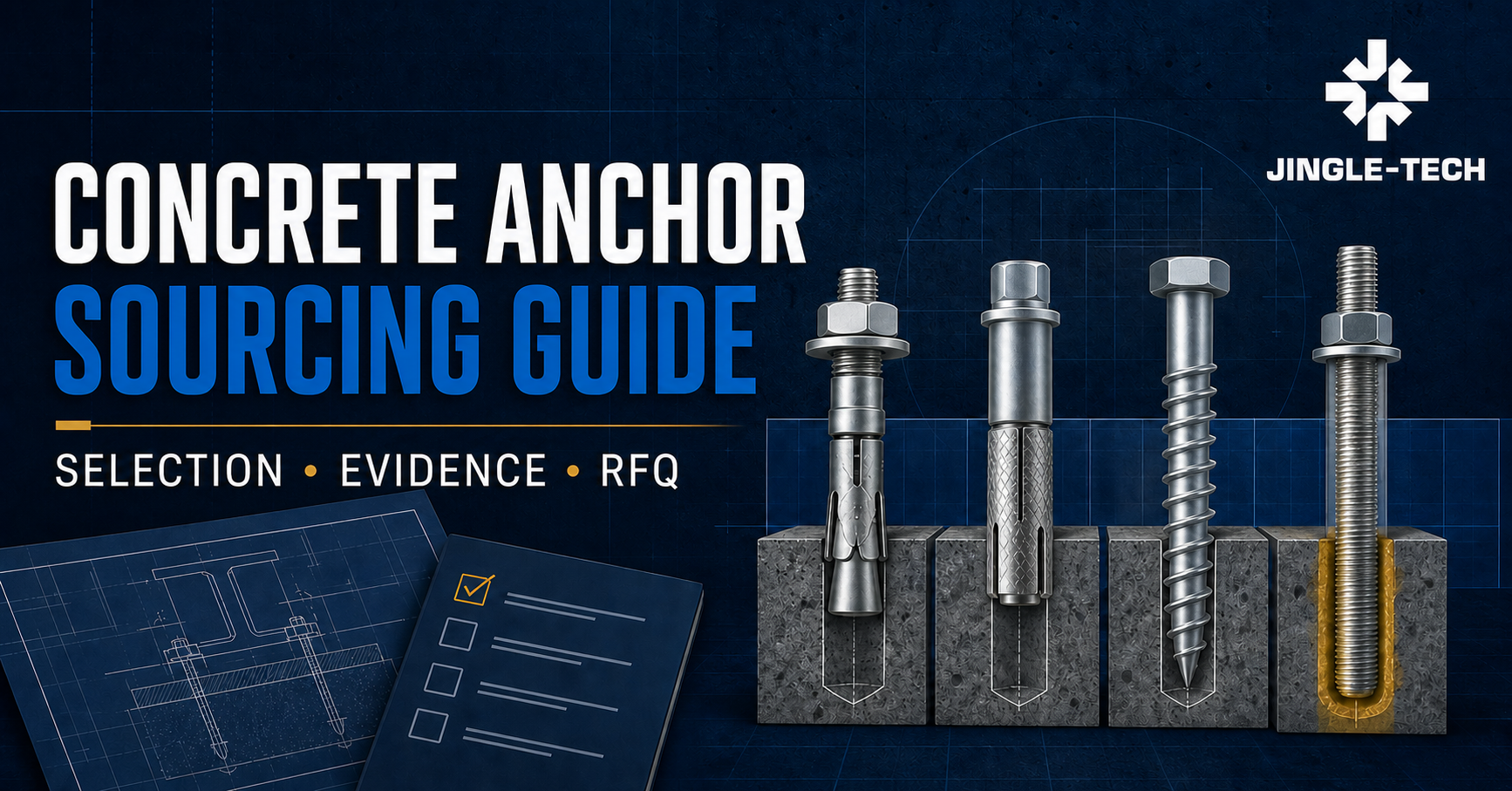
Concrete Anchor Manufacturer: Selection and Sourcing Guide
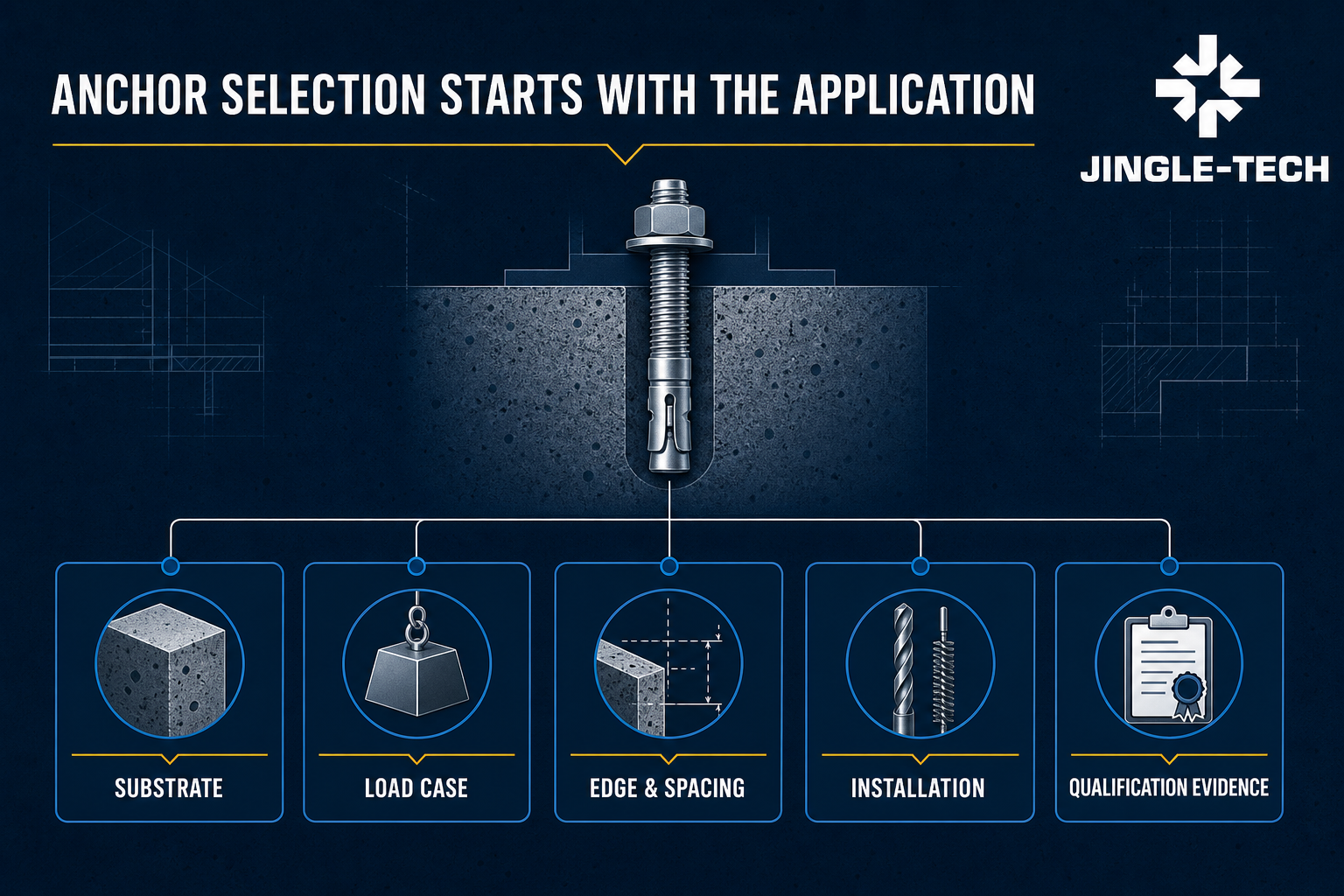
Quick answer: do not start with the catalog. Start with the connection. The design team first needs to settle the code route, concrete condition, design actions, geometry, exposure, installation method, and evidence expected for that job. Only then can procurement compare a supplier's exact product and approval scope.
Buyers looking for a concrete anchor manufacturer often arrive with a familiar part name: wedge, sleeve, drop-in, screw, or undercut. The name helps, but it cannot carry the RFQ. Describe the connection first. What is being attached? Does the design treat the concrete as cracked? Are the actions tension, shear, or both? Note awkward details too: a nearby edge, weather exposure, vibration, or a seismic role. The applicable code edition and product-evaluation route complete the starting brief.
This guide focuses on supplier qualification, product-specific evidence, RFQ control, and cross-border procurement. Use the separate concrete fixing anchor type-selection guide for a more application-led comparison, and the cast-in anchor-bolt manufacturer checklist when the project concerns anchor rods or bolts placed before the concrete hardens.
When those questions are missing, quotations may look comparable while covering different products, assumptions, or evidence. The lowest price can then conceal a costly mismatch: the wrong approval scope, a material that does not fit the environment, installation tooling that is unavailable on site, or documentation that cannot be connected to the shipped lot.
This guide gives engineers, purchasing teams, distributors, and project suppliers a practical route from application definition to a controlled request for quotation. If you already have a drawing and application summary, Discuss your concrete anchor RFQ. Supplier input is limited to product and commercial information and does not constitute engineering selection or project approval.
1. Start with the connection, not the anchor name
A concrete anchor transfers action from an attached component into a concrete member. That short sentence describes a system, not merely a steel item. The base material, anchor geometry, fixture, washer or nut, installation hole, setting process, and concrete around the anchor all influence the connection. Changing one element can move the design outside the evidence that supported the original selection.
The first procurement task is a one-page application envelope. Name the attached item and say what it does. Record the project, jurisdiction, concrete member, and engineer-supplied actions. Add the intended service life, exposure, installation sequence, and inspection or document obligations. Some fields may still be open. Write “unresolved” beside them; a visible gap is safer than a quiet supplier assumption.
The minimum decision brief
- Connection function: structural attachment, equipment restraint, façade support, handrail, services support, temporary installation, or another defined use.
- Concrete: member type, specified strength, cracked/uncracked design condition, lightweight or normal-weight classification when relevant, condition, and accessible thickness.
- Actions: engineer-provided tension, shear, combined action, sustained action, fatigue, impact, vibration, fire, or seismic requirements as applicable.
- Geometry: fixture thickness, hole pattern, nearby edges, anchor spacing, reinforcement, embedded items, and available drilling depth.
- Exposure: interior dry, exterior, coastal, industrial, chemical, wet, temperature-sensitive, or other project-defined environment.
- Compliance route: adopted code, project specification, evaluation report or European Technical Assessment, inspection, and submittal requirements.
Do not ask a sales team to calculate missing design actions or decide whether concrete should be treated as cracked. Those are project decisions. A responsible supplier can flag gaps, explain its product evidence, and organize a quotation around stated requirements; it should not replace the engineer of record.
2. Understand the main concrete anchor families
Concrete anchor names are not perfectly uniform across markets, so the quotation should include a drawing, product designation, and installation principle. The following comparison is a sourcing orientation only. It does not establish suitability or capacity.
Also separate cast-in anchorage from post-installed systems at the start of the RFQ. Cast-in anchor rods, headed anchors, studs, channels, and inserts are positioned before the concrete hardens and follow a different detailing, placement, inspection, and product-specification path. ASTM F1554-20, for example, is a steel anchor-bolt and anchor-rod product specification. It covers products intended to anchor structural supports to concrete foundations and expressly excludes mechanical expansion anchors; by itself, it is not an anchorage design or product-qualification standard. These products should not be grouped together simply because the word “anchor” appears in the name.
| Anchor family | General setting principle | Questions that control selection | Procurement evidence to check |
|---|---|---|---|
| Torque-controlled expansion anchor (often including wedge styles) | Installation torque drives expansion against the drilled hole. | Concrete condition, approved diameter and embedment, fixture thickness, edge/spacing geometry, torque procedure, and exposure. | Product-specific report, installation instructions, dimensions, setting torque, tooling, material/finish, and identification. |
| Deformation-controlled expansion anchor (often including drop-in styles) | A setting tool expands an internal or external element in the hole. | Setting-tool access, verified setting, internal thread engagement, fixture assembly, and approved base material. | Matched setting tool, setting indicator or inspection method where specified, thread data, report, and packaging controls. |
| Sleeve-type expansion anchor | A sleeve expands as the assembly is tightened. | Exact product classification, approved concrete condition, through-fixing geometry, fixture thickness, and installation sequence. | Do not infer scope from appearance; check the specific evaluation, instructions, components, and dimensions. |
| Concrete screw anchor | A hardened threaded anchor cuts or forms engagement in a predrilled hole. | Hole diameter, drilling system, approved installation tool, head/fixture interface, approved reuse or adjustment provisions, and substrate condition. | Product report, drill-bit and tool requirements, installation limits, head marking, coating/material, and lot identity. |
| Undercut anchor | A mechanical bearing feature engages an undercut in the concrete. | Hole/undercut creation method, specialized tooling, installation access, inspection, and product approval scope. | System tooling, training needs, setting verification, report, dimensions, and complete component list. |
| Adhesive anchor system | A qualified adhesive system bonds a threaded element or reinforcing bar in a prepared hole. | Price it as a system, not as a cartridge plus rod. The brief has to cover the adhesive and element as well as drilling, cleaning, concrete condition, temperature, orientation, cure, sustained action, installer requirements, and inspection. | Check the named system qualification. Then trace shelf life, storage, dispenser, cleaning method, cure window, installer and inspection rules, and lot identity. |
A wedge anchor and a concrete screw may both be post-installed mechanical anchors, yet their hole preparation, setting mechanism, removal options, tooling, and evaluation data differ. A sleeve anchor can look similar to another expansion product while carrying a different scope. A drop-in anchor is incomplete without its compatible setting process. Undercut systems may require specialized hole geometry. These differences are why product substitution by diameter alone is unsafe.
Adhesive anchors deserve an explicit boundary. They are not simply “another finish” or a generic alternative to a mechanical anchor. Their qualification, storage, hole cleaning, installation temperature, curing, sustained-load considerations, and inspection obligations can be materially different. Keep adhesive scope on its own submittal and approval path.
3. Let the governing approval path filter the shortlist
A product data sheet is not the same thing as code-recognized evaluation evidence. Start by asking the design team which compliance route applies to the project and which edition has been adopted. In the United States, ACI CODE-318-25 is the current ACI building code as of this guide's review, and anchoring to concrete is within its scope. A local jurisdiction may still enforce a different edition, so “latest” and “legally applicable” are not interchangeable.
For post-installed mechanical anchors, ACI CODE-355.2-24 describes qualification testing and evaluation for structural applications addressed by ACI 318, including static or seismic actions and cracked or uncracked concrete classifications. ICC Evaluation Service lists AC193 for mechanical anchors in concrete elements and AC308 for post-installed adhesive anchors and reinforcing bars in concrete elements. ICC-ES also explains that an Evaluation Service Report identifies uses, installation provisions, conditions of use, submitted evidence, and product identification. Those sections are more useful to a buyer than a badge copied into a brochure.
Under the ACI route, ACI CODE-355.4-24 qualifies adhesive anchors, including deformed reinforcing bars used as anchor elements, for design under ACI 318 Chapter 17. ACI CODE-355.5-24 separately addresses post-installed reinforcing bar systems used under the straight-bar development and splice-length provisions of ACI 318. Confirm the intended design model before selecting qualification evidence.
For European projects, EOTA publishes EAD 330232-02-0601 for mechanical fasteners used in concrete and EAD 330499-02-0601 for bonded fasteners and bonded expansion fasteners used in concrete. The applicable European Technical Assessment and declaration route must be confirmed for the particular product and market. Do not assume that evidence under one route automatically satisfies another jurisdiction.
Supplier shorthand can blur an important line. ACI 318 is a design code; ACI 355.2, 355.4, and 355.5 deal with distinct qualification routes. None turns “ACI-certified anchor” into useful proof by itself. The useful record is the exact report or assessment for the product on the quotation, read against its current scope.
Read the report line by line
Record the report holder, product name, report number, applicable codes, anchor sizes, materials, approved concrete conditions, installation parameters, design data, special inspection provisions, conditions of use, and product identification. Then compare those items with the quotation and the delivered label. If the quote says “equivalent,” ask the supplier to identify the evidence that makes it equivalent for the actual project. Similar geometry does not extend an evaluation report to an unlisted product.
ASTM's official page for ASTM E488/E488M-22 describes laboratory test methods for tensile and shear strength of anchors in cracked or uncracked concrete across specified loading and environmental categories. The standard itself notes that product-specific evaluation and acceptance standards can add requirements. A laboratory report should therefore be read in the context of the relevant evaluation route; a single pull test or marketing graph is not a complete qualification.
4. Match the anchor to concrete, actions, and geometry
Buyers often ask, “What load can this anchor hold?” There is no responsible universal answer. The design may need to consider steel failure, concrete breakout, pullout, pryout, side-face blowout, splitting, and interaction of tension and shear, depending on the anchor and configuration. The controlling result can change with embedment, edge distance, spacing, member thickness, concrete strength and condition, anchor group layout, and reinforcement. Seismic, sustained, fatigue, fire, or other project requirements can further change the permitted scope.
| Design input | Why procurement needs it | Evidence or decision owner |
|---|---|---|
| Cracked/uncracked condition | Controls whether the product's approved scope matches the design assumption. | Design professional states condition; product report confirms qualification. |
| Tension, shear, interaction | A headline capacity cannot represent every direction or combination. | Engineer provides actions and calculation; report supplies product parameters. |
| Edge, spacing, group layout | Nearby concrete and neighboring anchors affect the connection response. | Approved drawing and anchor design. |
| Member thickness and reinforcement | Controls available drilling depth, installation conflicts, and design checks. | Structural documents, survey/scanning plan, and engineer review. |
| Fixture and hole geometry | Affects grip, stand-off, head/washer interface, access, and installation sequence. | Coordinated connection drawing and supplier dimensional data. |
| Environment and service | Drives material, corrosion, temperature, fire, and maintenance questions. | Project durability specification and product evidence. |
Substrate identification is equally important. Concrete anchors should not be casually transferred to masonry, hollow block, stone, grout, or a thin topping. An approval for normal-weight concrete may not cover every lightweight concrete configuration. Existing work brings uncertainties that fresh drawings may not show—repairs, voids, deteriorated zones, reinforcement, or buried services. Those conditions need project review; choosing a larger diameter by instinct does not resolve them.
5. Specify material and corrosion protection as a system
“Zinc plated,” “galvanized,” and “stainless” are not complete durability specifications. Put the base material and grade or alloy on the RFQ. Define the coating system and, where the project calls for it, its thickness. The exposure, design life, touching materials, and required evidence belong there too. Check the small pieces: the body, clip, sleeve, nut, washer, and accessory may not share one protection system, but their combination must be intentional and compatible.
A buried section and an exposed section can live in different environments even though they are one anchor. Moisture, chlorides, chemicals, heat, crevices, dissimilar-metal contact, and installation damage all matter. A shiny surface proves nothing about the coating. “Stainless” is a family, not one universal material, and a coating name without a governing specification does not establish performance. The project designer or corrosion specialist should define the required system.
Also ask how the manufacturer controls coating-related dimensions and installation behavior. A finish can influence thread fit, nut rotation, driving, or the way an expansion component moves. If the qualified product is defined with a specific material and coating, a change can be more than cosmetic. Require written change notification and review against the approval evidence.
6. Make installation part of the purchase specification
A correctly selected anchor can still be compromised by the wrong hole, damaged threads, incomplete setting, uncontrolled torque, missing components, or deviation from the approved instructions. Installation is therefore a procured process. The project team should know which drill, bit, cleaning equipment, setting tool, torque tool, depth control, access, training, and inspection method will be available before approving the product.
A field-control sequence
- Confirm the latest approved documents. Check drawing revision, anchor schedule, product report, and installation instructions at the point of work.
- Locate reinforcement and concealed services. Use the project-approved survey or scanning plan. Do not relocate an anchor without authorized design review.
- Verify the complete product. Match designation, size, material, components, marking, report number, and packaging to the submittal.
- Prepare the hole exactly as specified. Hole diameter, depth, drilling mode, bit condition, and cleaning steps are product-specific.
- Set the anchor with the specified tools. Follow the required sequence, tool, setting indication, and torque where applicable. Do not substitute a generic value.
- Inspect and record. Apply the required special inspection, sampling, location records, installer identification, and nonconformance process.
Concrete drilling can generate respirable crystalline silica. In the United States, OSHA's construction standard 29 CFR 1926.1153 requires employers to implement specified controls for listed tasks or follow the alternative exposure-control provisions. Site safety plans, local law, tool instructions, and employer programs govern the work; this procurement guide is not a substitute for them.
Before issuing the purchase order, ask for the installation instruction in the languages required by the project. Confirm that special tools are identified as line items and that replacement wear parts can be distinguished. For distribution, packaging should protect threads and finishes while keeping product designation and lot identity visible through receipt, storage, and issue to the installer.
Discuss your concrete anchor RFQ
7. Build an RFQ that suppliers can quote without guessing
A high-quality concrete anchor RFQ is not long because it contains sales language; it is useful because it exposes assumptions. Provide the same controlled package to every bidder. Ask each supplier to return a compliance matrix that states “complies,” “deviation,” “alternative,” or “not included” against every line.
| RFQ block | Information to provide | Supplier response required |
|---|---|---|
| Project and jurisdiction | Country, location, adopted code/edition, project specification, authority and submittal route. | Exact product evidence offered for that route; unresolved conflicts. |
| Application and drawing | Connection drawing, revision, fixture, hole pattern, installation orientation and function. | Product designation, dimensions, installation method and drawing review comments. |
| Design inputs | Engineer-approved actions, concrete data, geometry, seismic/fire/fatigue or other requirements. | Report sections and parameters relevant to each requirement; no generic capacity claim. |
| Material and finish | Material grade/alloy, coating specification, exposure and compatibility requirements. | Component-by-component material/finish, certificates, marking and deviation list. |
| Installation package | Site constraints, available tools, language, installer and inspection requirements. | Current instructions, tool list, setting controls, training/inspection obligations and exclusions. |
| Quality and traceability | Required certificates, inspection records, lot definition, retention, labels and change control. | Sample records and a map from raw material/process lots to carton and shipment identity. |
| Commercial data | Quantity per size, annual demand, delivery schedule, destination, packaging and Incoterm. | Price basis, tooling, samples, tests, documents, minimum batch, schedule assumptions, validity and exclusions. |
If design is still in development, issue the RFQ in stages. Stage one can request a technical shortlist and evidence index. Stage two can quote only the engineer-approved options. Stage three can cover samples or a pilot lot with a defined inspection plan. This prevents a preliminary conversation from being mistaken for a released production specification.
8. Audit the manufacturer behind the specific anchor
A company may manufacture many metal fasteners and still rely on outside parties for forming, heat treatment, coating, assembly, testing, or packaging. Outsourcing is not automatically a defect. Trouble begins when nobody can draw the boundary: who owns the product, who controls an outside source, where the lot identity travels, and who checks a process change against the qualified configuration.
Sketch the route of the quoted item from incoming stock to release. Depending on the product, the stops may include forming or machining, thread production, heat treatment, finishing, assembly, inspection, marking, and packing. Whenever the route leaves the supplier's site, name the person or organization that approves the source, holds the specification, carries the lot identity, reviews the result, and closes corrective action. If an evaluation covers the product, identify the report holder and document how the offered item connects to that report.
| Audit area | Evidence to request | Warning sign |
|---|---|---|
| Product identity | Controlled drawing, critical characteristics, marking and packaging example. | Report number is shown, but the supplied designation cannot be found in its scope. |
| Material and process | Material certificate example, route card, special-process specification and lot map. | Material or coating may change based on availability without approval. |
| Inspection | Characteristic, method, instrument, sample/frequency, acceptance limit and record. | “Final QC” is offered without measurable acceptance criteria. |
| Evaluation maintenance | Current report, listing status, surveillance or quality documentation as applicable. | An expired, withdrawn, or unrelated document is presented as universal approval. |
| Change control | Written rules for material, geometry, tooling, site, process, sub-supplier and packaging changes. | Changes are communicated only after shipment. |
| Nonconformance | Segregation, disposition authority, root-cause example and traceable corrective action. | Rework or sorting is performed without an approved instruction and verification. |
Request blank document formats before qualification: certificate of conformity, material certificate linkage, dimensional report, coating or process record, packing list, and nonconformance response. The title of a certificate matters less than whether its data can be tied to the correct part, revision, lot, and shipment.
9. Compare quotations on total risk, not unit price
Concrete anchor cost is affected by material and finish, diameter and length, manufacturing route, evaluation scope, lot size, testing and documentation, packaging, special tools, logistics, and the level of application support. A quote that excludes the setting tool, prescribed washer, inspection document, special packaging, or evaluation-related component is not directly comparable with a complete system quote.
Normalize quotations in one worksheet. Separate unit price, tooling, samples, testing, documentation, setting equipment, packaging, freight, duty, and recurring versus one-time costs. Record the technical deviations beside the commercial lines. A cheaper line that changes material, coating, approval, embedment, or packaging is an alternate, not a saving. Route that alternate back through engineering before it enters the comparison.
Build the schedule in stages rather than accepting one unexplained lead-time number. Show technical review and approval first; then tooling where needed, material, production, outside processing, inspection, documents, packing, and transport. Mark buyer-held decisions in one color and outside-supplier dependencies in another. An estimate becomes a commitment only when its assumptions are written down.
10. Use samples and a pilot lot to prove the supply process
A sample should answer a written set of questions. Was it made from the proposed material and route? Does it carry the required identification? Does the complete installation system work with site tooling? Do dimensions and components match the approved submittal? Can its records be traced? A polished sample with no connection to the planned production process provides limited evidence.
For a pilot lot, exercise the real path from purchase-order review through packaging. Verify drawing revision, product designation, incoming certificates, process lot controls, inspection records, labels, installation instructions, tools, carton quantities, damage protection, and export documents. Any deviations should be closed in writing before repeat orders.
Hypothetical sourcing scenario
Scenario—illustrative only, not a real JINGLE project: A buyer is sourcing post-installed anchors for an equipment base retrofit. The first RFQ lists only diameter, length, and quantity. Bidder A quotes a wedge-style anchor; Bidder B quotes a concrete screw. Prices cannot be compared because the concrete condition, actions, fixture geometry, approval route, material, and installation constraints are missing.
The team pauses the quote, obtains engineer-approved inputs, identifies the applicable evaluation requirements, scans the existing member, and issues a revised RFQ with a compliance matrix. One product remains within the approved scope and fits the available installation sequence. The commercial decision is then made between technically compliant offers. The value comes from removing ambiguity, not from assuming one anchor family is universally better.
11. Build an internal sourcing path across related components
Concrete anchors rarely sit alone in an industrial sourcing program. Teams may also need to qualify a custom fastener manufacturer, a custom screw manufacturer, a structural bolt manufacturer, or a custom nut manufacturer. Keep each product family's governing standard, evidence, and acceptance plan distinct while reusing the same disciplined RFQ and change-control method.
Related procurement teams can continue with a hose clamp manufacturer, a lifting anchor manufacturer, or a precast concrete accessories manufacturer. Note that precast lifting anchors are handling-system components and should not be confused with post-installed anchors used to attach fixtures to hardened concrete.
Where a program includes machined interfaces or combined sourcing, review the evidence expected from a precision CNC machining parts manufacturer and an OEM fastener and machined parts supplier. The common discipline is controlled requirements; the technical acceptance criteria remain product-specific.
12. Concrete anchor manufacturer FAQ
What information is needed for a concrete anchor quote?
Provide the project location and code route, connection drawing and revision, engineer-approved actions, concrete data, cracked/uncracked condition, geometry, fixture thickness, environment, material/finish, product evaluation requirements, installation constraints, inspection documents, quantities, packaging, destination, and schedule. If any field is unresolved, label it.
Wedge anchor or concrete screw: which should I shortlist?
There is no winner by category. The two systems engage the hole differently, install differently, and can carry different approval scopes. Let the design, concrete, geometry, product report, site access, tooling, inspection plan, and exposure narrow the choice.
Can an anchor approved for uncracked concrete be used in cracked concrete?
Do not make that substitution unless the responsible design professional confirms it and the product-specific evaluation evidence covers the required condition. The design team's concrete condition must match the product's qualified scope.
How do I verify an ICC-ES report for a concrete anchor?
Use the current report from ICC-ES, then match the report holder, product designation, size, material, code edition, approved uses, design data, installation, conditions of use, inspection, and product identification to the offered and delivered item. Do not rely on a cropped logo or report number alone.
Are adhesive anchors interchangeable with mechanical anchors?
No generic interchange should be assumed. Adhesive anchors form a separate qualified system with product-specific requirements for adhesive, element, hole preparation, cleaning, temperature, cure, storage, sustained loading, installer qualification, and inspection. Any change requires project review.
What is the minimum order quantity for custom concrete anchors?
There is no universal minimum. One order may be constrained by purchased material; another by tooling, furnace or coating batches, tests, packing, or documents. Request three separate quantity discussions—prototype, pilot, and repeat production—and make the supplier show what each assumption changes.
What drives concrete anchor price?
Key drivers include product type, material, finish, size, manufacturing route, approval maintenance, quantity, inspection and certificates, packaging, setting tools, logistics, and support scope. Compare complete compliant systems, not unit prices attached to different assumptions.
Can a manufacturer make an anchor from my drawing?
A drawing can support a manufacturability review, but it does not by itself establish code compliance or design suitability. For regulated or safety-relevant structural use, the project may require product-specific qualification and evaluation. Confirm that path before investing in tooling or production.
Should I request pull testing on site?
Field testing, proof loading, sampling, acceptance criteria, and interpretation must be defined by the project documents and responsible design professional. A field test does not automatically replace product qualification, anchor design, correct installation, or required inspection.
What documents should arrive with the shipment?
The list is project-specific. It may include a certificate of conformity, traceability data, material or process certificates, inspection results, packing list, product identification, current installation instructions, and any approved project submittal references. Agree on format and lot linkage before ordering.
How should distributors prevent product mix-ups?
Preserve the manufacturer's product designation, size, material, lot, report reference, labels, and instructions through repacking and order fulfillment. Physically segregate similar products, control substitutions, and ensure the installation document follows the correct item.
Can the supplier select the anchor for me?
A supplier can explain product scope, identify missing information, and help compare options against a defined application. Final design, code interpretation, suitability, and approval belong to the responsible project professionals and authority having jurisdiction.
13. Send a decision-ready inquiry
A useful inquiry is a compact technical package, not a price-only request. It gives the supplier enough context to surface product evidence and deviations before price pressure takes over. Begin with the controlled drawing, revision, application, and jurisdiction. Add the engineer-approved design inputs, concrete and exposure information, required material and finish, approval route, and installation limits. Close with documents, quantity, packing, destination, and the requested schedule.
The supplier's reply should name the product without shorthand. It should point to the evidence, map compliance, supply dimensions and installation information, state material and finish, and show how a lot can be traced. Keep quotation assumptions, exclusions, and change control in that same reply. Engineering, quality, and purchasing can then review one record instead of three versions of the story.
Discuss your concrete anchor RFQ
Authoritative references
- American Concrete Institute: ACI CODE-318-25 — structural concrete code requirements, including anchoring to concrete.
- American Concrete Institute: ACI CODE-355.2-24 — qualification requirements for post-installed mechanical anchors in concrete.
- American Concrete Institute: ACI CODE-355.4-24 — qualification requirements for post-installed adhesive anchors in concrete.
- American Concrete Institute: ACI CODE-355.5-24 — qualification requirements for post-installed reinforcing bar systems used under development and splice provisions.
- ICC Evaluation Service: approved acceptance criteria register — includes AC193 for mechanical anchors in concrete elements.
- ICC Evaluation Service: Reports Directory and report-reading guide — explains report scope, installation, conditions of use, and identification.
- European Organisation for Technical Assessment: EAD 330232-02-0601 — mechanical fasteners used in concrete.
- European Organisation for Technical Assessment: EAD 330499-02-0601 — bonded fasteners and bonded expansion fasteners used in concrete.
- ASTM International: ASTM E488/E488M-22 — laboratory test methods for anchor strength in concrete elements.
- ASTM F1554-20 anchor-bolt specification — covers steel anchor bolts used with concrete foundations and expressly leaves mechanical expansion anchors outside its scope.
- OSHA 29 CFR 1926.1153 construction silica rule — the official U.S. requirement relevant to respirable crystalline silica during concrete drilling.
Official pages checked on 20 August 2026. Before using this guide on a job, confirm the editions and listings that the local jurisdiction actually accepts; any of them may change or be withdrawn.