The short answer for a project buyer
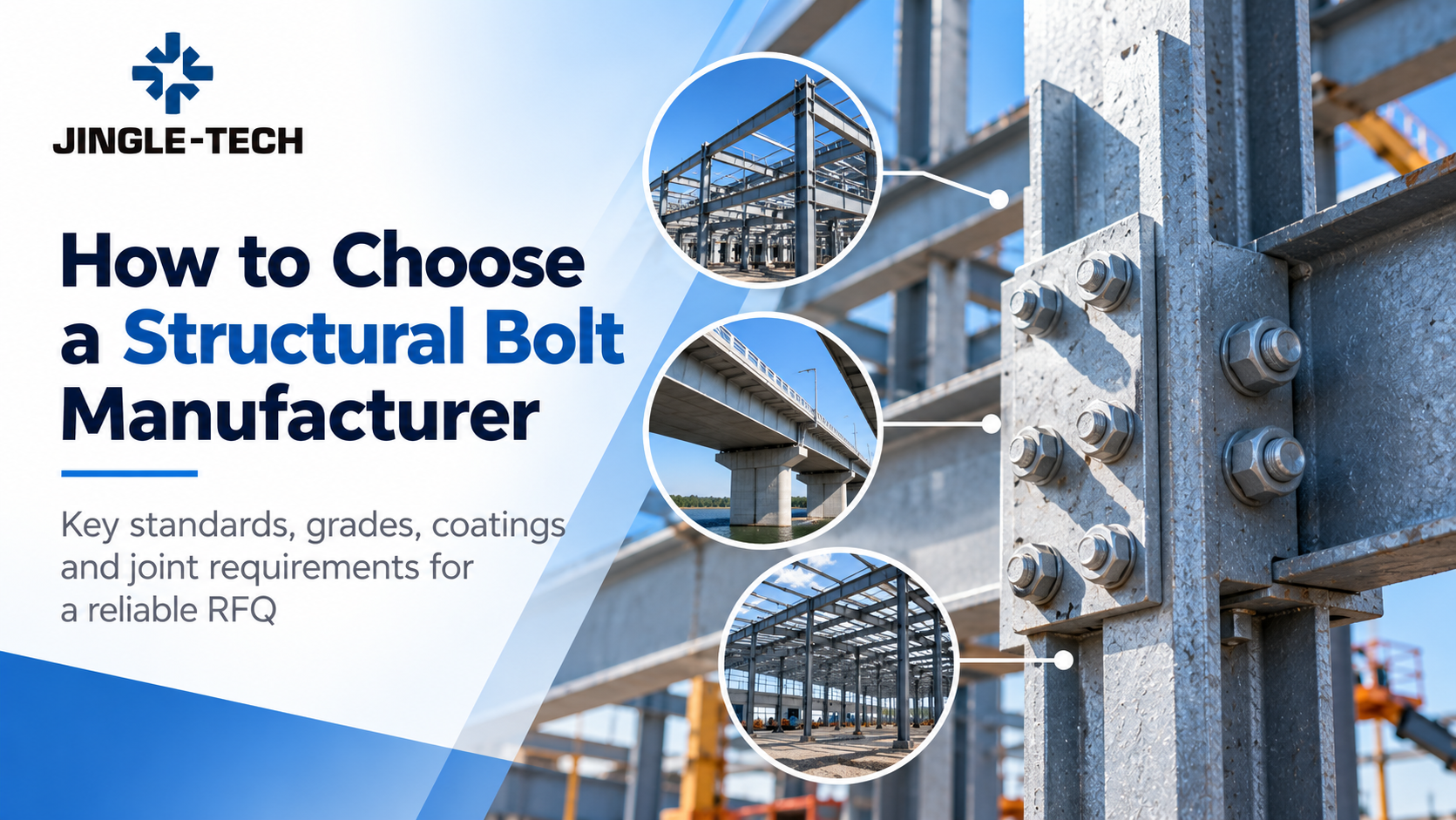
Choosing a structural bolt manufacturer starts with the joint, not with a familiar product photograph. The quotation should identify the governing standard, property or strength class, diameter, thread form, grip length, nut and washer combination, coating, inspection documents, packing method and destination requirements. If one of those fields is left open, two suppliers may quote parts that look similar but cannot be compared fairly. JingleFix public product records include carbon-steel hex bolts, hot-dip galvanized half-thread hex bolts and other bolt families used in machinery, steel frames, construction and outdoor infrastructure. The records also show options such as custom lengths, selected strength grades and different surface treatments. Those descriptions are a starting point for an RFQ. The exact material, standard, coating thickness, test scope and manufacturer must be confirmed against the controlled drawing and purchase order. For a useful first enquiry, send a drawing or a marked sketch together with the bolt diameter, nominal length, grip requirement, nut and washer requirements, quantity by size, application environment and required documents. A structural bolt supplier can then separate a standard item from a project-specific item and identify what still needs engineering approval.
Ask JingleFix to review a structural bolt RFQ
Why a structural bolt is a system item
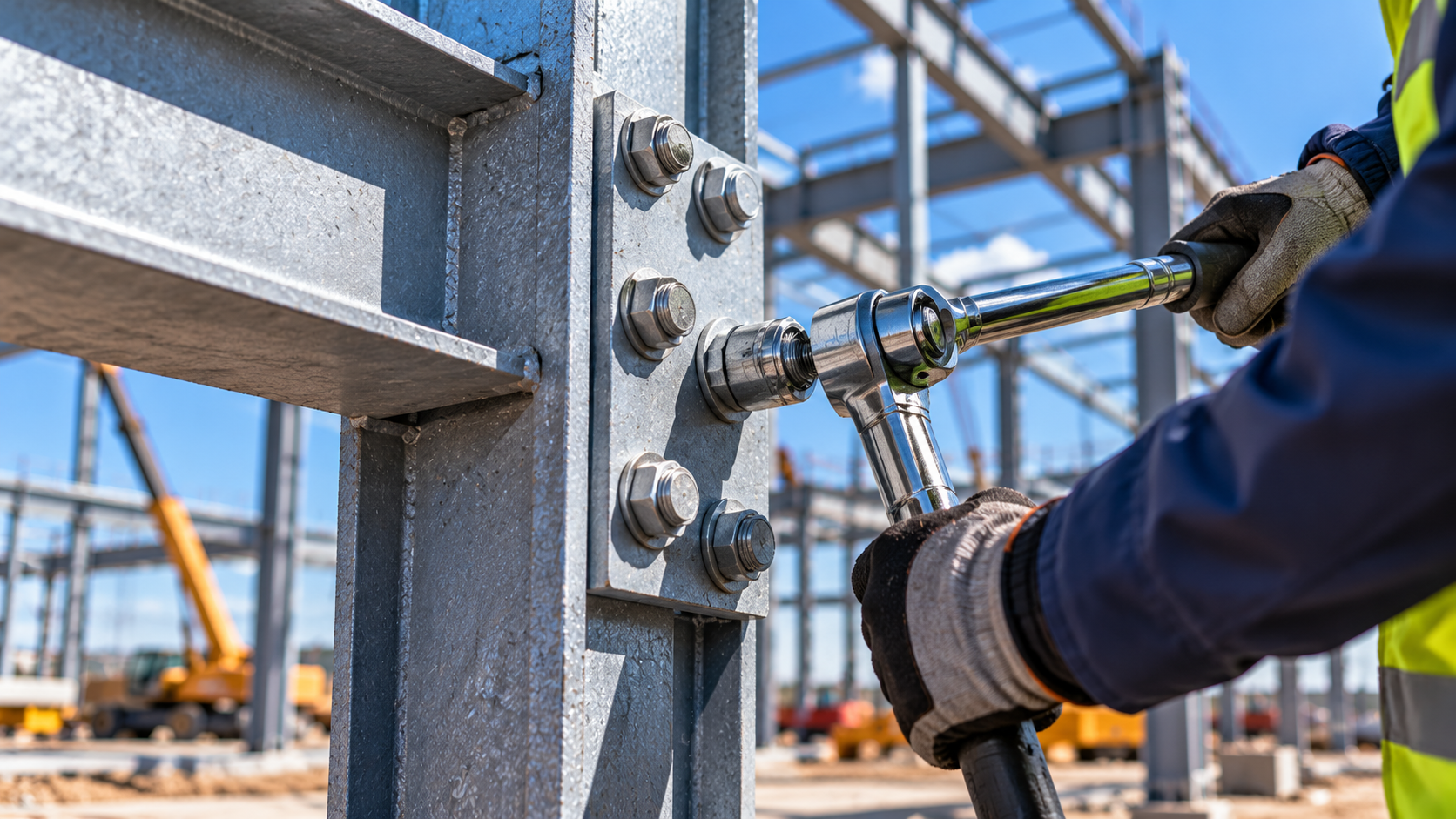
A bolt rarely works alone. The joint normally includes a nut, one or more washers, connected plates, holes, a tightening method and an inspection rule. The bolt grade may be correct while the nut class is wrong. The coating may look acceptable while the thread fit is poor. The diameter may be right while the unthreaded grip is too short for the plate stack. That is why a structural bolt manufacturer should receive the complete connection description. State whether the joint is a bearing-type connection, a slip-sensitive connection or another defined design. State whether the site will use a calibrated torque tool, a turn-of-nut method, tension-control equipment or a project-specific procedure. Do not ask a supplier to infer the installation method from the phrase "heavy duty." The buyer should also identify the consequence of a wrong part. A general workshop repair, a public steel frame, a power-support assembly and a bridge component do not have the same approval path. The higher the consequence, the more important it becomes to control the source standard, lot identity, test documents and change notification.
Separate the standard, grade and size
The words "high tensile" are not a complete specification. A buyer should put the governing standard and the mechanical designation in separate fields. Depending on the project, those fields may refer to an ASTM, EN, ISO, DIN, national or customer standard. A designation from one system should not be silently substituted for another merely because the numbers appear close. Ask the engineering team to confirm at least the following:
- the governing product and execution standard;
- the bolt property class, grade or strength requirement;
- the nut property class and washer specification;
- nominal diameter, pitch and thread tolerance;
- nominal length, threaded length and required grip;
- head dimensions, marking and any special geometry;
- mechanical tests, hardness range and sampling plan;
- coating system, thickness, friction or lubrication requirement;
- traceability and certificate format; and
- installation and acceptance instructions for the finished joint.
The product catalogue can help the buyer find a likely family. It cannot replace the project specification. If the customer supplies a standard number, attach the relevant revision or a controlled extract. This prevents an old internal description from being treated as the current requirement.
Structural bolt families worth comparing
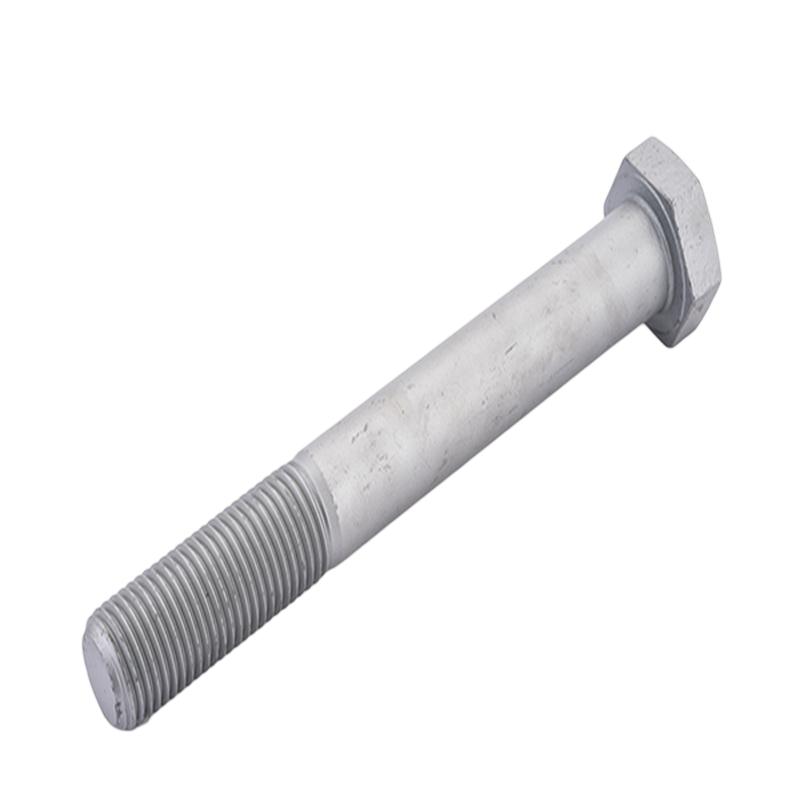
There is no single best construction for every project. The table below helps a buyer start the comparison without treating the options as interchangeable. | Bolt family | Typical reason to review it | Details to settle before approval | | --- | --- | --- | | Half-thread hex bolt | A long smooth shank is useful when the joint has a defined grip through thick plates | Grip length, threaded length, hole fit, nut engagement and standard | | Full-thread hex bolt | Flexible engagement can help in general assemblies and varied plate stacks | Thread runout, effective grip, installation clearance and grade | | Hot-dip galvanized bolt | Outdoor or exposed steelwork may need a heavier zinc protection system | Coating thickness, thread allowance, nut compatibility and inspection method | | Zinc-plated general bolt | Indoor or mild exposure may permit a thinner electroplated finish | Exposure limit, hydrogen-embrittlement controls where applicable and test basis | | Stainless steel hex bolt | Corrosion resistance or a clean finish may be important in a defined environment | Stainless grade, strength, galling risk, dissimilar-metal contact and standard | | Special or drawing-based bolt | The project has a hole, head, length, marking or assembly requirement outside a catalogue item | Controlled drawing, sample approval, tooling, inspection and change control | The family name is only the opening line. For example, a hot-dip galvanized half-thread bolt may suit a thick outdoor steel connection, while a full-thread bolt may be more convenient for a general fixture. The final choice belongs to the joint designer and the approved specification.
Half-thread versus full-thread: the grip question
A half-thread bolt has an unthreaded shank between the head and the threaded portion. In a thick plate stack, that smooth section can be useful because it passes through the grip while the threads remain in the nut area. The buyer still has to define the actual grip and thread engagement. A smooth shank that is too long can prevent the nut from reaching the required position; one that is too short can leave threads inside a shear interface when the design does not allow that. Full-thread bolts offer more freedom when the clamped thickness varies or when the item is used across several assemblies. They do not automatically provide the same joint behavior as a purpose-specified structural set. Check the thread engagement, bearing surfaces, hole condition and installation method. A full thread is a dimensional description, not a load approval. When preparing an RFQ, show the total material thickness, washer stack, coating or paint thickness, nut height and any required protrusion beyond the nut. A single nominal plate thickness is not enough when the joint includes shims, slotted holes or several coated layers.
Coating selection: protection and fit must be reviewed together
Coating is often treated as a colour choice. In a structural joint it can change thread fit, friction, installation behavior and corrosion performance. Ask the supplier to identify the coating on the bolt, nut and washer separately. If the bolt is hot-dip galvanized, the mating nut may need a compatible allowance or a matched system. A bright surface is not proof of a specified zinc thickness. For a buyer comparing a structural bolt supplier, the RFQ should state:
- electroplated, hot-dip galvanized, black oxide, plain or another defined finish;
- minimum or nominal coating thickness and measurement method;
- required appearance and allowable touch-up;
- corrosion-test method, duration and acceptance criterion if required;
- lubrication or friction-control requirement;
- thread oversize, masking or post-coating processing;
- hydrogen-embrittlement controls for the applicable material and process; and
- how coating records will be linked to the lot.
Hot-dip galvanizing can be attractive for outdoor steelwork, coastal support frames and other exposed applications, but the engineer and supplier must review thread allowance and installation. Electroplated finishes may fit a different exposure and commercial need. Stainless steel can help in some corrosive environments, yet it brings its own grade, galling and galvanic-contact questions. Do not describe any finish as corrosion-proof without a defined application and evidence.
Match the nut and washer, not just the bolt
An apparently correct bolt can be made unusable by an unmatched nut or washer. The nut should be specified by its property class, thread, height, finish and compatibility with the bolt system. The washer should be specified by inner diameter, outer diameter, thickness, hardness, geometry and governing standard where the joint requires it. Flat washers distribute pressure and can protect the connected surface. Heavy or square washers may be considered for a larger bearing area or a profiled steel surface. A tapered square washer can help match an inclined flange, but its angle and orientation should be shown on the drawing. A spring washer is not a universal substitute for an engineered structural tension or anti-loosening method. Ask the responsible engineer to approve the complete set. The purchase order should list the set as a controlled combination when the items are intended to be installed together. If the buyer allows alternatives, record the permitted alternative and the approval route. This prevents a warehouse from mixing a bolt from one system with a nut from another because both carry the same nominal diameter.
Applications and questions by project type
Steel building frames
State the connection drawing, plate thickness, hole pattern, access, installation sequence and site inspection rule. Coated plates may add thickness to the grip. The erection team may need clear carton labels because several bolt lengths can look nearly identical after coating.
Power and outdoor support structures
Weather, salt, ultraviolet exposure and maintenance access all influence the finish and packing. Identify whether the bolt is part of a tower, bracket, guard, support or tension assembly. If the product is used with a special nut, pin or locking feature, include that in the same item definition.
Bridges, guardrails and transport infrastructure
Project specifications often control the standard, inspection records, marking and traceability more tightly than a general hardware order. Confirm whether third-party witnessing, lot sampling, material certificates or a specific certificate format is required. The supplier should know which documents are included in the quote and which require a separate arrangement.
Solar support frames
Outdoor photovoltaic structures may combine thin formed sections, slotted holes, aluminium rails and steel fasteners. Check bearing surfaces, galvanic contact, coating, slot adjustment and the tightening method. A bolt that fits the slot is not automatically approved for the load case or the environment.
Machinery and industrial equipment
General machinery may use hex bolts with a range of strength grades and finishes. The buyer should still define vibration, service access, maintenance cycles, thread locking, torque control and replacement policy. A catalogue item can be appropriate, but the decision should be documented when the joint affects safety or uptime.
Quality evidence to request from a manufacturer
A certificate is useful only when it identifies what it covers. Ask for the document list before the order, then link each document to the item, lot and standard in the purchase order. Depending on the project, the package may include material certificates, dimensional reports, hardness and tensile results, coating measurements, thread checks, inspection records, packing photos and a certificate of conformity. The buyer and supplier should agree the sampling plan. Some features may be checked on every piece or every lot; others may be sampled according to the risk and the governing standard. A statement such as "100 percent inspected" is incomplete unless it says what was inspected and by which method. Useful checks can include:
- diameter, length, head dimensions and thread gauge;
- thread fit with the specified nut;
- material identity and heat or lot traceability;
- hardness, tensile or other required mechanical properties;
- coating thickness, appearance and adhesion where specified;
- marking legibility and orientation;
- surface defects, burrs and damage after finishing;
- packing count, size separation and carton identification; and
- change records when material, process or subcontractor changes.
If the application needs a torque-tension or friction test, define the bolt, nut, washer, lubricant, tool and acceptance limit. A result from a different coating or nut is not automatically transferable. Likewise, a salt-spray result should identify the specimen and method rather than appearing as an isolated number.
How to compare structural bolt manufacturers
The strongest comparison is a table with the same fields for every supplier. Do not compare one supplier's piece price with another supplier's complete delivered set. | Comparison area | Question to ask | Evidence or output | | --- | --- | --- | | Product definition | Is the standard, grade, size, thread and grip written clearly? | Controlled drawing and quotation line | | Mating hardware | Are the nut and washer included and compatible? | Complete set description | | Manufacturing route | Which process and approved source will make the item? | Supplier declaration and change route | | Inspection | Which dimensions and properties are checked? | Inspection plan and sample report | | Coating | Is thickness, friction, lubrication and thread fit addressed? | Coating record and installation guidance | | Traceability | Can the carton be connected to the lot and documents? | Marking, packing list and certificates | | Customization | Can length, marking, packing or finish be changed? | Sample, artwork and revision approval | | Commercial terms | Are MOQ, sample cost, lead time, Incoterms and exclusions stated? | Comparable quotation | JingleFix describes drawing- and sample-based customization for suitable fastener projects and can evaluate material, finish and packaging requirements by product. That is a capability to discuss during the RFQ, not a promise that every size, grade or certification is available without review. Ask for the exact manufacturer and document scope for the item you plan to buy.
RFQ checklist for a structural bolt supplier
Send the following information in one package when possible:
- Project name, application and destination country.
- Drawing number, revision and relevant standard extract.
- Bolt family, nominal diameter, pitch, length, thread length and grip.
- Bolt grade or property class, head marking and mechanical requirement.
- Nut and washer standard, class, dimensions and finish.
- Coating system, thickness, friction or lubrication requirement and corrosion test.
- Installation method, tool, torque or tension requirement and site acceptance.
- Sample quantity, first article quantity, production quantity and annual demand.
- Inspection documents, third-party inspection, certificates and traceability.
- Packaging, label language, barcode, pallet plan and mixed-size rules.
- Destination, requested Incoterms 2020 rule, target date and delivery split.
- Any import, origin, trade-remedy or project-approval information already known.
If a field is not known, write "to be confirmed." Visible open questions are easier to manage than silent assumptions. For a safety-critical or regulated project, send the request through the responsible engineer and purchasing approver rather than relying on a catalogue description.
Sample approval and first-article control
The first sample should be checked as a set. Measure the bolt, nut and washer. Assemble them with the intended tool or gauge. Confirm thread engagement, grip, protrusion, marking, coating appearance and access. If the project uses a coated plate stack, test the real or representative stack rather than a bare plate. Keep a record of the supplier item number, drawing revision, material, finish, lot, sample date, inspection result and photographs. When the sample is approved, state what may not change without written approval. This could include the steel source, heat treatment, coating subcontractor, nut pairing, lubricant, label or carton. For a repeat order, compare the new lot with the approved sample. Review the certificate and packing label before releasing the material to the site. If the supplier proposes a different coating or substitute standard, stop and route the change through engineering. A substitute can be evaluated; it should not arrive as an unannounced change.
Packaging, labelling and logistics
Structural bolts are dense. A carton designed for light hardware may split under the unit weight, and mixed lengths can become difficult to count after transport. State the pieces per inner pack, the maximum carton weight, the pallet pattern, moisture protection, label fields and separation method. Include the bolt size and length in a large, readable format. For coated parts, clarify whether the package needs drying agent, protective paper, oil, ventilation or another agreed method. For private-label supply, approve the logo, item code, size, grade wording, quantity, lot and country-of-origin information before printing. Branding is useful only when it remains attached to a clear technical identity. Write the delivery term with the named place and version. Freight, customs duties, local charges and tariff treatment depend on the destination and the complete product facts. The supplier can provide accurate product and origin information; the importer or broker should confirm the destination-country classification and current trade requirements.
Cost drivers that change the quotation
Unit price is affected by diameter, length, steel grade, forging or forming route, thread process, heat treatment, coating, nut and washer pairing, testing, marking, packing and quantity. Hot-dip galvanizing may change both processing and thread-fit requirements. Special lengths can affect tooling or production sequencing. Third-party inspection and project documents can add time and cost. Ask for one quotation that separates recurring item cost from one-time tooling, artwork, sample and inspection charges. State whether the price includes the nut and washer or only the bolt. Ask when the lead time starts: purchase order, deposit, drawing approval, sample approval or another milestone. When comparing offers, normalize the following before choosing the lowest number:
- complete bolt, nut and washer set;
- material and mechanical grade;
- coating and lubrication;
- inspection and certificate scope;
- pack quantity and label requirements;
- delivery term, destination and freight assumptions; and
- validity period and raw-material adjustment clause.
Questions buyers ask
What makes a bolt a structural bolt?
The answer depends on the governing project standard and joint design, not on the marketing label alone. The bolt, nut, washer, material, grade, dimensions, installation method and evidence must match the approved specification.
Is a hot-dip galvanized bolt always better?
No. It may be appropriate for a defined outdoor exposure, but coating thickness, thread fit, nut compatibility, friction and installation still need review. Another finish may fit a different environment or standard.
Can I use a high-strength bolt with any nut?
Do not assume that. The nut class, thread, finish and system requirement should be specified with the bolt. Use the combination approved by the responsible engineer.
Should the RFQ include the connected plate thickness?
Yes. The plate stack, coating, shims, washer thickness and required protrusion determine grip and length. A nominal bolt length alone can produce an unusable quote.
What documents should a manufacturer provide?
Request the documents required by the project: for example, material and lot records, dimensional and mechanical reports, coating measurements, conformity statements, packing records or third-party inspection. Define the exact scope and item linkage.
Can JingleFix make custom structural bolt lengths?
Public product records list custom length and selected grade or finish options for applicable bolt families. Send the drawing, standard, quantities, mating hardware, finish and document requirements so the specific feasibility can be reviewed.
Turn the RFQ into a controlled supply decision
A dependable structural bolt purchase is built from a defined joint. Confirm the standard and grade, calculate the grip and length, match the nut and washer, select the coating with fit and environment in mind, and agree the inspection and traceability package before production. Then keep the approved sample, drawing revision and packing identity together for every repeat order. JingleFix can review structural and general fastener requirements for steelwork, machinery, outdoor support structures, distributors and OEM buyers. Include the size schedule, drawing or sample, grade, finish, quantity, destination, inspection documents and packaging plan in the first enquiry.
Send your structural bolt RFQ to JingleFix
Product families, materials, dimensions, standards, tests and packaging are subject to confirmation against the current controlled drawing and agreed order conditions. Structural and safety-critical connections require review and approval by the responsible engineer.