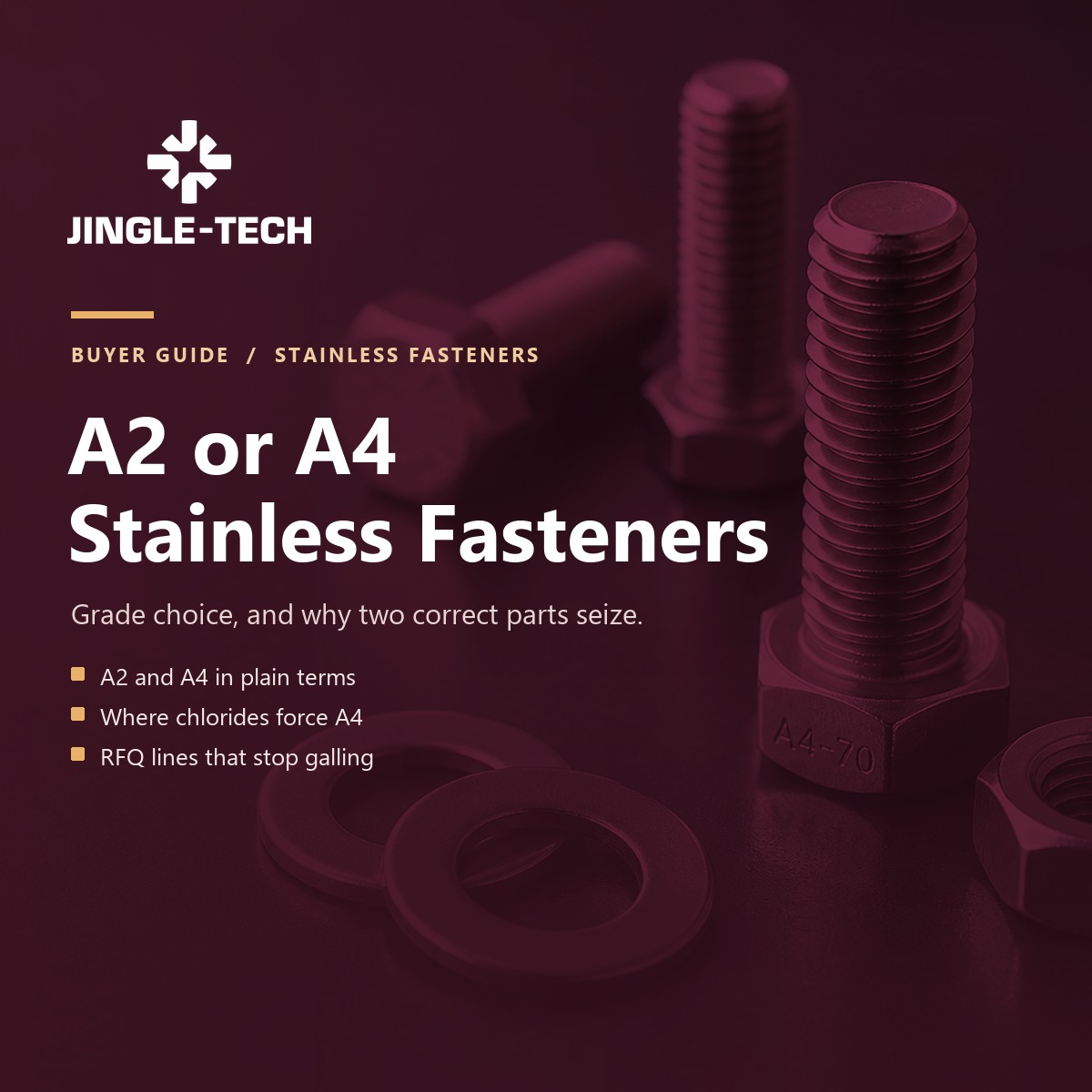
A2 or A4 Stainless Fasteners: Grade Choice and Stainless Steel Fastener Galling
A stainless bolt and a stainless nut, both correct, both from the same carton. Four turns in, the wrench stops dead. The thread is torn. Nothing was over-torqued. Nothing was out of tolerance.
That is stainless steel fastener galling, and it eats more assembly hours than any grade mix-up on a typical job.
Two decisions get made in two different rooms. Engineering picks the alloy family. Production discovers the seizure. The purchase order has to carry both, or the second room pays for the first one's silence.
This guide covers both halves. The alloy decision. And the assembly condition that decides whether it survives the bench.
What A2 and A4 actually are
Both are austenitic stainless steel. Neither is a strength grade. That single sentence prevents most of the confusion on a drawing.
A2 is the 304 family. EN 1.4301 is the European designation. Roughly 18 percent chromium, 8 percent nickel, no molybdenum. It is the default stainless fastener alloy on the planet, and for good reason. It forms well, it welds well, it is available everywhere, and it handles most indoor and fresh-water work.
A4 is the 316 family. EN 1.4401. Chromium stays around 16 to 18 percent, nickel rises slightly, and molybdenum appears at roughly 2 to 3 percent. That molybdenum is the entire commercial argument. It stabilises the passive film against chloride attack, which is why A4 shows up on jetties, in chemical plants, and anywhere salt spray is a normal working condition.
Both alloys are non-magnetic in the annealed condition. Both become slightly magnetic after cold working. A magnet is therefore a poor acceptance tool and a worse grade test. We have seen a buyer reject a good A4 lot because a magnet stuck to a cold-formed bolt head. The head was cold worked. That is all the magnet proved.
The grade mark on the head tells you the family. A2 or A4. Sometimes the manufacturer adds a mill mark. It does not tell you the mill, the heat number, the surface finish, or whether the part was passivated. Those arrive on paper, or they do not arrive at all.
What neither grade has is self-lubricity. Austenitic stainless is a sticky metal. It work-hardens under sliding contact instead of yielding away, which is excellent for wear plates and terrible for threads.
What the -70 and -80 suffixes do and do not promise
The suffix is a property class under ISO 3506-1 for screws and bolts, and ISO 3506-2 covers nuts. The number is the nominal tensile strength in megapascals divided by ten. A2-70 is 700 MPa nominal. A4-80 is 800 MPa nominal.
There is no quench and temper in that route. Austenitic stainless cannot be hardened by heat treatment. Strength comes from cold working plus the alloy's own work-hardening rate. An A4-80 bolt is not a heat-treated bolt. It is a more heavily cold-worked one.
Say it plainly, because the mistake is common in incoming inspection: the grade mark proves the alloy family, not the heat treatment. There is no heat treatment to prove. What the mark promises is a combination of chemistry, condition and mechanical result, tested to the standard named on the certificate.
Two consequences follow. Higher classes get harder to produce as diameter grows, because you cannot cold-work a large section as aggressively without cracking it. Availability narrows at the top of the size range. And cold-worked austenitic stainless carries residual stress. Stress plus chloride plus warmth is the recipe for chloride stress-corrosion cracking, so a higher class is not automatically a safer class in a wet chloride environment.
Full designation on an order: ISO 3506-1, A4-80, M12, coarse pitch. Not "stainless 316 bolt".
| Property | A2 (304 / EN 1.4301) | A4 (316 / EN 1.4401) | What it means on the order |
|---|---|---|---|
| Alloy family | Austenitic, 18/8 type | Austenitic, molybdenum-bearing | Certificates print the EN number, not the A-code |
| Molybdenum | None specified | Typically 2 to 3 percent | The chloride resistance you are paying for |
| Classes in supply | A2-50, A2-70 | A4-50, A4-70, A4-80 | Do not specify a class the mill cannot roll |
| Strength route | Cold work | Cold work, more of it | No heat treatment exists to certify |
| Chloride pitting | Moderate | Better, still not immune | Coastal, marine and brine service pulls to A4 |
| Stress-corrosion cracking | Sensitive when warm and wet | More resistant | Warm chloride may need duplex or coated steel |
| Cost | Baseline | Higher | A blanket A4 spec is a monthly donation |
| ASTM route | ASTM A193 B8 | ASTM A193 B8M | Pressure work specifies ASTM, not ISO |
| Typical service | Indoor, fresh water, general assembly | Marine, chemical, coastal | Write the environment, not just the alloy |
Note the last two rows carefully. A2 and A4 are not interchangeable in either direction. Putting A4 where A2 would do costs money quietly, every month, for the life of the programme. Putting A2 where A4 was needed shows up later as brown staining on a finished facade, and the second conversation is far more expensive than the first.
When chlorides force A4, and when A4 still fails
Chlorides are the decision point. Not water. Not humidity on its own. Chloride ions, which arrive as salt spray, de-icing salt, bleach, hydrochloric acid traces, brine, or process chemicals.
A2 under chloride attack pits. The passive film breaks down locally, the pit deepens, and the part bleeds rust streaks onto whatever sits below it. On a coastal job the staining shows before anyone inspects the fastener, so the whole assembly looks defective when only the alloy was wrong.
The second failure mode is worse, because it is sudden. Chloride stress-corrosion cracking needs three things at once: a susceptible austenitic alloy, tensile stress, and chlorides with some warmth and moisture. Cold-worked fasteners are full of residual tensile stress. A tightened bolt is under tensile stress by definition. Put that combination on a warm coastal site and a crack can run through a bolt that looked perfect at installation.
That is the uncomfortable part. A4-80 is stronger than A4-70, and in a warm chloride environment the extra cold work buys you less margin against cracking, not more. When the service is genuinely aggressive — hot brine, concentrated chemical exposure, repeated wetting — the honest answer is that you may have left the A2/A4 choice behind entirely. Duplex grades, super duplex, or a coated carbon steel with a proper corrosion allowance may be the engineering answer. On the carbon steel route the coating rewrites the tightening behaviour, as covered in hot-dip galvanized fasteners. A supplier who says A4 solves everything is selling a part number, not a solution.
A2 and A4 are also weak next to a class 8.8 carbon bolt. Where a joint needs high preload in a confined space, no austenitic grade gives it cheaply. Coated high-strength steel is the usual answer.
For everything between the two extremes, the practical rule is short. Coastal, marine, de-icing salt, swimming pool atmosphere, food plant washdown with chloride sanitisers: specify A4. Dry indoor, sheltered, fresh water, general machinery: A2 is adequate and cheaper.
Then there is contamination, which is a separate problem wearing the same clothes. A2 that has been cut, brushed, or blasted with tooling previously used on carbon steel will rust. Free iron embedded in the surface starts corroding immediately. That is not a grade failure. It is a housekeeping failure, and passivation to ASTM A967 is the usual remedy. Passivation dissolves the embedded free iron and rebuilds the passive film. It does not change the alloy, and it will not rescue A2 from a chloride environment.
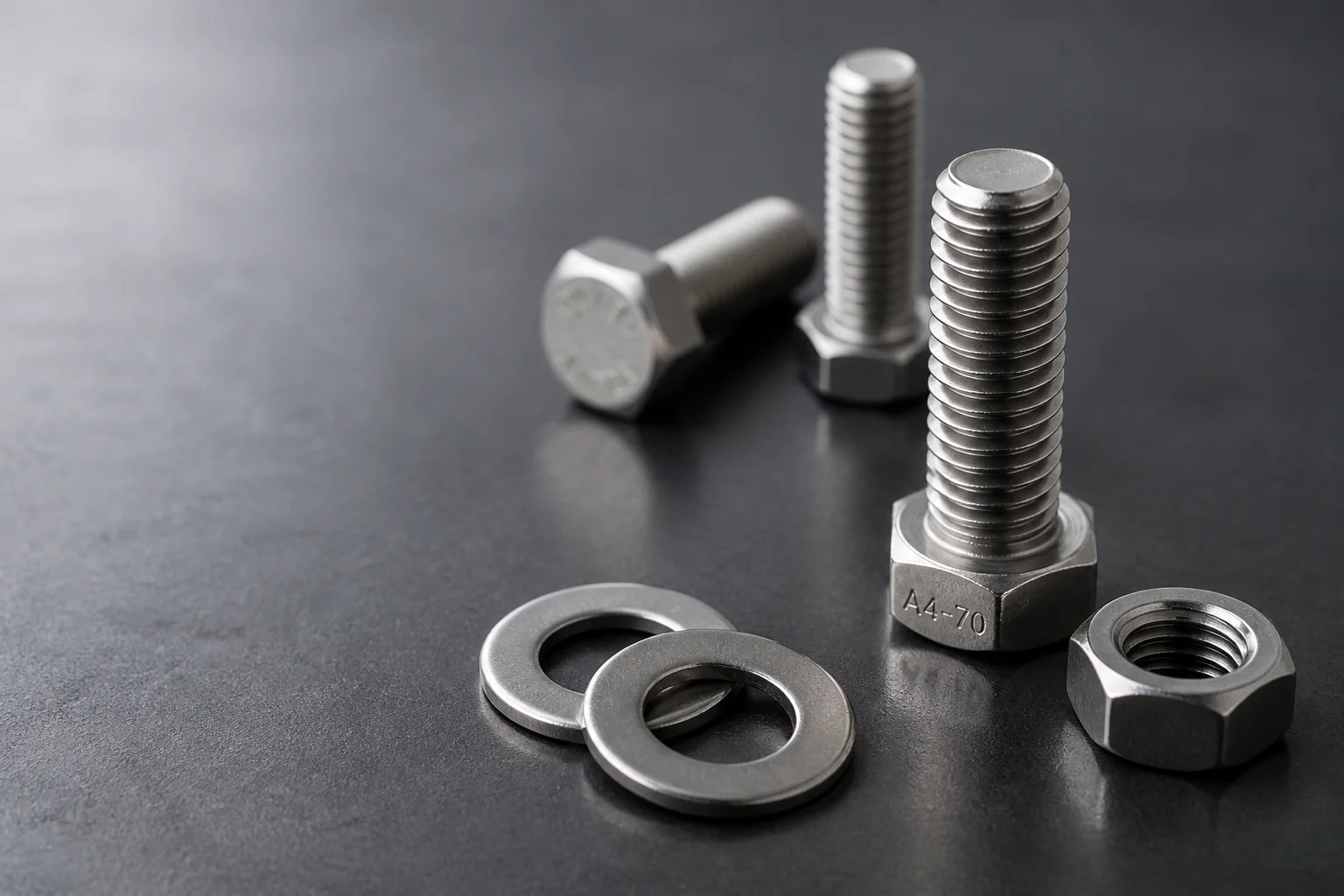
A2 and A4 bolts and nuts look identical on the bench. The head mark and the mill certificate are the only reliable separation, and the certificate is the one that survives an audit.
Why two correct stainless parts seize
Now the part that stops production lines. Stainless steel fastener galling is cold welding between two austenitic surfaces under pressure, and it needs no help from a bad supplier.
The mechanism is ordinary. Every metal surface carries an oxide film. Under the contact pressure of a loaded thread, that film ruptures at the microscopic high spots. Fresh, bare metal meets fresh, bare metal, and at that scale the two surfaces bond. Austenitic stainless does this eagerly, because its oxide layer regenerates almost instantly and work-hardening keeps the contact pressure high.
Once a local bond forms, continued turning tears metal rather than sliding over it. The torn material becomes a lump. The lump increases friction. Higher friction demands more torque for the same rotation, which increases pressure, which creates more bonds. The thread galls, the nut locks, and the installer either snaps the bolt or cuts the nut off.
The signs come in order, and they are worth teaching to anyone on the bench. First a change in feel — the nut stops running down freely. Then a faint squeak. Then warmth at the nut. Then a rough, grating drag. After that the joint is scrap.
Both components can be perfectly to specification. Galling is not a defect in either part. And a stainless nut on a stainless bolt is the worst possible pairing, which is exactly what most drawings call for, because matching grades look tidy.
Now add the design habits that make it worse. Fine pitch gives more flank in contact and more sliding per millimetre of clamp. Long engagement multiplies the area that can bond. A high-speed impact driver supplies fast rotation, high torque and no feedback. All three are common. All three are avoidable.
| Trigger | Why it promotes seizure | Mitigation that works | Strength of the fix |
|---|---|---|---|
| Stainless on stainless, dry | Same alloy, same hardness, no film | Anti-seize on thread and bearing face | Strong |
| Fine thread pitch | More flank contact, more sliding | Coarse pitch unless the design needs fine | Strong, and free |
| Impact driver | Hammered torque, heat, no feedback | Hand tools or a low-speed driver | Strong |
| Long engagement | More surface to cold-weld, more friction | Match engagement to the design | Moderate |
| Matching hardness | Neither surface can yield | Pair grades of different hardness | Weak alone |
| Grit in the thread | One particle scores the flank | Clean before assembly; bag small parts | Strong |
| Crossed thread start | The first turn galls, the rest follows | Chamfered ends; start by hand | Strong |
| Reusing a galled part | Torn flanks guarantee a repeat | Scrap both parts; never dress and refit | Absolute rule |
Read that table with one thing in mind. The rows near the top are process fixes. They cost almost nothing and they work. The rows further down are design and purchasing fixes. They work too, but they need someone to change a drawing or a purchase order, and that is always the slower route.
The shop-floor fixes, in the order they should be tried
Lubricant first. An anti-seize compound puts a film between the two surfaces and drops friction far enough that the asperities never reach the pressure needed to bond. Molybdenum-disulfide and copper-based pastes are the traditional choices. Wax-based and dry-film lubricants are cleaner and common in food-adjacent plants. All beat dry assembly.
Apply it to two places, not one. The thread and the face under the nut or bolt head both carry sliding contact. Shops that lubricate only the thread still gall, then blame the paste.
A thin, even film is the target. A loaded brush attracts grit and changes the torque coefficient. And a lubricated joint needs its own torque value, because grease lowers friction and the same wrench setting then delivers more clamp load. That is usually welcome, and it still has to be calculated. The relationship is set out in our note on bolt torque and clamp load.
Break the hardness match second. If bolt and nut are the same alloy and class, neither surface can yield and let the other slide. Pairing an A2 bolt with an A4 nut gives one surface a slight advantage. It helps. It is not a cure, and anyone who presents it as one has not watched a stubborn joint. The stronger version is a different alloy entirely: a silicon bronze nut, or a stainless nut with a dry-film coating, removes the stainless-on-stainless contact at the sliding interface. Reserve that for joints that keep failing.
Go coarse on pitch. Coarse threads gall less than fine threads of the same diameter. Fewer revolutions to seat, less sliding distance. If the drawing says fine pitch for a reason — vibration, adjustment, thin wall — keep it and lean harder on lubricant. If fine pitch arrived by habit, change it.
Slow the rotation down. Heat is the accelerator. A nut spun on at high speed generates friction heat at the flank before the film can do its job, and hot stainless galls more readily than cold. A slow, steady, continuous turn is better than fast bursts. If the nut squeaks, stop, back it off, add lubricant, and start again. Forcing it through the squeak converts a recoverable joint into scrap.
Put the impact driver away. It is the most common cause in plants that did everything else right. An impact driver delivers torque in hammer blows, at speed, with zero feedback. It is the ideal galling machine. Use hand tools, a controlled low-speed driver, or a torque wrench applied slowly. If production insists on speed, the answer is a lubricated supply and a coated nut, not a bigger driver.
Then the basics. Clean threads. Chamfered starts. No re-use of a galled part. Individual bagging for small stainless hardware so the threads do not rub against each other in the carton for three weeks at sea. None of that is exotic. All of it gets skipped.
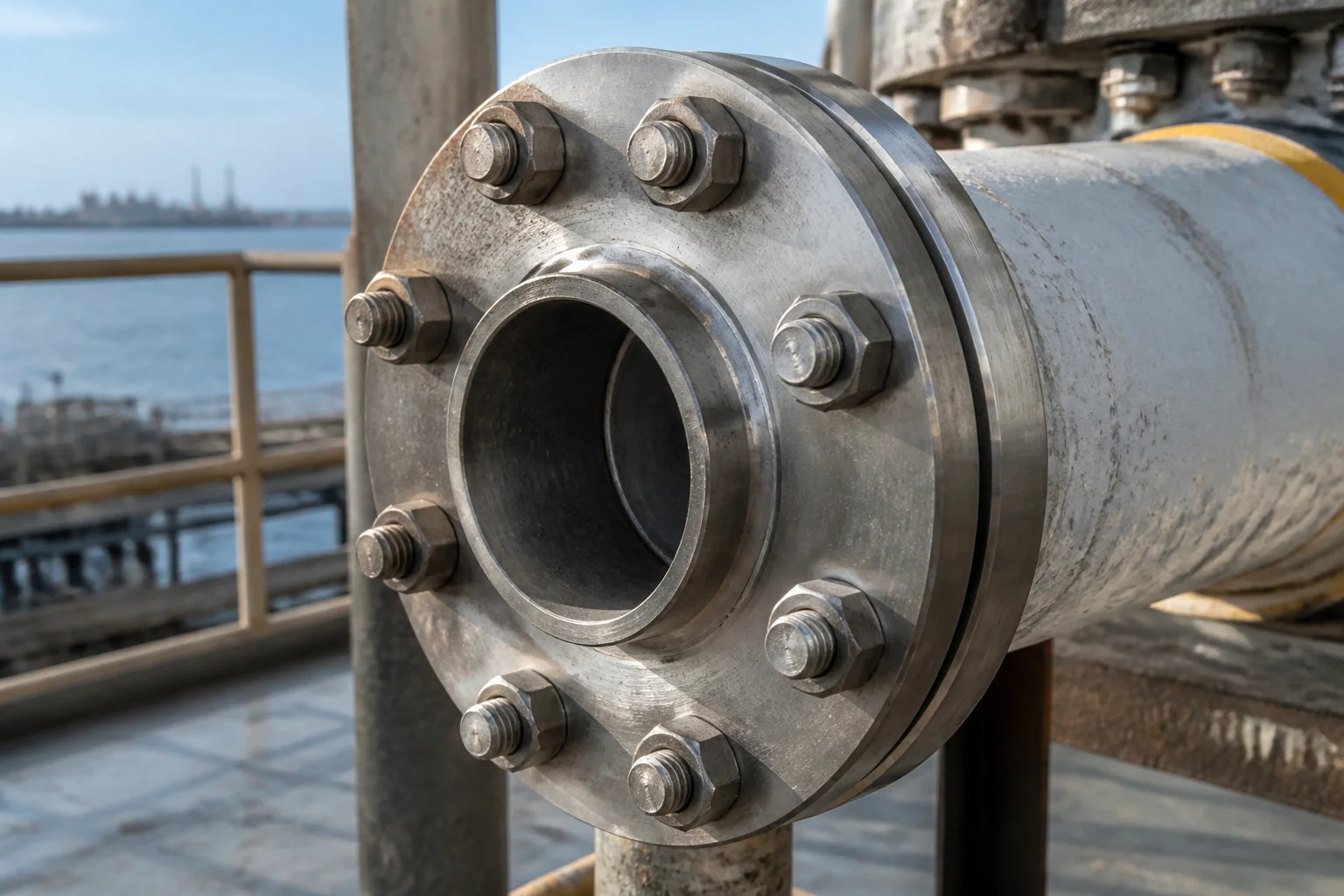
Marine and chemical installations are where the grade decision gets tested. Chlorides plus warm, wet service plus a tightened bolt is the exact combination A2 handles badly.
What the drawing and the inspection report will not tell you
Open a typical stainless fastener drawing. You will find the size, the length, the thread callout, the grade mark, and a finish note that says "passivated" or "clean". That is the whole specification, and it is missing the three variables that decide whether the assembly runs.
The first missing line is the lubricant, or its absence. A dry A4-70 nut and a waxed one are the same part on paper and different products on the bench. Nothing on the drawing distinguishes them, so nothing on the quotation does either.
The second is the mating part. Galling is a property of a pair. A drawing that specifies a bolt and leaves the nut to the installer has specified half a joint. If the nut comes from a different supplier, in a different alloy, at a different hardness, the pairing was never designed. It happened.
The third is thread engagement and hole depth. Both influence contact area, and contact area drives seizure risk. Both are usually set by whoever modelled the bracket.
Now the inspection report. It will show dimensions against tolerance, thread gauge results, and a mill certificate with chemistry and mechanical properties. Good documents, and all of them silent on the failure mode you are actually fighting. A go/no-go gauge proves the thread fits. It says nothing about how the thread behaves at 40 N·m with grit on it.
The certificate is worth reading for two things. Chemistry against the grade ordered, because A2 sold as A4 is a known substitution and the price gap is real. Mechanical result against the class on the head, because a class 70 part marked 80 is a different conversation.
Where a hardness figure is available, keep it. It is the one number that tells you whether the dissimilar-hardness trick has any chance of working.
One more document matters and rarely gets requested: the passivation record. ASTM A967 is the reference most buyers cite. Passivation removes free iron and restores the passive layer. It also leaves a very clean, very active surface, and clean stainless galling is no gentler than dirty stainless galling. Passivate a lot and assemble it dry, and the risk goes up rather than down. That is an argument for making the lubricant decision after passivation, deliberately.
Which brings the whole problem back to a single observation. Stainless steel fastener galling is not caught by inspection. It is prevented by specification, and specification happens before the parts exist.
What belongs on the purchase order
Most of this article reduces to a page of purchase-order text. Write it once and the argument stops recurring.
The order needs the grade twice, as the A-code the shop recognises and the EN number the mill certificate prints. Then the class with its standard, and the pitch stated explicitly, because "M10" alone leaves coarse an assumption on some desks and fine on others.
Then the part suppliers rarely see: the assembly condition. Who applies the lubricant, what it is, and whether it goes on the thread only or on the bearing face too. A supplier applying dry film in-house quotes differently from one who ships dry. Both are legitimate. Only one matches your process.
Add the packaging line. Stainless hardware that travels loose in a carton arrives with thread damage that shows up as galling on the line, and the line blames the alloy. Individual bagging or partitioned boxes are cheap insurance on small sizes.
Finally, ask for a trial quantity before the full run. Fifty pieces assembled under your own conditions will tell you more about seizure risk than any certificate, at almost no cost.
| PO / RFQ field | What to write | Why it belongs there |
|---|---|---|
| Grade, both ways | A4, EN 1.4401 | Chemistry is checked against the EN number |
| Class and standard | A4-70 or A4-80 to ISO 3506-1; nuts to ISO 3506-2 | Alloy and strength are two decisions |
| Thread and pitch | M12 x 1.75 coarse, or fine if genuinely required | Fine pitch raises risk, so make it visible |
| Mating part | Nut grade, class and finish, supplied as a set | Galling is a pair property |
| Lubricant | Type, coverage, applied by supplier or by us | The most effective control, and the most omitted |
| Engagement | Clamped thickness plus engagement in nut or hole | Long engagement costs torque and adds contact |
| Passivation | To ASTM A967 or not, with the record supplied | Stops free-iron rust being read as a grade fault |
| Thread condition | Rolled, chamfered, no rolled-over start | Most seizures begin on the first turn |
| Documentation | Mill certificate per lot, mechanicals per class | Ties the alloy claim to the shipment |
| Environment | Coastal, chemical, washdown, temperature | Lets the supplier challenge the grade |
That table fits on one page. Put it in the RFQ template and the recurring arguments stop before they start. The full discipline, including drawing-based wording, is in our guide to writing a custom fastener RFQ.
One caution. Not every order needs a hardness figure, a passivation record and a trial batch. A box of M6 A2 button screws for a machine guard is not a flange set on a chemical line. Match the paperwork to the cost of failure, or it becomes noise that suppliers learn to ignore.
Questions buyers actually ask
Is A4 always better than A2?
No. A4 resists chlorides better and costs more, and for dry indoor service it buys nothing. Choose A4 where chlorides, marine air or chemical exposure are real. Choose A2 everywhere else and spend the difference on lubricant and better packaging, which will prevent more failures.
Can I use A2 bolts with A4 nuts?
Yes, and plenty of plants do it deliberately. The mixed pair gives a slight hardness difference, which reduces galling risk, and the nut's molybdenum content helps where the exposed thread sees chloride. Write the pairing on the order so it is a decision rather than an accident of stock.
Does anti-seize affect the torque value?
Yes, substantially. A lubricated thread has a lower friction coefficient, so the same wrench setting produces more clamp load than a dry assembly. Recalculate the torque for the lubricated condition, and state on the drawing that the parts are supplied lubricated.
Why did the same parts assemble fine last year?
Something in the chain changed. A different lubricant or none at all, a new supplier's thread finish, a faster driver on the line, a coarser batch of grit in the shop, or a different operator. Galling is sensitive to conditions, not just to materials, so the comparison has to be about the process as well as the part.
Can a galled bolt be cleaned up and reused?
No. Galling transfers metal and tears the thread flanks, so the geometry is no longer what the drawing specifies. Dressing the thread with a file hides the damage and guarantees a second seizure at lower torque. Scrap both parts and start again.
Is a coated stainless fastener still stainless?
The substrate is. A dry-film or wax coating sits on top of it, and the corrosion resistance of the base alloy is unchanged apart from any cut edges. Coatings on stainless exist mainly for lubrication and for stopping thread-to-thread contact, not usually for adding corrosion protection.
How do I know the grade I received is the grade I ordered?
By the mill certificate, checked against the chemistry the grade requires, and by a grade mark on the head that matches. A magnet proves nothing useful. If the risk is high, a spot chemical check or a hardness test on a sample settles it in minutes.
The grade protects the structure. The lubricant protects the assembly
Two decisions, one purchase order, and they get confused constantly.
The grade answers a corrosion question. A2 for ordinary service, A4 where chlorides are present, and an honest conversation when neither grade really suits. That decision is engineering's, and it should be made against the environment, not a habit.
The property class answers a strength question. It sets what the joint can carry, and the number is a cold-working outcome rather than a heat-treatment one. A class 80 mark is not a promise of better metallurgy. It is a promise of more deformation during manufacture.
Neither decision touches the assembly problem. Galling is a surface event, and surfaces are governed by lubricant, pitch, speed, cleanliness and hardness pairing. Neglect all five and a perfectly specified A4-80 joint will still seize on the first bolt.
That is why stainless steel fastener galling keeps appearing on cost reports under the wrong heading. It gets filed as a quality complaint against a supplier who shipped exactly what was ordered. The real gap is one line of text that nobody wrote.
Write the line. Name the grade twice, name the class and its standard, name the pitch, name the lubricant and who applies it, name the mating part, and ask for a trial batch. Then, on the floor, slow the driver down and keep a brush of anti-seize at the bench.
JingleFix supplies stainless and carbon steel fasteners, anchors, clamps and machined parts out of Ningbo, with drawing-based and sample-based customization and inspection documentation agreed per order. Twelve years of export experience, and a habit of asking what the joint does before quoting the grade. If you are choosing between A2 and A4, or fighting seizure on a line that should be running, the range is here and the hex bolts are specified in detail on the hex bolt page.
Send the environment, the size, the class and what the parts are clamping. We will tell you what is missing from the specification before anyone quotes a price.
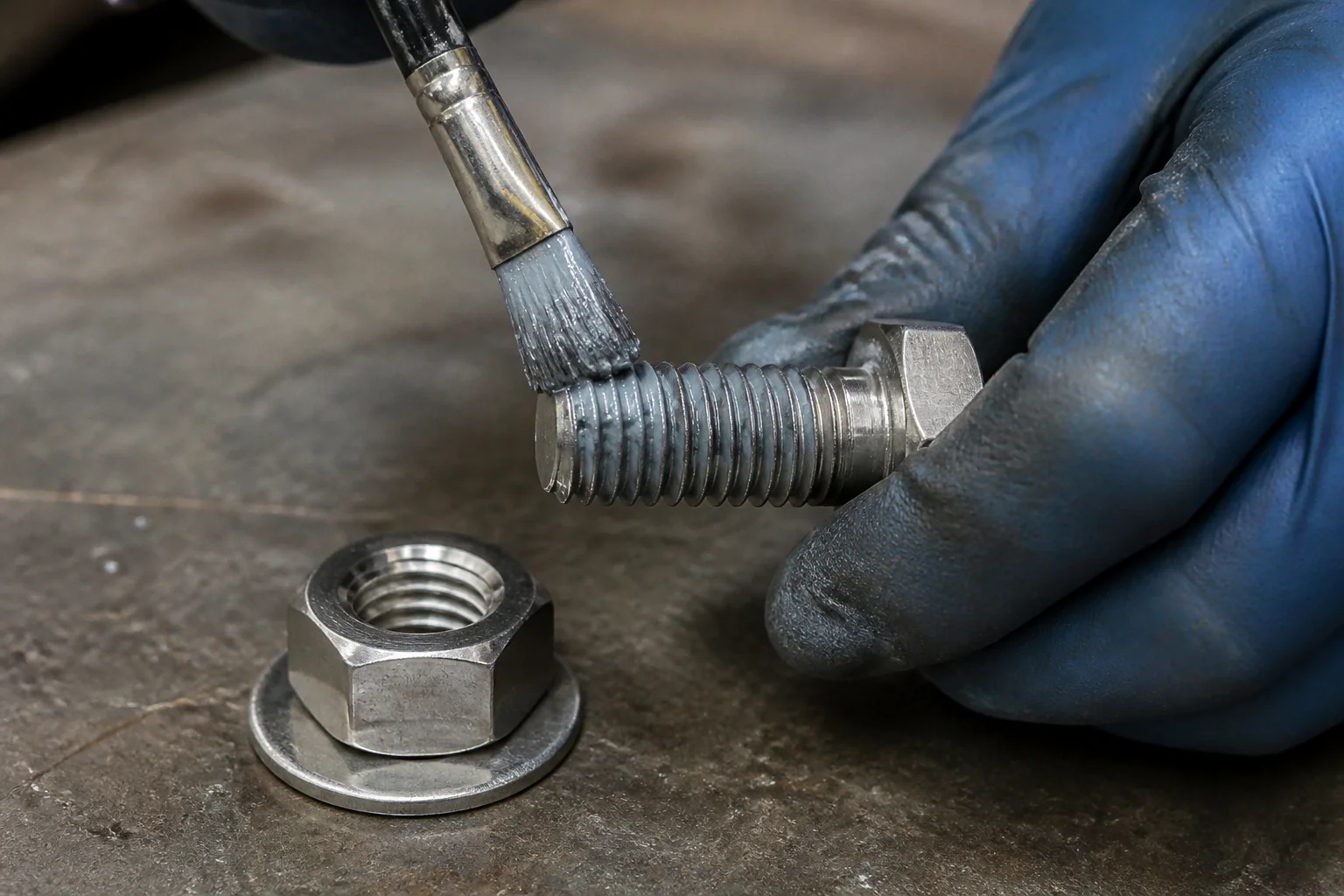
A thin, even film on the thread and under the bearing face. Two surfaces, not one, and never a loaded brush — excess paste collects grit and changes the torque coefficient.
Specify the grade and the assembly condition in one go
Send your size, quantity, property class and service environment. We reply with grade options, lubricant and packaging choices, and the documentation we can provide for that specific part.
Send Your Inquiry Now →Or email sales@jinglefix.com · WhatsApp +86 13958236696