A zinc plated fasteners manufacturer should be evaluated by the coating system it can define, control and document—not by the words “zinc plated” on a quotation. Buyers see that two-word finish description every day, yet it settles surprisingly little. A coating standard is still missing. So are the thickness basis, conversion layer, sealer, lubricant, color limit, corrosion test, final thread check and hydrogen plan. Put two such offers beside each other and they may look alike on paper, while the parts assemble, age and inspect quite differently.
This is a working guide for the people who actually compare offers: an importer checking a new source, an OEM buyer, a distributor, a project purchaser or the engineer supporting them. Alongside the coating questions, it covers shipment evidence, sample trials, price and lead-time effects, and the information a factory needs before it can quote responsibly.No one needs to turn a purchase order into a coating textbook. The useful goal is simpler: uncover the choices while they are still inexpensive to change.
JINGLE-TECH supplies standard and drawing-controlled fasteners, precast accessories and machined components for overseas sourcing programs. Available product-page information is suitable for initial selection; the final material, property class, finish, testing and document scope must be confirmed against the specific item, order and application. Safety-critical joints, anchors and lifting products also require application engineering and applicable approvals.
Need a comparable zinc-plating quotation?
Send the part standard or drawing, material and property class, finish designation, quantities, destination and required inspection documents. We will review the technical gaps before quoting.
✉ Request a Technical Quote1. The fast buyer’s decision: seven items to lock before price comparison
A useful RFQ begins with a controlled product definition. If any of the following fields is left open, the buyer should expect assumptions to appear in the quotation.Assumptions are not automatically wrong, but they must be declared so that every bidder prices the same requirement.
| Decision | What to state | What can go wrong if omitted |
|---|---|---|
| Base fastener | Product standard or drawing revision, dimensions, thread system and tolerance | A visually similar part may not assemble or carry the required load |
| Material and performance | Steel grade, property class, heat treatment and mechanical requirements | Coating and hydrogen-risk decisions may be based on the wrong substrate |
| Coating system | Standard and full designation, zinc or zinc-alloy type, conversion layer, sealer and lubricant | Color,friction and corrosion behavior can vary between lots |
| Thickness | Minimum, local or other defined thickness requirement and measurement locations | Thin areas may fail acceptance; excessive build can affect thread fit |
| Hydrogen controls | Risk review, pretreatment, relief process and test/document requirements | High-strength or hardened parts may face delayed-failure risk |
| Acceptance evidence | Dimensional, thickness, appearance, corrosion and batch records | A certificate may list a result without proving it belongs to the shipped lot |
| Commercial definition | Quantity tiers, packaging, labels, Incoterms® place and requested date | The lowest unit price may exclude essential packing, inspection or logistics work |
2.“Zinc plated” describes a family, not one finished product
Electroplated zinc is a sacrificial metallic coating commonly applied to carbon-steel fasteners. The zinc preferentially reacts in many environments, helping to delay attack on the steel substrate. A conversion coating, sealer or topcoat can add protection and create a controlled appearance. Lubrication may be integrated or added later to influence assembly behavior. This layered construction is why a color alone cannot identify performance.
ISO 4042:2022 addresses electroplated coating systems for steel fasteners and includes zinc and zinc-alloy systems with optional conversion coatings, sealants, topcoats and lubricants. It also contains requirements and recommendations intended to minimize hydrogen-embrittlement risk. The 2026 amendment should be considered when the contract calls for the current edition. For inch and metric mechanical fasteners ordered to ASTM practice, ASTM F1941/F1941M-16(2025) is a relevant active specification. A buyer should name the applicable standard and designation rather than mixing fragments from several standards.
A purchase description such as “M10 bolt, blue zinc, 8 microns” is still incomplete. Which bolt standard applies? Is 8 µm a local minimum, a nominal target or an average? Is the passivation trivalent? Is a sealer or lubricant included? Are threads gauged after coating? What corrosion criterion is used, and at what point is white or red corrosion evaluated? Is the property class appropriate for electroplating, and what hydrogen-risk controls are required? These questions are not bureaucracy.They determine whether the part can be received, assembled and reordered consistently.
3. Electroplated zinc is not the same as hot-dip galvanized zinc
International buying teams often use “galvanized” as a broad word for zinc-coated steel. Technically, electroplated zinc and hot-dip galvanizing are different processes with different coating structures, typical thickness ranges, dimensional effects and application profiles. A supplier needs the intended process, not just the generic word.
| Comparison point | Electroplated zinc | Hot-dip galvanized zinc |
|---|---|---|
| Process | Zinc is deposited electrolytically after cleaning and activation | Steel is immersed in molten zinc under a specified process |
| Typical design preference | Controlled appearance, relatively thin coating and close dimensional needs | More substantial zinc protection for appropriate outdoor or infrastructure use |
| Thread impact | Still important,especially on internal threads and tight tolerance combinations | Larger coating build demands an explicitly coordinated thread allowance system |
| Surface appearance | Blue-white, yellow-toned, black or other defined system appearance | Usually a thicker, more characteristic galvanized finish |
| Buyer warning | Review hydrogen risk for high-strength or hardened steel | Review size limits, thread accommodation and process effects |
Neither process is automatically “better.” The suitable finish depends on the joint, service exposure, product standard, dimensions, assembly method, expected service life, maintenance plan and regulatory requirements. If a drawing says “galvanized” but the approved sample appears electroplated, pause and resolve the conflict before quotation.
4. Build a complete coating designation
The coating should be treated as a system of decisions. Start with the governing standard and coating type. Then define thickness, conversion coating, sealer or topcoat, color where appearance matters, and lubrication where torque or friction is controlled.The exact way these elements are encoded must follow the selected standard and current contract edition.
Do not create a hybrid designation by copying one code from an old drawing, another from a supplier catalog and a third from a salt-spray report. Codes change between standards and revisions. Send the source specification or ask the supplier to state its interpretation line by line. If appearance is controlled, use an approved physical sample or a defined color method; words such as “bright,” “clear” and “yellow” are too subjective to be the only acceptance criterion.
For regulated markets, confirm the required conversion chemistry and substance declarations. Trivalent-chromium systems are commonly discussed in modern supply chains, but a buyer should not assume that color proves chemistry. Request the declaration, test or supply-chain document required by the destination and end product. Compliance obligations vary by jurisdiction and product category, so the responsible importer or product manufacturer must confirm the applicable rule set.
5. Thickness is a functional requirement, not a decorative number
More zinc can increase the amount of sacrificial material, but “more” is not a universal procurement strategy. Fasteners contain recesses, edges, shanks and threaded surfaces where current density and geometry can produce different deposits. Coating that is too thin at a specified measurement area may not meet the agreed system.Coating that is unnecessarily thick may interfere with threads, drives, recess fit, holes or mating parts.
Define the thickness term exactly as the selected standard uses it and agree on the significant surface and measurement method. A supplier and buyer can report different numbers from the same part if one measures a convenient flat head surface while the other expects a defined local area on the shank. Small parts may require an agreed sample plan or alternative measurement technique. The report should identify instrument, calibration status where required, part number, lot, measurement locations, number of readings and acceptance decision.

A practical drawing note should avoid an unexplained single value. If the requirement is a minimum local thickness, say so. If a nominal target with an agreed range is needed for process control, write the range. If only selected areas are significant, show them. The manufacturer can then evaluate whether barrel or rack processing, masking, dedicated tooling or a changed design is needed.
6.Thread fit must be decided before plating
Zinc occupies space on both flanks of an external or internal thread. The effect is not judged simply by adding the coating thickness to the nominal diameter; thread geometry magnifies the relationship. The correct accommodation method depends on the thread standard, tolerance class, coating system and mating-part strategy. That is why a drawing should state the thread condition and acceptance point rather than telling the supplier to “make it fit.”
Confirm whether the base thread is produced to a coating allowance, whether the mating component is coated, and whether the final thread is accepted with the specified gauge after coating. Recutting an external thread after plating can remove protective zinc from the load-bearing flanks and create an unapproved condition. Coating a finished nut without planning internal-thread build can cause rejection even when the uncoated nut was dimensionally correct.
Assembly samples are especially valuable when the buyer controls both bolt and nut, changes coating suppliers, introduces a sealer or lubricant, or uses a captive component with limited clearance. Use the actual mating parts, assembly tools and torque procedure. Record run-down behavior, seating, prevailing torque where applicable, visible damage and final joint function. A gauge result and an assembly trial answer different questions; good qualification may need both.
7.Hydrogen embrittlement: treat risk, not just baking time
Hydrogen can be introduced while susceptible steel is being made ready for plating—cleaning and pickling are two familiar routes—and during electroplating itself. The awkward part is timing. A bolt can pass the gauge, look bright in its bag and still crack later after it is put under load. Hardness and strength matter, but they are only part of the picture. Microstructure, cold work, residual stress, service stress, shape, pretreatment and the chosen plating line all belong in the review.
ISO 4042 includes fastener-specific recommendations intended to minimize this risk. ISO 9587:2007 separately describes pretreatment stress-relief requirements for certain high-strength steels before hydrogen-charging operations. For a specific order, the engineering team should review the product standard, fastener standard, material condition and purchaser requirement together. A generic statement such as “baked after plating” is not enough because it omits timing, temperature, duration, batch evidence, part susceptibility and validation method.
Relief treatment can lower susceptibility when its conditions are right; it does not turn risk into zero. Consider a very high-strength, surface-hardened or safety-related part separately. Engineering may decide to assess a suitable non-electrolytic zinc-flake finish, or it may change the material or design. A plater cannot reach that conclusion from the diameter and requested color.
| Risk-review input | Evidence or decision to request |
|---|---|
| Material, property class and actual hardness | Material/heat-treatment records and batch test results appropriate to the specification |
| Cold work, machining, grinding and residual stress | Process-route review and pretreatment stress-relief decision |
| Cleaning, activation and plating route | Controlled process plan and approved subcontractor scope |
| Post-plating relief | Recorded start time, temperature, duration and lot identity when required |
| Validation | Applicable product/test method, sampling and acceptance criteria agreed before production |
8. Salt spray results are acceptance data, not a service-life calendar
Salt spray can be a useful acceptance tool, but only after the system, method, exposure, specimen preparation and failure criteria are agreed. It is good at answering a narrow question such as “did this batch meet the contracted chamber test?” It is poor at answering “how many years will this bolt last beside the sea?” ASTM B117-26 describes a controlled environment for relative information and warns against that stand-alone leap from chamber hours to natural exposure.
A complete corrosion requirement should identify the method, exposure duration, sample state, rack orientation if relevant, number of specimens, evaluation interval and separate criteria for coating corrosion and basis-metal corrosion. Define whether handling marks, thread contact areas and edges are evaluated differently. Do not accept a line that says only “salt spray passed.” Ask what passed, under which method, for how long, and against which failure definition.
Real service depends on humidity cycling, temperature, pollutants, chlorides, joint crevices, contact with other materials, installation damage and maintenance. Outdoor, coastal, chemical, buried and permanently wet environments require an application-specific corrosion review. Thin electroplated zinc is not automatically a “marine” finish. When long outdoor exposure is expected, compare suitable hot-dip galvanized, zinc-flake, stainless or engineered coating options using the actual joint and cost-of-failure profile.
9.Color and appearance need an acceptance language
Blue-white and yellow-toned zinc finishes are common in purchasing descriptions. Their appearance can vary with chemistry, thickness, substrate texture, part orientation, lighting, handling and sealing. A marketing photograph is useful for product identification but not a calibrated appearance standard. For retail packs, visible hardware or mixed-lot assemblies, appearance control may be commercially important even when mechanical function is unchanged.
Agree on the allowed color range, brightness expectation, stains, water marks, contact marks, rack marks, bare areas, blisters, peeling and handling damage. Provide a signed sample set under controlled lighting if appearance is critical. For barrel-plated parts, the buyer should understand that small contact points can appear differently from broad surfaces. For rack-plated parts, define acceptable suspension or contact locations. Packaging separators, gloves and moisture control may be needed to preserve the approved appearance through ocean transit.
10. Lubrication changes assembly behavior
A topcoat or lubricant can alter friction at the threads and bearing surface. This affects the relationship between applied torque and achieved clamp force. Two bolts with the same dimensions and property class can behave differently if one uses a dry clear sealer and the other an integrated lubricant. A coating change approved only by purchasing may therefore disturb an established tightening process.
If the joint is torque-controlled, provide the required friction window or torque–tension validation plan and identify the mating nut, washer and bearing surface. ISO 16047 is commonly referenced for torque/clamp-force testing, but the exact test setup and acceptance values must be agreed. Do not assume a generic “lubricated” note defines the chemistry, amount or stability. For prevailing-torque nuts or thread-forming screws, application trials are particularly important because coating and lubrication interact with the locking or forming mechanism.
11. What a controlled manufacturing and plating route should show
Many fastener exporters coordinate forming, heat treatment, machining, plating, sorting and packaging across specialist operations. That can be a workable supply model, but responsibility must remain clear. The quoted supplier should identify which steps it controls directly, which are subcontracted, how approved sources are managed, and how the lot identity follows the product.
- Contract review: drawing revision, product standard, material, property class, finish designation, test scope and packaging are converted into a controlled order specification.
- Incoming material control: heat/lot identity and required material documentation are checked before production.
- Fastener production: forming, machining, thread rolling or tapping and heat treatment are carried out under defined process instructions.
- Pre-plate inspection: critical dimensions, hardness and thread condition are checked before the coating masks or changes the surface.
- Plating preparation: cleaning and activation are selected with substrate condition and hydrogen risk in view.
- Electroplating and post-treatment: bath controls, thickness targets, conversion treatment, sealer/lubricant and required relief steps are recorded.
- Final acceptance: appearance, thickness, dimensions, threads and specified performance tests are verified against the shipment lot.
- Packaging release: part identity, count, labels, moisture protection and export packaging are checked before dispatch.
Traceability does not mean every standard commercial screw needs aerospace paperwork. It means the level of control matches the risk and purchase agreement. A distributor’s routine replenishment may use supplier lot numbers and inspection summaries. A structural, automotive or safety-sensitive program may require heat-level traceability, retained samples, third-party witnessing or customer-approved process changes. Define the level before the price is fixed.
12. Inspection documents that help buyers make a decision
More pages do not automatically create more confidence. A useful quality file connects the right part and lot to the agreed characteristic, method, result and acceptance limit. The following menu helps buyers choose evidence proportionate to their application.
| Document or check | Use | Buyer verification point |
|---|---|---|
| Material certificate or supplier material record | Supports substrate identity | Certificate type, heat/lot relationship and required chemical/mechanical fields |
| Dimensional report | Confirms selected dimensions | Drawing revision, sample size, gauges and actual results |
| Thread gauge record | Checks coated thread acceptance | Gauge standard/class,calibration and whether inspection was after coating |
| Coating-thickness report | Verifies defined deposit requirement | Locations, number of readings, method and minimum/maximum data |
| Corrosion report | Confirms agreed laboratory performance | Method/version, hours, white/red corrosion criteria, photos and specimen lot |
| Hydrogen-control record/test | Supports risk-control plan | Applicability, process timestamps, lot and specified validation method |
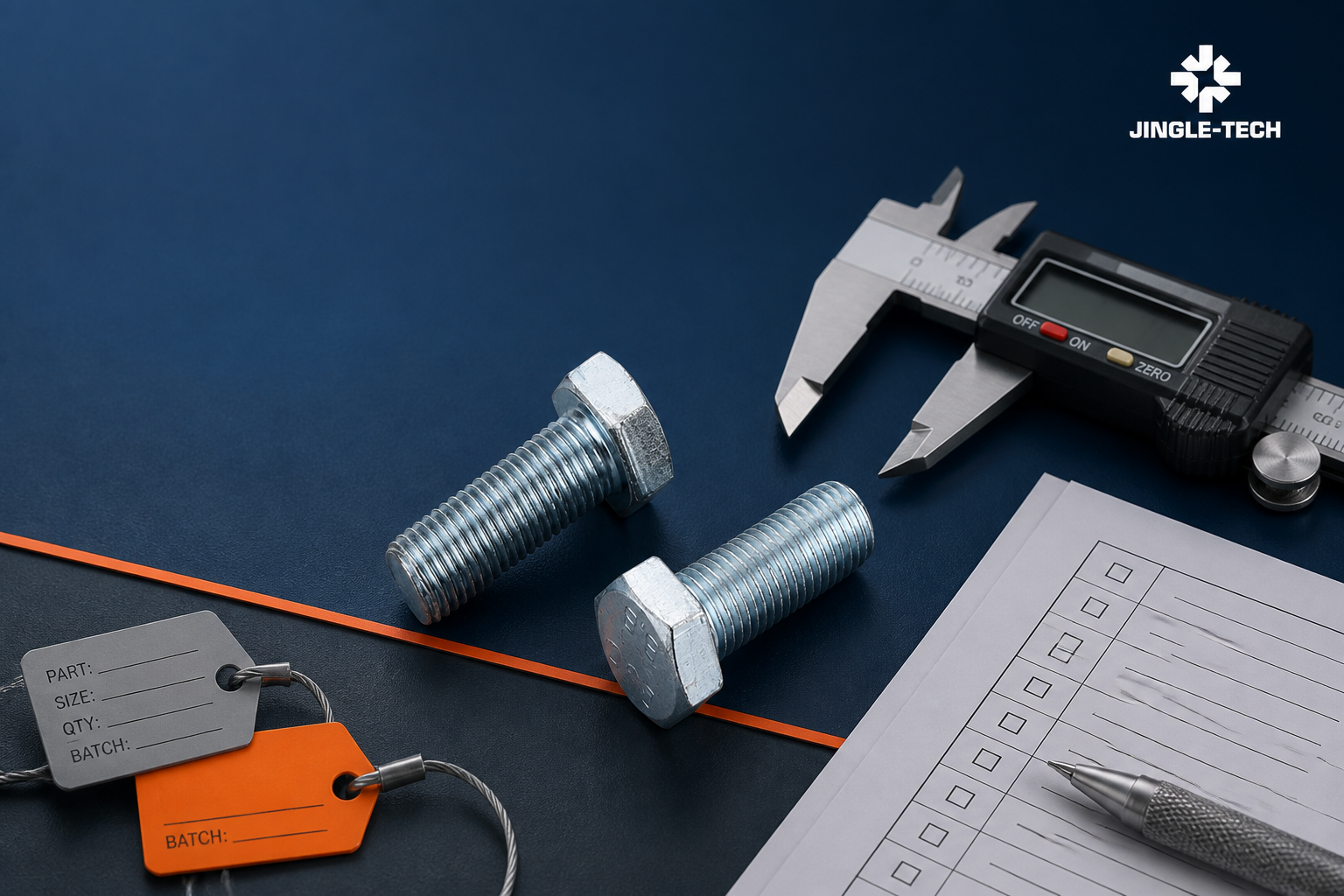
| Packing and label photos | Prevents identity and distribution errors | Part number, quantity, language, barcode, carton and pallet marks |
If independent inspection is required, name the organization or qualification criteria, inspection stage, witness/hold points, sampling plan, report format and who pays. “SGS inspection” on its own does not define what an inspector should examine.Give the inspector the approved drawing, order specification, defect classification and authority to handle deviations.
13. Match the zinc system to the product and application
JINGLE-TECH’s public product range includes blue-white zinc-plated full-thread hex bolts, yellow-zinc chipboard screws and yellow-zinc wedge anchors, among other coated products. These examples illustrate why one finish sentence cannot cover every buying situation.

Full-thread hex bolts
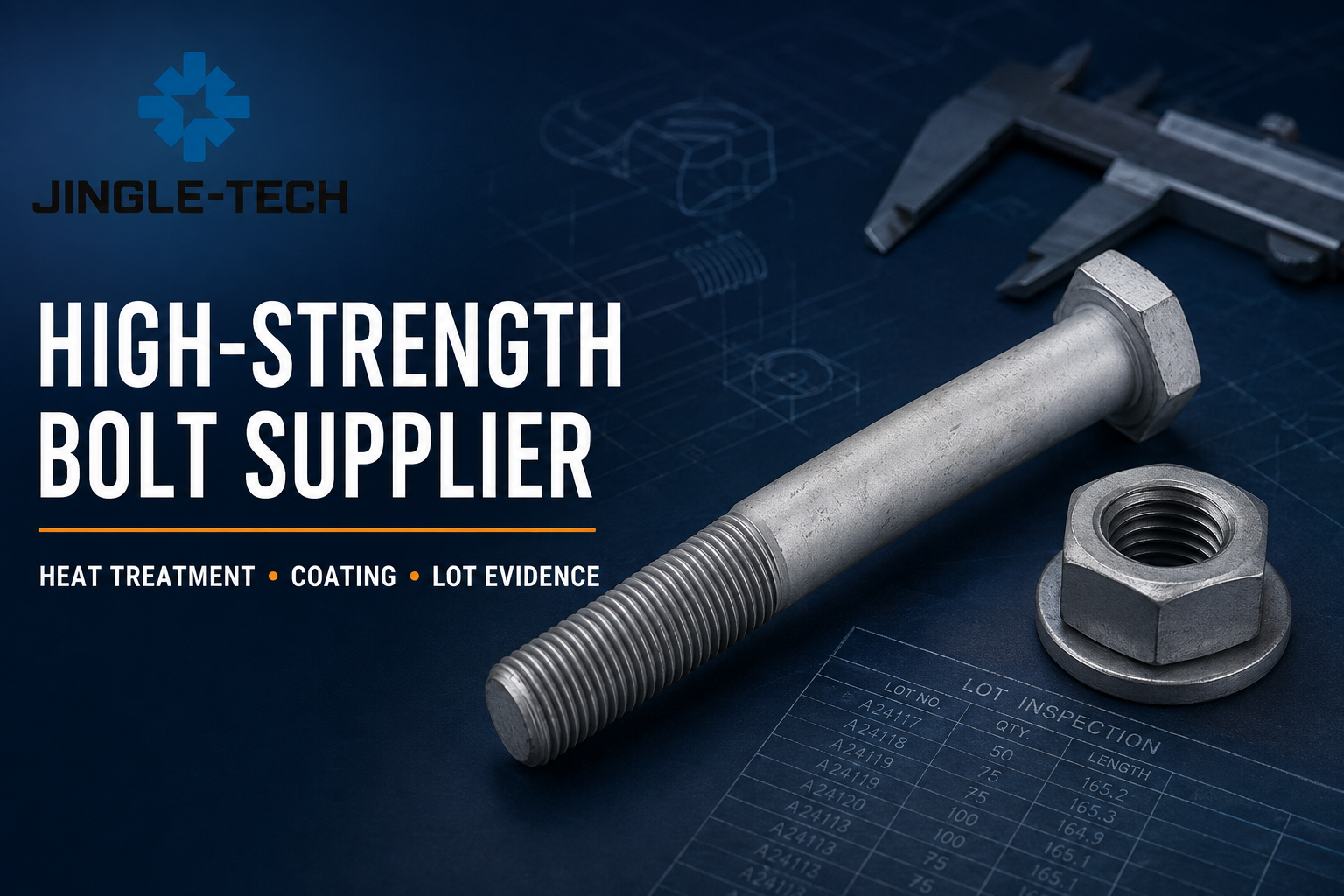
A general-purpose hex bolt program should lock the applicable dimensional standard, diameter/length, thread tolerance, property class, material or steel grade where required, coating system, mating nut/washer, assembly method and packaging. A grade marking is not a substitute for a mechanical test plan. For higher property classes, the coating route and hydrogen review become more important. Explore the referenced blue-white zinc-plated full-thread hex bolt, then send the exact standard and order list for confirmation.
Chipboard and furniture screws
A yellow-zinc chipboard screw is selected by more than length. Head geometry, recess fit, point, thread form, surface appearance and pack count affect line performance and retail acceptance. Test the screw in the buyer’s real board density, edge distance and driver setup. When a plated screw is changed, repeat the trial if friction or recess behavior could differ. Review the full-thread yellow-zinc chipboard screw as an initial sourcing reference.
Wedge anchors
Anchors require the substrate, hole preparation, embedment, spacing, edge distance, installation torque and load/approval basis to be reviewed together. Zinc color alone says nothing about suitability for a safety-critical installation or a particular environment. Do not substitute an anchor merely because nominal dimensions match. The yellow-zinc wedge anchor page can support initial identification; final selection requires the exact installation and project specification.
14. How to audit a zinc plated fasteners manufacturer
A good supplier review follows the actual product route.Ask the candidate to explain one representative order from contract review to shipment. Look for controlled handoffs, not rehearsed slogans. The supplier should be able to show how a drawing revision becomes a work instruction, how a plating subcontractor receives the coating designation, how nonconforming material is isolated and how records are tied back to the shipped lot.
Use a risk-based audit. A low-strength commercial screw in retail boxes does not need the same controls as a hardened automotive part or an anchor used in a regulated project. However, even routine items benefit from basic supplier-change control, incoming inspection, gauge management, approved samples and packaging verification.
| Audit question | Strong evidence | Red flag |
|---|---|---|
| Who owns the plating process? | Named site/subcontractor, approved scope and change-notification rule | “Any local plater can do it” |
| How is the coating code reviewed? | Current standard, decoded order specification and technical sign-off | Color is treated as the full requirement |
| How are threads protected? | Planned tolerance/allowance strategy and post-coating gauge evidence | Threads are chased after coating without authorization |
| How is hydrogen risk handled? | Material-based review,controlled timing/temperature records and defined validation | A universal baking certificate for every part |
| How is lot identity maintained? | Traveler, labeled containers and linked inspection/packing records | Mixed unmarked bins between processes |
| What happens after a deviation? | Containment, root-cause analysis, approved disposition and recurrence control | Rework or substitution without buyer approval |
15. Prepare an RFQ that produces comparable quotations
The most efficient RFQ is a controlled data package, not a long email. Provide a spreadsheet line list plus the drawing or standard for each part. Identify conflicting information instead of asking the supplier to guess which document takes precedence. If a legacy specification uses an obsolete coating code, state whether the objective is exact legacy replication or migration to a current system.
Product definition
- Part name, buyer part number, drawing number and revision.
- Applicable ISO, DIN, EN, ANSI/ASME, ASTM or customer standard and edition.
- Diameter, length, thread series, pitch, tolerance class and critical dimensions.
- Base material/steel grade separated from property class.
- Heat treatment, hardness and mechanical requirements.
- Final application, joint details and whether the part is safety-critical.
Coating and validation
- Electroplating standard and complete coating-system designation.
- Thickness requirement and significant measurement surfaces.
- Conversion treatment, chemistry restriction, color, sealer, topcoat and lubricant.
- Thread condition and post-coating gauge acceptance.
- Corrosion test method, duration, specimen and white/red corrosion criteria.
- Hydrogen-risk control, relief and validation requirements where applicable.
- Appearance sample, defect limits and handling-mark expectations.
Commercial and logistics data
- Sample quantity, pilot quantity, initial order quantity and annual forecast.
- Bulk, small-box, private-label, barcode, carton and pallet requirements.
- Required material, dimensional, mechanical, coating and packing documents.
- Third-party inspection scope and responsible cost party.
- Destination, Incoterms® 2020 rule with named place, and required arrival date.
- Requested quotation validity, payment expectation and currency.
Send one controlled RFQ package
Include your line list, drawing revision, coating designation, inspection scope and quantity tiers. JINGLE-TECH can review standard parts, OEM fasteners and related machined items as one purchasing package.
➜ Start Your RFQ Review16. Compare total landed risk, not just unit price
A quotation should repeat the technical basis and clearly state deviations. Build a comparison matrix that separates included and optional items. One supplier may include post-coating gauges, batch thickness records and private-label boxes; another may price only bulk parts with a generic certificate. Their unit prices are not comparable until scope is normalized.
| Quotation line | What to normalize |
|---|---|
| Part price | Same standard/drawing revision, material, property class and coating system |
| MOQ and tiers | Per size, per finish, per pack format and total order |
| Tooling and samples | Ownership, life, refund policy, sample count and approval cycle |
| Testing | Routine versus special tests, frequency, laboratory and report language |
| Packaging | Count, materials, labels, barcodes, carton weight and pallet treatment |
| Delivery | Lead-time start point, approval dependencies,Incoterms® place and shipment mode |
The lowest purchase price becomes expensive if the coating causes assembly stoppages, mixed appearance, customer returns, port delays or unplanned sorting. Conversely, do not over-specify every routine part with costly documents that add no decision value. The commercial skill is to pay for controls that reduce a real risk.
17. Cost and lead-time drivers buyers can manage
Coating cost is influenced by part geometry, size, weight, surface area, batch volume, rack or barrel method, thickness, post-treatments, color control, hydrogen-relief requirements, test frequency, sorting and packaging. Small mixed lots often cost more per kilogram or piece because every setup, bath schedule, report and label must be managed across fewer parts.
Lead time begins only after the specification is stable. Custom packaging artwork, third-party testing, approved-sample cycles and special corrosion tests can sit on the critical path. Buyers can shorten the schedule by releasing one approved finish family across several sizes, sending editable artwork early, pre-approving document templates and identifying long-duration tests before purchase-order placement.
Ask the supplier to split sample, pilot and mass-production timing. An early sample may confirm dimensions and appearance but may not represent the final production lot or corrosion evidence. Define what each approval stage releases.If shipment is tied to a jobsite or launch, give the required arrival date and destination—not just “urgent”—so the supplier can work backward through inspection and transport.
18. Six recurring mistakes in zinc-plated fastener sourcing
- Buying by color: blue-white or yellow appearance is treated as a complete performance specification.
- Mixing material and property class: “8.8 carbon steel” is used without defining the base material or heat-treatment requirement.
- Ignoring the final thread: an uncoated thread passes inspection but the coated assembly binds.
- Treating baking as a guarantee: one generic statement replaces a product-specific hydrogen-risk review.
- Turning salt-spray hours into years: laboratory acceptance data is marketed as a universal field-life promise.
- Approving a substitute by dimensions alone: anchors, high-strength bolts or application-specific screws are changed without installation or engineering validation.
A seventh mistake sits behind the others: not recording the approved configuration. Keep the drawing revision, coating designation, approved sample reference, pack specification and quality-document list under one part number. When a buyer, manufacturer or plater changes, that file becomes the baseline for controlled review.
19.Three buying scenarios and the right level of control
Scenario A: distributor replenishment of commercial hex bolts
The distributor needs consistent dimensions, property class, appearance, pack count and label data across repeat lots. A controlled standard/finish designation, post-coating thread gauges, routine thickness sampling and pack inspection may be the core evidence. Annual forecast and consolidated sizes can improve production planning. If the distributor sells into multiple markets, it should separate labeling and substance-declaration requirements rather than using one vague global specification.
Scenario B: OEM furniture screw program
The factory cares about driver engagement, head seating, board behavior, corrosion/appearance and uninterrupted feeding or manual assembly. A pilot run in the real board and tool setup provides more value than a generic brochure. Lock the approved screw sample, recess gauge or bit, coating appearance, lubrication behavior and branded package. Incoming inspection can then focus on characteristics that actually stop the line or affect the customer-visible product.
Scenario C: plated high-strength or safety-related part
This program starts with engineering review. Material condition, hardness, forming history, stress, coating process and service loading require a documented hydrogen-risk decision. Mechanical, dimensional and coating evidence must be tied to the lot.Any change of material source, heat treater, plater or relief process may require notification and requalification. The buyer should not accept a cheaper alternative finish until its joint performance and approval path are resolved.
20. How JINGLE-TECH supports an overseas buying program
JINGLE-TECH supports combined sourcing for standard fasteners, drawing- or sample-based custom parts, precast accessories and CNC-machined components. That range is useful when a buyer wants one technical line list and coordinated export package rather than unrelated purchase orders. Available options may include material, dimensions, finish and buyer-specific packing, subject to product review, MOQ and process feasibility.
For zinc-plated orders, the productive starting point is a drawing or standard plus the complete finish requirement. We can review missing RFQ fields, separate material from property class, identify where thread condition and coating thickness need clarification, and align requested inspection evidence with the quoted scope. Manufacturer, finishing route, certification and tests are confirmed for the actual product and batch; they should not be assumed from a general website statement.
Sample-to-production control is equally important. The approved sample should be linked to the final drawing, coating and package—not stored as an unlabeled reference in a cabinet. If the buyer requests a change, revise the controlled specification before production. This protects both sides when the same item is reordered months later.
21. Related sourcing guides and product clusters
Use these pillar pages to build a complete purchasing package. Each cluster addresses a different product or process family; choose the pages relevant to your BOM rather than forcing one specification across unrelated parts.
| Sourcing need | JINGLE-TECH guide |
|---|---|
| Drawing-controlled bolts, screws, nuts and specials | custom fastener manufacturer |
| OEM screw geometry, drives and threads | custom screw manufacturer |
| Construction and structural bolting | structural bolt manufacturer |
| Mechanical anchoring | concrete anchor manufacturer |
| Nonstandard and special nuts | custom nut manufacturer |
| Clamps for hose and pipe programs | hose clamp manufacturer |
| Precast lifting components and system review | lifting anchor manufacturer |
| Sockets, inserts and related precast items | precast concrete accessories manufacturer |
| Drawing-based metal components | precision CNC machining parts manufacturer |
| One RFQ for mixed fastener and machined-part sourcing | OEM fastener and machined parts supplier |
22. FAQ for international buyers
What information should I send to a zinc plated fasteners manufacturer?
Send the product standard or controlled drawing, material, property class, dimensions, thread details, coating standard and full designation, thickness, passivation/sealer/lubricant requirements, test and document scope, quantity tiers, packaging, destination and required date. State the application and safety relevance so the coating and hydrogen-risk review is appropriate.
Can I specify only “blue zinc” or “yellow zinc”?
That is suitable for an early inquiry but not a final order.Color does not define thickness, chemistry, sealer, corrosion performance, thread acceptance or hydrogen controls. Convert the visual preference into a complete specification and, when appearance matters, an approved sample.
Is zinc plating suitable for outdoor use?
It depends on coating system, thickness, joint design, exposure, installation damage and required service life. General electroplated zinc may suit controlled or mild environments, but demanding outdoor, coastal, chemical or permanently wet service needs an engineering corrosion review and comparison with other materials or finishes.
Does a higher salt-spray result guarantee longer field life?
No. A defined salt-spray test can compare or accept laboratory performance. ASTM B117 cautions against treating stand-alone salt-spray data as a direct prediction of natural-environment performance. Field exposure includes cycles and mechanisms the chamber may not reproduce.
Will thicker zinc make the thread fail a gauge?
It can if the thread allowance and final coating build were not coordinated. Define the thread class, coating accommodation method, mating part and post-coating gauge acceptance before production. Avoid unauthorized thread chasing after plating.
Are zinc-plated property class 10.9 or 12.9 fasteners safe?
The answer cannot be based on class alone.Higher-strength and hardened parts require a documented assessment of material, hardness, manufacturing history, coating route, stress and application. Applicable standards and engineering requirements may call for specific controls, validation or another coating system.
Does post-plating baking eliminate hydrogen embrittlement?
No process should be described as eliminating all risk. Correctly specified and controlled relief treatment can reduce susceptibility, but timing, temperature, duration, part condition and validation matter. Prevention and risk reduction must cover the whole process route.
What should a coating-thickness report contain?
It should identify the part, drawing/standard, batch, method, instrument or equipment, required limit, measurement surfaces, sample size, actual readings and disposition. Calibration or verification information should be included when required by the quality agreement.
Can the coating color vary within one shipment?
Some variation can occur with chemistry, geometry and processing. If appearance is critical, agree on sample limits, lighting, allowed marks and lot-mixing rules. The inspection and packaging plan should protect the agreed appearance during handling and transport.
Should I choose barrel plating or rack plating?
The supplier should recommend the method based on geometry, cosmetic surfaces, damage risk, quantity, thickness uniformity and cost.Barrel processing is common for many small fasteners; rack processing may suit parts needing controlled contact or reduced part-to-part damage. The product and acceptance standard remain the decision basis.
Can JINGLE-TECH supply private-label packaging?
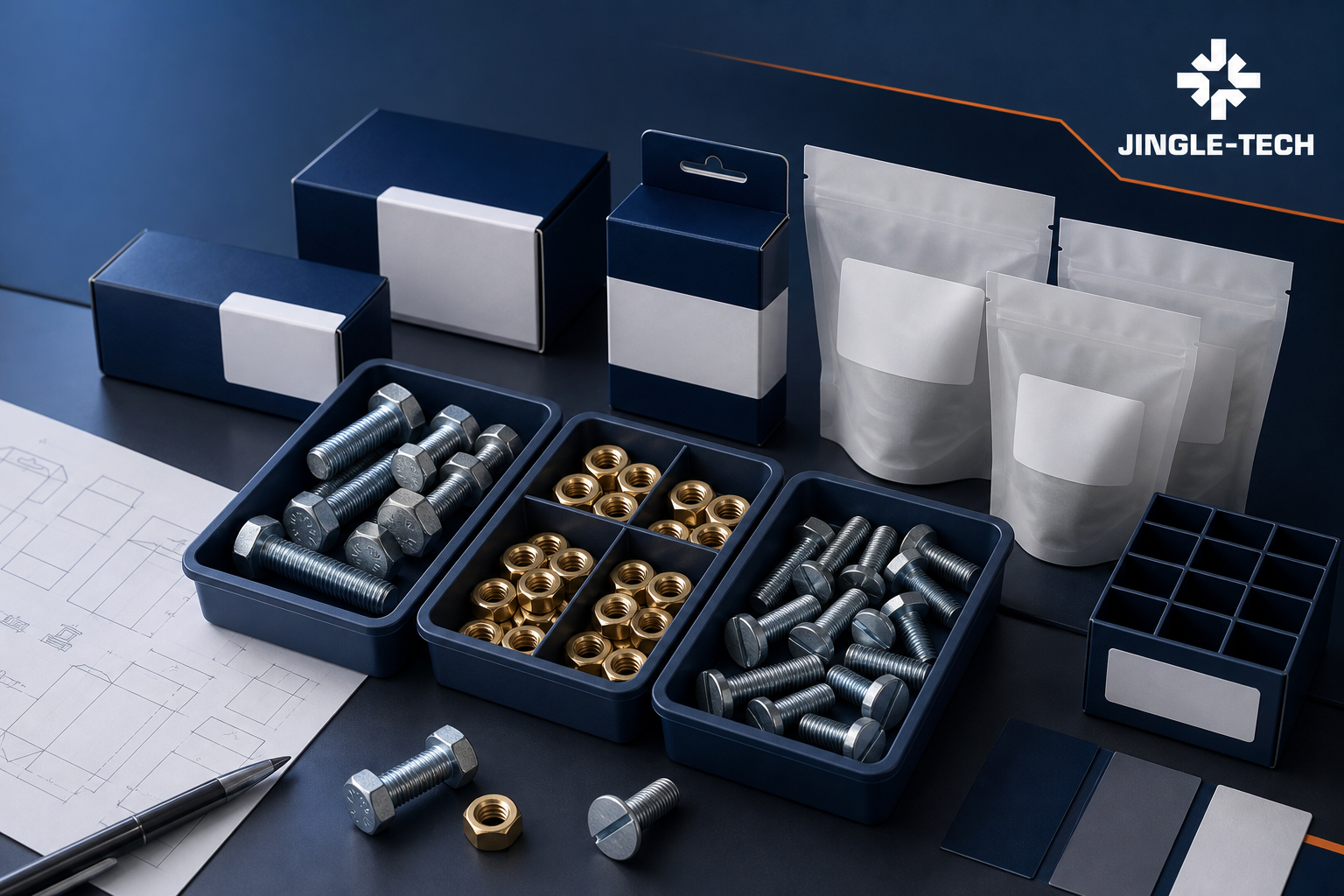
Buyer-specific packing can be reviewed for suitable products. Include inner count, bag or box material, label language, barcode data, carton weight limit, shipping marks, pallet pattern and artwork. MOQ and lead time depend on the item, finish and package configuration.
How do I get an accurate lead time?
Provide a stable specification, sample/pilot/mass-production quantities, required test durations, document scope, packaging artwork status, destination and arrival date. Lead time should state its start point—such as approved drawing, deposit or approved sample—and any dependencies.
23. Final buyer checklist
Before releasing the purchase order, confirm that the quotation repeats the product and drawing revision; separates material, property class and heat treatment; names the complete zinc coating system; defines thickness and appearance; addresses final thread acceptance; records the hydrogen-risk decision; identifies corrosion and mechanical tests; links documents to the lot; includes the approved packaging; and states quantities, pricing basis, Incoterms® place and lead-time trigger.
A capable supplier will not answer every question with “yes.” It will identify what is standard, what needs confirmation, what requires a sample, and what falls outside the quoted scope. That discipline is more valuable than a confident promise because it turns a fastener inquiry into a repeatable manufacturing and purchasing plan.
Choose a zinc plated fasteners manufacturer that makes assumptions visible before production and produces evidence your receiving team can actually use. Send JINGLE-TECH your controlled part list and target market. We will review the available product route, coating details, inspection scope and commercial requirements before preparing an offer.
Ready to qualify your zinc-plated fastener order?
Attach the drawing or standard, coating designation, quantity tiers, required evidence and destination. Our team will review the RFQ and identify the points needed for a technically comparable quotation.
✉ Contact JINGLE-TECH for a Quote