Automotive Fasteners Supplier Qualification: APQP, PPAP and CNC Part Evidence
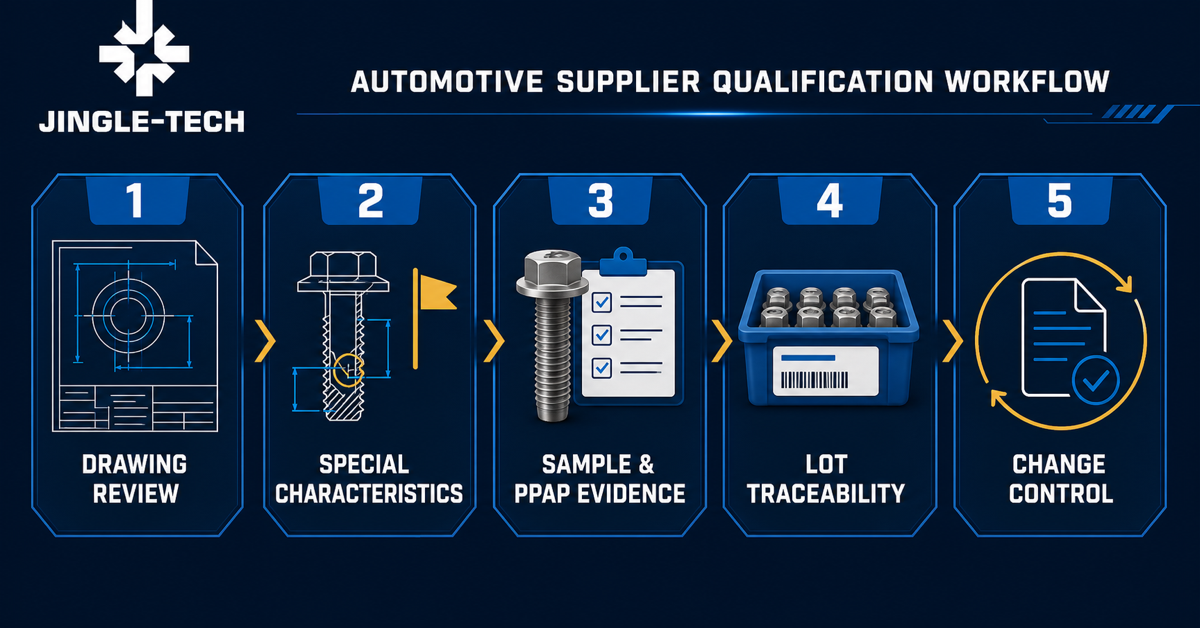
Quick answer: automotive fasteners supplier qualification should test whether one controlled product definition can travel intact through feasibility, APQP planning, sub-tier controls, special-characteristic handling, project-defined PPAP, lot identification, shipment records and change approval. If the RFQ also contains CNC-machined companion parts, their model/drawing, route, measurement and approval evidence must be controlled separately. A certificate, sample bag and unit price do not answer those questions. Buyers need linked evidence and quotations returned on the same technical and commercial basis.
The strongest qualification starts before anyone visits a plant. Procurement first defines the program boundary, engineering freezes the quotation baseline, quality identifies APQP and approval evidence, and the bidder states assumptions and gaps. A desk review establishes the proposed chain; the site or process audit then tests it against the agreed baseline. Without this sequence, qualification can become a certificate check or clean-floor tour that says little about whether the quoted fastener and any CNC companion part can be launched and controlled.
This guide deliberately differs from the existing automotive supply-chain article on this site. It avoids that page's broad inventory, application and supply-continuity themes, and it promises no certification or capacity.Its narrower purpose is to help an OEM, Tier 1, integrator or technical distributor build a qualification record from drawing through APQP and production-part approval, then convert that evidence into a comparable RFQ decision.
Discuss your automotive fastener RFQ baseline
1. Audit the evidence chain, not the sales claim
A useful audit question has three parts: what requirement controls, where the supplier converts it into work, and what record shows that conversion happened. “Can you make this bolt?” invites a yes. “Show how revision D, characteristic symbol K3 and coating specification C are transferred into routing, control plan, inspection instruction and release record” invites evidence.
The distinction matters because automotive fastener supply can involve several organizations. Material may come from a mill or service center. Forming, thread rolling, heat treatment, plating, patch application, sorting, laboratory work and packaging may happen at different sites. The company issuing the quotation may control all, some or none of those operations directly. That arrangement is not automatically acceptable or unacceptable.The buyer must understand the map, assign controls to each node and verify that no critical requirement disappears at a commercial handoff.
AIAG's CQI-19 Sub-Tier Supplier Management Process Guideline is an official industry reference for supplier identification, control, risk and pass-through characteristics. It does not approve a bidder or define every customer's expectations. It supports a practical audit principle: review the quoted supply network and the controls at the point where the characteristic is actually created or verified.
| Claim or document | Buyer verification | Evidence to sample | Decision boundary |
|---|---|---|---|
| Management-system certificate | Issuing body, status, exact legal entity, manufacturing address and certified scope. | Certificate plus independent status verification and site-to-route match. | A valid certificate is not product approval or proof of part-specific control. |
| “PPAP support” | Customer method, submission/retention scope, responsible owners, dates and open evidence. | A redacted index or controlled sample package mapped to a real process route. | Only the customer or its authorized process grants project approval. |
| “Full traceability” | Trace object, forward/backward link, split/merge rule, retention and response target. | A live trace drill from packed lot to material and process records, then forward to affected shipments. | Traceability depth must match customer, product-safety and regulatory needs. |
| “Special processes controlled” | Process owner, location, customer-mandated assessment, edition, scope and corrective actions. | Current assessment status plus part-family routing and sub-tier monitoring. | An assessment is relevant only when it covers the required process and location. |
| Quoted compliance | Line-by-line requirement response, deviations, assumptions and exclusions. | Signed feasibility/compliance matrix tied to drawing and specification revisions. | Silence is not acceptance; unresolved items remain release blockers. |
2. Freeze the drawing-to-RFQ baseline before comparing suppliers
A supplier cannot quote a stable production route against a moving or ambiguous product definition. The RFQ cover sheet should identify the buyer part number, design-record revision, three-dimensional model revision if supplied, file precedence, units, governing fastener/product standards, material and condition, finish, marking, packaging, destination and every referenced specification. The bidder should acknowledge each item and identify anything unavailable, contradictory or open.
Keep performance language connected to an approved requirement. A property class does not automatically define corrosion resistance, friction behavior, fatigue, joint preload or performance at non-ambient temperature. A coating name may not define pretreatment, thickness distribution, friction window, hydrogen-embrittlement controls, topcoat, color or contact restrictions. A torque value without the joint, mating surface, lubricant, tightening strategy and validation basis can be actively misleading. Engineering must decide what the assembly needs; the supplier audit tests whether the chosen requirements can be realized and evidenced.
For drawings using ASME practice, the official page for ASME Y14.5-2018 (R2024) explains that GD&T provides a common language for communicating design intent.The audit lesson is not to impose ASME rules on every program. It is to state the adopted drawing system and edition, then verify that the supplier's interpretation, programming, gauges and reports follow that same basis.
Resolve conflicting files without asking the bidder to design the part
When a model, drawing, purchase specification and legacy sample disagree, list the conflict on an open-item register. Name the buyer owner and required resolution date. The supplier may propose a manufacturability option, but the buyer's authorized engineering function must approve any design change. A quotation can carry an explicit temporary assumption; production release should not.
A controlled baseline also protects later negotiations. If two suppliers receive different revisions or one is allowed a finish deviation, their prices are not directly comparable. Record every clarification in a shared bid bulletin and require revised acknowledgements. This small discipline prevents a low price from winning only because it priced a narrower part.
3. Define the automotive customer path before requesting PPAP
“Automotive” is not one approval system. An OEM production program, a Tier 1 subassembly, a service part, industrial equipment used at a vehicle plant and an aftermarket product can have different contractual paths.Identify the actual customer, manufacturing location, destination market, vehicle or platform context where authorized, part phase, customer portal, responsible SQE or approval function, and the documents that establish customer-specific requirements.
The IATF official customer-specific requirements page shows why a generic checklist is unsafe: OEM documents have different revision dates, and some are under development. Freeze the applicable customer document and revision in the RFQ. Recheck it at nomination, submission and production release rather than relying on a supplier's old template.
At the editorial date, the official IATF publications page lists IATF 16949:2016, first edition. The IATF stakeholder page also carries active information about a second-edition update, but an update notice is not a published replacement. Buyers should verify the governing edition and transition instructions at contract time. This article does not interpret licensed requirements.
| RFQ field | Buyer states | Supplier returns | Why it matters |
|---|---|---|---|
| Customer and program | Contracting entity, applicable customer documents, part phase and destination. | Acknowledged requirement set and missing access or interpretation questions. | Prevents one OEM's forms or symbols being applied to another program. |
| Submission route | Method, requested submission level/scope, portal, language and approver. | Deliverable index, responsible owner, timing and open dependencies. | “PPAP included” otherwise hides different package assumptions. |
| Production basis | Intended site, tooling status, production material, rate condition and launch phase. | Proposed run conditions and any non-production exceptions. | Prototype evidence cannot silently stand in for the approved production route. |
| Approval gates | Feasibility, tool release, sample, validation, PPAP and shipment authorization gates. | Inputs due from buyer, planned evidence dates and gate risks. | A quote lead time is meaningless if approval dependencies are invisible. |
| Change/revalidation | Notification categories, approval authority and resubmission decision route. | Proposed change-control workflow and sub-tier cascade. | Protects the approved state after launch. |
4.Convert special characteristics into one connected control chain
Special characteristics should never live only as symbols on a drawing. The buyer must identify which symbols and definitions apply, who designated them, what customer document governs them and how they connect to function or regulatory/product-safety concerns. The supplier then demonstrates how each one is recognized in feasibility, process risk analysis, process flow, control plan, work instructions, error-proofing or detection, measurement method, reaction plan, records and change control.
Do not invent a universal symbol or capability threshold. Customers use different symbols, severity logic, approval routes and statistical expectations. A characteristic may require prevention, mistake-proofing, a dedicated gauge, process monitoring, complete verification or another approved method. The correct control comes from risk, process knowledge and customer requirements—not from copying “Cpk 1.67” into every RFQ.
The official AIAG page for Control Plan, first edition describes the plan's linkage with APQP and includes guidance for safe launch and highly automated manufacturing. The buyer does not need to prescribe a control-plan answer before the process is developed. The audit should verify that the supplier's plan is consistent with the process actually quoted and that customer-designated characteristics remain visible through every relevant document.
| Link | Audit question | Sample evidence | Warning sign |
|---|---|---|---|
| Design record → feasibility | Does the review identify every controlled symbol and referenced definition? | Marked-up characteristic matrix and signed open-item log. | Supplier uses its own legend without customer confirmation. |
| Feasibility → risk analysis | Are failure effects, causes and prevention/detection controls connected to the real route? | Process flow and PFMEA alignment review. | Generic PFMEA names equipment or steps absent from the quote. |
| Risk analysis → control plan | Are characteristic, method, frequency, sample, record and reaction explicit? | Cross-reference showing control source and reaction ownership. | “Per drawing” appears without a measurable shop-floor instruction. |
| Control plan → operation | Can an operator identify the characteristic, method and out-of-control action? | Current work instruction, gauge status, segregation and escalation records. | The floor copy has a different revision or local nickname. |
| Operation → release data | Can released product be linked to the applicable results and reactions? | Lot record, inspection status, deviation authorization and shipment release. | Results exist but cannot be tied to the packed lot. |
5. Treat PPAP as a customer-controlled approval path
PPAP is not a folder of documents that every bidder can sell as the same package. The official AIAG PPAP fourth-edition page describes a process intended to show that engineering design-record and specification requirements are understood and that the manufacturing process can consistently produce conforming product during an actual production run at production rates. The buyer still has to define which customer method applies, what must be submitted, what may be retained, what production conditions qualify and who can approve.
Begin with an evidence index, not a submission-level label. List the design record, authorized engineering changes, customer engineering approval where required, design or process risk analysis as applicable, process flow, control plan, measurement-system evidence, dimensional results, material and performance results, initial process studies where required, qualified laboratory documentation where applicable, appearance approval where relevant, sample product, master sample, checking aids, customer-specific records and the warrant or equivalent approval record. Then mark each item required, not applicable, buyer-supplied, supplier-retained, submitted, open or approved.
That list is deliberately conditional.A buyer should use the licensed manual and customer requirements rather than treating this article as a definitive PPAP element list. The supplier audit asks whether evidence is mutually consistent. A beautiful dimensional report is weak if it measures prototype parts from a different material or tool. A control plan is weak if its process flow omits the outside heat-treatment operation. A warrant is not approval until the authorized customer route says so.
Separate quotation evidence from production approval evidence
At RFQ, the supplier may not have part-specific process studies, production-run samples or final customer approval. Asking it to pretend otherwise encourages generic documents. Request planning evidence appropriate to the phase: a feasibility response, proposed route, gap list, project timing, analogous-system evidence where permitted, planned special-process controls, traceability concept and an itemized PPAP work scope. After nomination, release part-specific planning and validation through controlled gates.
Commercially, separate recurring unit price from non-recurring tooling, gauges, test fixtures, outside testing, sample production, documentation and resubmission work. State who owns each asset and record, when it becomes payable, what happens after an engineering change, and whether the charge is included, separate or conditional. This makes quotations comparable without forcing suppliers to expose proprietary process details.
6.Build the RFQ return around decisions, evidence and gaps
A well-controlled RFQ lets a bidder say yes, no, conditional or buyer decision required against each requirement. It does not force a false “full compliance” declaration. Provide a returnable matrix with columns for requirement source, clause or drawing location, supplier response, proposed evidence, process owner/site, exception, buyer action and quotation impact.
Require one controlled quote-basis page. It should name the revision, quantity by phase, expected batch and release pattern, delivery point, Incoterm, currency, validity, raw-material basis, special-process boundary, PPAP scope, packaging, freight, taxes/duties where relevant, exclusions, buyer-supplied items and open technical assumptions. If the bidder offers an alternative, preserve both the compliant base and the alternative as separate lines.
| Return block | Minimum buyer input | Expected supplier response | Comparison use |
|---|---|---|---|
| Technical baseline | Drawing/model/specification revisions, precedence, material, finish and marking. | Acknowledgement, conflicts, substitutions and DFM proposals separated. | Confirms bidders price the same part. |
| Manufacturing map | Required disclosure boundary and restricted sources. | Proposed operations, legal sites, sub-tiers and source-change controls. | Reveals route and special-process scope differences. |
| Quality/PPAP plan | Customer method, deliverable index, gates, records and approval owner. | Owner, timing, submission/retention response, gaps and price boundary. | Prevents unlike evidence packages being compared as equivalent. |
| Traceability | Required trace object, depth, labels, retention and response expectation. | Lot model, split/merge logic, record links and drill method. | Shows whether proposed records match recall/containment needs. |
| Commercial return | Quantities, releases, destination, terms, tooling and change rules. | Unit/NRE split, assumptions, validity, exclusions and price-change triggers. | Creates a normalized landed and launch scope. |
Request a structured RFQ discussion
7. Map every operation and sub-tier before the site audit
Ask for a proposed high-level process flow before the audit. Depending on the part, it may include material receipt, incoming verification, cutting, cold or hot forming, machining, thread forming or cutting, heat treatment, cleaning, coating, lubrication, locking feature application, sorting, testing, marking, packaging and release. This is a map for verification, not an instruction that every fastener follows the same route.
For each step, record the legal organization, physical site, process owner, approved source status, transfer method, lot transformation, key input and output records, nonconformance route and change-notification obligation. Highlight outsourced operations and pass-through characteristics. If a distributor manages the order, determine which entity owns product realization decisions, records and customer communication.
During the audit, select a requirement and walk it through the flow in both directions. Start with a packed lot and trace to material, forming/tooling status, heat-treatment batch, coating batch, inspection and release.Then start with a suspect sub-tier batch and identify all potentially affected internal lots, inventory locations and shipments. The goal is not a rehearsed screen demonstration; it is a bounded, explainable result with evidence and identified gaps.
8. Audit special processes at the place where risk is created
Final inspection cannot directly prove every aspect of heat treatment, plating, coating, patch application or other process whose result depends on controlled conditions. Where a customer requires an AIAG special-process assessment or another scheme, confirm the exact document, edition, applicable process table, site, line or equipment scope, assessment date, assessor qualification, open findings, corrective-action evidence and customer acceptance route.
The official AIAG page describes CQI-9 Heat Treat System Assessment, fourth edition as a common automotive approach and, at the editorial date, warns that AIAG anticipates a new version later in 2026. The CQI-11 Plating System Assessment, third edition addresses plating-management processes. Neither page means every automotive fastener requires those processes or assessments. Apply them only when the actual route and customer requirement call for them, and verify the edition again at the audit date.
Do not accept an overall score without scope. Sample the part-family route, furnace or line authorization, recipe or parameter control, load/lot identity, maintenance and calibration status, reaction to out-of-limit conditions, reprocessing authority, sub-tier reports and linkage to shipped product. If confidential process data cannot be copied, agree how the buyer will verify it on site and what controlled summary can be retained.
9. Make fastener and CNC part evidence characteristic-specific
A supplier audit should not ask only whether gauges are calibrated. It should test whether the selected measurement system can evaluate the defined characteristic under the relevant production conditions and decision rule. Review datum simulation, part restraint, contact or non-contact method, resolution, range, fixture influence, operator method, environmental needs, software/version control, correlation and record identity.A calibration label is one input; it is not proof that the measurement strategy fits the feature.
Build a characteristic-to-evidence matrix. For each drawing or specification requirement, identify the manufacturing step that creates it, the control or detection point, instrument or test method, frequency or monitoring logic, acceptance source, required record, reaction plan and release linkage. Mark which evidence is expected at feasibility, trial, PPAP, safe launch and steady production. This prevents the PPAP package from becoming a one-time report disconnected from normal controls.
When the RFQ includes CNC-machined companion parts
A qualification package may contain a headed fastener, nut or washer together with a CNC-machined spacer, boss, sleeve, bracket or interface part. Do not treat the machined item as automatically covered by fastener evidence. Give it its own part number and revision, drawing/model precedence, material condition, datum scheme, dimensional and geometrical requirements, surface-texture and edge/cleanliness instructions, finish, special characteristics, process flow, inspection plan, trace boundary, PPAP status and change triggers. If the part is sourced through a different site or sub-tier, record that route explicitly.
The audit should connect each machined characteristic to a capable operation and a suitable measurement method without demanding proprietary toolpaths or an invented machine list. Sample how CNC program/revision release, fixtures, offsets, in-process checks, tool-change reactions, nonconforming product and final reports are controlled.A buyer may accept a process proposal only after engineering approves the product-definition interpretation and quality approves the evidence plan. The fastener and CNC component can share a commercial RFQ while keeping technical approval records distinct.
NIST's official Metrological Traceability policy and FAQ stresses that traceability is a property of a measurement result, not an instrument, calibration report or laboratory, and that a documented unbroken calibration chain contributes to measurement uncertainty. The buyer's practical question is therefore not “Is the CMM traceable?” but “What supports the traceability and fitness of this reported result for this characteristic?” NIST does not certify a supplier's measurement results merely because a calibration chain includes NIST.
A standards number can make an evidence pack look settled before anyone has checked what the document actually covers. Start with scope. ISO lists ISO 16426:2002 as published and confirmed; it deals with a fastener quality-assurance system running from receipt of material through manufacture and delivery. ISO 16228:2017, by contrast, defines the types and content of fastener inspection documents that may be requested with an order.Its official scope excludes special-purpose or specially engineered applications that call for other procedures, including initial samples. In a sourcing review, that distinction matters: the routine inspection report may be useful evidence, but it cannot quietly take the place of a PPAP submission controlled by the customer.
Sampling language deserves the same pause. The official abstract for ISO 3269:2019 says it applies where the parties have no prior agreement. It also excludes fasteners for high-volume machine assembly, special-purpose applications and specially engineered applications that need more advanced in-process control and lot traceability. ISO showed a revision under development in 2026. So when a quotation simply says “inspection to ISO 3269,” the buyer still has work to do: confirm the current edition, read the scope against the intended assembly, and reconcile it with the customer agreement before putting any sampling rule in the automotive RFQ.
A property class is not a shorthand for every performance requirement, either. Where the drawing adopts a metric class, first confirm that the product and conditions fall inside ISO 898-1:2013 with its corrigendum. That publication specifies mechanical and physical properties for defined carbon- and alloy-steel bolts, screws and studs under stated geometry, thread and ambient-test conditions. ISO marks it for revision.The official abstract also leaves corrosion resistance, torque/clamp-force behavior, fatigue, weldability and shear resistance outside its specification. Those items remain separate engineering decisions, however familiar the marking on the head may look.
For an electroplated steel fastener, ISO 4042:2022 with Amendment 1:2026 can be relevant within its stated scope. It addresses electroplated coatings and coating systems and includes recommendations intended to reduce hydrogen-embrittlement risk. It is not a promise of every functional result; the official page, for example, excludes paintability and weldability. A usable RFQ therefore names the adopted coating system and the drawing or customer requirement, then connects any required friction or corrosion evidence to the process source, report and approval route. Otherwise, two bidders may both cite ISO 4042 while pricing materially different work.
Read capability evidence in the context of the actual characteristic
Suppose a bidder presents one capability index beside a green check mark. Before treating it as evidence, ask which characteristic was studied, whether the process was stable, how the data behaved, what measurement system and sample basis were used, and which customer rule governed the decision. The supplier should be able to explain the calculation method, study conditions, excluded data, subgroup logic and its reaction when an agreed criterion is missed.Engineering and quality can then decide where a statistical study makes sense and where another control is more appropriate. The number by itself—especially one lifted from a sales slide—does not answer those questions.
Torque/clamp-force evidence illustrates the point. ISO 16047:2005 with Amendment 1:2012 covers specified test conditions for certain threaded fasteners and related parts, subject to its exclusions. The citation alone does not tell the laboratory which mating components, finish, lubrication, tightening conditions, sample plan or acceptance rule represent the intended joint. Engineering still has to approve those project details before the result can support the design decision.
10. Design traceability backward from containment decisions
Begin traceability design with an uncomfortable but practical question: if a suspect coating load is reported this morning, exactly what can the team contain? “Trace by batch” will not answer it unless everyone agrees what the batch is. Material heat, wire coil, forming run, heat-treatment load, coating barrel, inspection group, sorting run, packaging lot and shipment can all have different edges. At every handoff, name the trace object and show how identity is preserved when material splits, merges, waits in a queue, or returns after rework or concession.
The AIAG CQI-28 Traceability Guideline is an industry reference with a self-assessment and a traceability fire-drill form. Where the customer mandates a method, that method controls. Even then, its basic test is useful during a buyer audit: pick a finished lot the supplier did not prepare in advance and walk it back to source and process evidence; afterward, choose a source or process batch and follow it forward into inventory and every potentially affected shipment.
Speed is worth recording, but it is not the result. The drill record should preserve the query, the digital and manual sources consulted, the population found and the reconciliation against production, scrap and rework. Note missing or duplicate links. Name the person authorized to set the affected scope and capture the follow-up action. A five-minute screenshot with an unexplained gap is weaker than a slower exercise that produces a defensible containment boundary.
| Trace node | Required link | Audit sample | Containment question |
|---|---|---|---|
| Material | Supplier, specification/condition, source lot and receiving status to issued quantity. | Receiving record, identity transfer and reconciliation of use/scrap. | Which finished lots contain material from the suspect source? |
| Internal transformation | Input lot, operation, tool/setup status, output lot and disposition. | Traveler or digital history with split/merge and rework records. | Can mixed inputs or returned pieces be bounded? |
| Outside process | Shipped quantity/lot, sub-tier receipt, process batch, return and report. | Purchase order, packing/receipt, batch report and quantity reconciliation. | Can one heat-treatment or coating batch be traced forward and backward? |
| Inspection/release | Product lot to results, instrument/method, inspector/system and disposition. | Result set, nonconformance, concession and release authorization. | Was any affected product released before the deviation decision? |
| Pack and shipment | Pack ID, quantity, product lot, label revision, pallet/container and shipment. | Physical label compared with system and shipping records. | Where is every affected pack now? |
11. Make change control part of the original quotation
Waiting until nomination to discuss change control can expose a commercial assumption that was buried in the price. Perhaps the supplier expects freedom to move coating, substitute a source or alter an inspection route; perhaps the buyer expects advance approval. The original RFQ should settle which changes call for notification, customer approval, new evidence, resubmission or a revised quotation. It should also say how those obligations pass down to material, heat-treatment, coating, sorting, laboratory, packaging and logistics sub-tiers.
ISO 10007:2017 supplies useful configuration-management guidance across the product or service life cycle. ISO confirmed it in 2023 and now marks it for revision. At a high level, the discipline is straightforward: identify the approved configuration, control proposed changes, maintain its status and audit it. The contract and current customer rules still have to turn that discipline into a notification and approval path for the actual part.
Examples make a “no change without approval” boundary usable, although no generic list can decide it for every customer. Discuss product design and drawing revision; material manufacturer and condition; process sequence, tooling, line and equipment; manufacturing or storage site; sub-tier and special-process route; control method, gauge, laboratory and process software; packaging, label, rework, capacity pattern and restart after a prolonged shutdown.Then let the authorized customer process decide which events require notice, which need approval and what evidence follows. The point is clarity before the event, not a longer clause.
| Change category | Supplier must describe | Buyer must decide | Quotation control |
|---|---|---|---|
| Design/specification | How revision is received, reviewed, implemented and made effective. | Approval owner, validation and disposition of old inventory. | Delta cost, obsolete work and effective-lot rule. |
| Material/source | Proposed source, equivalence basis, trace impact and timing. | Whether substitution is allowed and required approval evidence. | Price validity and source-change trigger. |
| Process/site/sub-tier | Reason, affected operation, risk review and readiness plan. | Audit, validation, PPAP/resubmission and shipment hold. | Who pays for buyer-requested versus supplier-requested change work. |
| Control/inspection | New method, correlation, MSA impact and record continuity. | Acceptance of method and transition evidence. | Gauge, validation and recurring report effects. |
| Capacity/restart | Idle duration, preservation, personnel/tool status and restart controls. | Requalification or safe-launch need. | Conditional restart evidence and schedule dependency. |
12. Use a risk-based, evidence-based audit plan
An audit is worth the travel only if it answers a sourcing decision. The current ISO 19011:2026 offers guidance on audit principles, audit-program management, audit conduct and auditor competence. ISO also makes clear that the document does not itself lead to certification. A buyer may use that framework for a supplier visit without presenting the visit as an ISO certification audit. Before anyone arrives, write down the objective, scope, criteria, methods and sampling approach, then settle team competence, confidentiality, reporting and follow-up.
Audit depth should feel different for a new design with customer-designated special characteristics, outsourced heat treatment, an unproven source and a tight launch gate than it does for a stable catalog item with established history. The same risk picture helps choose the people in the room. Purchasing can probe quotation and contract controls; engineering can follow requirement interpretation and DFM; quality can compare the proposed process with its evidence; logistics can test labels, preservation and the trace response. Sending a large team without those assignments usually creates more notes, not a better decision.
Let the supplier explain its system, but retain control of the sample. A label found in inventory, a recent shipment, an entry in the nonconformance log, a maintenance event or a sub-tier batch can each open a more revealing trail than a prepared showcase file. When the trail reaches an anomaly, follow it and ask what the system actually did. Speak with the people who perform and release the work, and compare the controlled document with the copy at the point of use. A finding should identify objective evidence, the affected scope and the source requirement. Personal preference is not an audit criterion.
A four-stage buyer audit sequence
- Desk review: establish who is quoting and where the work will happen. Review the legal entity, sites, any required certificates, process map and sub-tiers, then compare the feasibility matrix, proposed quality/PPAP plan and change process with the open gaps.
- Process audit: choose a requirement and follow it into the operation instead of touring by department. Along that trail, test the special-characteristic cascade, material and lot control, special processes, measurement, nonconformance handling and release.
- Trace and change exercises: run the backward/forward fire drill. Add one plausible source or revision change and ask the team to take it through approval and implementation.
- Closure: connect every finding to objective evidence and risk. Assign an owner, immediate containment where needed, corrective action, a due date, the verification method and the sourcing gate that remains closed.
Share your supplier audit and evidence checklist
13. Verify certificates by legal entity, site and scope
A certificate PDF is a starting point, not the end of the check. When the program requires IATF 16949 certification, match the legal name and manufacturing-site address to the bidder, read the scope, confirm status and issuing certification body, and relate the document to the quoted process. IATF's official list says that IATF-recognized certification bodies are authorized to conduct IATF 16949:2016 certification activity. A group logo, a brochure or a certificate attached to a sales office, affiliate or different manufacturing site does not automatically cover the route being offered.
Keep two questions separate. The management-system certificate may support qualification of the supplier organization, site and scope.It does not approve a particular fastener, drawing, PPAP package, special process, laboratory result or customer deviation. At the same time, a project may include a customer-defined supplier-development or exemption route. Eligibility comes from the contract and current customer-specific requirements—not from an inference drawn from this guide.
The edition line also needs to be read literally. On 26 August 2026, ISO still listed ISO 9001:2015 with Amendment 1:2024 as published, while a new edition was under publication and expected to replace it. Record the standard and edition that the certificate actually covers today. When official transition rules are issued, follow them; until then, a final draft or a marketing page is not an effective certificate requirement.
14. Normalize the quote after technical and audit scope align
The lowest total may exclude the work that makes the part approvable. One bidder may include production tooling, checking aids, special-process assessments, trial material, outside testing, PPAP documentation, safe-launch inspection, controlled packaging and freight. Another may price only finished pieces at annual volume. A third may amortize non-recurring work in the unit price. These are different commercial architectures.
Build a normalization sheet without demanding confidential shop rates.Compare the compliant technical baseline, material/source assumption, production sites, included operations, outside processes, one-time charges, recurring evidence, PPAP scope, traceability, packaging, release quantity, freight boundary, currency, validity, capacity assumption, change triggers and excluded risks. Preserve supplier alternatives in separate columns and require engineering/quality approval before using an alternative price as the award basis.
| Normalization row | Common hidden difference | Required return | Award check |
|---|---|---|---|
| Product definition | Different revision, finish boundary, marking or approved deviation. | Acknowledged controlled baseline and exception list. | Engineering confirms equivalent scope. |
| Route and source | Supplier omits operation, uses alternate sub-tier or assumes buyer-supplied process. | Process/site map and outside-process responsibility. | Quality approves route and audit boundary. |
| Launch/PPAP | Different submission, trial, gauge, test or resubmission assumptions. | Itemized NRE and deliverable responsibility matrix. | Approval owner accepts planned evidence. |
| Production quality | Reports, special-characteristic controls, sorting or trace records excluded. | Recurring control/report/retention scope and exception. | Quality confirms control continues after approval. |
| Demand and delivery | Annual volume priced as one batch, freight omitted or inventory assumed noncancelable. | Firm batch, releases, forecast, Incoterm, destination and validity. | Purchasing compares same commercial boundary. |
| Change and risk | Price assumes source flexibility or unrestricted process change. | Notification/approval terms, price triggers and open risks. | Contract protects approved state. |
Ask for deltas, not a mysterious revised total
When the buyer approves a drawing, coating, test or quantity change, request a delta quotation tied to the old and new baselines. Show the affected recurring and non-recurring blocks, obsolete material or tools, validation work, timing dependency and effective lot. A controlled delta preserves auditability and makes future reorder reviews easier.
15.Use an award scorecard with non-negotiable release gates
A weighted score can support comparison, but it should not average away a critical gap. Separate disqualifying or hold conditions from scored preferences. For example, unresolved drawing conflict, unapproved special-process source, inability to trace a safety-related characteristic or refusal to notify required changes may block award or production release even if commercial scoring is strong. The actual gates must come from program risk and customer requirements.
| Area | Gate evidence | Scored maturity evidence | Owner |
|---|---|---|---|
| Technical feasibility | Controlled baseline acknowledged; blockers and deviations visible. | Clear DFM evidence, risk logic and rapid question closure. | Engineering |
| Quality/approval | Customer PPAP path, special characteristics and evidence owners defined. | Strong document linkage, reaction discipline and learning from analogous launches. | Quality |
| Trace/change | Trace drill closes; required change notification accepted. | Fast reconciliation, robust split/merge control and disciplined configuration history. | Quality/program |
| Commercial | Quote is compliant, normalized and free of hidden release blockers. | Transparent delta logic, reasonable validity and useful alternatives. | Purchasing |
| Delivery/continuity | Firm batch/release and logistics boundary acknowledged. | Credible constraint disclosure, recovery planning and controlled packaging. | Supply chain |
The scorecard should retain objective evidence and reviewer comments. Avoid invented percentage weights presented as industry norms. A buyer may weight launch readiness, quality risk, commercial scope and continuity differently by program. What matters is that the rule is agreed before offers are opened and that unresolved gates remain visible to the award authority.
16. Two hypothetical audit scenarios
Hypothetical scenario A: the low quote excludes the approval route
Hypothetical only: a Tier 1 buyer receives three bids for a drawing-controlled coated fastener. Supplier A has the lowest unit price. Its return matrix leaves PPAP, a checking aid, outside coating validation and customer-specific packaging blank. Supplier B lists those items as separate non-recurring and recurring blocks. Supplier C includes them in the unit price but assumes one annual shipment.
The buyer should not negotiate against Supplier A's total until the scope is normalized.Engineering confirms the same revision and coating requirement. Quality defines the actual submission and recurring evidence. Logistics states the release pattern and pack. Each bidder returns a delta. The decision can then compare route, evidence, risk and commercial terms on the same baseline. No savings or supplier outcome is assumed.
Hypothetical scenario B: the trace drill finds an orphaned sub-tier link
Hypothetical only: an auditor selects a packed lot and traces it to an internal forming record and an outside heat-treatment report. The report identifies the sub-tier batch, but the supplier's system does not reconcile the quantity returned, scrapped and split across two finished lots. The product may still conform; the evidence chain is incomplete.
The buyer records the requirement source, objective evidence, potential containment impact and release gate. The supplier analyzes the split/merge process, identifies affected population, proposes containment and corrects record linkage. Verification should test a new unpredictable sample in both directions. The article does not decide whether the finding is major, minor or award-blocking; the customer's criteria and risk process do.
17.Questions to ask the supplier team, not only the salesperson
- Engineering: Which requirement is hardest to realize, and what approved decision would change the route?
- Program management: Which buyer inputs control feasibility, tooling, trial, PPAP and shipment gates?
- Quality: Show one special characteristic from design record to reaction and release evidence.
- Production: How does the point-of-use instruction identify revision, method and out-of-control response?
- Metrology: Why is the measurement method suitable, and how are correlation and change controlled?
- Sub-tier management: Which external operation creates or controls a pass-through characteristic, and how is it monitored?
- Traceability: Demonstrate one backward and one forward query, including split, merge, scrap and rework.
- Change control: Walk a proposed source, process or gauge change through notification, approval and effective-lot status.
- Purchasing/commercial: Which technical assumption or buyer delay can change price or timing?
- Leadership: Which open audit risks can stop nomination or launch, and who owns closure?
Answers should lead to controlled evidence. A good interview can reveal ownership and understanding, but it does not replace a record sample. Equally, a document that nobody can explain may not represent the live process. Use both.
18. Common buyer mistakes that weaken the audit
Auditing a corporate presentation instead of the quoted site
Capabilities at an affiliated plant do not prove the route at the named manufacturing address. Map every operation and verify the exact legal entity, site and sub-tier used for the quotation.
Requesting “Level 3 PPAP” without the customer method
A level label can conceal different assumptions about production conditions, submission, retention, customer forms and approval. Freeze the method, evidence index, responsible approver and timing.
Treating every drawing dimension as equally critical
This can create cost without controlling actual risk. Engineering and the customer designate functional, safety, regulatory and other special characteristics; the audit tests their cascade and reaction.
Accepting a test report without lot linkage
A result can be technically valid yet commercially useless if the packed product cannot be linked to the tested population, method, revision and acceptance decision.
Scoring findings without a release-gate rule
An attractive average can hide an unresolved blocker. Define gate criteria and escalation before the audit, and preserve the finding's requirement source and affected scope.
Comparing annual-volume prices against small releases
State firm order, production batch, shipment release and forecast separately. Ask how each drives material purchase, setup recovery, inspection, packaging and inventory risk.
19. Keep the approved state visible after sourcing
An automotive fasteners supplier audit is a starting control, not a lifetime guarantee. After nomination, link the award baseline to APQP gates, open findings, approved deviations, tooling, sub-tier list, evidence due dates, trace definition and change rules. At each gate, record what changed and whether the quotation, risk analysis, control plan, validation or customer submission must change with it.
The official AIAG APQP third-edition page highlights sourcing, change management, risk-mitigation plans, gated management and part traceability. Use the licensed manual and customer process where required. For buyer governance, the enduring lesson is to connect commercial award, technical decisions and quality evidence in one controlled program record.
Monitor performance with definitions the parties share: delivery against confirmed releases, defect and disruption records, response/closure, trace-drill results, unauthorized change, PPAP or evidence status and sub-tier performance where contractually accessible. Do not claim “zero defects” or automatic approval from a certificate. Trend actual program evidence and revise controls through the authorized process.
20. Navigate the related sourcing clusters without mixing requirements
This audit framework can sit beside other procurement paths, but each product family needs its own technical baseline. For a broader factory-evaluation method, use the custom fastener manufacturer guide. Thread-forming or drawing-controlled screw projects can start with the custom screw manufacturer checklist. Construction bolting belongs with a qualified structural bolt manufacturer review, not an automotive PPAP template.
Post-installed or cast-in anchoring questions should move to the concrete anchor manufacturer cluster. Internally threaded custom components have their own custom nut manufacturer sourcing path. Fluid-line retention needs a separate hose clamp manufacturer specification because band, housing, screw, hose and assembly behavior are not established by this fastener audit.
Temporary precast lifting systems must be reviewed through a competent lifting anchor manufacturer framework and coordinated with a precast concrete accessories manufacturer where the project calls for a system of inserts and accessories. Machined automotive or industrial components can use the precision CNC machining parts manufacturer guide. A mixed bill of fasteners and machined parts can be organized through the OEM fastener and machined parts supplier cluster while keeping approval evidence distinct by part and process.
21. RFQ checklist to send before an automotive supplier audit
- Buyer part number, project phase, controlled drawing/model and referenced specification revisions.
- State which document wins if the model, drawing and specification disagree. Add the working units, material and condition, finish, marking, mating or functional context, and list every conflict that still needs a buyer decision.
- Identify the customer-specific requirements that apply. Where the buyer is authorized to share them, show the product-safety or regulatory route and name the portal or approval owner rather than leaving the supplier to guess.
- Provide the special-characteristic legend and its source. Explain where each designation must cascade and which control expectations the buyer has actually approved.
- Describe the PPAP or alternative approval route in practical terms: the deliverable index, what is submitted versus retained, the production-run basis and the gate each package must support.
- Make the proposed manufacturing route visible, including sites and sub-tiers. Call out any source that is nominated, restricted or still awaiting authorization.
- Define the trace object before asking for “full traceability.” Set the backward and forward reach, rules for split or merged lots, required label fields, record retention and the fire-drill expectation.
- For inspection and reports, specify the evidence boundary and the approved method or standard where applicable. Name who makes the acceptance decision and in what format the record must return.
- List the events that enter change notification, along with the advance-approval route. The RFQ should also show who decides revalidation or resubmission and how the first effective lot will be identified.
- Separate prototype, pilot and production demand. Give the firm batch, expected releases and forecast context, then ask for capacity evidence that corresponds to that pattern.
- Close the physical delivery boundary: preservation and packaging, label content, destination, Incoterm, freight responsibility and any logistics constraint that could change the quote.
- Ask for a returnable compliance matrix and a quote-basis sheet. One-time or NRE charges and unit cost should be visible, as should assumptions, exclusions, validity and the decisions the bidder needs from the buyer.
A budgetary RFQ can leave questions open. It should not hide them. Label each open item, show the priced assumption beside it and assign the point at which it must be closed. Tooling, production validation and shipment may each have a different gate.A conditional price built this way is more useful than a confident-looking total supported by defaults that neither party discussed.
22. Frequently asked questions
What should an automotive fastener supplier audit cover?
Start with the controlled product definition and the customer approval path. Then follow feasibility into the actual process and sub-tier map, paying particular attention to special characteristics, the PPAP plan and measurement evidence. Traceability, nonconformance, change control, packaging and release need sampling too. Finally, check that the commercial assumptions describe the same scope. How far the audit goes should reflect the part and program risk.
Is IATF 16949 certification the same as PPAP approval?
No. They answer separate questions. Certification relates to the management-system scheme for the named organization, site and scope; PPAP or another production-part approval is controlled by the customer and project. When the contract calls for both, verify each on its own evidence.
Can a supplier promise PPAP before receiving the final drawing?
The supplier can outline a proposed route, who would do what, likely timing and known gaps. That is useful planning, not completed part approval.Part-specific evidence still depends on the controlled design record, the customer's method, the production conditions used and the finished validation work. Any pre-drawing promise should say what it is conditional upon.
Which PPAP submission level should the RFQ request?
There is no single level that fits every RFQ. The authorized customer function should apply the licensed PPAP method together with current customer-specific requirements, then define what must be submitted and what the supplier retains. In the RFQ, an indexed list of expected evidence is usually less ambiguous than a level number with no explanation.
How should special characteristics be audited?
Choose a customer-designated characteristic and walk it end to end. Its definition should remain consistent from the design record through feasibility, risk analysis, process flow, control plan and the work instruction used at the operation. Next, sample measurement, reaction records, lot release and the change path. Use the customer's designation and decision rules; do not invent a universal symbol or capability target.
What is a traceability fire drill?
It is a live test, not a review of a prepared trace report. Pick an unpredictable finished lot and trace it backward. Then begin with a source or process batch and follow it forward. The exercise should reconcile splits and merges as well as scrap, rework, inventory and shipments.Any missing link belongs in the record because it changes the defensible containment scope.
Does a material or test certificate replace PPAP?
No. An inspection or material document may support a particular order requirement within its scope. PPAP addresses a broader, customer-controlled route to production-part approval. Whichever record is being reviewed should still link to the applicable requirement and to the material, process and product lot it represents.
Should an automotive buyer use ISO 3269 sampling?
Not by default. Read the scope and the parties' agreement first. ISO's official abstract excludes high-volume machine assembly as well as special-purpose and specially engineered applications that need advanced in-process control and lot traceability. For an automotive program, the customer and project requirements govern the control plan.
How are outsourced heat treatment or plating audited?
Begin with the real sub-tier site and process rather than the name on a commercial certificate. Where the customer mandates an assessment, verify the required edition. Sample the selected part family's routing, its process-batch record and the link back from test reports. Ask what happens after an out-of-limit result, who can authorize reprocessing, how corrective action is closed and when a change must be reported.
What makes two automotive fastener quotations comparable?
Put both bids on the same technical and commercial baseline. That means the same drawing and specification revision, route boundary, material and source assumptions, PPAP and recurring evidence, traceability, packaging, quantities and releases, delivery terms and change controls. Keep the compliant base distinct from alternatives, and split one-time charges from recurring ones.
What changes may trigger customer notification or resubmission?
The customer's process decides; a generic article cannot. Common discussion categories include design, material or source, process sequence, tooling, line or equipment, site, sub-tier, special process, inspection method, software, packaging and restart. For each one, clarify whether notice is enough, approval is required, or new evidence and resubmission follow.
Should audit scorecards use one industry-standard weighting?
No. This guide does not establish a universal weighting. Build the score around program risk, then keep non-negotiable release gates outside the arithmetic. Otherwise, a strong average can mask the one unresolved technical, traceability, approval or change-control issue that should stop sourcing.
Can a distributor qualify as the quoted supplier?
Possibly, depending on the contract and customer rules.The audit still has to find who controls product realization, approved sources and records, who handles sub-tier changes and nonconformance, and who communicates with the customer. Calling the bidder a distributor does not make the manufacturing route—or the evidence behind it—optional.
What should be sent for a qualified quotation discussion?
Send the controlled drawing or model and referenced specifications, plus the customer approval path the bidder is authorized to know. Include quantities and releases, finish, special characteristics, PPAP or other evidence expectations, traceability, packaging, destination and commercial terms. An open-item list is essential. Remove confidential customer information unless its disclosure has been authorized.
23. Official sources and edition-control notes
Editorial check date: 26 August 2026. We used the official organization pages below to check publication status, stated scope or the availability of a current resource. The short notes are navigation aids, not reproductions of licensed requirements. For a live program, the contract, released product definition, licensed standard or manual and current customer-specific requirements remain controlling. Editions, sanctioned interpretations, FAQs and OEM documents can move; check them again before the audit and again before product release.
- For the standard itself, start at IATF Publications. At the editorial check, the listing showed IATF 16949:2016, first edition.
- The IATF Stakeholder Communiqués page carries active notices, including information about the second-edition update. In this article, an update notice is not treated as a published replacement.
- OEM documents sit in the IATF Customer-Specific Requirements index. Revision dates and availability differ, so the buyer has to select the document that belongs to the program.
- Issued English SIs available at the check date were listed on the official IATF 16949:2016 Sanctioned Interpretations page.
- For published clarifications, use the IATF 16949:2016 Frequently Asked Questions. Check the latest English issue when a translation trails it.
- The bodies authorized to conduct IATF 16949:2016 certification activity appear on IATF's list of IATF-recognized certification bodies.
- AIAG APQP, third edition is the official product page used here for its sourcing, change, risk, gated-management and traceability themes.
- The official page for AIAG Control Plan, first edition describes links to APQP along with safe-launch and control-plan guidance.
- AIAG PPAP, fourth edition is AIAG's product page for the production-part approval process.
- Sub-tier supplier management is covered by the official guideline page for AIAG CQI-19.
- The AIAG CQI-28 page describes the traceability guideline and its self-assessment and fire-drill resources.
- At the check date, the official AIAG CQI-9, fourth edition page also announced another heat-treatment assessment version anticipated later in 2026. Verify the version before use.
- For plating-system assessment, the referenced AIAG product page is AIAG CQI-11, third edition.
- ISO 19011:2026 was published as guidance on audit principles, programs, conduct and auditor competence. It is not a certification standard.
- ISO lists ISO 10007:2017 as published configuration-management guidance, confirmed in 2023 and marked for revision.
- The fastener quality-assurance-system reference used in this discussion is ISO 16426:2002, which ISO lists as published and confirmed.
- ISO 16228:2017 is the current fastener inspection-document standard on the linked page. Its official scope contains the noted exclusion for initial-sample type procedures.
- The official page for ISO 3269:2019 shows a published acceptance-inspection standard, the scope limitations discussed above and a revision under development.
- ISO 898-1:2013 with corrigendum covers defined carbon- and alloy-steel bolts, screws and studs within its property-class scope. It is marked for revision and should not be read as a universal performance specification.
- For electroplated fastener coating systems, the linked publication is ISO 4042:2022 with Amendment 1:2026, within its stated scope.
- The torque/clamp-force testing reference is ISO 16047:2005 with Amendment 1:2012; apply it only within the scope described by ISO.
- ASME's official dimensioning and tolerancing page is ASME Y14.5-2018 (R2024).
- NIST Metrological Traceability policy and FAQ explains why traceability belongs to a measurement result and needs documented support. It does not certify a supplier or instrument.
- On 26 August 2026, ISO showed ISO 9001:2015/Amd 1:2024 as published while a new edition was under publication.
24.Turn the audit into a controlled RFQ decision
A thick supplier file is not the objective. The buyer needs to see an unbroken decision trail: this is the part to be purchased; this is the route the bidder proposes; these are the customer-controlled records; these lots will carry the identity; and these changes cannot happen without the agreed decision. Once that trail is visible, engineering can close feasibility, quality can plan approval and purchasing can compare offers that really cover the same work.
Before contacting an automotive fasteners supplier, assemble the controlled drawing or model package, the customer path, special-characteristic matrix, quantity and release plan, PPAP or other approval index, trace definition, packaging and destination details, and the decisions still open. Strip out confidential program information unless transmission has been authorized. A useful supplier response comes back in several connected pieces: a compliance matrix, a process and site map, an evidence plan, the proposed change workflow, and a commercial return normalized to the stated baseline.