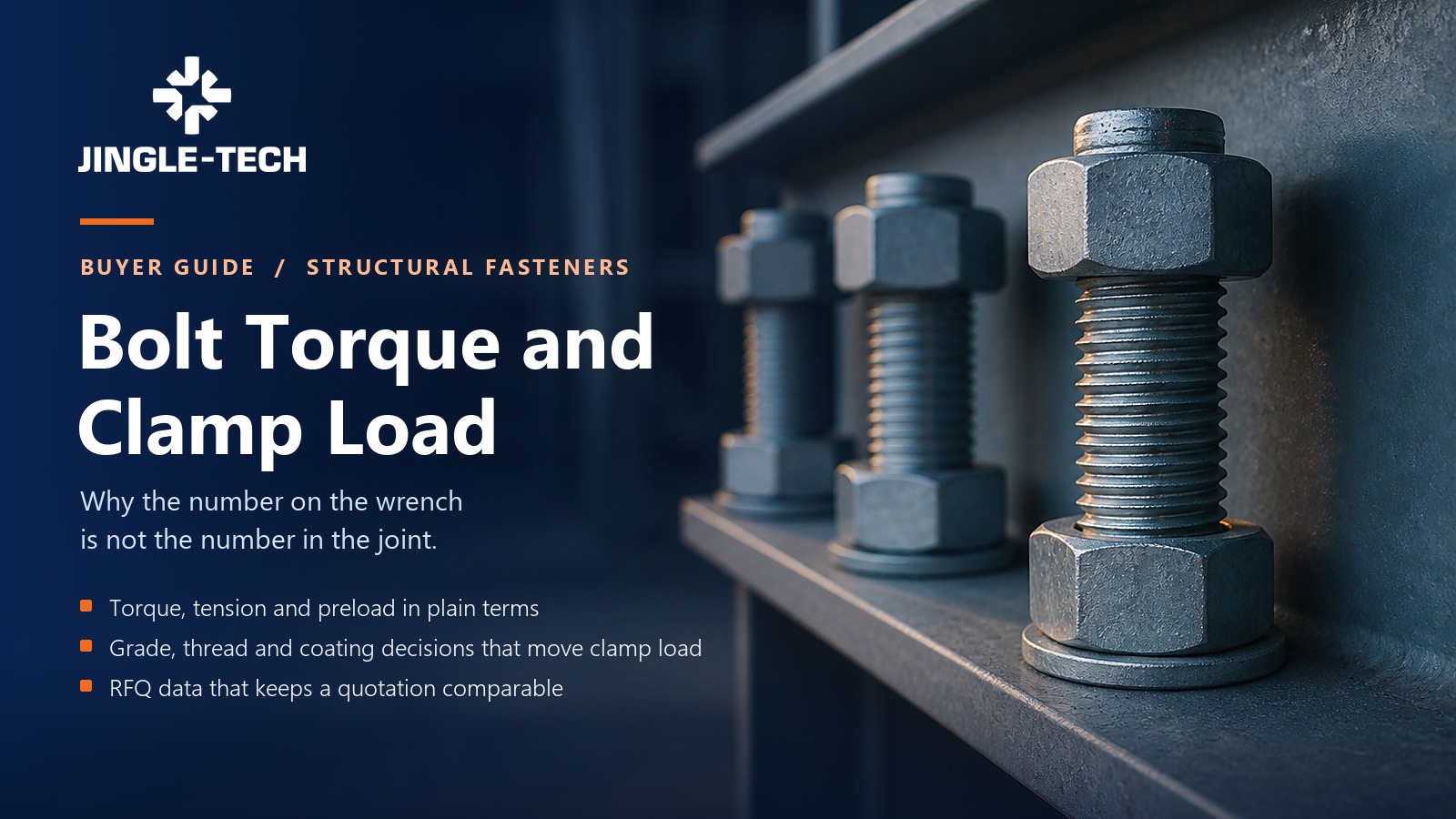
Bolt Torque and Clamp Load: What Buyers Must Specify Before Sign-Off
Two bolts leave the same factory. Same drawing. Same wrench. Same 210 N·m. One joint holds for years. The other comes loose on the first shift.
Nothing in the paperwork explains that. The paperwork recorded an input. It never recorded what the joint actually got.
Torque is what the wrench delivers. Clamp load is what the joint receives. Friction sits between the two, and friction is the one variable almost nobody writes down.
So this guide to bolt torque and clamp load stays on what you can control as a buyer. What torque can and cannot tell you. Which details move clamp load. How the tightening methods differ in what they prove. And what belongs in an RFQ so two quotations can be compared without guessing.
One sentence, if you remember nothing else: a torque value without a friction condition is a number without a meaning.
Your wrench measures friction, not force
A torque wrench measures resistance. That's the whole job. It knows how hard it was to keep turning the nut. It has no idea what the plates got.
What the plates get is stretch. The bolt grows a few hundredths of a millimetre. It acts like a very stiff spring and pulls the joint closed. That force is clamp load.
The link between the two is a short formula. T = K × F × d. Torque equals the coefficient, times preload, times nominal diameter. K bundles every friction effect into one dimensionless number, which is why it carries so much weight and so little trust.
Take a 50 mm bolt asked to carry 100 kN. K of 0.20 says roughly 1,000 N·m. K of 0.14 says 700 N·m for the identical joint. Same bolt. Same target. Thirty percent less work at the wrench.
Nothing about the steel changed. Only the surfaces did.
That is the entire problem, and it fits in one line of arithmetic. If you want the small-fastener version of the same argument, our note on why torque matters when installing screws covers it from the assembly side.
Where the effort actually goes
In a dry steel joint, roughly a tenth of the applied torque becomes clamp load. The rest goes into friction. Under the nut face. Along the threads. That split shows up again and again in bolting literature, and it explains why small surface changes produce large preload changes.
| Path | Share of applied torque (dry steel, typical) | What controls it |
|---|---|---|
| Under-head / nut-face friction | ≈ 50% | Washer hardness and flatness, bearing area, coating, burrs |
| Thread friction | ≈ 40% | Thread condition, plating thickness, lubricant, fit class |
| Useful work (bolt stretch) | ≈ 10% | Grip length, shank diameter, modulus |
Those proportions explain most field surprises. A washer change moves the bearing term. A coating change moves both terms at once. Neither difference appears on a dimensional inspection report.
Which means a dry zinc-plated nut and a waxed zinc-flake nut are not interchangeable at 210 N·m. They can both pass dimensional inspection and still produce joints that behave nothing alike.
K is a number you inherit, not a number you look up
Nobody measures the torque coefficient for a routine order. They inherit it. From a coating data sheet. From a previous project. From a table someone emailed around in 2019.
Measuring it properly is described in ISO 16047. Production bolt, production nut, production washer, a calibrated torque-tension rig, and a plot of torque against preload across a run of assemblies. That last part is the part people skip. One assembly proves nothing, because the spread between assemblies is the whole point.
A quotation that carries a K value should also carry three details: the test standard, the assembly tested, and the date. Without them, the number is an average of somebody else's parts.
Ranges you'll meet in practice, all approximate, all dependent on the exact finish and lubricant:
- Plain or lightly oiled steel, as-received: around 0.18 to 0.22
- Zinc electroplated with wax or dry-film lubricant: around 0.14 to 0.18
- Zinc-flake with built-in lubricant: around 0.12 to 0.16
- Hot-dip galvanized, as-coated, nothing added: often above 0.22, sometimes above 0.30
- Stainless without anti-galling lubricant: high, erratic, and prone to seizure
Treat those ranges as orientation, not as acceptance criteria. ISO 16047 exists to replace an inherited average with a measured coefficient for the exact bolt, nut, washer, coating and lubricant being supplied. That measurement is what a purchase order should reference.
Grade sets the ceiling. The wrench just chases it
Before friction gets a vote, the bolt decides how much preload is even available. Property class under ISO 898-1, or grade under the relevant ASTM specification, fixes tensile strength, yield strength and the proof load your tightening programme should stay under.
| Designation | Nominal tensile strength | Typical use | Buyer caution |
|---|---|---|---|
| Class 4.8 / 5.8 | 400 / 500 MPa | Light structural, furniture, general assembly | Low preload; not a substitute for 8.8 in a loaded joint |
| Class 8.8 | 800 MPa | Machinery, general structural steelwork | Most common class; confirm it's quenched and tempered, not just marked |
| Class 10.9 | 1,000 MPa | High-load machinery, automotive, structural | Hydrogen embrittlement risk after electroplating |
| Class 12.9 | 1,220 MPa | Compact high-strength joints | Very sensitive to coating process and thread damage |
| ASTM F3125 Gr. A325 / A490 | 825 / 1,035 MPa minimum | Structural steel connections in North America | Both were folded into F3125; older drawings still use the old names |
| EN 14399-3 / -4 (HR, HV) | System-specific | European structural bolting assemblies | Supplied as a matched assembly; don't mix components between systems |
Two things follow from that table. First, target preload usually gets written as a share of proof load or minimum tensile strength. Seventy percent of minimum tensile strength is a common convention for preloaded structural joints, and the governing specification always beats the convention. Second, the nut and washer have to keep up.
A class 10.9 bolt under a class 8 nut is an expensive way to build a weak joint. A washer that dishes under load changes the friction the whole calculation depends on.
Which is why we push nut and washer specification into the same conversation as the bolt. A custom nut manufacturer can match property class, thread tolerance and bearing surface, but only when the buyer describes the joint instead of the part number.
Threads, burrs and the washers nobody checks
Incoming inspection usually stops at "goes on by hand". That check tells you nothing about friction at 200 N·m. Three things matter more.
Thread fit and coating build-up. A 6g/6H fit is designed with clearance. Electroplating adds a few micrometres. Hot-dip galvanizing adds a lot more, which is why galvanized fasteners normally ship with overtapped nuts and, in some standards, slightly reduced bolt threads so the assembly can still be turned. Specify "M20 hot-dip galvanized" without stating that the nut is overtapped to the matching standard and the first assembly attempt may not thread at all.
Debris and handling damage. One grit particle in the thread can double local friction at that spot and eat torque that was meant for clamp load. Threads that were blasted and never re-cleaned are a regular culprit on galvanized lots.
Bearing surface. The nut or washer bears on the plate. A punched hole with a raised burr, a painted faying surface, or a washer softer than specified changes under-head friction and the embedment that follows.
Embedment deserves its own line. A few hundredths of a millimetre of coating crush or surface smoothing removes a real share of preload in the hours after tightening. The joint was right at 9 a.m. By 4 p.m. it isn't.
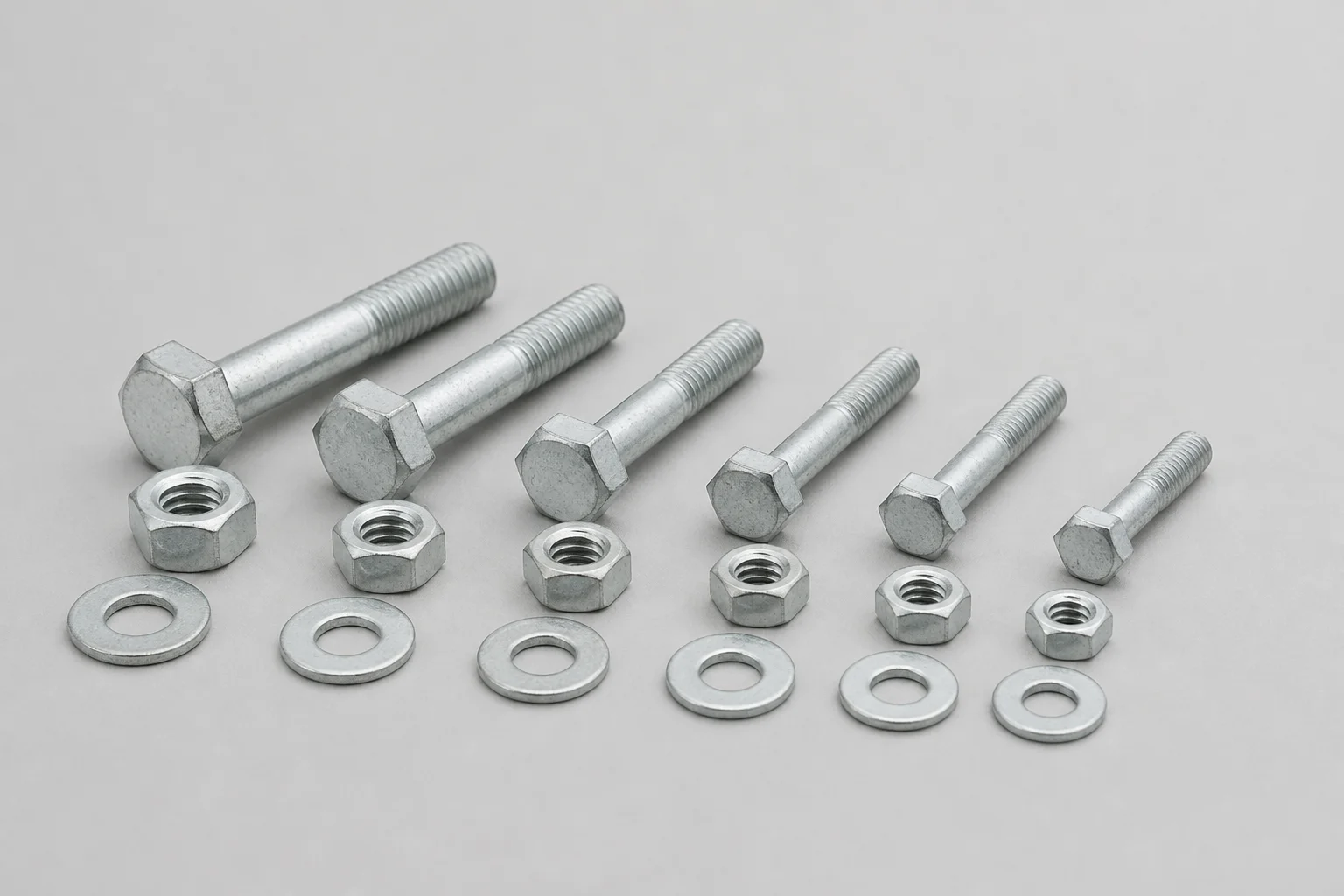
A matched set is a system, not three parts. Bolt class, nut property class, washer hardness and coating all feed the torque value.
Coatings change two things at once
Coatings get chosen for corrosion resistance, then quietly rewrite the tightening behaviour. You end up managing both effects with one decision, which is why a coating choice is a bolt torque and clamp load decision, not only a corrosion one.
Hot-dip galvanizing per ISO 10684 or ASTM F2329 gives you a thick zinc-iron layer and, untreated, a high and jumpy friction coefficient. Some suppliers add a lubricant or a passivation to settle it down. That's a legitimate engineering choice. It also moves the torque coefficient, so the number on the drawing has to move with it.
A drawing that says "hot-dip galvanized, torque 400 N·m" and stops there has left the most important variable open. We went through the coating side separately in hot-dip galvanized fasteners, because the corrosion argument and the friction argument usually happen in different meetings with different people.
Zinc-flake sits at the other end. Thin, lubricant-bearing, usually lower and more repeatable friction. Good answer for class 10.9 and 12.9 parts where hot-dip thickness and heat are a problem, and where hydrogen embrittlement from electroplating is a worry. If a high-strength part gets electroplated anyway, the baking and embrittlement controls in the relevant standard become part of the purchase. Not an afterthought.
Then there's fit. Any coating that adds thickness eats thread clearance and shrinks the effective minor diameter of a nut. Buyers who switch coating to answer a rust complaint, without reopening the thread tolerance question, sometimes trade a corrosion problem for a stopped assembly line. It's a familiar sequence and one RFQ line prevents it.
Five ways to tighten, five different proofs
Torque control is popular because it's cheap and portable. It's also the least accurate of the common methods. Scatter above 25 percent of target preload is routine on dry, as-received assemblies. That isn't a reason to drop it. It's a reason to know what it supports.
| Method | How it works | What it proves | Where it fits |
|---|---|---|---|
| Torque control | Wrench stops at a set torque | Applied effort, within friction scatter | General assembly, small bolts, volume production |
| Turn-of-nut | Snug, then a set rotation | Stretch, largely independent of friction | Structural steelwork under RCSC-type rules |
| Direct tension indicator | Compressible washer, measured gap | Whether a minimum tension was reached | Site work where inspection is visual and fast |
| Tension-control bolt | Splined end shears at set tension | Installation completed to the assembly design | High-volume structural connections |
| Hydraulic tensioning | Bolt pulled directly, nut seated by hand | Preload, measured at the source | Large studs, confined joints, critical sealing |
The split is clean in one respect. Turn-of-nut, DTI, tension-control and hydraulic tensioning all terminate on tension. Torque control terminates on effort. Only the tension methods can be verified after installation without instrumenting the bolt.
A specification that asks for both a torque value and a verified preload is describing two separate clauses: an installation instruction and an acceptance test. RCSC-style bolting specifications already separate them. Merged clauses produce a known failure mode, where the supplier meets the instruction, the site fails the test, and neither party owns the outcome.
For imported structural bolts this matters commercially. A structural bolt manufacturer can supply F3125 or EN 14399 assemblies with the right mark, coating and test record. The tightening method belongs to the project's bolting specification. Blur the two in a PO and you've built a dispute.
Anchors don't work like bolts
Anchors borrow the same words and mean something slightly different by them. Set torque on a wedge anchor isn't a preload target in the structural sense. It's the force that drags the expansion clip into the cone and seats the anchor against the hole wall.
The capacity comes from the concrete, the embedment and the expansion mechanism. Not from how hard the installer leaned on the wrench.
Three consequences follow.
Over-torque breaks the mechanism. Past the specified value, the clip cuts into the concrete, the stud yields, or the surface spalls. The joint looks tight and holds less.
Under-torque leaves it unseated. The clip never fully engages. The anchor creeps under load. The failure shows up months later, during a proof test or a windy night.
The hole is part of the fastener. Drill diameter, depth, cleaning and edge distance decide whether you can reach the specified torque at all. Dust left in the hole is one of the most common reasons a properly installed anchor reads loose.
Cracked concrete changes the qualification route, not just the torque. In North America, ACI 355.2 defines what testing an anchor needs before it can be offered for a given condition. In Europe the ETA route under the relevant assessment document does the same job. So when you compare quotes from a concrete anchor manufacturer, ask which qualification covers the exact product and diameter. Not whether the supplier "has anchors tested". The selection logic itself — base material, load case, edge distance — is set out in our concrete anchor manufacturer guide.

On site the wrench reads torque. The joint needs tension. Turn-of-nut, DTI and tension-control assemblies exist because that gap is expensive to inspect afterwards.
Clamps, sockets and lifting gear
Not every tightening instruction is a preload calculation. Mixing the two is a reliable way to write a wrong specification.
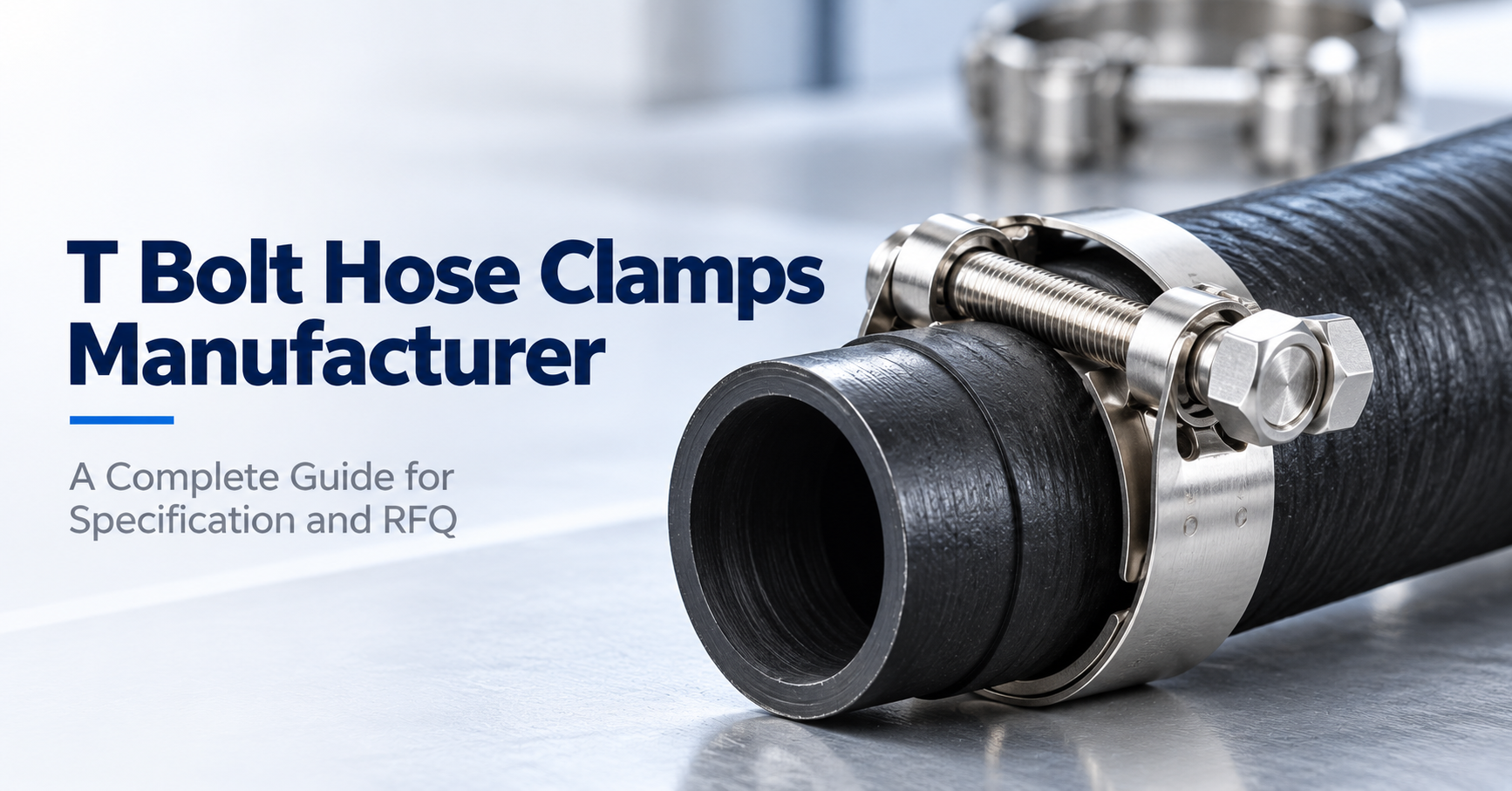
Hose clamps. What matters is band tension, expressed as a tightening torque range. Too little and the joint weeps under pressure or vibration. Too much and the band yields, the housing distorts, or a soft hose gets cut. A hose clamp manufacturer should be able to state a recommended installation torque for the specific band width, screw type and housing, because a 9 mm worm-drive clamp and a T-bolt clamp don't share a figure. Application first — coolant, fuel, air intake, industrial fluid line — then band style, then torque.
Threaded sockets. In precast work, a lifting socket or fixing socket goes into the concrete and later receives a bolt or a clutch. What matters is thread condition before casting, seating of the anchor end, and protecting the thread through casting and stripping. Torque at the point of use is usually modest. The failure that bites is a thread full of laitance, and no torque value fixes that.
Lifting systems. Here the vocabulary needs care, because this is safety equipment. A lifting anchor manufacturer works with working load limits, load groups, concrete strength at lift, embedment, edge distance, lifting angle and clutch compatibility. None of those is a torque figure, and none can be inferred from a neighbouring product. Swapping one supplier's anchor for another's because the thread looks the same is a decision that shouldn't happen at the loading bay.
Machined interfaces. When a joint depends on a machined shoulder, a spigot or a clamp collar, torque usually exists to seat the interface, not to stretch a fastener. Flatness, perpendicularity and finish carry the load path. That's the territory of a precast concrete machining parts manufacturer or a general CNC shop, and the drawing needs the datum and the seating condition, not just the thread callout.
The records that settle arguments later
Most torque disputes are documentary rather than technical. A preload was promised, the friction condition was never recorded, and by the time the joint misbehaves the shipment is installed. Six records close most of that gap.
- Material and property class certificate tied to the actual lot, not to a product family.
- Coating specification and thickness, with the standard named and the lubricant condition stated.
- Torque coefficient or torque-tension data where the joint is critical, including the test standard and the assembly tested.
- Thread inspection results — gauge type, fit, and whether overtapping was applied for a thick coating.
- Mechanical results where the grade demands them: proof load, tensile, hardness, and the wedge test for structural bolts.
- Tool calibration on site, usually the project's job, but worth writing down before anyone needs it.
The list is not an argument for demanding everything on every order. Evidence should match the cost of failure: a furniture screw kit and a bridge connection do not carry the same documentation burden. Over-specifying has its own cost, because suppliers price the paperwork whether or not anyone reads it.
One page that survives a supplier switch
If you build one thing for a repeat programme, build a joint data sheet. One page. The first supplier fills it in during quotation. The second supplier quotes against the same page. Purchasing stops renegotiating physics every time a source changes.
| Field | What to record | Why it matters |
|---|---|---|
| Joint function | Sealing, structural, locating, safety-critical | Sets the evidence level and the safety factor expectation |
| Fastener and mating parts | Bolt class, nut property class, washer type and hardness | Preload capability is a system property, not a bolt property |
| Grip and engagement | Clamped thickness, thread engagement in the nut | Short engagement moves failure from the shank into the threads |
| Target preload | kN, plus the basis (percentage of proof load and the standard) | Makes the intent explicit instead of implied |
| Friction condition | Coating, lubricant, washer finish, as-received or cleaned | Drives the coefficient, and therefore the torque value |
| Tightening method | Torque, turn-of-nut, DTI, tension-control, tensioning | Determines what the operator does and what inspection checks |
| Acceptance evidence | Which tests, sampling plan, who signs | Prevents a late argument about scope |
| Service environment | Indoor, coastal, chemical, temperature range | Coating selection and any galvanic couple risk |
Nothing in that table is confidential. It's what a competent buyer already knows, written down once so the next quote, the next audit and the next complaint start from the same baseline.
Failures you'll recognize
Field failures repeat. Spotting the pattern early usually saves a containment exercise.
Loose with no torque complaint. Tightened to spec, still came loose. Usually one of three things: preload was short because friction ran higher than assumed, embedment ate it after assembly, or a compliant gasket relaxed. The fix is rarely "tighter". It's a different target, a harder washer, or a locking feature.
Threads strip before the bolt breaks. The nut was softer than the bolt, or engagement was too short. A custom nut manufacturer can match property class, but the order has to state the bolt class and the engagement length.
Stainless seizes at assembly. Galling, stainless on stainless. Anti-seize, a different grade pair, or a coated nut sorts it. More torque makes it worse.
Coating damaged under the head. Washer too hard, or no washer where the drawing assumed one. Corrosion starts exactly where the coating was cut.
Cracks around an anchor. Over-torqued setting, hole too close to an edge, or a hammer-drilled hole in young concrete. The anchor gets blamed and usually isn't at fault.
What to actually put in the RFQ
State the joint, not the part. Give the supplier the clamped thickness. The target preload, or the torque plus its friction condition. The mating nut and washer. The coating with its standard. The tightening method. The service environment. The evidence you expect to receive.
A good custom fastener manufacturer will use those details to propose a class, a coating system and a process route. Without them, every quote is a guess wearing a price, and the cheapest guess wins. That's the wrong outcome for everyone except the person who booked the saving.
Same logic runs across categories. A custom screw manufacturer needs the substrate and the drive style, not just the dimensions. An OEM fastener and machined parts supplier running a whole programme benefits from one joint data sheet per assembly instead of one drawing per part. And a precast concrete accessories order needs the casting sequence, because the anchor that works in a precast bed can fail in a tilt-up panel. The anchor didn't change. The joint did.
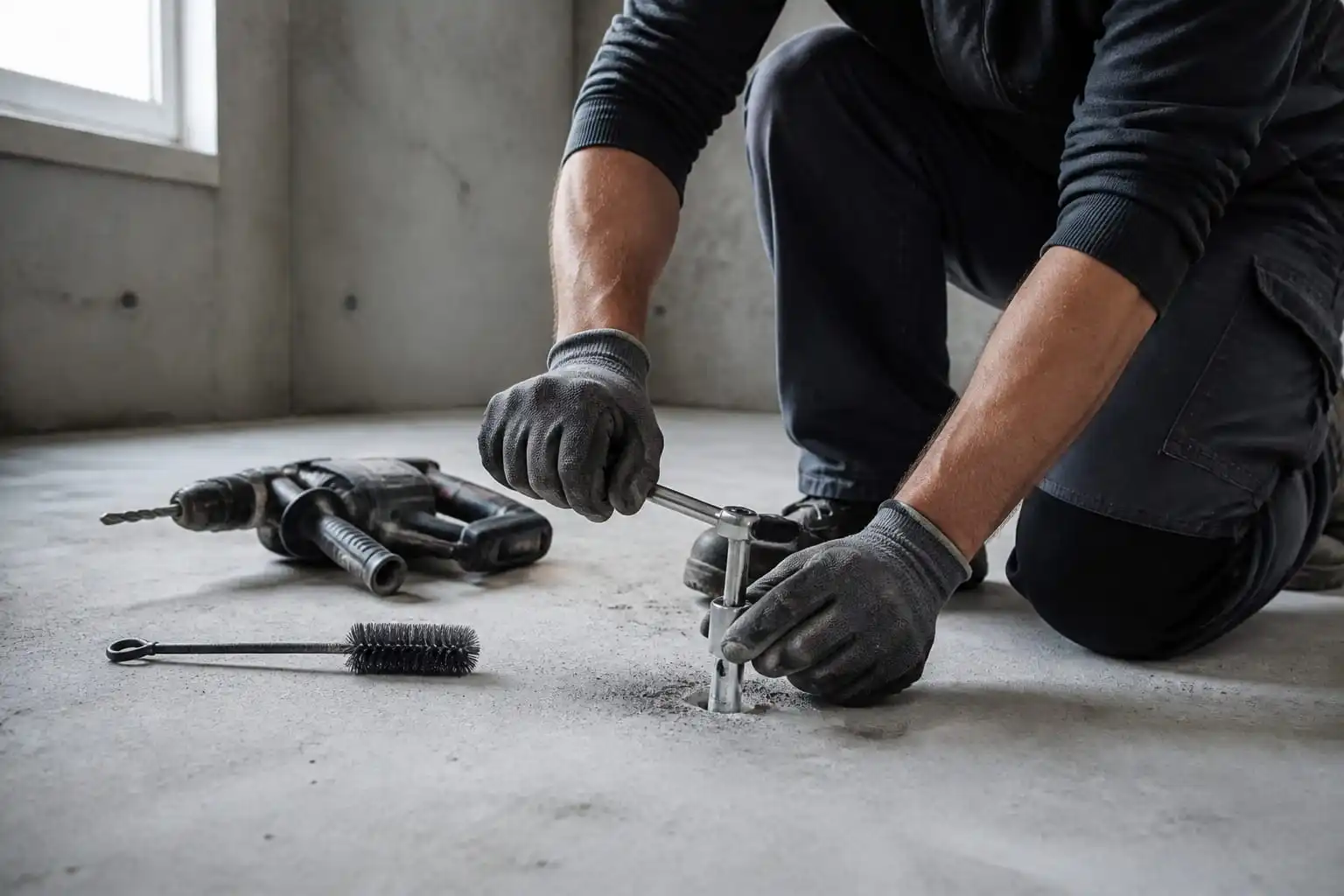
Setting torque seats the mechanism. It doesn't create capacity. Hole cleaning, embedment and edge distance decide what the anchor can carry.
Questions buyers actually ask
Can I use one torque table for every bolt of the same size?
No. Size and class set the ceiling. Friction sets what a given torque delivers. Two M16 class 8.8 bolts with different coatings can differ by 30 percent or more in clamp load at the same setting. Use a table to start the conversation, then confirm on the real assembly.
Is a calibrated torque wrench enough to guarantee the joint?
It guarantees the wrench. Not the joint. Calibration removes tool error. It doesn't remove friction scatter, embedment or thread condition. On a critical joint, pair torque control with a verification method or move to a tension-based method.
How accurate is torque control in practice?
Scatter of 25 percent or more in preload is normal for dry, as-received assemblies. Wider when coatings and lubricants vary between lots. Lubricated, controlled assemblies do better. Any spec that assumes five percent accuracy from a torque wrench is describing a different instrument.
Why does the same torque behave differently after a coating change?
Because the coating changed both friction interfaces. A thicker or drier coating raises the coefficient, so the same wrench setting delivers less clamp load. When the coating changes, the torque value has to be re-established. It can't be inherited.
Should the nut be a different class from the bolt?
Usually matched, or deliberately overmatched, so the bolt fails in tension rather than the thread stripping. The exact pairing depends on the standard and the engagement length. State both and let the supplier confirm, instead of assuming an off-the-shelf nut is fine.
Do galvanized bolts need a different torque?
Almost always. Untreated hot-dip raises friction a lot, and the overtapped nut changes thread contact. Some suppliers add a lubricant to stabilise the coefficient. That decision changes the torque value, so it belongs on the order.
What torque goes on a wedge anchor?
Whatever is published for that anchor, diameter and base material — as an installation instruction. It isn't a way to increase capacity. Exceeding it can damage the expansion mechanism or the concrete around the hole.
Can a supplier provide the torque value?
A supplier can give you test data, a coating spec and a recommended installation torque for a defined assembly. The final tightening spec belongs to the joint designer, because it depends on the plates, the gasket, the service load and the safety factor. Good suppliers say that out loud instead of inventing a number.
What line is most often missing from an existing drawing?
The friction condition. Coating standard, lubricant, washer type, and whether parts are used as-received or cleaned. One line. It explains more field failures than any other missing note.
Torque is a means. Clamp load is the requirement
Bolt torque and clamp load are two different promises on the same drawing. One is an input someone records. The other is what the structure actually relies on.
Fastener buying spends most of its attention on what can be measured at the border. Dimensions. Grade marks. Coating thickness. Certificate numbers. All of it matters.
But what the customer actually buys is a joint that stays tight. That property comes from a preload nobody inspects and a friction condition nobody specifies.
Three artefacts fix most of it: a one-page joint data sheet, a coating line that states the lubricant condition, and a torque figure with a test reference behind it. Once they exist, quotations become comparable, incoming inspection shortens, and a source change stops resetting the physics of the joint.
JingleFix supplies fasteners, precast accessories and machined parts out of Ningbo, with drawing-based and sample-based customization and inspection documentation agreed per order. Twelve years of export experience, and a habit of asking what the joint is for before quoting a price.
If you have a joint that keeps causing trouble, send the details. Clamped thickness, target preload, coating, environment. We'll tell you what's missing before anyone quotes.
Get a quotation you can actually compare
Send your drawing, joint details and target quantity. We reply with material, grade, coating options and the evidence we can provide for that specific part.
Send Your Inquiry Now →Or email sales@jinglefix.com · WhatsApp +86 13958236696