Quick answer for buyers

Start the supplier check from the wall panel section, not from the anchor photo. Before price comparison, write down whether the panel is non-composite, partly composite or fully composite, the insulation thickness, the two wythe thicknesses, the movement expected between layers, and the supplier data the engineer wants to review.
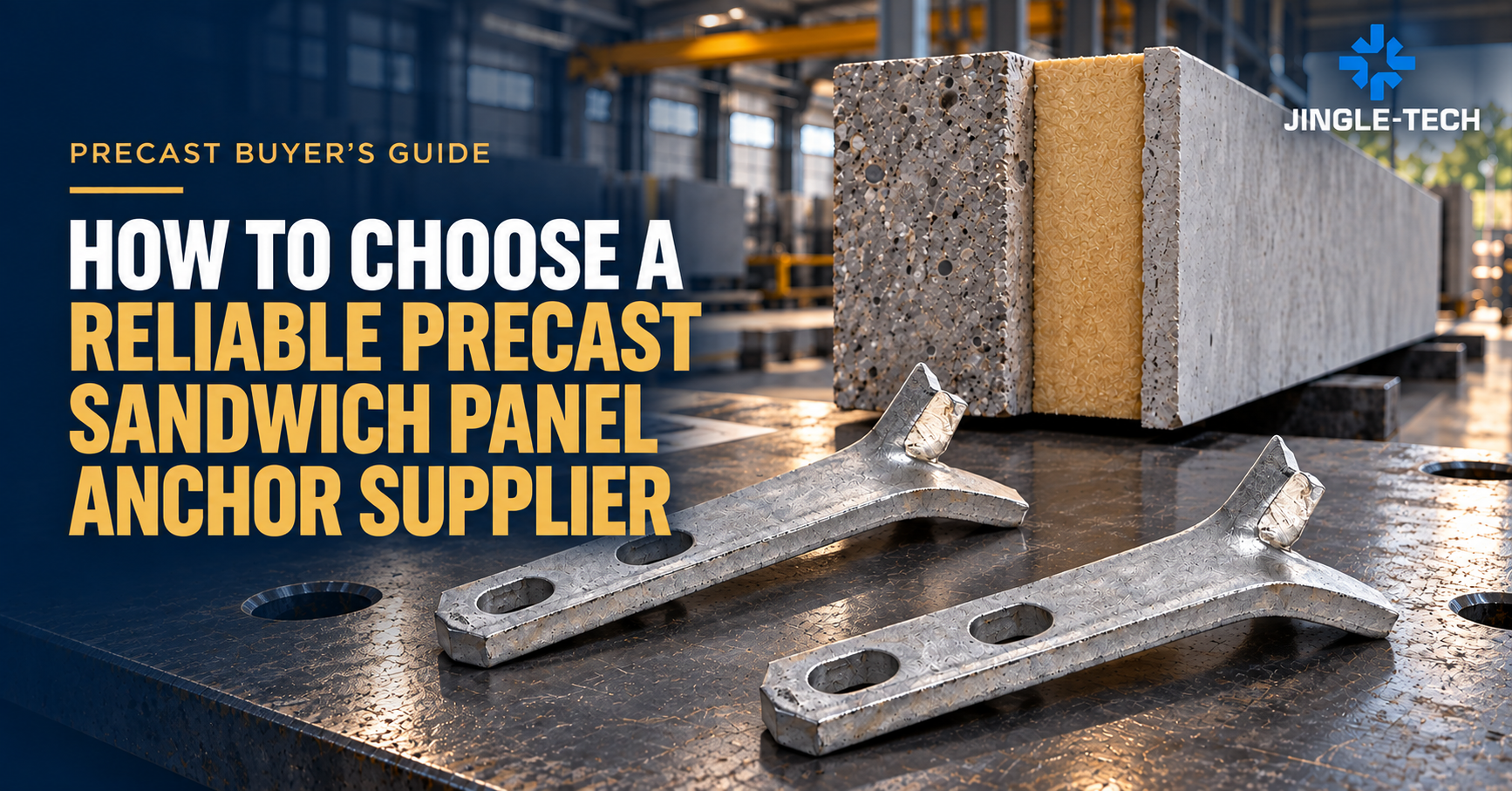
For JINGLE Precast Accessories, avoid approving a precast sandwich panel anchor from a small catalogue image. Send the wall section, inner wythe, outer wythe, insulation type, insulation thickness, anchor layout, expected composite behaviour, any fire or thermal notes, sample request, packing rule and document list. Any missing value should stay visible as [NEEDS JINGLE CONFIRMATION].
Why sandwich panel anchors are not ordinary spacers
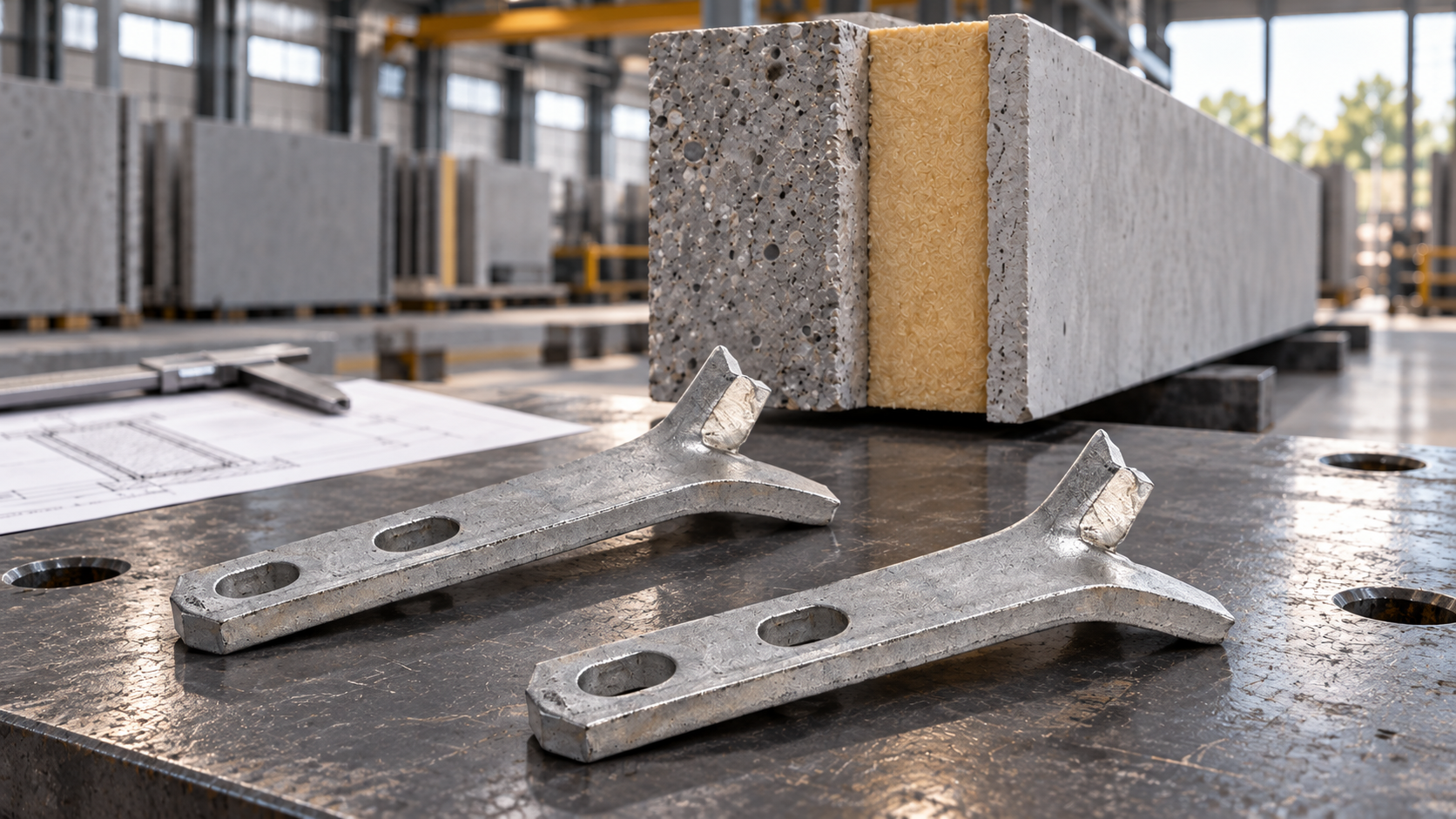
In a typical sandwich wall panel, insulation sits between two concrete layers. The anchor may be small, but it can affect heat flow, shear transfer, handling behaviour, panel bowing, casting speed and service life.
That makes it a project part, not a random plastic clip or steel tie. A cheap anchor becomes costly when it bridges heat, misses the insulation thickness, moves during casting, tears insulation, or comes with vague composite-action information.
Start with a plain shop-floor question: what job must this precast sandwich panel anchor do in this exact panel?
Confirm the panel type before asking for price
Before the RFQ, define the sandwich panel type. In buyer language, people may say “sandwich panel anchor,” “wythe anchor,” “Sandwich Panel Anchor” or “insulation anchor” for related parts. The supplier needs more detail.
Ask the design or project team:
- Is the panel non-composite, partially composite or fully composite?
- Is the anchor mainly for wythe restraint, shear transfer, lifting-stage support or production alignment?
- What insulation type and thickness are used?
- What is the inner wythe thickness?
- What is the outer wythe thickness?
- Is it a load-bearing wall panel or a cladding panel?
- Is it prestressed, conventionally reinforced, or built another way?
- Is the anchor layout already designed?
ANSI/PCI 150 treats composite action and wythe anchor information as part of insulated wall panel design. For purchasing, the lesson is practical: the anchor quote should match the design assumptions, not just the panel name.
Thermal break and material choice
Thermal bridging is one reason buyers look closely at anchor material. Steel anchors, composite anchors, polymer anchors and hybrid anchor systems can behave differently. The correct choice depends on the design, fire requirements, structural demand and supplier data.
Ask the precast sandwich panel anchor supplier to explain:
| Question | Why it matters |
|---|---|
| What material is used? | Affects strength, stiffness, corrosion and thermal bridge |
| What thermal data is available? | Helps the design team judge heat flow |
| What composite-action data is available? | Supports panel design assumptions |
| What insulation thickness is supported? | Prevents wrong anchor length |
| How is the anchor fixed during casting? | Reduces movement in the mould |
| What documents are supplied? | Helps project review and quality records |
Do not let the supplier answer only “thermal break type.” Ask what data is behind that phrase.
Composite action: ask for conditions, not slogans
Supplier brochures may use labels such as “composite,” “semi-composite” or “non-composite.” Treat those words as a starting point only. The project engineer still needs the conditions behind the claim.
Ask:
- What test or evaluation supports the composite-action claim?
- What anchor spacing was used?
- What panel thickness and insulation thickness were tested or evaluated?
- What load direction was considered?
- Does the anchor allow differential movement between wythes?
- What limits apply for handling, service load and temperature movement?
If the supplier cannot explain the conditions, keep the offer open. An anchor used outside its tested or evaluated range may not support the same design assumption.
Insulation thickness and anchor length
Insulation thickness is one of the easiest details to get wrong. The same anchor family may have several lengths. A short anchor may not engage properly. A long anchor may interfere with reinforcement, surface finish or production sequence.
Put these values in the RFQ:
- insulation thickness;
- inner wythe thickness;
- outer wythe thickness;
- total panel thickness;
- anchor embedment requirement;
- expected anchor spacing;
- whether insulation is continuous or cut around the anchor;
- whether installation uses a drilled, pushed, clipped or cast-in method.
If the insulation supplier changes thickness after the anchor order, check the anchor again. Do not assume the same item still works.
Production checks in the precast plant
An anchor that looks correct on the drawing can still cause trouble during production. It may be hard to place, easy to tilt, or sensitive to concrete placement.
Ask the supplier:
- How is the anchor installed in the first wythe?
- Does it need a jig, template or spacer?
- Can workers see whether it is seated correctly?
- How much tolerance is allowed in placement?
- Can concrete flow around the anchor without leaving voids?
- Does the anchor damage or crush the insulation?
- Is there a recommended casting sequence?
These shop-floor details matter. An anchor that saves a few cents but slows the line can cost more than expected.
Sample approval checklist
For a new anchor supplier, ask for a sample set before bulk order. The sample should not be reviewed as a loose object only. It should be checked against the actual panel section.
Use this checklist:
- Compare sample length with insulation and wythe thickness.
- Check material and surface condition.
- Test how it passes through or sits against insulation.
- Check whether workers can install it consistently.
- Confirm that it does not clash with reinforcement.
- Review any installation tool or jig.
- Confirm packing and label format.
- Ask for the document package before approving bulk order.
If possible, make a small mock-up. A mock-up can reveal tilt, spacing, insulation damage and installation time better than a desktop photo.
Documents buyers should request
The document set depends on the project, but a serious Sandwich Panel Anchor manufacturer should be ready to discuss evidence. Ask for:
- product drawing;
- material description;
- supported panel thickness or insulation range;
- installation instructions;
- test or evaluation summary;
- thermal-performance information;
- composite-action information where applicable;
- packing list and label sample;
- inspection method or factory QC checklist.
Do not ask the supplier to invent a design value in email. If the project needs a design value, the design team should review the supplier’s proper data.
Packing and identification
Anchors can be small and similar-looking, especially when several lengths are ordered together. Poor packing can cause wrong anchor placement in the mould.
Specify:
- anchor length or type on every inner bag;
- quantity per bag and carton;
- project code if needed;
- separation by length, material and type;
- carton label with batch reference;
- protection from bending or contamination;
- photos before shipment.
For a precast plant, the best packing is the packing workers can understand quickly while the casting bed is busy.
RFQ checklist
Send this information to the precast sandwich panel anchor supplier:
- product name: Sandwich Panel Anchor / wythe anchor / insulation anchor;
- panel type: non-composite, partially composite or fully composite;
- inner and outer wythe thickness;
- insulation type and thickness;
- total panel thickness;
- anchor spacing or layout;
- expected composite action;
- thermal requirement or design target;
- fire or durability requirement if applicable;
- installation method and casting sequence;
- sample quantity and mock-up needs;
- document request;
- packing and label rule;
- order quantity and delivery destination;
- unknown values marked as
[NEEDS JINGLE CONFIRMATION].
A detailed RFQ makes supplier comparison fair. It also protects the buyer from comparing two anchors that solve different problems.
Supplier comparison table
| Supplier answer | Buyer risk | Better response |
|---|---|---|
| “Universal anchor” | Panel conditions ignored | Ask for supported panel and insulation range |
| “Thermal break type” | No data | Ask for thermal-performance information |
| “Composite action available” | Conditions unclear | Ask for test or evaluation basis |
| “Any spacing is fine” | Design assumption may be wrong | Ask for layout and spacing rules |
| “Packed by carton” | Mixed lengths possible | Require length labels and batch separation |
| “No sample needed” | Production issues hidden | Ask for sample set or mock-up check |
The better supplier gives usable conditions, not only a product name.
When to stop and ask for clarification
Stop the order if:
- panel type is not defined;
- insulation thickness is still changing;
- anchor length is guessed;
- composite action is required but not supported by data;
- thermal performance is important but no information is supplied;
- installation method is unclear;
- several anchor lengths are packed without labels;
- the design team has not reviewed a substitute.
This pause is not wasted time. It prevents the wrong anchor from being cast into a wall panel.
Where JINGLE can help
JINGLE can help buyers organize RFQs for precast Sandwich Panel Anchors and related precast accessories. Send the panel section, insulation thickness, wythe thickness, anchor layout, required documents, sample request and packing rule.
If some values are not ready, JINGLE can keep them visible as [NEEDS JINGLE CONFIRMATION] items so the quotation does not hide missing design information.
FAQ
What is a wythe anchor?
A wythe anchor links the concrete layers, or wythes, in a precast sandwich panel. Depending on design, it may restrain layers, transfer shear, reduce thermal bridging or support production alignment.
Can I choose an anchor only by insulation thickness?
No. Insulation thickness is important, but the buyer also needs wythe thickness, panel type, composite-action target, thermal requirement and installation method.
Are steel anchors and composite anchors interchangeable?
Not automatically. They can differ in stiffness, thermal bridging, durability and design data. Substitution needs project review.
What should I ask a Sandwich Panel Anchor manufacturer first?
Ask what panel types and insulation thicknesses the anchor supports, what design or test data is available, and how the anchor is installed in production.
Do I need samples?
For a new anchor type, new insulation thickness or new supplier, samples are strongly recommended. A small mock-up is even better when production speed or anchor placement is uncertain.