What Should Buyers Check Before Ordering Precast Lifting Anchors?

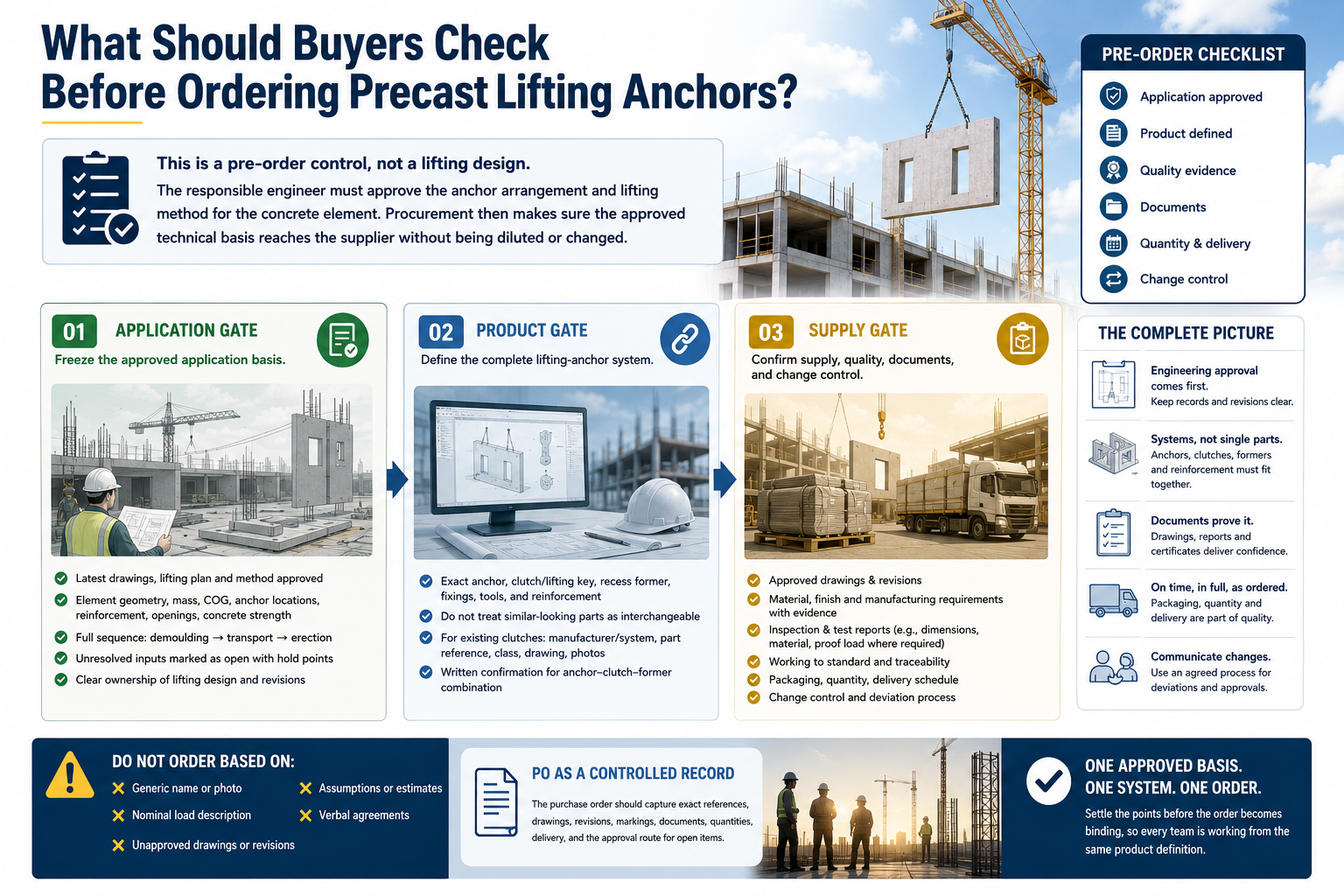
Before ordering precast lifting anchors, confirm that the application is approved, the exact product system is defined, and the supplier’s quality and delivery evidence matches the purchase order. Do not release an order based only on a generic name, photograph, or nominal load description. Record exact references, drawing revisions, matching accessories, markings, documents, quantities, and the approval route for open items.
This is a pre-order control, not a lifting design. The responsible engineer must approve the anchor arrangement and lifting method for the concrete element. Procurement then makes sure the approved technical basis reaches the supplier without being diluted or changed.
Treat the purchase order as a controlled record
A line such as “precast lifting anchor, heavy duty, 500 pieces” can start a conversation, but it cannot govern manufacture. It leaves the anchor family, lifting device, drawing revision, markings, records, and deviation process unresolved.
Settle those points before the order becomes binding, or each team may be working from a different product definition.
A useful way to organise the review is to use three approval gates:
- Application gate: the element and handling assumptions are recorded and engineering approval is in place.
- Product gate: the anchor, accessories, drawings, and product interfaces are unambiguous.
- Supply gate: quality evidence, documents, packaging, quantity, timing, and change control are agreed.
Gate 1: freeze the approved application basis
Start with the latest element drawing and lifting plan. Record its geometry, mass, centre of gravity where established, anchor locations, lifting points, reinforcement, edges, openings, and concrete strength at each stage. Show the full sequence from demoulding through transport and erection.
Mark unresolved inputs as open; do not turn an estimate into an approved value. Either wait for the engineer’s decision or add a hold point that prevents manufacture.
Confirm who owns the lifting design. Supplier support does not silently transfer project responsibility. Keep the approved design, method statement, and product selection under clear revisions.
For buyers who are still at the selection stage, JINGLE’s guide on how to choose a lifting anchor for precast concrete explains the application inputs that come before this pre-order check.
Gate 2: define the complete lifting-anchor system
An embedded anchor rarely stands alone. Name the exact references for its clutch or lifting key, recess former, fixing accessories, installation tools, and additional reinforcement where required.
Do not treat similar-looking parts as interchangeable. For existing clutches, provide the manufacturer or system, part reference, marked class, drawing, and photographs. Require written confirmation for the proposed anchor and former combination.
PFEIFER’s lifting-anchor systems overview presents separate system families and their related components. The Halfen DEHA KKT page from Leviat likewise presents a defined anchor-and-clutch system. These official examples support the system approach; they do not approve a mixed-brand combination for a project.
The same discipline applies to JINGLE supply. Use the lifting foot anchor product page as a starting reference, then ask JINGLE to identify the exact matching components and documents for the proposed order.
Approve the product drawing and its revision
The order should point to one governing drawing with a part number, revision, date, units, dimensions, tolerances, marking location, and interface details. If buyer and supplier drawings serve different purposes, state what each controls.
Check every attachment revision. Old drawings survive in email chains, and unlabelled samples create the same problem. Resolve any drawing–sample conflict in a written approval record.
For a custom product, name the person who approves the production drawing and the hold point before tooling, samples, or mass production.
Confirm material, finish, and manufacturing requirements
Use the approved material and surface requirement; do not substitute a broad family name where a grade, condition, or coating specification is required. Ask what evidence is available for the exact offer.
Give finish its own order line. “Galvanized,” “coated,” or “plain” is ambiguous without the governing requirement and inspection basis. Follow the project and operating environment, not a catalogue photograph.
Procurement need not invent manufacturing limits. It should ensure the agreed process and control plan support the approved product, and name any required process records before price and delivery are final.
Decide what markings and traceability the order needs
Define the permanent product marking, label information, lot identification, and language requirements. Clear identification helps prevent similar anchors from being mixed.
Decide whether a packed lot must connect to a production batch, material record, inspection report, or other evidence. Use the same lot reference on the documents and packaging.
Do not request “full traceability” without defining what must be traced and which record proves it.
Agree inspection, testing, and documents before pricing closes
Ask for an order-specific document list. It may cover the approved drawing, project-required certificate or declaration, material evidence, inspections, test or coating records, marking photographs, packing list, and system instructions. The exact list depends on the product and project.
State when each document is due and who reviews it. A certificate that arrives after the anchors are cast into elements may be too late to resolve a discrepancy.
PFEIFER’s WK System planning and installation document addresses planners, plants, and users and connects the system with written handling information. Obtain current instructions for the exact system, not a copied page of unknown revision.
Set the sample or first-article approval route
Define whether a sample is for identification, dimensional inspection, fit, finish, destructive evaluation, or a first-article report. State its revision, checks, quantity, approval authority, and production hold point.
A hand fit may reveal a mismatch. It cannot prove system compatibility or approve a lift design.
If a first article has a deviation, record whether it is temporary, order-specific, or incorporated into a new drawing.
Prevent mixing through packaging and receiving controls
Ask how references, sizes, classes, finishes, and lots will be separated. Define labels, quantity per pack where needed, transport protection, and destination requirements.
Give receiving staff the approved reference, revision, labels, lot information, quantities, and document list. Quarantine conflicting packages instead of comparing parts by eye.
Keep different references separated, retain labels with partial packs, and keep unidentified returns out of approved stock.
Protect repeat orders with change control
“Same as last time” is not a specification. Repeat the approved reference and revision, then check for changes to the supplier, factory, material source, process, tooling, finish, marking, or packaging.
Require review before a supplier change affects the approved definition. The categories and approval authority should match the buyer’s quality system and project.
When engineering issues a new revision, all teams need the same effective date and disposition for old stock.
Pre-order approval matrix
| Approval item | Buyer should provide | Supplier should confirm | Release condition |
|---|---|---|---|
| Application | Approved element and handling information | Inputs used for its product proposal | Responsible engineer’s approval recorded |
| System | Anchor and existing accessory references | Exact proposed anchor, clutch or key, and former | Interfaces confirmed in writing |
| Product drawing | Governing drawing and revision | Production drawing and any declared deviation | One approved definition |
| Material and finish | Project requirement | Exact offered material, finish, and available evidence | No silent substitution |
| Marking and traceability | Required identifiers and record endpoint | Marking layout, lot method, and document links | Receiving check is possible |
| Inspection and documents | Order-specific list and review timing | Available records and submission timing | Open document questions closed |
| Sample or first article | Purpose and acceptance criteria | Quantity, timing, and production hold point | Written approval where required |
| Packaging | Separation, labels, protection, destination needs | Pack method and label example | Mix-up risk addressed |
| Commercial scope | Quantity, destination, delivery terms, required date | Price basis, MOQ, lead time, validity, exclusions | Technical and commercial scope agree |
| Change control | Notification and approval rule | Acceptance of the rule | Repeat-order basis protected |
Warning signs before the order is released
Pause the order if the supplier quotes only against a photograph, describes the item as “universal,” will not name the matching lifting device, or cannot identify the drawing revision. Other warning signs include certificates with no product or lot connection, unexplained material or finish substitutions, a sample produced before requirements were agreed, and a price that excludes documents the project later expects.
Silence is also a warning. When an RFQ contains an unresolved interface or conflicting attachment, a reliable quotation should identify the question or assumption. A fast price built on an unstated guess is not a clean approval.
For a deeper supplier review, use JINGLE’s 12-point lifting-anchor manufacturer checklist and the separate guide to lifting-anchor manufacturer qualification.
Final buyer checklist
- The responsible engineer has approved the application and lifting arrangement.
- The latest element drawing and full handling sequence are recorded.
- The exact anchor system, reference, and marked class are named.
- Matching clutch or lifting key and recess-former references are confirmed.
- One governing product drawing and revision are attached.
- Material, finish, markings, and critical tolerances are defined.
- Required inspection, testing, certificates, and traceability are listed without vague catch-all terms.
- Document submission dates and approval responsibilities are agreed.
- Sample or first-article purpose and hold point are recorded.
- Packaging, labels, lot separation, and receiving checks are defined.
- Quantity, MOQ, price basis, delivery terms, destination, and requested date are aligned.
- Supplier deviations and future changes require the agreed written review.
- Every unresolved item has an owner and a release hold point.
Frequently asked questions
Is nominal load capacity enough to place an order?
No. It does not define the application, anchor family, geometry, clutch interface, recess, load direction, concrete condition, reinforcement, or governing technical documentation.
Should procurement wait for engineering approval?
The order should not release an anchor for manufacture against an unapproved application. If an early commercial step is necessary, use a clearly defined hold point that prevents unauthorised manufacture or use.
Can a buyer approve an alternative from a sample?
A sample can support identification and agreed inspections. It does not by itself establish design suitability, load performance, or compatibility with another manufacturer’s lifting system.
Which certificates should be requested?
Request the documents required for the exact product, project, destination, and quality plan. Ask the supplier what is available, then name the accepted list and submission timing on the order. Do not assume every product includes the same certificate package.
What should be checked on a repeat order?
Confirm the product reference and current drawing revision, then review any change to the supplier, factory, material source, process, tooling, finish, marking, documents, or packaging under the agreed change-control rule.
Who approves the final lifting-anchor selection?
The responsible engineer approves the system for the element and lifting method. The supplier supports the decision with product information, while procurement and quality control the approved commercial and manufacturing definition.
Send JINGLE a controlled pre-order package
To request a review and quotation, contact JINGLE with the approved application information, anchor and accessory references, current drawings, required material and finish, markings, inspection and document list, sample needs, quantity, packaging, destination, delivery terms, and requested date. JINGLE can confirm the offered supply scope and identify items that still need buyer or project approval. Final lifting-system selection and use remain subject to the responsible engineer and the current instructions for the exact products.