Choosing a Precast Lifting Anchor: Seven Checks Before You Request a Quote

A lifting anchor should be chosen as part of a lifting system, not as a loose steel item. Start with the precast element and every planned handling stage. Then check the governing load case, concrete condition at the time of each lift, anchor location, reinforcement and edge geometry, lifting direction, and the exact clutch or lifting key. Only after those points are fixed does it make sense to compare anchor sizes, finishes, documents, and prices.
That order matters. Two anchors can look similar on a quotation and still belong to different systems or suit different load paths. A safe selection has to connect the drawing, the lift plan, the embedded anchor, the recess former, and the reusable lifting device.
Begin with the element, not the catalogue
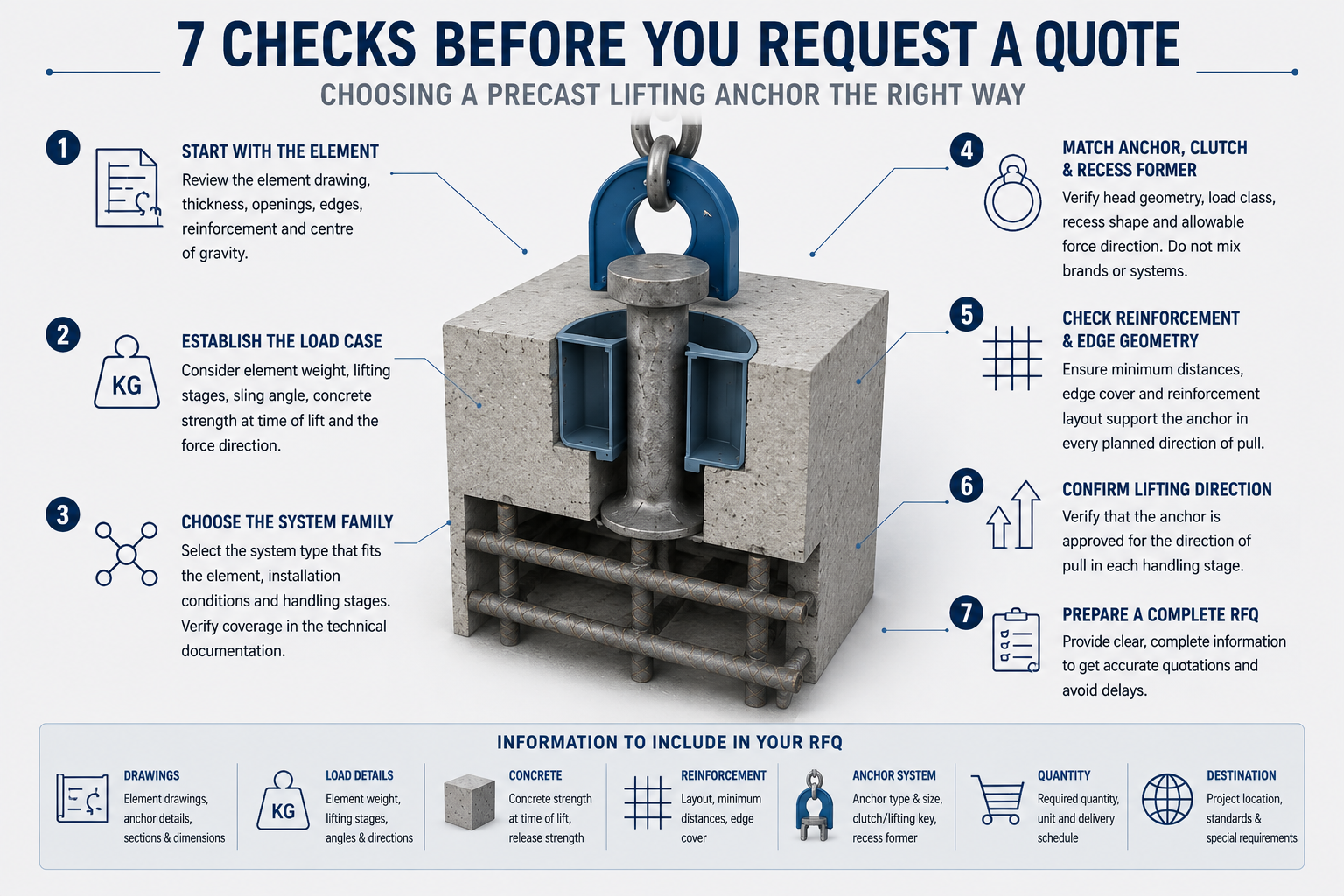
The first useful document is normally the precast element drawing. Put that page in front of the supplier and the project engineer. They can then look at the same thickness, openings, edges, reinforcement zones, and proposed lifting points instead of working from two different descriptions.
Also describe the element in plain language. A thin wall panel, a deep beam, a stair flight, and a compact utility unit do not present the same installation space or handling problem. If the unit has an uneven mass distribution, identify the centre of gravity rather than assuming that geometric centre and mass centre are the same.
Ask one more question before discussing hardware: how will this element move?
- stripping or demoulding;
- rotation from horizontal to vertical;
- yard handling and storage;
- loading and unloading;
- transport-related handling; and
- final erection or positioning.
The most demanding stage may not be the final lift. Form adhesion during demoulding, a tilted pick, or an awkward rotation can govern the selection even when the element weight does not change.
Establish the real load case
Element weight is an input, not the answer. The responsible engineer must assess the complete lifting arrangement for the project. That review can include dynamic effects, adhesion to the form, sling angle, unequal load sharing, centre-of-gravity offset, number of effective lifting points, and the direction of force at each anchor.
Concrete strength at the time of lifting is equally important. The concrete may be much younger during demoulding than it is during final erection. A catalogue value or a familiar anchor size should never replace a check against the supplier's current technical documentation and the approved lifting design.
For the RFQ, provide the known facts and label assumptions. If a lifting angle, release strength, or load-sharing condition has not been confirmed, say so. A visible gap in the information is safer than a confident but unsupported number.
Choose the system family that fits the job
Precast lifting systems solve the connection in different ways. Common families include spherical-head or foot-anchor systems used with a compatible clutch, threaded inserts used with the specified lifting key, and wire-loop systems for applications suited to direct hook or dedicated lifting-device engagement. Each family brings its own formwork arrangement, recess, attachment method, and installation limits.
There is no useful universal ranking. Instead, compare the system family against four practical questions:
- Does it fit the element thickness, edges, openings, and reinforcement layout?
- Can the plant place it consistently in the mould and keep the head or thread protected?
- Can the lifting crew identify and engage the correct device without improvisation?
- Does the technical documentation cover the planned force direction and handling stages?
Established suppliers present lifting anchors as complete systems. For example, PFEIFER's lifting-anchor overview groups anchors with their associated lifting keys and application information. Leviat's Halfen DEHA KKT page likewise describes an anchor-and-clutch system. These links are useful examples of documentation structure, not permission to mix brands or assume interchangeability.
Match the anchor, clutch, and recess former
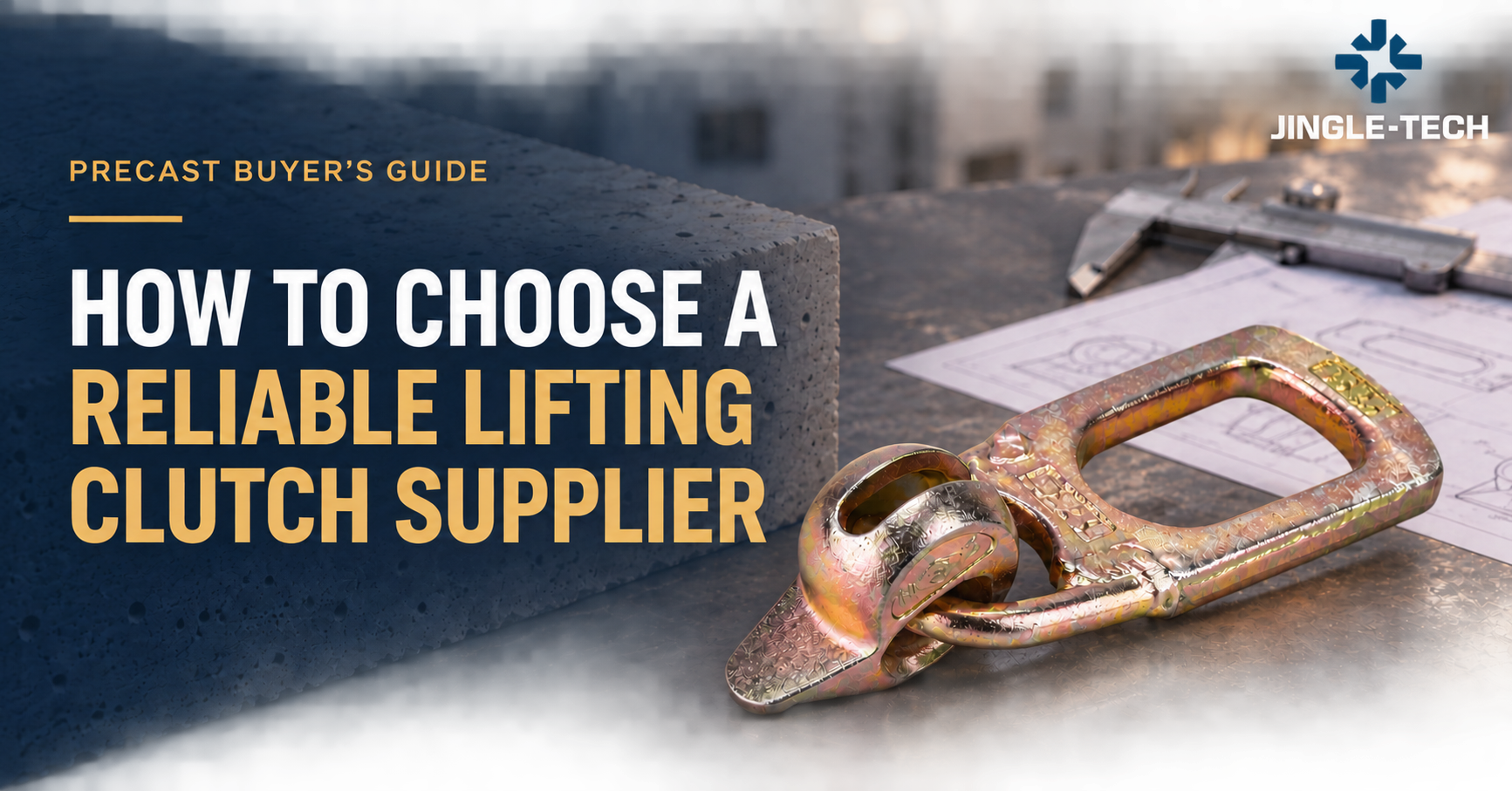
This is where a surprising number of purchasing mistakes begin. A clutch that closes around an anchor is not automatically a verified match. Head geometry, load class, recess shape, dimensions, markings, and allowable force direction all matter. The recess former also controls access and the way the clutch bears around the anchor head.
Treat the embedded anchor, recess former, and reusable lifting device as one controlled set. If a buyer wants an alternative to an existing system, the RFQ should include the current system reference, drawings, critical dimensions, clear photos, and—when practical—a sample for comparison. The alternative should be reviewed and approved before production use.
Never write “compatible with all common systems” into an order unless the scope has actually been verified. A better statement names the exact reference and records who approved the comparison.
See JINGLE's lifting foot anchor product page for the relevant product category, and use the project drawing and system information when requesting a technical review.
Check placement, edge geometry, and reinforcement
The anchor has to transfer force into concrete without colliding with reinforcement or creating an unworkable mould setup. Before approval, the drawing review should cover:
- anchor orientation and embedment position;
- distance to edges, openings, and thin sections;
- local reinforcement and possible congestion;
- recess-former location and removal access;
- concrete cover and surface requirements;
- permitted lifting directions at each handling stage; and
- plant tolerances for holding the anchor in position during casting.
A technically suitable anchor can still become a production problem if the fixture is awkward, the former moves during casting, or the clutch cannot be attached after stripping. Ask the precast plant to review placement as well as the design office.
Compare options with a selection table
| Project condition | What the buyer should send | What must be checked before approval |
|---|---|---|
| Thin wall or panel | Element thickness, edges, openings, reinforcement drawing | Available embedment space, edge behaviour, local reinforcement, lift direction |
| Beam, column, or deep unit | Dimensions, weight, centre of gravity, lifting points | Anchor orientation, load sharing, rotation and yard-handling stages |
| Tilt-up or rotation | Full handling sequence and proposed rigging geometry | Force direction during rotation, effective lifting points, concrete strength at that stage |
| Existing clutch inventory | Clutch reference, markings, drawings, photos, dimensions | Verified system match; do not approve by appearance alone |
| Alternative to an existing anchor | Existing part reference, controlled drawing, sample if available | Critical dimensions, recess geometry, clutch engagement, documentation and approval path |
| Custom anchor request | Revision-controlled drawing, material and finish requirements, quantity | Manufacturability, inspection points, marking, traceability, validation plan |
Ask for evidence that matches the order
A quotation is easier to compare when the evidence scope is defined before prices arrive. Do not ask for a standard paperwork bundle. Start with the exact anchor named on the quotation and ask, item by item, what will be available for that order. Put the agreed list on the purchase specification so it does not disappear between quotation and shipment.
A controlled drawing and readable product mark may be enough for an early comparison. A project can also call for a material record, a dimensional report, or a coating record. If testing, installation instructions, or lot traceability form part of the approval, state when each one has to arrive. The appropriate package depends on the lifting system, market, contract, and project engineer's requirements.
Avoid vague requests such as “all certificates.” They often produce a folder of unrelated documents. Name the product, revision, inspection stage, report language, and whether the documents are needed with the quotation, before production, or with the shipment.
Compare total supply, not just the anchor price
Unit price is only one line. A fair commercial comparison should normalize the complete scope:
- anchor type, dimensions, material, and finish;
- matching recess formers and lifting clutches, if required;
- drawing or sample-development work;
- inspection and documentation;
- marking, packaging, and batch identification;
- sample, pilot, and production quantities;
- quoted lead-time basis and delivery terms; and
- destination market and shipment plan.
An apparently cheaper anchor may create extra cost if the buyer has to replace clutches, change mould tooling, sort unclear markings, repeat trials, or resolve missing documents later. Make those differences visible before comparing totals.
Lifting anchor RFQ checklist
Send one controlled RFQ package rather than a trail of partial emails. Include:
- precast element drawing and revision;
- element type, dimensions, thickness, and weight;
- centre of gravity, if known;
- complete handling sequence;
- proposed lifting points, sling arrangement, and force directions;
- concrete strength at each planned lift, when confirmed;
- reinforcement drawing around the anchor zones;
- preferred anchor-system family or existing system reference;
- clutch and recess-former references, drawings, photos, or samples;
- required material, finish, markings, inspection, and documents;
- sample, pilot, and expected production quantities; and
- destination country and requested commercial terms.
If some engineering inputs are still open, identify them in the RFQ and request a technical review rather than filling the gaps with guesses.
Common purchasing errors
Nominal capacity is only one place a purchase can go wrong. On a real job, the missing detail is often ordinary: the casting-yard lift never made it onto the schedule, or somebody assumed that every lifting point would share the load evenly. Concrete strength at the first lift can be missed as well. A photograph is not proof that one brand's clutch fits another brand's anchor, and the recess former still matters after the anchor itself has been selected.
The quieter problem shows up when quotations are compared. One supplier may have priced bare anchors. Another may have included formers, clutches, inspection paperwork, and export packing. Those totals do not describe the same package. Put each offer beside the RFQ and check it line by line; most of the unexplained price gap will have a name.
Three JINGLE articles take the review a step further:
- What buyers should check before ordering a lifting anchor
- Precast lifting hardware: what plant teams should check
- How to review a lifting ring clutch
The complete product family is on JINGLE's precast accessories page.
Frequently asked questions
Can I choose a lifting anchor from the precast element weight alone?
No. Weight is only one input. The selection also depends on the handling sequence, lifting geometry, effective lifting points, concrete condition, anchor position, edges, reinforcement, and the supplier's documented system limits.
Can an existing lifting clutch be used with a new anchor supplier?
Only after the exact system match has been checked and approved. Similar appearance is not enough. Send the clutch reference, markings, drawings, dimensions, and photos; provide a sample when practical.
Which lifting anchor is best for a thin precast panel?
There is no single answer without the panel drawing and lift plan. Thickness, edges, openings, reinforcement congestion, force direction, concrete strength at lifting, and handling stages all affect the choice.
Should I request samples before a production order?
Samples are useful when fit, system compatibility, markings, dimensions, finish, packaging, or an alternative-to-existing-part comparison must be checked. A sample does not replace project engineering approval or the required product evidence.
What information produces the most accurate quotation?
A revision-controlled element or anchor drawing, the handling sequence, known load-case inputs, the existing system reference, material and finish requirements, evidence scope, quantities, and destination usually remove the most uncertainty.
Send your project details for a controlled review
Before asking for a lifting anchor price, send the drawing and the handling facts behind it. JINGLE can review the requested product category, existing anchor or clutch reference, dimensions, quantity, finish, documentation needs, and destination market, then identify the items that still need project confirmation.
Send your project details to JINGLE and request a factory quotation. Include the current drawing revision and any clutch, recess-former, or sample information available. Compatibility and project suitability should be confirmed before use.