Lifting Anchor Manufacturer Qualification: 7 Gates From RFQ to Repeat Orders

Searching for a lifting anchor manufacturer usually means the buyer has moved beyond basic product education. The team may already understand what a lifting anchor does. What it needs now is confidence that a supplier can manufacture the correct component repeatedly, document it properly, and deliver it without introducing hidden technical or supply-chain risks.
That requires a different evaluation process from comparing catalog pages.
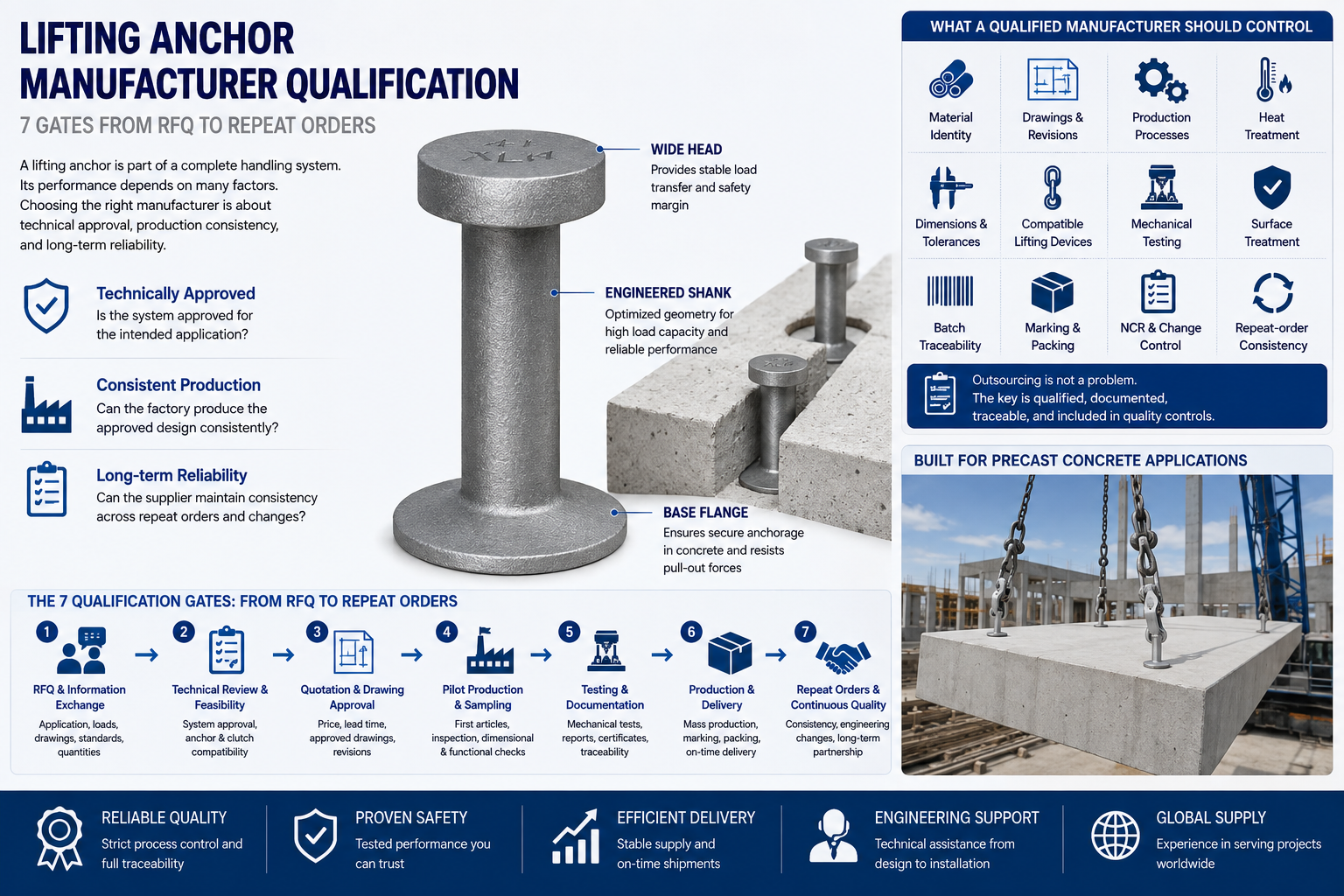
A lifting anchor is part of a complete handling system. Its performance may depend on the concrete element, anchor geometry, embedment, concrete strength, reinforcement, lifting direction, sling arrangement, recess former, clutch, installation method, and lifting sequence.
For this reason, manufacturer qualification should answer three questions:
-
Can the proposed system be technically approved for the intended application?
-
Can the factory produce the approved design consistently?
-
Can the supplier preserve that consistency across repeat orders and engineering changes?
This guide organizes those questions into seven qualification gates, from the first RFQ to recurring production.
Quick Answer: What Should a Lifting Anchor Manufacturer Control?
A qualified lifting anchor manufacturer should be able to demonstrate control over:
-
Application review
-
Product drawings and revisions
-
Material identity
-
Forging, casting, forming, machining, or welding processes
-
Heat treatment where applicable
-
Critical dimensions and tolerances
-
Compatible lifting devices
-
Surface treatment
-
Mechanical testing
-
Product marking
-
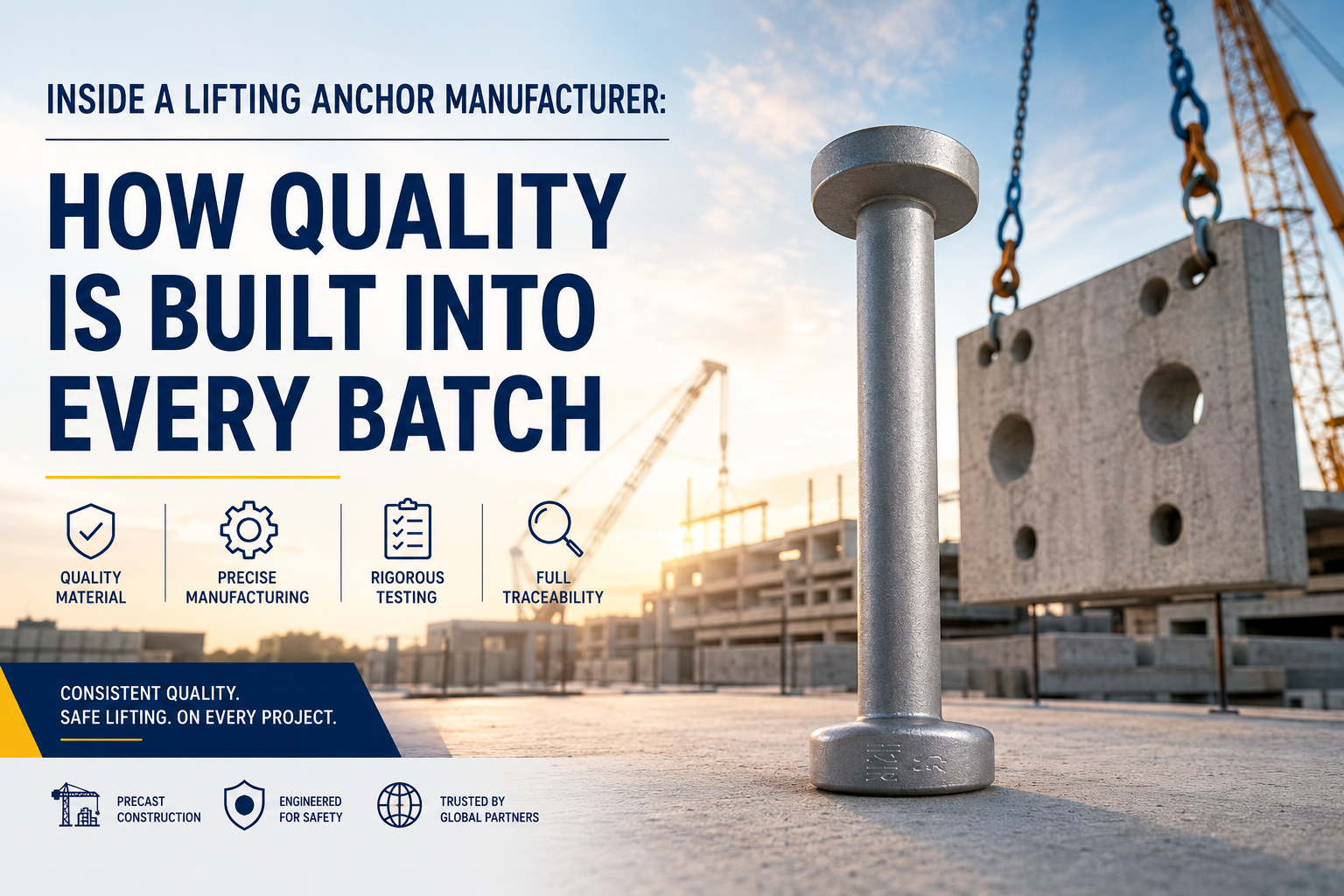
Batch traceability
-
Packaging
-
Nonconforming-product control
-
Engineering changes
-
Repeat-order consistency
Not every factory performs every process internally. Outsourcing is not automatically a problem. The important issue is whether subcontracted processes are qualified, documented, traceable, and included in the manufacturer’s quality controls.
Why “Manufacturer” Search Intent Is Different From Product Search Intent
A buyer searching for a “lifting anchor” may be comparing types, capacities, or applications.
A buyer searching for a “lifting anchor manufacturer” is usually evaluating business and production capability. Typical concerns include:
-
Can this factory work from an approved drawing?
-
Does it understand the anchor and clutch as one system?
-
Can it supply material certificates?
-
Are critical dimensions inspected?
-
Can test reports be linked to the offered product?
-
Are different capacities clearly marked?
-
Can the factory support OEM production?
-
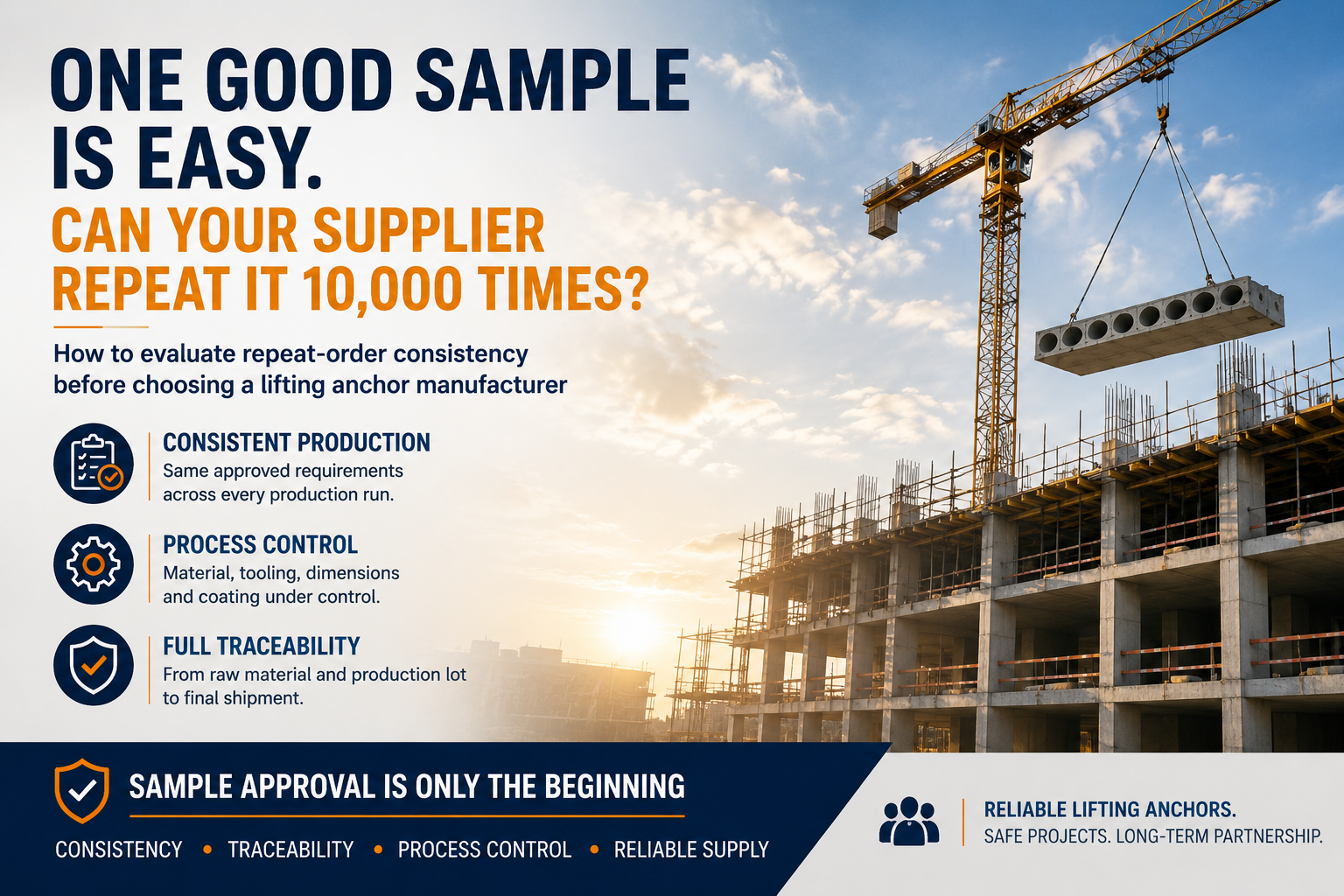
Will repeat orders match the approved sample?
-
How are material or process changes controlled?
-
Can the supplier support international delivery?
An effective manufacturer article should therefore provide a qualification method, not simply repeat product features.
The Manufacturer-Control Map
Before sending an RFQ, understand which controls should be visible at each stage of production.
| Control area | Evidence to request | Risk if control is weak |
|---|---|---|
| Material identity | Material specification, supplier record, heat or batch certificate | Unauthorized substitution or inconsistent mechanical properties |
| Product drawing | Approved drawing, tolerances, part number, revision | Different interpretations between buyer, sales team, and factory |
| Forming or forging | Process route, tooling control, in-process inspection | Geometry variation, folds, cracks, or inconsistent load-transfer features |
| Heat treatment | Approved parameters, batch record, test results | Incorrect hardness, strength, or toughness |
| Machining and threads | Gauge plan, calibration record, dimensional report | Poor engagement with sockets, clutches, or lifting eyes |
| Surface treatment | Finish specification, thickness control, inspection record | Corrosion risk or dimensional interference |
| Mechanical testing | Test plan, setup, sample identification, report | Capacity claims that cannot be connected to the supplied product |
| Marking and packing | Product mark, lot label, packing specification | Mixing capacities, finishes, models, or production batches |
| Change control | Engineering-change record and buyer-notification procedure | Unapproved changes after sample or production approval |
This table is not a product design checklist. It is a supplier-control checklist. Product suitability must still be determined for the specific lifting application.
The Seven Qualification Gates
Gate 1: Build an Application Brief Before Requesting a Price
The first sign of a technically engaged manufacturer is the quality of the questions it asks.
A useful application brief may include:
-
Precast element type
-
Element dimensions
-
Total mass
-
Center of gravity
-
Concrete strength at first lift
-
Anchor locations
-
Number of lifting points
-
Lifting direction
-
Sling angles
-
Edge distances
-
Reinforcement arrangement
-
Demolding method
-
Rotation or erection sequence
-
Required lifting clutch or attachment
-
Environmental exposure
-
Project destination
-
Applicable specification
-
Required quantity and delivery schedule
The manufacturer does not replace the project engineer. However, it should recognize when important information is missing and avoid presenting a catalog capacity as a complete engineering decision.
A quotation prepared before the supplier understands the application should be treated as preliminary.
Gate 1 approval question
Has the supplier received enough information to identify the correct product family and technical documents without relying on unstated assumptions?
Gate 2: Confirm System Compatibility in Writing
A lifting anchor should not be evaluated separately from the component that engages it.
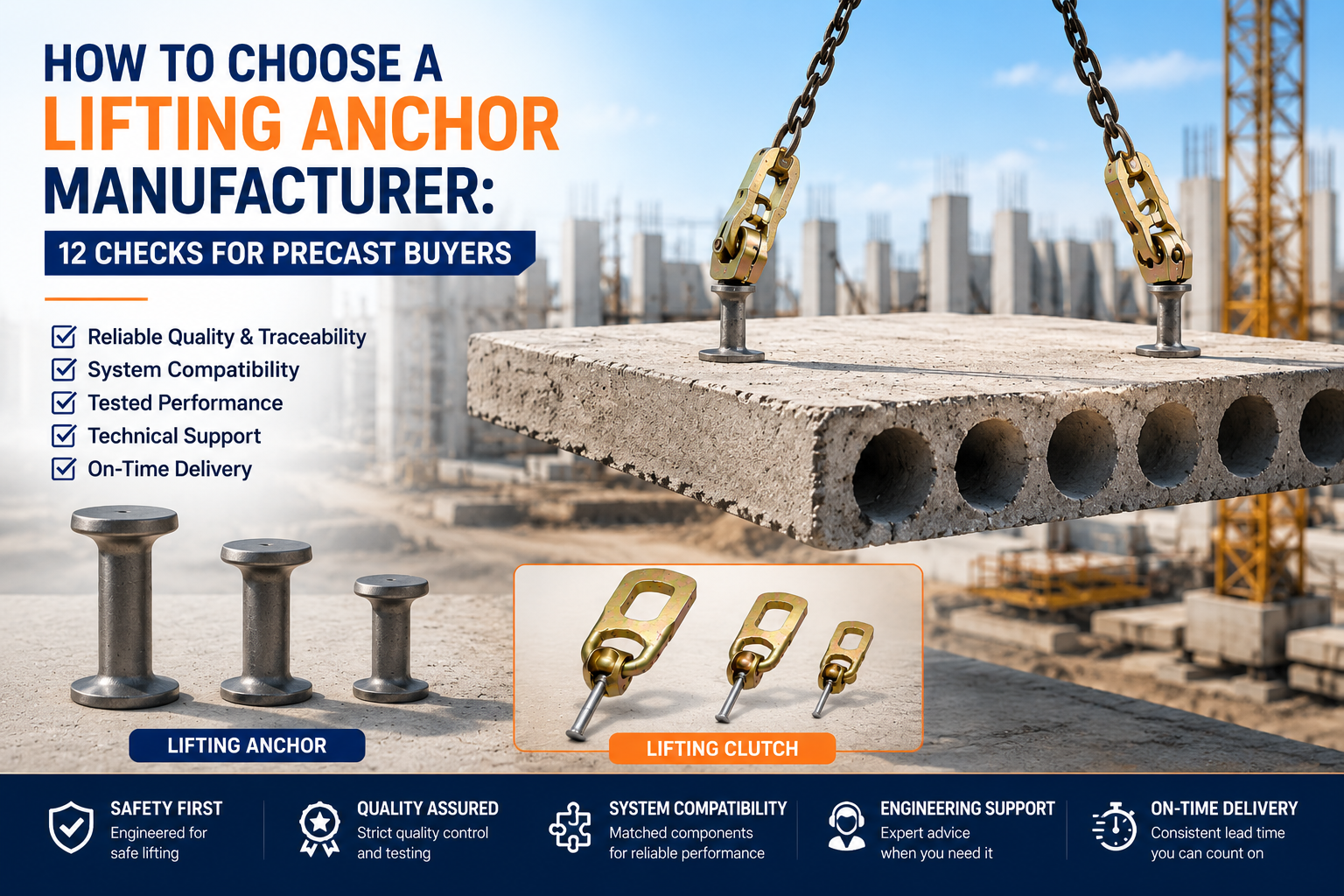
The complete system may include:
-
Spherical-head or foot anchor
-
Spread or erection anchor
-
Threaded lifting socket
-
Coil insert
-
Cast-in loop
-
Lifting clutch
-
Ring clutch
-
Lifting eye
-
Recess former
-
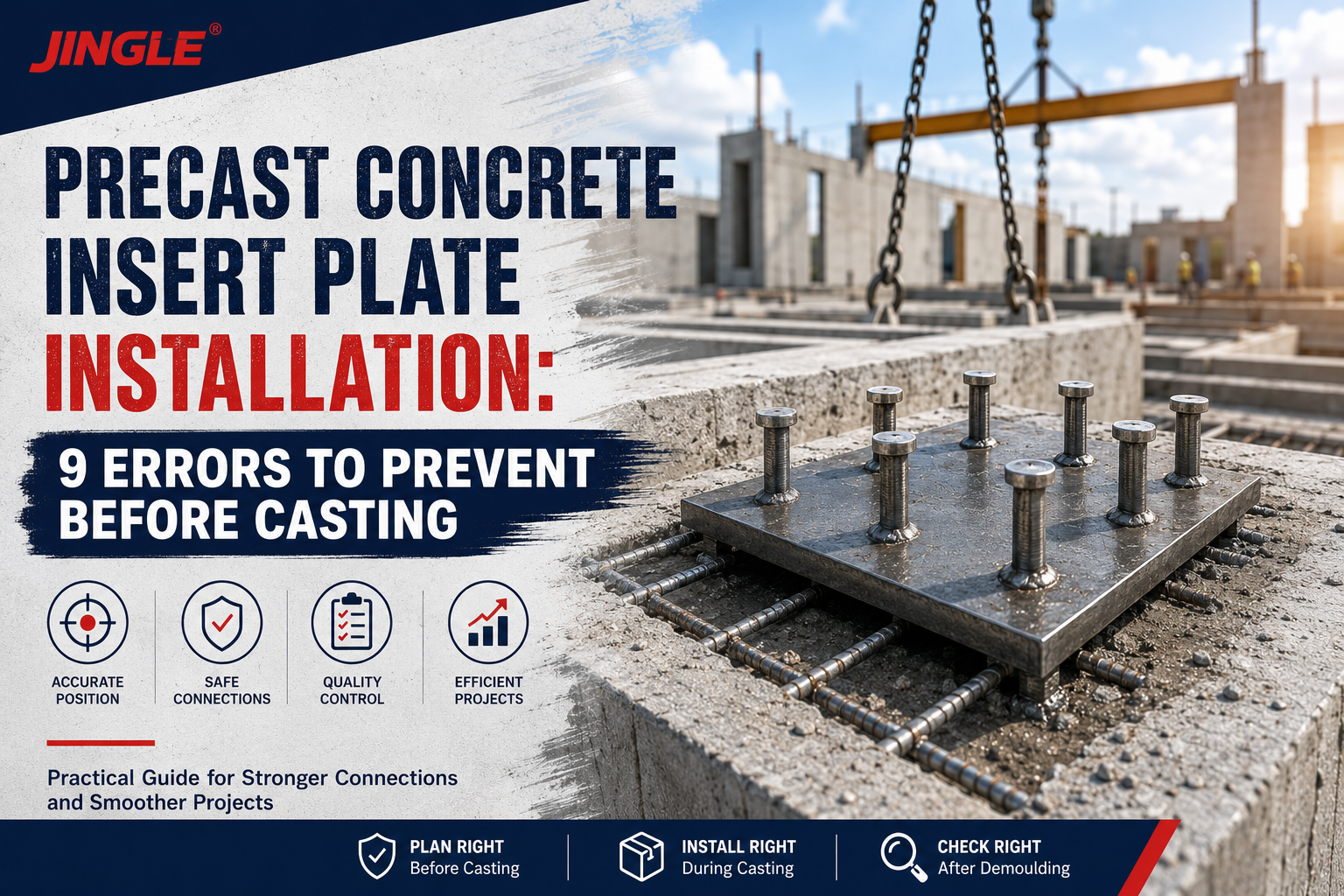
Installation plate
-
Additional reinforcement
Ask the supplier to identify the compatible components by model, size, and revision.
Do not accept statements such as “universal type” or “compatible with all standard clutches” without technical evidence. Similar-looking components can differ in head profile, seating depth, locking geometry, thread form, or dimensional tolerance.
The safest commercial approach is to place compatibility responsibility in writing before samples or tooling are approved.
Questions to ask
-
Which clutch or lifting device is approved for this anchor?
-
Is the recess former part of the same system?
-
Are cross-brand combinations permitted?
-
Which dimensions control engagement?
-
Is there a go/no-go inspection method?
-
What marking distinguishes one capacity from another?
-
Are installation and inspection instructions available?
Jinglefix’s precast accessories range includes lifting-anchor, threaded-socket, spread-anchor, coil-insert, recess-former, and other precast-related product families. Buyers should still request written compatibility information for the exact components under consideration.
Gate 3: Audit the Actual Manufacturing Route
A factory audit should follow the product through production rather than relying only on a general company presentation.
Start with the approved drawing and map each manufacturing step:
-
Raw-material receipt
-
Material verification
-
Cutting or blank preparation
-
Forging, casting, forming, machining, or welding
-
Heat treatment where required
-
Dimensional inspection
-
Surface treatment
-
Mechanical testing
-
Product marking
-
Final inspection
-
Packing and shipment release
The required route depends on the lifting-anchor design. A forged anchor, threaded insert, welded assembly, and wire-rope loop should not be audited as if they were produced through identical processes.
A capable lifting anchor manufacturer should explain which processes are completed internally and which are performed by approved subcontractors.
What to inspect during the audit
Raw-material control
Check how material is received, identified, separated, and connected to production orders.
Ask whether the factory can trace:
-
Material supplier
-
Material specification
-
Heat or batch number
-
Received quantity
-
Inspection status
-
Production lot
-
Finished-product shipment
Tooling and equipment
Confirm that tooling is identified and maintained. Worn tooling can change product geometry even when the material and machine remain the same.
For buyer-owned tooling, clarify:
-
Ownership
-
Storage
-
Maintenance responsibility
-
Tool-life monitoring
-
Replacement approval
-
Use for other customers
Critical dimensions
The inspection plan should focus on dimensions that influence engagement, seating, embedment, load transfer, thread fit, or installation.
Ask which dimensions receive:
-
First-piece inspection
-
In-process inspection
-
Final inspection
-
Gauge verification
-
Periodic capability review
Special processes
Heat treatment, welding, coating, and other special processes may require more control than a final visual inspection can provide.
Review process qualifications, batch records, inspection methods, and subcontractor controls.
Gate 3 approval question
Can the factory show a controlled production route for the exact product, rather than only general manufacturing capability?
Gate 4: Match Every Technical Claim to Evidence
A technical claim becomes useful only when it can be connected to the product being purchased.
If a supplier claims a particular load capacity, ask which document defines it and which evidence supports it.
The evidence package may include:
-
Product drawing
-
Product data sheet
-
Material specification
-
Installation instructions
-
Compatible-component list
-
Load table
-
Test plan
-
Test report
-
Material certificate
-
Dimensional inspection report
-
Surface-treatment record
-
Quality-management certificate
-
Product marking specification
-
Packaging specification
Each document should identify the relevant product number and revision.
Test-report matching check
Before accepting a report, compare:
-
Product model
-
Product size
-
Drawing revision
-
Material grade
-
Manufacturing method
-
Heat-treatment condition
-
Surface finish
-
Test direction
-
Test setup
-
Sample quantity
-
Test date
-
Production or sample lot
A report for a different size or older geometry is not automatically evidence for the quoted product.
Regulatory context
For projects subject to United States rules, OSHA 1926.704 states that:
-
Lifting inserts for tilt-up precast members must support at least two times the maximum intended load.
-
Lifting inserts for other precast members must support at least four times the maximum intended load.
-
Lifting hardware must support at least five times the maximum intended load.
These are U.S. regulatory minimums. They do not replace the project engineer’s design, local rules, manufacturer instructions, concrete-condition review, or engineered lift plan.
Quality-system evidence
A quality-management certificate can indicate that organizational processes are audited, but it does not approve an individual lifting product.
ISO is preparing a new 2026 edition of ISO 9001. Buyers should check the current publication and transition status on ISO’s official ISO 9001 update page, then verify the supplier’s certificate edition, issuing body, site, scope, and validity.
Gate 4 approval question
Can every important technical or certification claim be traced to a current document covering the exact product and supplying site?
Gate 5: Use a First-Article Approval Process
Samples should be treated as technical approval parts, not promotional pieces.
Before ordering samples, freeze:
-
Product drawing
-
Revision
-
Material
-
Manufacturing route
-
Heat treatment
-
Surface finish
-
Product marking
-
Compatible lifting device
-
Inspection requirements
-
Packaging requirements
The first-article inspection should compare the sample with the approved drawing and specification.
First-article review checklist
-
Correct product and revision
-
Required material documentation
-
Critical dimensions
-
Thread or clutch fit
-
Surface condition
-
Coating thickness where relevant
-
Product marking
-
Lot identification
-
Packaging label
-
Dimensional report
-
Test documentation
-
Required installation accessories
Fit checks should use the intended clutch, lifting eye, socket, former, or gauge. Appearance alone cannot establish compatibility.
Where product or project validation is required, it should be planned and approved by the responsible technical parties before testing begins.
Gate 5 approval question
Does the approved sample represent the exact configuration that will be used for pilot and recurring production?
Gate 6: Validate the Factory Through a Controlled Pilot Order
A good sample does not prove that the factory can sustain quality across a production lot.
A pilot order tests the complete supply process:
-
Production planning
-
Material purchasing
-
Tooling control
-
In-process inspection
-
Batch testing
-
Final inspection
-
Marking
-
Packaging
-
Documentation
-
Export preparation
-
Delivery performance
The pilot quantity should be large enough to reveal production variation while remaining manageable if a problem is discovered.
Pilot-order acceptance criteria
Define acceptance requirements before production begins:
-
Approved drawing and revision
-
Lot quantity
-
Sampling plan
-
Critical dimensions
-
Required certificates
-
Testing scope
-
Product marking
-
Packaging
-
Documentation format
-
Delivery date
-
Nonconformance process
When the pilot order arrives, compare it with the approved first article. Confirm that the factory did not change the material, tooling, finish, markings, or packaging after sample approval.
Gate 6 approval question
Can the supplier reproduce the approved sample across a controlled production lot and deliver the required records with the shipment?
Gate 7: Protect Repeat Orders With Traceability and Change Control
Supplier approval should not end after the first successful shipment.
Repeat-order control is where a lifting anchor manufacturer demonstrates long-term reliability.
For every production lot, consider requiring:
-
Purchase-order reference
-
Product number
-
Drawing revision
-
Material heat or batch
-
Manufacturing lot
-
Quantity
-
Inspection status
-
Test status
-
Product marking
-
Packing label
-
Shipment record
The manufacturer should notify the buyer before changing:
-
Material grade
-
Material supplier
-
Manufacturing location
-
Tooling
-
Product geometry
-
Tolerance
-
Manufacturing method
-
Heat treatment
-
Surface finish
-
Testing method
-
Subcontractor
-
Product marking
-
Packaging
The buyer can then determine whether document review, resampling, retesting, or full requalification is required.
Repeat-order performance indicators
Track more than on-time delivery. Useful indicators include:
-
Incoming rejection rate
-
Dimensional nonconformance
-
Documentation accuracy
-
Lot-traceability completeness
-
Packaging errors
-
Response time
-
Corrective-action closure
-
Unauthorized changes
-
On-time delivery
-
Repeat-order consistency
Gate 7 approval question
Can the supplier demonstrate that future shipments will remain connected to the approved design and process?
Calculate the Real Cost of a Manufacturer Decision
The lowest quoted price is not always the lowest delivered cost.
A realistic comparison should consider:
Total sourcing cost = unit price + tooling + inspection + testing + documentation + freight + inventory + expected failure and delay cost
Possible hidden costs include:
-
Rechecking incomplete documents
-
Sorting mixed products
-
Replacing incorrect markings
-
Production delays caused by poor clutch fit
-
Reworking precast elements
-
Emergency air freight
-
Additional third-party testing
-
Requalification after an unauthorized change
-
Crane or erection delays
-
Supplier-corrective-action management
Commercial comparison becomes more meaningful when all suppliers quote against the same approved specification and documentation scope.
Warning Signs During Manufacturer Qualification
Pause the approval process if:
-
The supplier provides a firm recommendation without reviewing the application.
-
Load claims cannot be connected to a current document.
-
The test report covers a different product or revision.
-
The manufacturer cannot explain critical dimensions.
-
Different capacities have unclear markings.
-
Material certificates cannot be linked to production lots.
-
The factory cannot identify subcontracted special processes.
-
A certificate is expired or outside the supplying site’s scope.
-
Sample material differs from the quoted production material.
-
Production changes do not require buyer notification.
-
Packaging allows different models or lots to become mixed.
-
The supplier refuses to provide installation or compatibility information.
-
Technical answers change depending on which salesperson is contacted.
A low price should not be used to offset missing safety-critical evidence.
How Jinglefix Supports Standard and OEM Sourcing
Jinglefix supplies industrial fasteners, precast accessories, CNC-machined parts, and drawing-based OEM/ODM components.
The company’s precast accessories portfolio includes lifting-anchor, threaded-socket, spread-anchor, rebar, cast-in-channel, coil-insert, recess-former, and related product categories.
Based on the supplied company content library, Jinglefix can support manufacturing processes that include machining, forming, forging, casting, welding, heat treatment, and surface finishing. The actual process route and production location should be confirmed for the specific product.
Buyers can review the Jinglefix company profile, read the company’s lifting anchor selection guide, or examine a representative lifting foot anchor product page.
Website information should be followed by a product-specific technical review. Request current drawings, material requirements, compatibility details, testing evidence, certificates, lead time, and packaging information for the exact item.
RFQ Checklist for a Lifting Anchor Manufacturer
Include the following information where applicable:
Application information
-
Precast element drawing
-
Element dimensions
-
Element mass
-
Center of gravity
-
Concrete specification
-
Concrete strength at first lift
-
Lifting-point locations
-
Sling arrangement
-
Lifting angles
-
Demolding and erection sequence
-
Reinforcement constraints
-
Environmental exposure
Product information
-
Preferred anchor family
-
Required capacity class
-
Compatible clutch or lifting device
-
Recess former
-
Material
-
Surface finish
-
Product marking
-
Packaging
-
Expected annual demand
-
Quantity by size
Quality and documentation
-
Approved-drawing requirement
-
Material certificates
-
Inspection report
-
Testing requirements
-
Third-party inspection
-
Witness or hold points
-
Batch traceability
-
Certificate requirements
-
Sample quantity
-
Pilot-order requirements
-
Change-notification requirements
Commercial and delivery information
-
Target sample date
-
Production delivery date
-
Destination
-
Incoterms
-
Required packaging
-
Forecast
-
Safety-stock requirement
-
Tooling ownership
-
Required quotation validity
For a standard or drawing-based inquiry, submit the application package through the Jinglefix contact page.
Frequently Asked Questions
What is the difference between a manufacturer and a trading supplier?
A manufacturer performs defined production operations and controls the resulting product. A trading supplier may coordinate products from other factories.
Either model can work, but the buyer should know who performs each process, who owns the technical documentation, and who is responsible for quality, traceability, testing, and engineering changes.
Should every process be completed in-house?
Not necessarily.
Surface treatment, heat treatment, mechanical testing, or other specialized operations may be outsourced. The manufacturer should qualify the subcontractor, define requirements, preserve traceability, inspect the results, and control changes.
What should be checked first during a factory audit?
Start with one actual product and follow its production route from incoming material to final packing.
This is usually more informative than reviewing a general presentation or inspecting unrelated equipment.
Does a quality-management certificate approve the product?
No.
A quality-management certificate relates to organizational processes and certificate scope. Product approval still requires drawings, material control, manufacturing control, compatibility information, testing, inspection, installation instructions, and project review.
How can buyers verify repeat-order consistency?
Freeze the approved drawing, material, process, finish, marking, and packaging. Require lot-specific records and compare future shipments with the approved first article.
Use formal change notification to prevent silent substitutions.
Can an OEM lifting anchor be approved from a drawing alone?
Usually not.
The drawing is an essential starting point, but approval may also require design-responsibility clarification, material evidence, process validation, dimensional inspection, compatibility checks, mechanical testing, installation information, and a pilot order.
How many samples should a buyer request?
The appropriate quantity depends on the number of sizes, manufacturing processes, inspection plan, testing requirements, and project risk.
Samples should represent the intended production configuration. The approval plan should be agreed before samples are produced.
Can lifting anchors and clutches from different manufacturers be mixed?
Do not assume interchangeability.
Cross-manufacturer use should require written compatibility evidence and approval by the responsible technical parties. Visual similarity is not enough.
What documents should accompany a shipment?
Requirements vary, but the shipment file may include a packing list, product identification, drawing revision, material certificate, inspection report, test record, lot number, and certificate of conformity.
Define the required document package in the purchase order.
When should a supplier be requalified?
Requalification may be required after a change in product geometry, material, tooling, manufacturing location, critical process, heat treatment, finish, test method, or subcontractor.
Repeated quality problems or long gaps between orders may also justify requalification.
Conclusion
A dependable lifting anchor manufacturer should make the product easier to verify at every stage—from RFQ and drawing approval to production, testing, marking, packing, and repeat delivery.
The strongest supplier evaluation does not rely on one certificate, one sample, or one load-capacity statement. It uses seven connected gates:
-
Application brief
-
System compatibility
-
Manufacturing-process audit
-
Technical evidence
-
First-article approval
-
Controlled pilot order
-
Repeat-order and change control
Once these gates are passed, price and lead time can be compared on a more reliable basis.
If you are qualifying a standard or OEM lifting-anchor product, prepare the element information, lifting conditions, preferred component system, destination requirements, quantities, and document list. Then request a product-specific technical review through the Jinglefix inquiry page.
Technical Note
This article provides supplier-qualification and procurement guidance. It is not a lifting design, product approval, installation instruction, or engineered lift plan.
Product capacities, compatible components, certificates, materials, test reports, installation requirements, and regulatory compliance must be verified for the exact product, revision, application, and destination before purchase or use.