Why buyers care about the right self-tapping screw source
If you are sourcing from a Self Tapping Screw Manufacturer, you are usually not shopping for a single screw. You are trying to protect an assembly: thin sheet metal that cannot be over-torqued, plastic parts that crack too easily, or a production line that slows down every time fasteners vary from lot to lot. That is why the supplier decision matters as much as the fastener design itself.
For engineers and sourcing teams, the real question is simple: which fastener supplier can provide a screw that installs consistently, holds the joint reliably, and matches the application without creating rework? The answer depends on thread form, head style, material, finish, and manufacturing consistency, not just on the price per thousand.
What the product type suggests
The screw style shown in the preparation data looks like a sheet-metal or self-tapping type fastener with a pointed tip, coarse threads, and a wide washer or flange head. That combination is common in assemblies where the head needs to spread load over a larger area and reduce pull-through. In practical terms, it is the kind of screw often selected for thin metal panels, brackets, enclosures, HVAC parts, appliance subassemblies, and similar light-duty industrial work.
The bright silver finish appears zinc-plated or galvanized-looking, which is a common choice when buyers want a corrosion-resistant appearance without moving to a more specialized coating. Still, the exact coating and its performance would need confirmation from the manufacturer. A photo can suggest a lot, but it cannot certify salt-spray behavior or long-term outdoor durability.
How a good OEM fastener manufacturer is judged
When people say they need an OEM Fastener Manufacturer, they usually mean a partner who can make the part to drawing, repeat it across production runs, and support the realities of assembly. That includes thread consistency, head geometry, drive quality, plating uniformity, and packaging that survives transit without mixed lots or damaged tips.
For self-tapping screws, the boring details are the important ones. If the thread is too aggressive, installation torque may spike. If it is too soft, the screw can strip the mating material. If the flange head is poorly formed, it may not seat flat. Buyers often focus on the headline dimensions and miss these issues until pilot production starts.
Quick buyer checklist
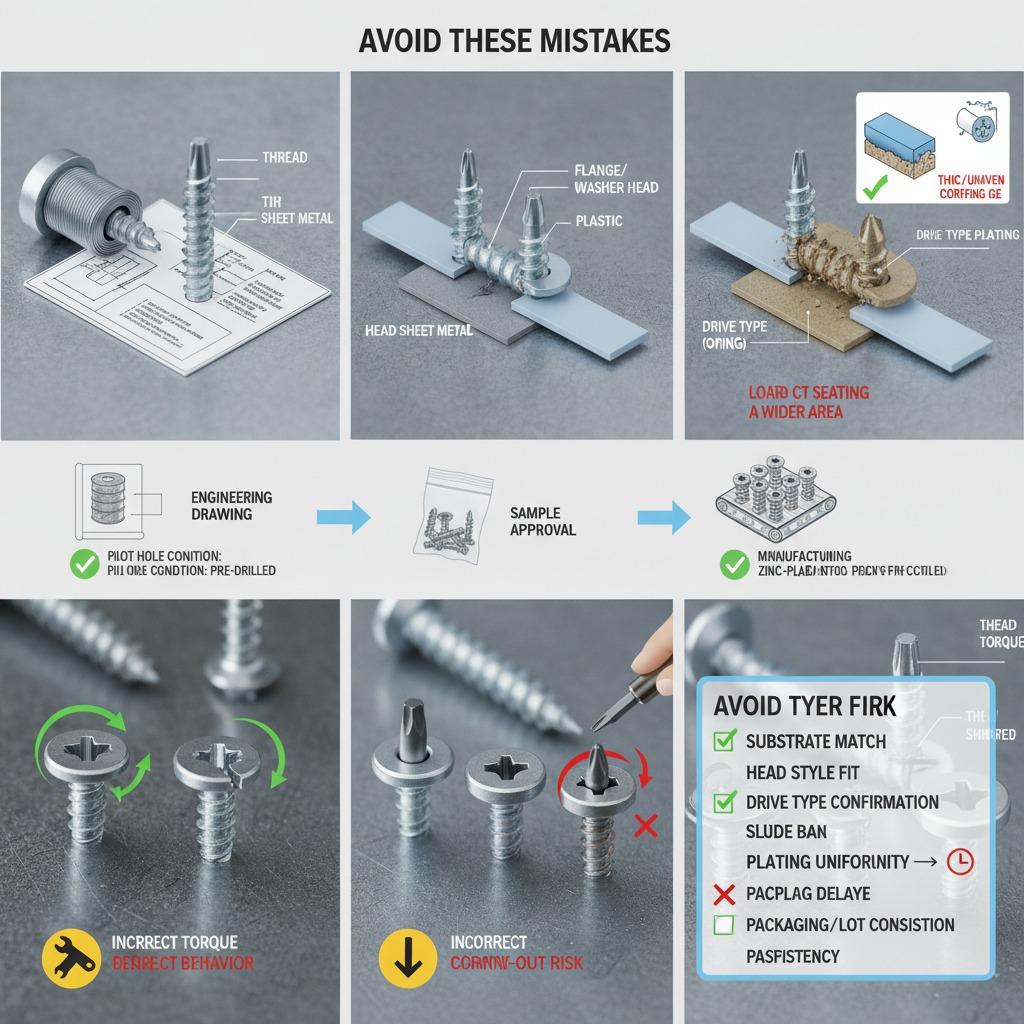
1. Match the screw to the substrate
Self-tapping screws behave differently in sheet metal, plastic, and softer composite materials. The screw that works well in a metal enclosure may be the wrong choice for polymer housings.
2. Confirm the head style
A washer or flange head helps distribute clamp load. That is useful, but only if the mating surface can accept the larger contact area and the head profile does not interfere with nearby features.
3. Review the drive type
The image suggests an internal drive, possibly hex or Torx-style, but it cannot be confirmed from the photo alone. Drive choice affects tool wear, assembly speed, and the risk of cam-out.
4. Ask about manufacturing process
Cold forming and thread rolling are common for this class of fastener. That is usually a good sign for repeatability, but buyers should still request the actual process control information for their order.
Common sourcing mistakes
One frequent mistake is treating every silver screw as interchangeable. Another is assuming that a screw described as “self-tapping” will perform the same way in every material. It will not. The mating hole condition, material hardness, and installation method all change the outcome.
There is also a tendency to over-specify where it is not needed and under-specify where it matters. A procurement team may lock down finish color while leaving the drive engagement ambiguous. That is backwards. Assembly reliability usually matters more than appearance, unless the screw is visible in the finished product.
What a fastener supplier should be able to answer
A capable Fastener Manufacturer in China or elsewhere should be able to tell you how the screw is formed, what base material is used, what finish is applied, and which applications it is intended for. They should also be able to discuss whether the part is intended for predrilled holes or self-starting use, since the image alone does not settle that point.
If you are comparing suppliers, ask for drawings, sample confirmation, and process details before you commit to volume. The best buying decision is not the one with the cleanest catalog photo; it is the one that holds up on the line.
Practical next step
If your team is evaluating a self-tapping screw for sheet metal or light assembly work, start by defining the substrate, head requirements, drive preference, and finish expectation. Then ask the supplier for samples and a clear spec sheet. That is the fastest way to separate a capable Fastener Supplier from one that is only good at quoting.
When the application is borderline, a short validation run is worth more than a long email thread. Fasteners are small parts, but they can cause large problems when chosen loosely.