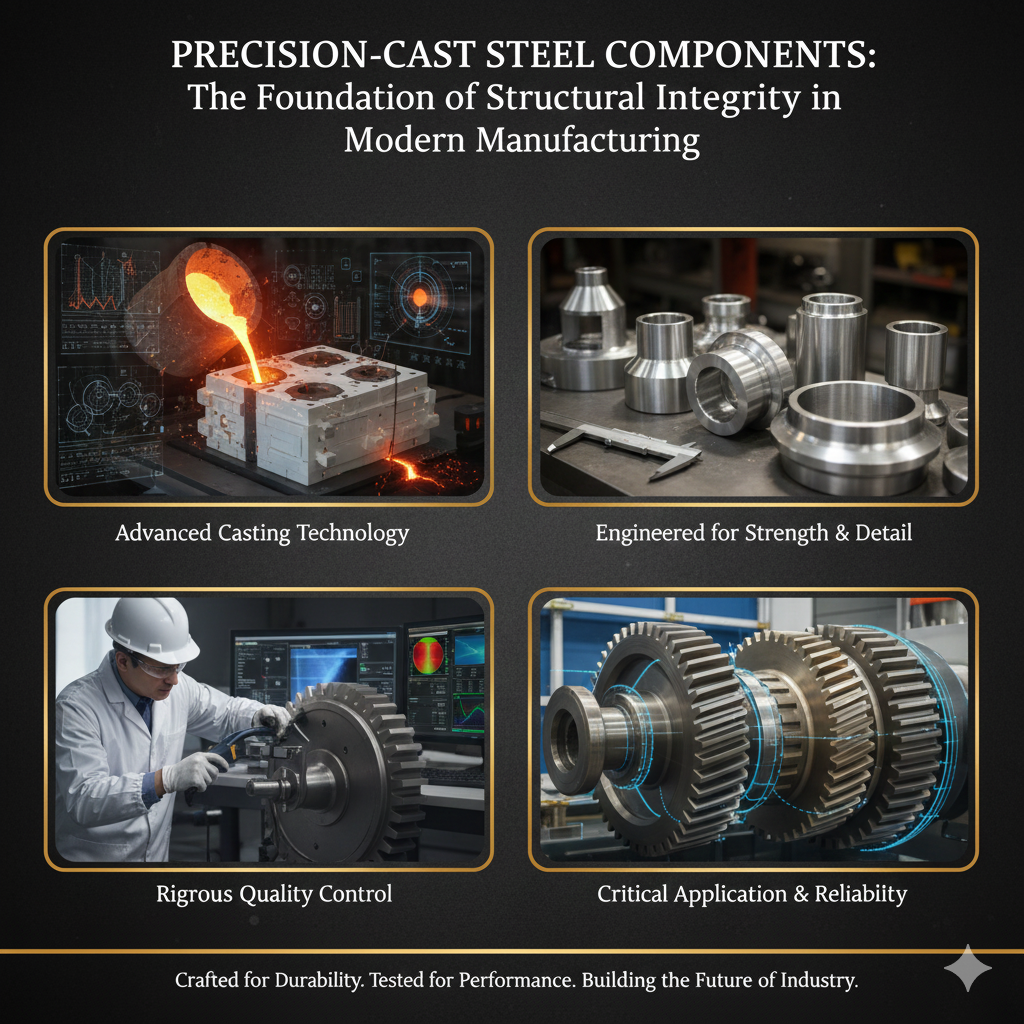
Why Precision Casting Matters More Than Ever
In industrial manufacturing, failure is not an option. Whether used in cranes, turbines, or automotive systems, every steel component must bear load, resist fatigue, and align perfectly with its counterpart.
Traditional casting often struggles with dimensional consistency and porosity—but precision casting eliminates these uncertainties through controlled mold design, refined melting processes, and advanced solidification techniques.
For global OEMs, precision-cast steel represents the intersection of structural integrity, geometric accuracy, and economic production—where quality defines competitiveness.
Inside the Process: How Precision Steel Casting Ensures Accuracy
Unlike conventional sand casting, precision casting (also called investment casting) uses a wax pattern and ceramic shell to create an ultra-detailed mold. Once the steel is poured and cooled, the shell is removed, revealing a near-net-shape component requiring minimal machining.
| Stage | Description | Impact on Quality |
|---|---|---|
| Wax Pattern Creation | Produces exact replica of final part | High surface detail |
| Ceramic Shell Building | Layered coating for heat resistance | Dimensional stability |
| Steel Pouring & Cooling | Controlled temperature curve | Reduced internal stress |
| Shell Removal & Cleaning | Removes residue and flash | Smooth surface finish |
| Machining & Finishing | Adds tolerance accuracy | Assembly-ready precision |
Jingle’s automated casting lines maintain temperature, viscosity, and solidification rate in real time—ensuring every batch meets ISO 8062 and ASTM A957 standards.
Material Engineering: Selecting the Right Alloy for Each Application
Precision-cast steel components are not one-size-fits-all. The choice of alloy determines tensile strength, corrosion resistance, and machinability.
| Alloy Type | Mechanical Properties | Typical Applications |
|---|---|---|
| Carbon Steel (A216 WCB) | High strength, economical | Machinery frames, brackets |
| Alloy Steel (A217 WC6/WC9) | Heat & fatigue resistant | Power generation, turbines |
| Stainless Steel (CF8/CF8M) | Corrosion proof, aesthetic | Valves, pumps, marine fittings |
| Tool Steel (H13) | Hard-wearing, abrasion-resistant | Die casting tools, molds |
| Duplex Stainless (CD3MN) | Strength + corrosion resistance | Offshore, chemical plants |
Through metallographic analysis and heat-treatment optimization, Jingle tailors each alloy’s microstructure to match its real-world stress environment.
Comparing Precision Casting vs. Conventional Fabrication
| Criteria | Precision Casting | Conventional Machining/Forging |
|---|---|---|
| Dimensional Accuracy | ±0.1 mm | ±0.3 mm or more |
| Surface Finish | Ra 1.6 μm | Ra 3.2 μm+ |
| Material Utilization | Up to 95% | 60–70% (high waste) |
| Design Flexibility | Complex internal geometry | Limited by tooling |
| Cost Efficiency (per complex part) | Moderate to low | High due to machining time |
For intricate components—gear housings, impellers, yokes—precision casting achieves complex shapes without additional welding or assembly, cutting production time by 20–40 %.
Practical Selection Guide for Engineers and Buyers
When choosing precision-cast steel components, the right decision depends on performance priorities, not just cost.
Below are practical scenarios that help align specifications with project goals:
| Project Condition | Engineering Challenge | Recommended Solution |
|---|---|---|
| High vibration (e.g., compressors) | Fatigue & thread loosening | Use alloy steel with shot-peened finish |
| Outdoor or marine environment | Salt corrosion | Opt for CF8M stainless casting |
| Heavy static load | Risk of creep deformation | Select low-alloy steel with heat treatment |
| Tight tolerance assembly | Misalignment risk | CNC post-machining after casting |
| Lightweight structural frame | Need for balance of mass vs. strength | Use duplex steel with reduced wall thickness |
These guidelines ensure the component not only fits but functions under long-term stress—the true test of engineering reliability.
Why OEMs Choose Jingle as Their Casting Partner
1. End-to-End Precision Control
From 3D modeling to ultrasonic inspection, every process is fully traceable.
2. Export-Grade Quality System
Certified under ISO 9001 and CE, ensuring compliance across EU and North American markets.
3. Flexible Order Quantities
From prototypes to high-volume batches, production lines are scalable without compromising accuracy.
4. Surface Treatment Options
Shot blasting, zinc plating, black oxide, and passivation extend component lifespan.
5. Logistics & Documentation Support
Each shipment includes inspection reports, MTCs, and RoHS/REACH certifications for customs clearance.
6. Collaborative Engineering
Jingle’s technical team supports clients from drawing optimization to alloy selection, reducing trial costs and lead time.
FAQs
Q1 – Can precision-cast steel components replace forged parts?
Yes, in many medium-stress applications they offer comparable strength with lower machining cost.
Q2 – What tolerance can Jingle guarantee?
Typically ±0.1 mm for small parts, ±0.2 mm for large castings after machining.
Q3 – How do you prevent porosity in cast steel?
By using vacuum melting and controlled solidification; defects are detected through X-ray and ultrasonic testing.
Q4 – Can coatings be applied after casting?
Yes, we offer galvanizing, powder coating, and epoxy paint based on environmental exposure.
Building Structural Confidence Through Precision
Every component leaving Jingle’s foundry carries a promise—accuracy, strength, and endurance.
By combining metallurgical expertise with CNC finishing, we deliver steel castings that perform reliably across continents and conditions.
If your next project demands precision-cast components that meet international standards, explore more at Jingle Homepage or connect with our engineers via Contact Us.