What buyers really mean when they search for a machine screw manufacturer
People usually look for a Machine Screw Manufacturer when the fastener itself is not the whole problem. The real issue is reliability: can the supplier make screws that fit the assembly, hold up in service, and arrive in the right material and finish without turning procurement into a guessing game? For engineers and sourcing teams, that question matters because a machine screw is often a small part with an oversized role. If the thread is off, the head style is wrong, or the coating is not suited to the environment, the downstream cost shows up in rework, line stoppage, or field failures.
That is why the best buying decisions start with application detail, not just a part number. A capable supplier should be able to discuss thread geometry, drive style, material selection, and packaging in plain language. If they cannot, that is usually a sign to keep looking.
Machine screws versus other fasteners: the practical difference
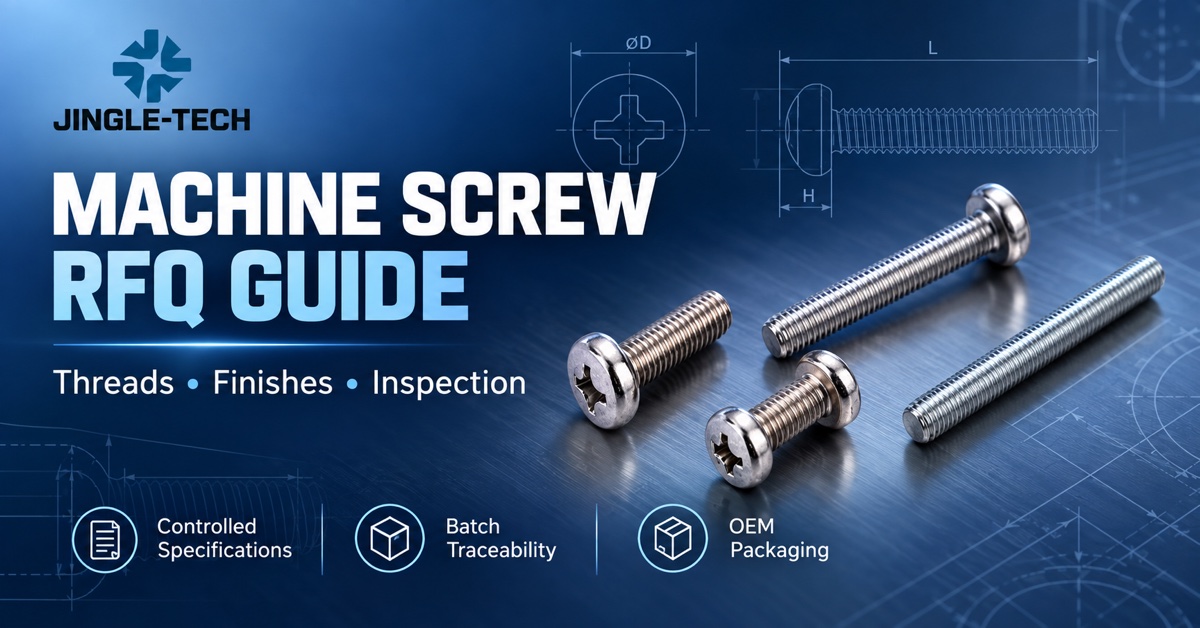
Machine screws are used in pre-tapped holes, nuts, or threaded inserts. They are not the same as wood screws or self-tapping screws, and that distinction affects everything from assembly speed to retention strength. In controlled assemblies, the screw has to match the mating thread precisely enough to avoid cross-threading while still giving the clamp load the application needs.
For buyers, this means the sourcing brief should cover more than basic dimensions. Head type, slot or drive recess, length, diameter, thread pitch, and material all matter. So does the environment. A fastener that performs well indoors may be a poor choice outdoors or in a wet, corrosive setting.
Where stainless steel machine screw options fit
Among common choices, Stainless Steel Machine Screw options are often selected for corrosion resistance and a cleaner appearance. They are widely used in equipment housings, appliances, marine-adjacent hardware, and other assemblies where rust is a concern. Stainless is not a universal answer, though. It can be the right choice for durability, but it is not always the best choice for cost, strength, or anti-galling behavior. That last point is worth a pause: in some assemblies, stainless threads can seize if the design or installation process is careless.
So the buyer’s question is not simply “stainless or not.” It is “what alloy, what finish, what loading condition, and what service environment?” If the supplier treats stainless as a one-size-fits-all answer, that is a warning sign.
What a strong manufacturer should be able to support
A good machine screw supplier should offer predictable manufacturing capability and enough process control to keep parts consistent across production runs. For industrial buyers, that usually means a few practical things:
Dimensional consistency
Even small variation can create assembly problems when parts are automated or built at high volume. Threads that are too loose or too tight may not show up until a line operator or robot starts loading parts.
Material and finish guidance
The supplier should help narrow material choices based on use case. Stainless steel, carbon steel, and coated variants each have tradeoffs. The point is not to chase the “best” material in the abstract, but the one that matches the environment and budget.
Application-aware packaging
This is overlooked more often than it should be. Mixed lots, damaged threads, or poor packaging can undo otherwise good manufacturing work. For assembly plants, packaging that supports counting, kitting, and clean handling can save more time than a small unit price difference suggests.
Selection criteria that save trouble later
When comparing suppliers, it helps to separate marketing language from the details that affect production. Start with the screw size and thread standard your design uses, then confirm material compatibility with the assembly environment. Next, decide whether the fastener will be installed by hand or by automation, because drive style and head geometry can affect tool engagement.
Buyers should also ask how the manufacturer handles repeat orders. A screw that meets spec once is useful; a screw that can be repeated across batches is what production teams actually need. Consistency is the quiet requirement behind most fastener purchases.
Common mistakes in sourcing machine screws
One common mistake is over-specifying appearance and under-specifying function. Another is assuming a stainless solution automatically solves corrosion problems without checking the rest of the assembly. Galvanic interaction, trapped moisture, and poor storage conditions can still create failures.
Another buyer trap is treating every “equivalent” screw as interchangeable. In practice, small differences in drive style, thread engagement, or head height can affect assembly clearance and torque behavior. That is especially important when replacing an existing part rather than designing new hardware from scratch.
What to ask before you place an order
Before moving forward with any machine screw sourcing project, ask the supplier to confirm the exact specification, the available material options, and how they control repeatability. If the project uses stainless steel, ask whether the grade is appropriate for the intended environment and whether installation has any special cautions. A practical supplier will answer in terms of function, not just catalog labels.
If your team is still choosing between options, it usually helps to map the application first: indoor or outdoor, dry or corrosive, manual assembly or automated, cosmetic or structural. That shortlist will eliminate many poor-fit options quickly.
FAQ: short answers buyers often need
Is stainless steel always the best choice?
No. It is often a strong choice for corrosion resistance, but strength, cost, and galling risk also matter.
Why does supplier consistency matter so much?
Because a fastener that works in a sample order still has to work the same way across repeated production lots.
What is the fastest way to qualify a supplier?
Start with the exact part requirements, then test communication, specification clarity, and repeat-order reliability. That usually reveals more than a polished brochure.
For teams sourcing machine screws at scale, the next step is straightforward: document the application conditions, define the screw specification tightly, and then evaluate suppliers on their ability to repeat that result without drift. That is the difference between buying hardware and controlling risk.