How to Choose a Reliable Precast Accessories Manufacturer

Choosing the wrong supplier for precast accessories can quietly turn into a serious problem. A batch of lifting anchors that don’t match the drawings, sockets that fail a basic pull test, or delayed shipments of cast-in channels can stop production or hold up installation on site. The right manufacturer simply delivers what was ordered, on time, and with the performance data to back it up.
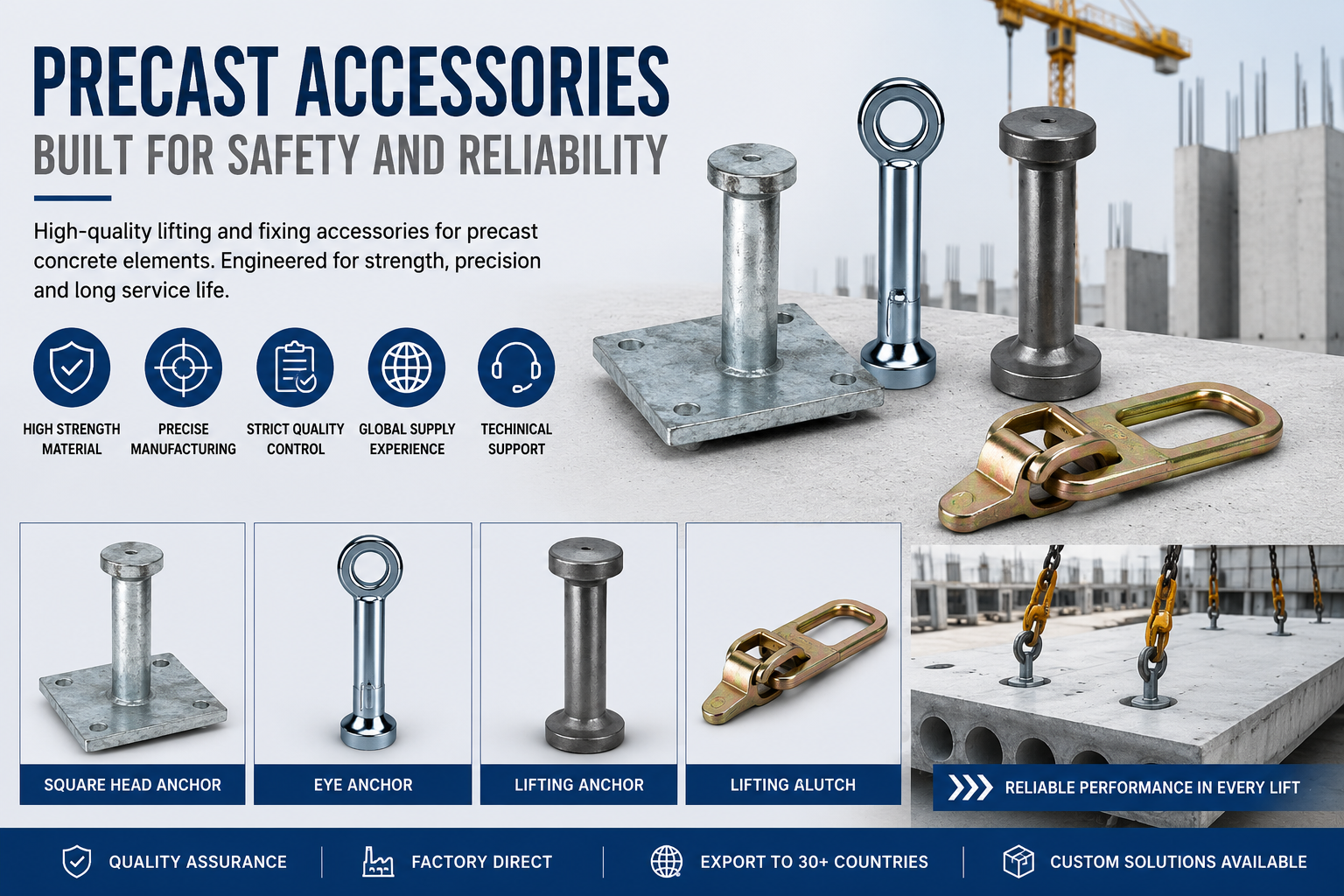
This guide focuses only on precast accessories—lifting anchors, threaded sockets, spread anchors, wire loop boxes, cast-in channels, coil inserts, recess formers and related hardware. It covers the practical checks experienced buyers use when evaluating manufacturers, especially those in China supplying projects in Europe, North America and other markets.
Quick Comparison Table
| What to Check | Reliable Manufacturer | Common Warning Signs |
|---|---|---|
| Certificates | Valid ISO 9001, open to SGS or similar inspection | Expired papers or “we’ll send later” |
| Production focus | Dedicated lines for precast accessories | Only trading, no real factory |
| Testing capability | In-house lab + full batch reports with heat numbers | Sales talk only, no actual test data |
| Lead times | Clear and realistic | Always “very fast” with no detail |
| Technical support | Engineers discuss loads and embedment | Only sales replies, slow or vague |
| Export experience | Regular shipments to your target markets | Almost no overseas track record |
If a supplier fails two or more rows, it is usually safer to move on.
Certificates and real quality control
ISO 9001 is the baseline. Ask for the current certificate and a couple of recent third-party inspection reports. CE support is useful for many European projects. More important than the paper itself is whether the factory runs proper testing and keeps heat-number traceability from the steel to the finished part.
Request sample reports for the exact product type you need—spherical-head lifting anchors, RD-threaded sockets, spread anchors or cast-in channels. Hesitation or generic documents usually signal weak process control.
Capacity and product range
Look for a manufacturer that has specialised in precast accessories for years, not one that added the category recently. A real production floor with dedicated equipment, consistent annual output and the ability to handle both standard and custom items is a better indicator than marketing claims.
Confirm they actually make the systems you require:
- Lifting anchors (spherical head, foot anchors, erection anchors)
- Threaded socket systems
- Spread anchor systems
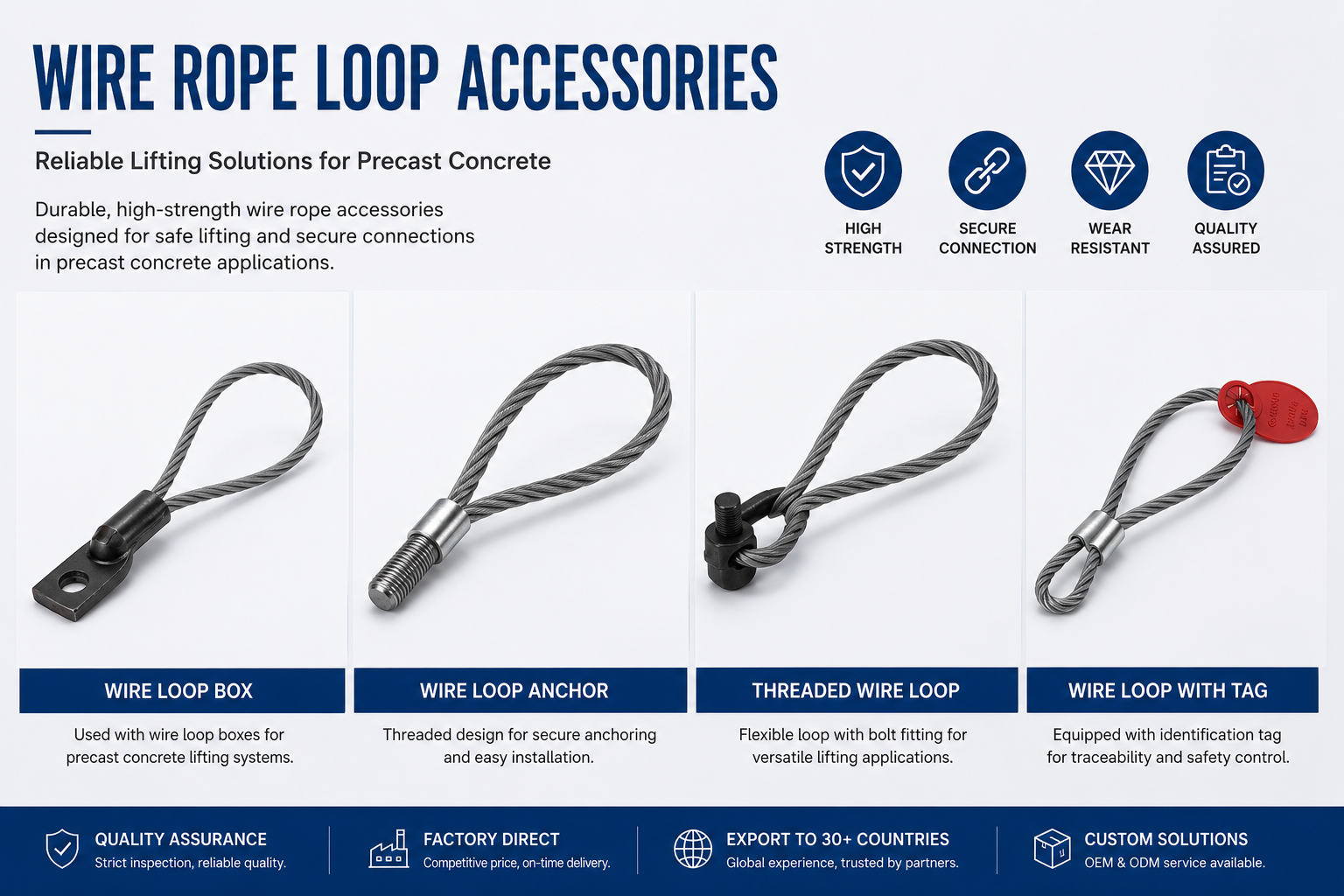
- Wire loop boxes and lifting loops
- Cast-in channels
- Coil inserts and ties
- Recess formers and related plastic parts
Engineers who can discuss drawings, load cases and embedment details add real value, especially on non-standard elements.
Material quality and testing in practice
Steel grade, any necessary heat treatment and surface protection must suit the project conditions. Consistency across batches matters more than one perfect sample. A good factory checks incoming material, verifies dimensions, performs proof-load or sample destructive tests, and issues proper reports with every shipment.
Packaging that protects threads and finished surfaces during sea freight is another practical detail that separates serious suppliers from the rest.
Delivery and communication
Ask for realistic lead times and how the factory handles schedule changes. Honest dates and regular updates are worth more than optimistic promises. Technical questions about safe working loads or compatibility with common lifting clutches should receive useful answers within a day.
Export experience and references
Regular shipments to your markets mean the manufacturer already understands packing standards, documentation and typical logistics issues. Ask for a couple of recent project examples or references from similar work. A short video of the production and testing areas can reveal more than a polished brochure.
Price versus total cost
The lowest unit price often becomes the most expensive once rework, delays or rejected parts appear. Request a clear breakdown covering unit price by quantity, any tooling, packaging and shipping terms. Proper inspection reports and technical support have measurable value.
Simple buyer checklist
| Step | Action | Status |
|---|---|---|
| 1 | Obtain current ISO 9001 and recent test reports | ☐ |
| 2 | Confirm they produce the specific accessories needed | ☐ |
| 3 | Order samples or first-article pieces | ☐ |
| 4 | Arrange third-party inspection if possible | ☐ |
| 5 | Clarify packaging and shipping details | ☐ |
| 6 | Protect any proprietary drawings | ☐ |
| 7 | Start with a trial order before scaling | ☐ |
A manufacturer focused on precast accessories
Jingle Fast Group in Ningbo has specialised in precast accessories for more than two decades. The factory holds ISO 9001:2015 certification and supports third-party inspections such as SGS. The product range covers lifting anchors, threaded sockets, spread anchors, wire loop boxes, cast-in channels, coil inserts, recess formers and related hardware. Annual output exceeds 10,000 tons, with regular exports to more than 30 countries.
Full inspection reports accompany shipments, and the engineering team can discuss custom requirements. Product details and quotations are available at www.jinglefix.com or by emailing sales@jinglefix.com.
Common questions
What certificates should I insist on? Valid ISO 9001 is the minimum. CE support and willingness to accept third-party inspection help for many destinations. Product-specific load-test data adds further confidence.
How do I verify safe working loads? Request the data sheets and recent batch test results. Confirm the stated values apply to the concrete strength, edge distance and lifting direction of your elements.
Can they handle custom designs? Most established manufacturers can. Send drawings early and request samples or first-article approval before full production.
Typical lead times? Standard items are often available in a few weeks. Custom work or larger volumes take longer. Always confirm current capacity when you enquire.
How to reduce risk on the first order? Start with samples or a small pilot batch, arrange third-party inspection, and agree packaging and documentation details in advance.
The difference between a reliable precast accessories manufacturer and a risky one usually shows up in the details—traceability, consistent testing, honest communication and real production focus. Checking these points carefully avoids most of the common problems later.
For current product information or a project-specific quote, contact us at sales@jinglefix.com.