Why a Hex Nut Manufacturer Matters in Real-World Purchasing
If you are sourcing a Hex Nut Manufacturer, you are usually not shopping for a commodity in the abstract. You are trying to keep an assembly from backing off, a frame from loosening, or a service job from stalling because the fastener on hand does not match the bolt, the load, or the environment. That is why hex nuts look simple but still deserve careful buying decisions.
The basic geometry is familiar: a hexagonal exterior for wrenching, an internally threaded bore, and chamfered faces that help guide the nut onto a bolt or threaded rod. Yet small differences in material, finish, thread quality, and consistency can matter a great deal once the part is installed in machinery, equipment frames, automotive assemblies, or maintenance work. A Hex Nut Supplier may offer the size you need, but the real question is whether the parts arrive with the right repeatability and the right fit for your application.
What Buyers Usually Need to Decide First
Before comparing a Hex Nut Factory China against other sourcing options, the first task is usually to narrow the application. Is this for general industrial fastening, a repair inventory, a fabrication project, or a production assembly that needs a stable supply chain? That decision affects how much you should care about material, surface condition, and inspection discipline.
For many buyers, the short list comes down to a few practical points: the thread must match the mating bolt; the nut must survive the environment; and the finish should not create its own problems during assembly. A dark oxide-coated or unfinished steel nut may be perfectly acceptable in some enclosed machinery, while a brighter, more corrosion-resistant option may be more appropriate elsewhere. The point is not to over-specify everything. It is to avoid surprises.
Common Hex Nut Types and Where They Fit
Standard industrial hex nuts
These are the everyday fasteners most engineers picture first. They suit general mechanical assemblies, equipment frames, brackets, and plant maintenance. Their value is not glamour; it is availability and predictability.
Stainless Steel Hex Nut options
When corrosion resistance is a priority, a Stainless Steel Hex Nut is often considered. This can be useful in damp service, washdown areas, or outdoor equipment. Still, buyers should remember that stainless is not a universal upgrade. It may change cost, galling behavior, and compatibility with other metals.
Carbon Steel Hex Nut variants
A Carbon Steel Hex Nut is a common choice for general-purpose fastening and can be suitable when strength, cost, and broad availability matter. The exact grade or treatment is what determines whether it belongs in a light-duty fixture or a more demanding mechanical assembly, so the details matter more than the label alone.
What a Product Image Can Tell You — and What It Cannot
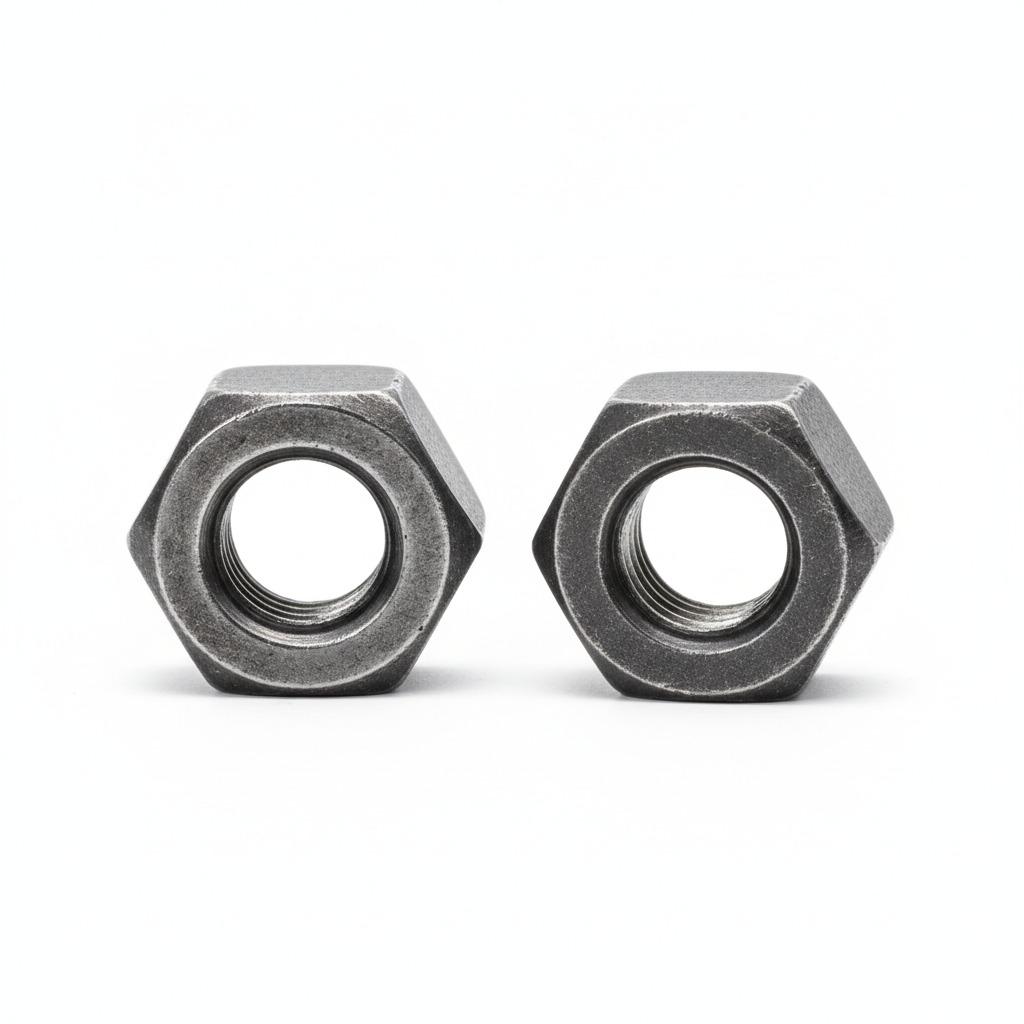
The product presentation here shows a standard hex nut in two views, one upright and one at an angle, which confirms the basic form: a hex exterior, threaded opening, flat bearing face, and chamfered edge. That is useful, but only up to a point. From an image alone, you cannot verify thread size, pitch, mechanical grade, coating type, hardness, or load rating. A cautious buyer should treat the photo as a shape check, not a specification sheet.
That caution is especially important when switching suppliers. Two nuts can look nearly identical on screen and still behave differently in production. Machining marks, thread finish, and surface coating can all influence installation feel and long-term performance. In procurement, “looks right” is not the same as “fits right.”
Selection Criteria That Save Time Later
Engineers and sourcing managers usually get the best results by asking for a complete definition of the part before placing volume orders. That means thread dimensions, material family, surface finish, packaging expectations, and any application limits that matter to the assembly. If the nut is part of a safety-related or load-bearing joint, extra scrutiny is not optional.
A practical buying checklist is simple enough:
Confirm thread compatibility with the bolt or stud.
Match material and finish to the operating environment.
Ask whether the nut is cold-formed or machined if that affects your process expectations.
Review whether the supplier can support consistent lots, not just a single sample.
It sounds basic, but these are the questions that prevent rework.
Common Mistakes in Hex Nut Sourcing
One common mistake is assuming every hex nut is interchangeable. Another is choosing by price alone and discovering that thread feel, finish quality, or packaging consistency creates assembly delays. A more subtle issue is overbuying a special material when a standard industrial nut would have done the job. Both errors cost money, just in different ways.
There is also the problem of vague part descriptions. If a purchase order simply says “hex nut,” the result may be technically correct and operationally annoying. Buyers do better when they describe the use case clearly, even if they do not specify every last detail.
Practical Advice for Buyers Working with Suppliers
When evaluating a Hex Nut Supplier, ask for samples that reflect the actual production lot, not a hand-picked piece. If the application is critical, request confirmation of dimensions and finish by the supplier’s own inspection method. That does not guarantee perfection, but it does tell you whether the supplier has a disciplined process or just a good sales pitch.
If you are comparing a Hex Nut Factory China with other sources, the useful comparison is not geography by itself. It is process control, communication, and consistency. The best supplier is the one that can repeatedly deliver the same part definition without forcing your team to chase exceptions.
FAQ: Quick Answers Buyers Usually Want
Can I choose a hex nut just by visual appearance?
No. Appearance helps confirm the general form, but it does not prove thread size, grade, or coating.
Is stainless always better than carbon steel?
Not always. Stainless may help in corrosive environments, but it can introduce cost and installation issues that do not suit every assembly.
What should I verify first when changing suppliers?
Start with thread compatibility, then material, finish, and packaging consistency.
Next Step
If you are building a shortlist of fastener partners, start by asking each Hex Nut Manufacturer for a clear part description, sample consistency, and confirmation of the production method they use for your specific nut. A few careful questions at the sourcing stage usually save far more time than a rushed replacement order later.