Anchor Bolt for Concrete: Secure Foundations for Industrial and Structural Projects
1. The Foundation of Every Stable Structure
Concrete anchor bolts play a critical role in construction and industrial installation.
They connect heavy components — such as steel columns, machinery, and pipelines — to concrete bases, maintaining precise alignment and load transfer.
Whether for a warehouse, bridge, or production facility, these bolts ensure that every structure remains firmly attached to its foundation under vibration, impact, and weather exposure.
A high-quality anchor bolt for concrete must offer both strength and adaptability to handle real-world forces.
2. Key Material Choices and Performance Standards
Anchor bolts are produced using medium-carbon or alloy steels that undergo controlled heat treatment to improve tensile and yield strength.
For corrosive or outdoor environments, stainless steel or hot-dip galvanized finishes extend service life.
Typical Material Grades and Applications:
| Material | Tensile Strength | Corrosion Resistance | Common Use |
|---|---|---|---|
| Q235 / A36 | 400–500 MPa | Low | General construction |
| 8.8 / 10.9 alloy steel | 800–1000 MPa | Medium | Heavy structural projects |
| 304 / 316 stainless steel | 700–850 MPa | High | Marine and chemical facilities |
| Galvanized steel | 600–800 MPa | Very high | Outdoor and foundation works |
Factories like Jingle manufacture anchor bolts according to ASTM F1554, DIN 529, and ISO 898-1, ensuring consistent load-bearing capacity and surface protection.
3. Common Types of Anchor Bolts and Their Applications
Each project requires a specific type of anchor bolt, depending on installation method and load direction.
| Type | Description | Typical Application |
|---|---|---|
| L-shaped bolt | Bent end provides excellent pull-out resistance | Steel columns, foundations |
| J-shaped bolt | Used for embedded anchoring | Equipment base plates |
| Straight anchor rod | Installed with anchor plate or adhesive | Industrial machinery |
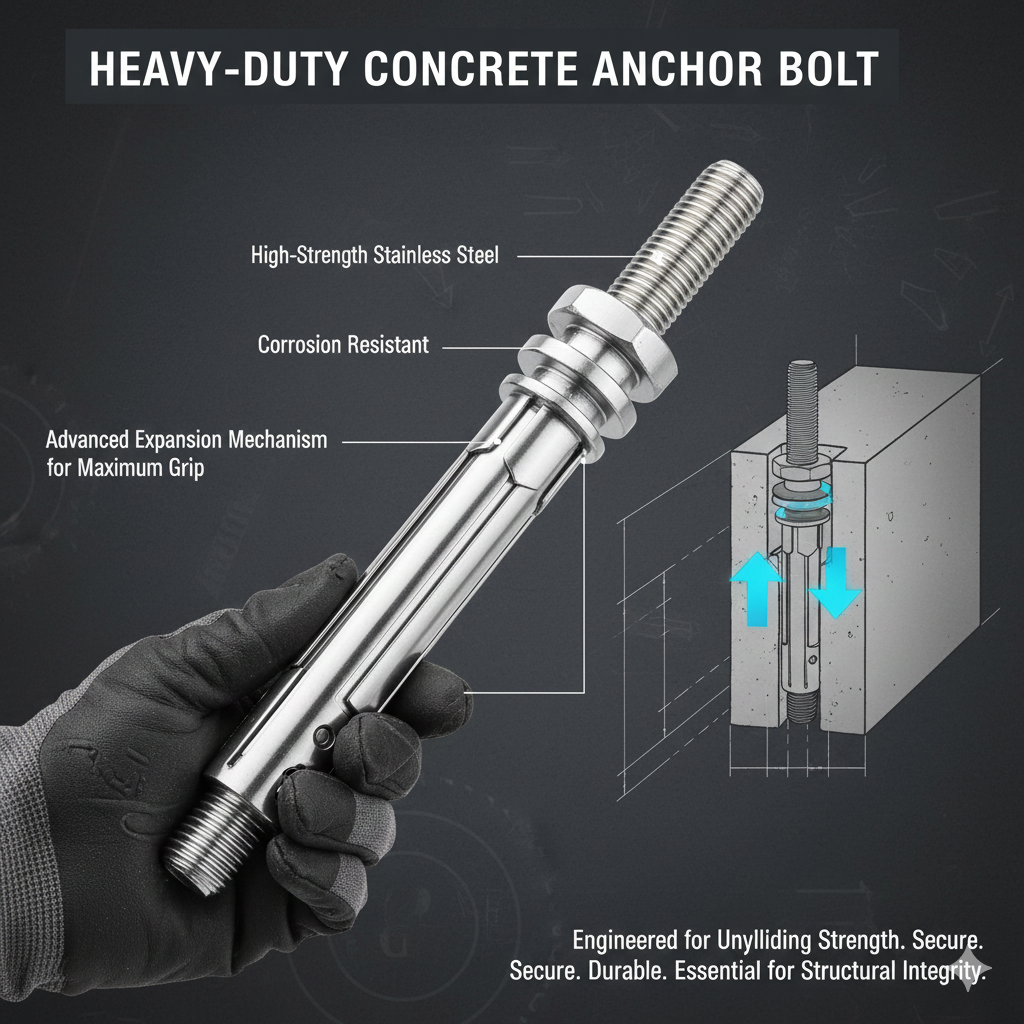
| Expansion anchor | Expands mechanically inside drilled holes | Retrofitting and field work |
| Chemical anchor | Fixed with resin or epoxy | Vibration-prone environments |
Selecting the correct anchor type is essential to ensure long-term joint integrity and reduce maintenance.
4. Manufacturing Process That Determines Strength
Producing reliable anchor bolts requires strict control from raw material to final inspection:
-
Cutting and bending – steel rods formed to exact dimensions.
-
Thread rolling – cold-formed threads improve fatigue strength.
-
Heat treatment – enhances hardness and uniform strength.
-
Galvanizing or passivation – protects against corrosion and humidity.
-
Inspection and testing – dimensional, torque, and tensile tests ensure performance consistency.
Manufacturers such as Jingle provide complete traceability for every batch, with certificates covering material, mechanical testing, and surface coating.
5. Installation Methods That Maximize Performance
Even the strongest anchor bolt can fail if installed incorrectly.
For cast-in-place bolts, precise positioning before concrete pouring ensures accurate alignment.
For post-installed anchors, drilling diameter, depth, and torque must match the bolt’s rated specification.
Installation Best Practices:
-
Clean drilled holes before insertion.
-
Use torque wrenches to achieve correct tension.
-
Avoid over-tightening to prevent thread damage.
-
Verify alignment before grout curing.
Proper installation transforms a strong bolt into a secure structural connection that lasts decades.
6. Testing That Confirms Load Capacity
Each batch of anchor bolts undergoes standardized quality verification:
-
Tensile and yield testing – ensures load-bearing capability under stress.
-
Pull-out tests – simulate real installation conditions.
-
Salt-spray testing (ASTM B117) – evaluates coating durability.
-
Impact tests – confirm stability during vibration or shock loads.
These tests guarantee that every bolt can withstand both static and dynamic forces without loosening or corrosion.
7. Where Anchor Bolts Are Most Widely Used
| Industry | Application | Main Advantage |
|---|---|---|
| Building and construction | Steel columns, base plates | Load distribution and stability |
| Bridges and tunnels | Expansion joints, bearings | Fatigue resistance |
| Energy facilities | Turbines, transformers | Vibration control |
| Industrial machinery | Equipment foundations | Alignment under stress |
| Marine structures | Platforms, retaining walls | Corrosion protection |
In all these sectors, anchor bolts for concrete secure critical load paths that protect both structures and equipment.
8. How to Choose the Right Anchor Bolt Supplier
A reliable supplier ensures not only consistent quality but also engineering support.
When evaluating options, consider:
-
Compliance with ISO 9001 and international standards.
-
Ability to provide customized dimensions and coatings.
-
Documentation for mechanical and corrosion testing.
-
On-time delivery and global logistics support.
A trusted partner supplies more than products — they deliver confidence in structural reliability.
9. FAQ: Questions Engineers Often Ask
Q1: What’s the best surface finish for outdoor anchor bolts?
→ Hot-dip galvanizing offers the highest protection against corrosion.
Q2: Can anchor bolts be customized in length or thread type?
→ Yes, certified factories produce custom bolts from M12 to M72 sizes.
Q3: What standard testing reports should accompany shipment?
→ Material test certificate (MTC), tensile report, and surface coating record.
Q4: How long do galvanized anchor bolts last outdoors?
→ Typically 20–25 years depending on humidity and exposure.
10. Building Stability from the Ground Up
Concrete anchor bolts are the unseen components that keep every column, beam, and machine firmly connected.
Their reliability defines the safety and longevity of modern infrastructure.
When manufactured and tested with precision, they provide lasting stability under every condition.
Learn more about fastening and connection solutions on the Jingle Home Page
or contact our specialists through the Inquiry Page for technical assistance and specifications.