


Why a hose clamp is a small part that can cause a big problem
A hose clamp looks like a minor purchasing decision until it is the part that keeps a fluid line from slipping, leaking, or blowing off under pressure. In manufacturing, automotive service, HVAC, irrigation, marine, and general maintenance work, the right hose clamp is often the difference between a stable assembly and a callback. Engineers and sourcing managers usually know this, but the practical question is not whether a clamp matters; it is which type fits the hose, the media, the vibration level, and the assembly method.
That is why buyers should treat clamp selection as a mechanical fit issue, not a commodity afterthought. A clamp that is too narrow can cut into a soft hose. A clamp that is too loose may never seal properly. And a clamp that looks fine on paper can still perform poorly if it is mismatched to the hose material or the service environment.
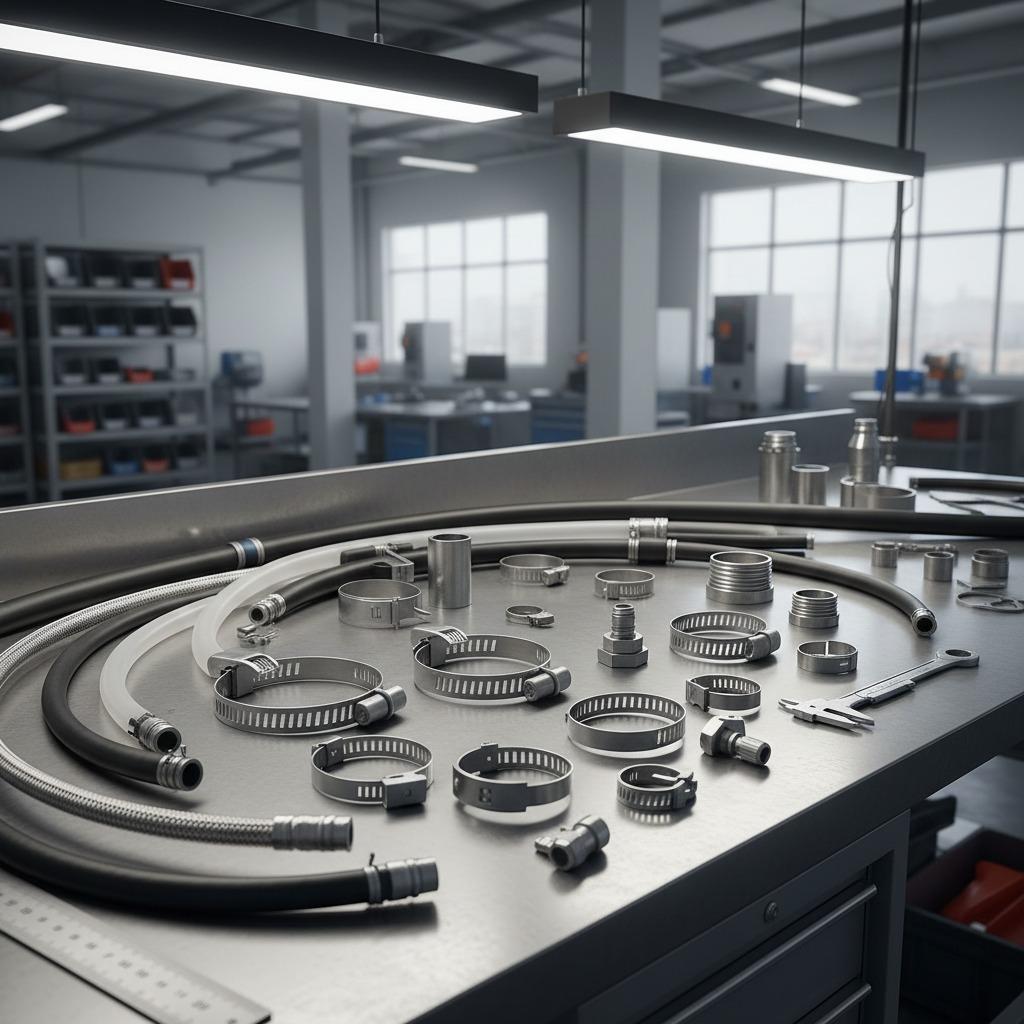
What the clamp is actually doing
At a basic level, a hose clamp creates radial compression around a hose and fitting. The goal is to maintain enough force to support sealing without damaging the hose wall. In practice, the clamp also has to survive vibration, thermal cycling, and long-term creep in the hose material. That matters because many hoses relax over time, especially when exposed to heat or repeated pressure changes.
For that reason, the clamp is not just holding pressure on day one. It is trying to keep a consistent seal after the system has settled in. That is where many field failures begin: the original assembly may have been acceptable, but the combination of hose movement, material relaxation, and poor clamp choice gradually creates a leak path.
Main clamp styles buyers usually compare
Not every hose clamp behaves the same way, and the choice often depends on the assembly and the service load rather than on preference alone.
Screw-drive clamps
These are widely used because they are easy to install and adjust with common tools. They work well in many general-purpose applications, but the worm gear band can concentrate force in places, which is not ideal for every soft hose.
Spring clamps
Spring-style clamps are useful where temperature swings are expected and the joint needs to accommodate expansion and contraction. They can maintain more consistent tension over time, though they are not always the easiest option for field service.
Ear or Oetiker-style clamps
These are often chosen for compact, more controlled installations. They can provide a clean, repeatable fit, but they usually require the right tooling and are less forgiving if the hose OD or fitting geometry is off.
T-bolt clamps
When higher clamping force is needed, especially on larger diameters or more demanding assemblies, T-bolt designs are commonly considered. They are bulkier, but that extra hardware can be useful when vibration or pressure demands are higher.
Selection criteria that matter in real purchasing decisions
Buyers should look beyond nominal diameter. The actual hose outside diameter, the fitting barb design, clamp width, band material, and expected service temperature all influence performance. A clamp that is technically “the right size” may still be wrong if the band width is too narrow for the hose wall or if the material is not suitable for the environment.
Corrosion resistance deserves attention as well. In wet, coastal, chemical, or outdoor settings, a clamp material that works indoors may degrade too quickly. Stainless steel is often considered for tougher environments, but even then, buyers should check the specific grade and whether the application calls for a plain band, a coated part, or a specialty finish. It is easy to over-specify in one area and under-specify in another.
Another practical point: installation access. If a technician cannot reach the clamp properly, a theoretically strong design may end up under-tightened or inconsistently positioned. That is not a design flaw in the clamp alone, but it becomes a real production problem.
Common mistakes that cause failures
One frequent mistake is using the same clamp family across different hose materials. Soft silicone, reinforced rubber, and rigid thermoplastic lines do not behave the same way. Another is overtightening. More force is not always better; it can deform the hose, create a leak path, or damage the sealing surface.
Buyers also sometimes ignore vibration. A clamp that works in a static test can loosen or shift in a machine with continuous motion. That is why engineers often review the whole joint, not just the clamp, including the fitting geometry and the expected motion of the hose.
Practical advice for sourcing teams and engineers
If you are comparing hose clamp options, ask for dimensional data, material information, and the recommended application range. If the supplier can describe the clamp’s intended hose types and installation conditions clearly, that is usually a better sign than a vague “universal use” claim. Universal often means compromised.
For production work, sample testing on the actual hose and fitting combination is worth the effort. Even a short validation run can reveal whether the clamp seats properly, whether the hose cold-flows, and whether installation is consistent across operators. That is cheaper than discovering the problem after shipment.
A quick buyer’s check before placing an order
Before you commit, confirm five basics: hose size, hose material, fitting style, service environment, and installation method. If any one of those is unclear, the clamp choice is probably premature. A little extra review at the purchasing stage can save a lot of rework later.
What to do next
For teams sourcing hose clamp components, the best next step is to compare the clamp style against the exact hose assembly, not the catalog description alone. If you are building a new product, lock down the joint geometry early. If you are replacing an existing part, inspect the failure mode first. The clamp may be the visible issue, but the root cause is often the way the whole connection was designed and assembled.





