Wire Loop Box Supplier Guide: Joint Evidence, Quality Checks, and a Better RFQ
Quick answer: choose a wire loop box supplier by verifying one controlled connection system, not by comparing box dimensions or rope diameter in isolation. Give every bidder the approved joint basis, exact product or assessment route, element geometry, reinforcement interfaces, grout system, service conditions, quantities, inspection plan, and document expectations. Ask each supplier to return a signed compliance matrix, model-specific evidence, deviations, lot-trace method, packaging plan, and commercial assumptions. The project engineer still approves the joint and all design values.
Evaluating a wire loop box supplier brings several disciplines to the same table. The component buyer sees a steel box, flexible loops, labels, cartons, and a price. The precast designer sees a load path, concrete anchorage, reinforcement congestion, joint behavior, durability, and erection movement. The plant sees a cast-in item that must be fixed to formwork and survive placing and compaction. The site team sees loops that must be exposed, aligned with the approved detail, combined with specified reinforcement, and enclosed by the specified joint material. Quality has to connect all of those views to one model, revision, production lot, shipment, and installation record.
That is why a short enquiry such as “wire loop box, standard size, galvanized, send best price” produces weak quotations. It leaves the bidder to invent the intended use, assessment basis, joint configuration, model identity, finish, packing, inspection, and exclusions. A low price built on different assumptions is not a saving; it is an unresolved technical change hiding in a commercial spreadsheet.
If you already have approved drawings, a product schedule, estimated quantities, destination, and open supplier questions, Send your wire loop box RFQ package. A useful first discussion can identify missing commercial or manufacturing inputs, but it cannot replace the project's design review.
1. What a wire loop box is - and what it is not
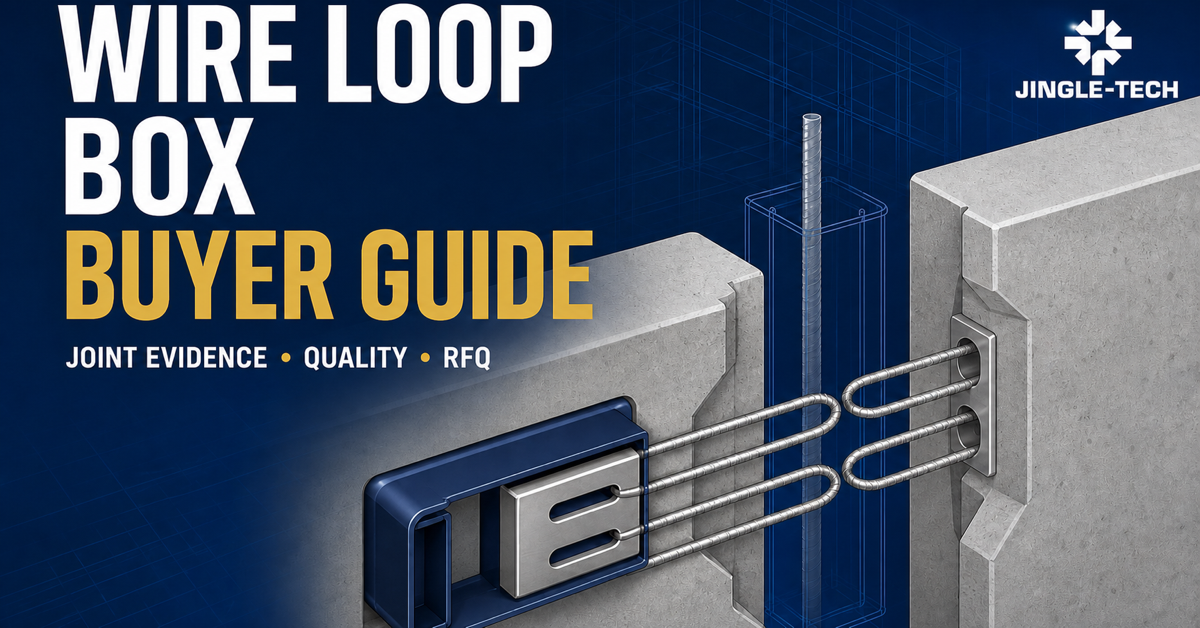
Within the scope described by the European Organisation for Technical Assessment, a wire loop system is a cast-in connection product that combines a box with flexible wire-rope loops. The loops are stored in the box before use and are opened for the approved connection arrangement. The current EAD 332589-01-0601 describes assessment methods for wire loop systems used to connect precast and in-situ concrete elements or two precast elements within its defined conditions. It is an assessment document, not a catalogue of interchangeable products.
A wire loop box is also not a lifting loop. The word “loop” causes avoidable confusion in multilingual bills of material. A lifting device is selected and used for temporary handling under its own system rules. A wire loop box discussed here is part of a permanent concrete connection. Never use a lifting capacity, lifting certificate, rope catalogue value, or visual similarity as evidence for permanent-joint performance. Keep the product family, drawing symbol, label, storage location, and purchasing description unambiguous.
Nor is the box alone the joint. The joint includes the connected concrete components, the embedded portion of the system, local reinforcement, the loop arrangement, any longitudinal or closure bar required by the approved detail, the joint geometry, the specified grout or concrete, surface condition, execution sequence, and acceptance records. If one interface changes, engineering must decide whether the existing evidence still applies.
2. Define the connection package before asking for a price
The most useful sourcing boundary is a connection package. It is wider than the purchased box but narrower than the whole building.Procurement does not have to design this package; it has to preserve the approved definition and make bidders respond to the same one.
| Interface | Controlled project input | Supplier response | Release owner |
|---|---|---|---|
| Wire loop system | Exact approved model or performance route, revision, orientation, quantity, and any project-specific restrictions. | Quoted identity, current data, conformity route, manufacturing location, exclusions, and deviations. | Project design and procurement teams. |
| Concrete components | Member types, concrete specification, thickness, reinforcement arrangement, cover, edges, openings, and cast sequence. | Compatibility questions and product envelope stated without inventing design values. | Licensed design professional and precast detailer. |
| Joint and reinforcement | Joint type, approved geometry, box layout, loop relationship, reinforcement, movement, load directions, and design actions. | Model-specific evidence cross-reference and a list of data still required. | Project engineer. |
| Joint material | Approved product, properties, mixing, placement, curing, exposure, and acceptance requirements. | Permitted material identity under the offered system evidence; no silent substitute. | Specifier and site quality team. |
| Execution and records | Approved method, hold points, competent persons, inspections, nonconformance route, and handover documents. | Product instructions, storage limits, traceability format, sample records, and technical support boundary. | Contractor, precaster, erector, and authorized inspector. |
This table exposes a critical commercial fact: two suppliers can quote boxes that look similar while offering different connection packages. One may base its offer on a named assessed system with a specific grout and declared use. Another may offer a drawing-controlled component without equivalent system evidence. A third may provide a loose approximation. The buyer should not force those offers into one price column until engineering has confirmed that the technical bases are comparable.
3. Freeze design responsibility before supplier selection
Precast connections influence strength, stability, serviceability, durability, movement, erection, and the integrity of the completed system. The Precast/Prestressed Concrete Institute's connection guidance explains that connection loads and locations are commonly shown by the architect or engineer of record while final connection design and details may be developed through the successful precast producer's engineering team. The exact allocation varies by contract. It should never be left to inference in an RFQ.
Write a responsibility matrix before asking suppliers to optimize. Identify who supplies design actions, who selects the system, who checks local anchorage and reinforcement, who approves shop drawings, who owns joint-material specification, who prepares the installation method, who accepts deviations, and who releases production. If the supplier proposes a different system, state whether the response is an alternate for engineering review or a compliant base bid. Never allow “supplier to design” to stand alone without deliverables, design criteria, checking responsibility, professional requirements, and approval gates.
For projects using the ACI/PCI route, the current ACI/PCI CODE-319-25 provides minimum requirements for structural precast concrete within its scope. European projects may use Eurocode provisions with national adoption and annexes. The European Commission Joint Research Centre notes a continuing transition to second-generation Eurocodes, including national implementation steps; see the official second-generation Eurocodes timeline. A bidder should therefore quote the exact project-adopted code and edition, not simply write “designed to international standards.”
4. Read EAD, ETA, DoP, and CE claims correctly
These terms are related but not interchangeable. EOTA explains that a European Assessment Document is a harmonised technical specification used as the basis for a European Technical Assessment. An EAD defines the product family, intended-use conditions, essential characteristics, assessment methods, and principles for constancy-of-performance verification. It does not declare that every product of a similar shape has passed those assessments.
An ETA is product-specific. It documents assessed performance for a defined product, holder, manufacturing context, intended use, and assessment basis. A Declaration of Performance and CE marking follow the applicable legal route. Another manufacturer's ETA can teach a buyer what a complete document looks like; it cannot prove JingleFix performance, authorize a substitute, or transfer values to a different model or factory.
EOTA's current EAD register lists EAD 332589-01-0601 as cited and shows that it supersedes 332589-00-0601. The consolidated EUR-Lex implementation list provides the official citation context. That status is useful when reviewing a European submittal, but it does not answer whether a particular offered model, factory, document version, or intended use is covered. Ask for the actual current documents and check their identity fields line by line.
A practical document-identity check
- Match the product trade name, exact model, and variants to the quotation and label.
- Match the assessment holder and manufacturing location or authorized production scope.
- Check issue date, version, amendment, and whether the document remains current for the order.
- Read the intended use and boundary conditions rather than jumping to a performance table.
- Confirm the joint configuration, concrete components, reinforcement, joint material, and execution assumptions match the approved project detail.
- Trace every quoted value to the offered product and its declared characteristic; do not import a value from a different model.
- Record gaps as deviations or requests for information. Silence is not compliance.
5. Use EOTA TR074 only inside its stated boundary
The current EOTA technical-reports register identifies TR074 as the 2022 edition.The report supports the design of wire loop systems covered by an appropriate ETA in accordance with the referenced EAD route. It relies on resistances stated in the relevant ETA. That sentence matters more to procurement than any equation: the calculation route does not manufacture missing product data.
The official EOTA TR074:2022-04 discusses actions and resistances for specified directions and combinations within its scope. A purchasing article should not turn that framework into generic capacity. The design team needs the project actions, relevant national rules, product-specific ETA data, concrete and reinforcement details, joint material, geometry, and applicable limit states. Procurement's job is to keep that chain intact.
Do not write “TR074 compliant, therefore approved” on a comparison sheet. Ask instead: Which exact ETA provides the product data? Which product and use does it cover? Which project detail was checked? Which calculations and drawings are submitted, by whom, and to whom? Which assumptions must be maintained in production and on site? These questions convert a standards reference into auditable evidence.
6. Build a wire loop box RFQ that suppliers can answer
A good RFQ separates three kinds of information: fixed requirements, supplier returns, and open decisions.Fixed requirements are released by the buyer's authorized team. Supplier returns show exactly what is offered. Open decisions are visible questions with owners and due dates. Mixing the three produces accidental approvals.
| RFQ block | What the buyer sends | What the bidder must return |
|---|---|---|
| Identity and use | Project, joint marks, member types, drawing revisions, design responsibility, and intended connection role. | Exact product, model, revision, offered use, origin, and list of assumptions. |
| Technical basis | Adopted code/edition, approved assessment route, design actions supplied to the bidder, and required calculations or submittals. | Model-specific evidence, calculations within contracted scope, drawings, and explicit departures. |
| Geometry and interfaces | Controlled component and joint drawings, box locations/orientations, reinforcement interfaces, and permitted construction sequence. | Product drawing, critical dimensions, installation envelope, and clashes or unresolved inputs. |
| Material and durability | Exposure, service environment, material/coating requirements, compatible concrete and joint material, and prohibited substitutions. | Material route, finish/coating, certificates, storage limits, and evidence linked to the offered product. |
| Quality and traceability | Lot definition, inspection characteristics, frequency/plan, document type, change notification, retention, and nonconformance process. | Inspection plan, sample records, label, lot map, certificate linkage, and sub-supplier controls. |
| Commercial and delivery | Quantity by model, forecast, releases, destination, Incoterm, requested milestones, packaging, and site sequence. | Price breakdown, tooling, sample/pilot terms, production batch assumptions, schedule gates, validity, freight, and exclusions. |
Attach a compliance matrix in editable form. Give each requirement a unique ID and require “comply,” “deviation,” or “not applicable,” followed by a document reference. A checkmark without a page, clause, drawing, report, or controlled statement is difficult to audit. Require the bidder to list every document used, its version, and the product identity it supports.
7. Review materials without confusing component tests and joint resistance
The visible loop is commonly made from wire rope, but rope evidence and joint evidence answer different questions. The official ISO 2408:2017 page states that the standard covers requirements for manufacture, testing, acceptance, packing, marking, and quality certificates for specified wire ropes. ISO 2232:2022 covers specified round non-alloy steel wires used for certain wire ropes, including dimensions, mechanical characteristics, coatings, sampling, and acceptance. Those scopes help a buyer ask better material questions.
ISO 3108:2017 specifies a tensile test method for determining measured breaking force of steel wire ropes. A measured rope breaking force is not the resistance of a completed wire-loop joint. Joint behavior also involves loop termination, box and loop geometry, anchorage in concrete, concrete and reinforcement, joint material, spacing and edges, load direction and combination, execution, and the approved design model. Never divide a rope test value by a guessed factor and publish a joint capacity.
Ask the supplier to identify the steel-sheet material, wire and rope specification, rope construction, finish or coating, termination method, and inspection route for the offered model. Request document linkage from incoming material through manufacturing lot to carton. If the product includes welds involving reinforcing steel or a connection device, the design and quality team should determine whether ISO 17660-1:2006 for covered load-bearing welded joints or ISO 17660-2:2006 for covered non-load-bearing welded joints is contractually relevant. Both published editions are under revision as of this article's check date, so the order must name the approved edition. Do not claim either standard applies merely because metal parts touch.
8. Control dimensions as functional relationships
A supplier drawing becomes useful when it shows how the product fits the approved joint. Box length, width, depth, profile, opening, loop projection, embedded tail envelope, orientation, label position, and any fixing features should be defined using consistent datums. The drawing should also show which dimensions are reference only, which are inspected, and which are inherited from an assessment document or controlled product specification.
The buyer should not invent a universal tolerance. Production tolerances, element tolerances, erection tolerances, and interfacing tolerances accumulate. PCI's current PCI 135-25 provides a consensus specification for tolerances across precast manufacturing and building processes within its scope and supersedes the tolerance values in the older MNL 135. That does not automatically set a wire loop box tolerance; it reminds the project team to coordinate product, element, erection, and joint interfaces under the adopted requirements.
Ask the bidder for a tolerance stack discussion around the approved layout: Can the loops be opened without conflict? Does the joint reinforcement occupy the same zone? Can the joint material surround the connection as specified? How will the site team identify a wrong orientation or model before closure? What happens when an embed or member is outside the accepted project limit? The answers should be drawings, checks, and a nonconformance route - not a promise that installers can “adjust on site.”
9. Treat durability as a system decision
“Galvanized” is not a complete durability specification. The buyer needs the exposure and design-life basis, material and coating system, embedded and exposed zones, compatibility with concrete and joint material, storage conditions, damaged-coating repair rule, and acceptance method. A rope, box, clamp, and reinforcement may not share the same material or coating. Their contact and exposure conditions can differ before and after the joint is closed.
Request the exact finish for each component and the evidence required by the approved product specification. If coating thickness, mass, appearance, adhesion, or corrosion testing is contractual, name the method and acceptance rule. A generic salt-spray duration is not a universal service-life prediction. Likewise, stainless material is not a blanket answer; alloy, condition, contact materials, contamination control, and project exposure still matter.
Packaging is part of durability control.Boxes should arrive dry, identifiable, and protected from damage that could deform the casing, trap contamination, impair loop deployment, or separate labels from lots. The supplier's storage statement should address weather, condensation, stacking, shelf or inspection limits if any, and the action required after compromised packaging. Site teams need a quarantine route rather than an instruction to wipe and use.
10. Summarize installation for procurement without writing a method statement
Procurement needs enough execution knowledge to buy the right package, yet the approved installer method belongs to the project. At a high level, the product is normally identified against the drawing, fixed to formwork in the approved position and orientation, protected during concreting, exposed after stripping, inspected, opened as directed by the product instructions, combined with the specified joint reinforcement, and enclosed by the approved joint material under the project sequence. Each verb hides project-specific limits and safety controls.
The EAD scope describes boxes fixed to formwork before concreting, folded loops opened for the connection, and joint filling for covered precast-to-precast uses. It does not give permission to substitute a box, bend a loop arbitrarily, relocate reinforcement, enlarge a joint, change the grout, or accept damaged product. Those decisions require the system instructions and authorized project review.
For a separate installation-focused overview, see how connecting loops support precast wall installation workflows. Use that page as orientation only, then follow the approved product instructions, drawings, risk assessments, erection plan, and site inspection plan.
Procurement-sensitive installation questions
- How is the model and orientation visible before and after casting?
- What formwork fixing features or accessories are included, and which are project-supplied?
- What damage requires quarantine, supplier review, or replacement?
- Which tools are permitted to expose and open loops, and which actions are prohibited?
- What reinforcement and joint-material inputs must be on the approved drawing?
- Which hold points occur before casting, after stripping, before joint closure, during joint filling, and at handover?
- What lot and inspection records remain traceable after the box is embedded?
11. Make the joint material part of the approved system
A box quotation often excludes grout or joint concrete, but design performance can depend on it. The current EAD includes defined joint-casting-grout conditions for covered uses and links assessment to the stated material route.Buyers should therefore ask whether the offered system requires a named product, a property-based specification, a controlled consistency, a specific preparation and placing method, or other limits stated in the product evidence.
Do not accept “equivalent non-shrink grout” as a self-approving substitution. The proposed material may differ in flow, segregation resistance, shrinkage behavior, strength development, bond, temperature limits, durability, installation thickness, mixing sensitivity, or compatibility. The responsible specifier must review the exact proposal against the connection design and product evidence. Record an approved substitution by product, revision, and conditions of use.
The construction specification should also define who supplies the material, who checks batch identity and shelf condition, who controls water and mixing, who confirms substrate and weather readiness, who observes filling and curing, and what record closes the hold point. ACI SPEC-301-20 is an official reference specification that an architect or engineer can apply and supplement for concrete construction within its scope. The adopted project specification, not this buyer guide, defines the actual work.
12. Request a technical submittal that can be audited
A glossy catalogue proves very little. Ask for a controlled submittal package and give each file a required purpose.The package should let a reviewer move from quotation to product, from product to evidence, from evidence to drawing, and from drawing to production and site records.
| Document | What it should establish | Identity check | Common weakness |
|---|---|---|---|
| Product data and drawing | Offered model, geometry, materials, finish, labels, interfaces, and controlled revision. | Quotation model and drawing revision match. | Generic family sheet with no offered-model mark. |
| Assessment and declaration | Applicable performance route, intended use, characteristics, limitations, holder, and production context. | Product, holder, factory/scope, version, and use align. | Another brand's ETA or an expired/irrelevant page. |
| Project calculations and detail | Connection check under supplied actions and approved boundary conditions. | Project, joint mark, model, code/edition, author, checker, and status. | Unstamped marketing table or calculation for another geometry. |
| Manufacturing and inspection plan | Process route, controlled characteristics, methods, frequency, lot definition, records, and change control. | Plan revision is released for the quoted model and site. | A checklist with no acceptance criteria or lot link. |
| Installation and storage instructions | Permitted handling, fixing, exposure, opening, inspection, storage, and damage response. | Model and revision match shipped product. | Uncontrolled video or translated excerpt without revision. |
| Sample shipment dossier | Material/process linkage, inspection results, certificate, label, packing list, and lot trace. | One part and lot can be followed through every record. | Certificates with no part number, lot, or shipment relationship. |
Ask for redacted examples when confidentiality prevents release of live customer records. A redacted document can still show structure, revision control, lot linkage, sign-off, and the quality of problem solving. It should not expose another customer's drawing, name, price, or proprietary requirement.
If you want to compare a proposed technical dossier against your drawing list and RFQ fields, Request a wire loop box document review discussion. Any engineering approval remains with the buyer's authorized project team.
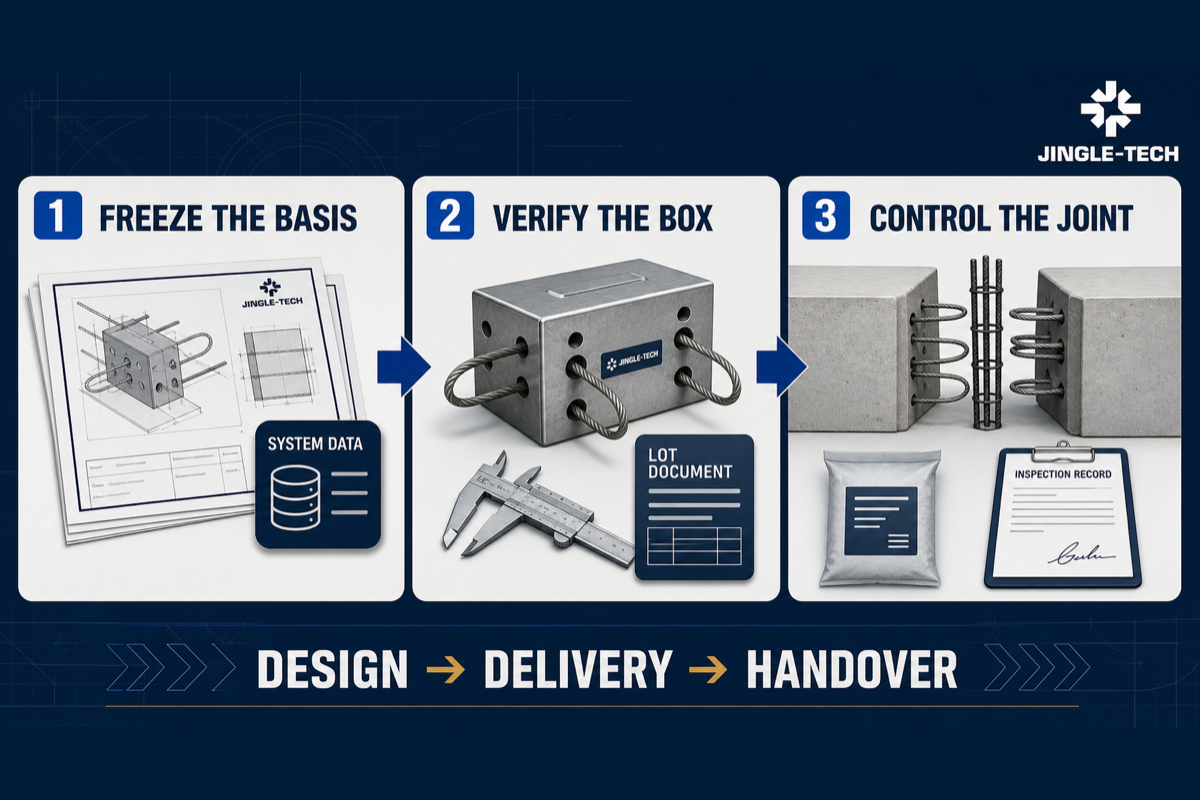
13. Define inspection by risk, not by habit
Incoming inspection should confirm identity and condition before product disappears into concrete. Manufacturing inspection should control the characteristics that create the released product. Site inspection should verify the joint at the project hold points. Those three plans are related but not duplicates.
The current ISO 2859-1:2026 defines AQL-indexed sampling schemes for lot-by-lot inspection by attributes within its scope. It replaced the 1999 edition. Citing it does not select an AQL, inspection level, lot definition, sample size, or treatment of a critical characteristic. The contract must make those choices through an approved quality plan.Some safety- or fit-critical characteristics may require process controls, first-article verification, proof or system testing, or full inspection according to the design and governing requirements.
| Gate | Typical evidence | Decision | Record linkage |
|---|---|---|---|
| Supplier release | Released drawing, material/process records, dimensional/functional results, label, and packing list. | Release, rework, sort, concession request, or reject. | Product model, revision, production lot, carton, and shipment. |
| Buyer receipt | PO and label identity, quantity, packaging condition, certificate presence, visual condition, and approved measurements. | Accept to controlled storage or quarantine. | Receipt, carton, lot, storage location, and inspection record. |
| Before element casting | Correct model, location/orientation, fixing, surrounding reinforcement, condition, and drawing status. | Close hold point or raise nonconformance. | Element mark, joint mark, lot, drawing, inspector, and date. |
| Before joint closure | Element alignment under project limits, box/loop condition, approved reinforcement, cleanliness, joint-material identity, and weather readiness. | Authorize closure or stop and escalate. | Joint mark, element marks, material batches, approved method, and inspection photos if required. |
| Handover | Completed hold points, joint-material records, curing/acceptance evidence, nonconformance closure, and as-built trace. | Accept, restrict, investigate, or repair under approved instruction. | Permanent joint/element record and project dossier. |
Do not ask an incoming inspector to reverse-engineer product performance from a caliper and tensile report. Incoming inspection can confirm selected characteristics and identity; it cannot recreate an ETA assessment or prove the completed joint. Define what each record can and cannot establish.
14. Preserve traceability after the product is embedded
A box may be visible for minutes during placement and then inaccessible for the life of the element. Traceability must move from the carton to the element record before that happens. A practical chain is: supplier production lot to carton label, carton label to goods receipt, issue transaction to precast bed or element batch, pre-pour inspection to element mark and joint mark, and final joint record to the connected elements.
Agree the lot definition before ordering. A “lot” may be material-based, production-shift-based, model-based, process-based, or shipment-based.If the supplier's definition is too broad to isolate a suspect process, a future containment action becomes expensive. If it is too narrow without operational value, paperwork grows without improving decisions. Quality, engineering, and the supplier should define a useful boundary.
Labels should remain readable through transport and controlled storage. Specify at least the buyer part number, supplier item, model, revision, lot, quantity, PO, and any storage or inspection status required by the project. Barcodes or QR codes can reduce transcription but should not hide essential identity behind a dead web link. Keep a human-readable fallback.
15. Audit the supplier around one real route
A capability presentation can be useful orientation. An audit becomes meaningful when it follows one representative product through the actual route. Choose the offered model or the closest controlled family. Start with contract review, then follow drawing release, incoming sheet and rope, cutting or forming, termination, box assembly, any outside process, inspection, labeling, packing, and record retention. Ask what happens when a characteristic fails.
Outside processing is not automatically a weakness. Hidden outside processing is. Require the supplier to identify which steps are internal, which are subcontracted, how suppliers are approved, how specifications and revisions flow down, how lots remain linked, and how changes are notified. Review a redacted purchase specification and returned certificate rather than accepting “approved vendor” as a complete answer.
Questions that reveal control quality
- How does contract review stop an unapproved model or old revision from entering production?
- Which characteristics are process-controlled, which are inspected, and why?
- How are rope, wire, sheet, clamp, finish, and any reinforcement-related records linked to a production lot?
- What is the approved response to damaged rope, distorted box, incomplete termination, unreadable marking, or mixed lots?
- How is measurement equipment selected and controlled for each characteristic?
- Which changes require buyer notification before implementation?
- Can the team show one closed corrective action that reached root cause and verified effectiveness?
- How are translated instructions reviewed so technical meaning and revision status remain controlled?
16. Normalize quotations before choosing a supplier
Unit price is only comparable after scope is comparable. Create a landed and risk-adjusted view without inventing a false precision score. Separate base product, documentation, testing, calculations, tooling, sample or pilot work, packaging, freight, duties, stock, and schedule. Then display exclusions and unresolved technical decisions beside the price.
| Line | Normalize | Ask the bidder | Buyer check |
|---|---|---|---|
| Technical scope | Exact model, system evidence, drawings, calculations, instructions, and deviations. | What is included, excluded, preliminary, or dependent on buyer approval? | Engineering comparability confirmed before price ranking. |
| Quantity basis | Annual estimate, production batch, release, carton, model mix, and forecast flexibility. | Which price changes at which quantity or mix? | Compare usable releases, not only largest tier. |
| One-time cost | Tooling, engineering, samples, pilot, third-party assessment, and buyer witness. | Who owns tools/data, what is refundable, and what triggers recurrence? | Ownership, maintenance, transfer, and change terms written. |
| Recurring evidence | Certificates, inspection reports, testing, labels, and document language. | Which records are standard, optional, or charged per lot? | Evidence matches contract risk and is lot-linked. |
| Schedule | Review, approval, tool/material readiness, production, outside process, inspection, pack, freight, and release. | Which dates are estimates, commitments, or waiting on buyer action? | Critical gates align with precast and erection sequence. |
| Logistics and risk | Incoterm, freight, duties, buffer, packing, storage, damage, shortages, and recovery. | What is the containment and replacement path for a suspect lot? | Total project exposure is visible beside landed cost. |
Never publish a universal MOQ or lead time. Both depend on model, evidence route, raw material, tools, manufacturing location, testing, quantity, mix, packaging, approvals, season, and destination. Ask suppliers to break the schedule into gates and state the assumptions behind each commercial number. That gives the buyer something to manage when a drawing approval or material release moves.
17. Hypothetical sourcing scenario: why the cheapest box may not be the cheapest joint
Hypothetical example - not a JINGLE project or customer case: A precast buyer receives three offers for a wall-joint program. Bidder A quotes the lowest unit price against a sketch and says “standard capacity.” Its dossier has a family brochure, no model-specific assessment, no declared grout relationship, and no lot-linked sample record. Bidder B quotes a named system, identifies a project-geometry conflict, and excludes calculations until design actions are supplied. Bidder C quotes a visually similar custom box and submits a rope certificate as the principal performance evidence.
If procurement ranks only unit price, A wins. A compliance review changes the picture. A's missing basis creates an engineering delay and possible redesign. C's rope certificate cannot establish joint resistance. B has not yet proved suitability, but it has separated knowns, gaps, and responsibilities. The buyer can now issue the same missing design inputs to all bidders, request model-specific evidence, and compare a compliant base bid with clearly labeled alternatives.
The lesson is not that the highest price is best. It is that unresolved scope is a cost. The strongest commercial process makes uncertainty visible early, assigns it to the right owner, and prevents an attractive number from becoming an unapproved technical substitution.
18. Connect the topic to related JingleFix sourcing guides
A wire loop box belongs to a broader supply program. Use the following internal resources when the purchase package reaches adjacent product families:
- For drawing control, sourcing routes, and supplier qualification across special hardware: custom fastener manufacturer.
- For thread-forming parts and screw-specific RFQ questions: custom screw manufacturer.
- For code-controlled bolting packages and traceable assembly evidence: structural bolt manufacturer.
- For anchor selection, project inputs, and concrete-fastening evidence: concrete anchor manufacturer.
- For drawing-controlled internal threads and nut inspection: custom nut manufacturer.
- For clamp geometry, material, and assembly-focused sourcing: hose clamp manufacturer.
- For temporary handling systems, where permanent connecting loops must not be confused with lifting products: lifting anchor manufacturer.
- For a wider embedded-item and precast-component supply strategy: precast concrete accessories manufacturer.
- For machined fixtures, gauges, plates, and drawing-controlled metal parts: precision CNC machining parts manufacturer.
- For programs combining standard hardware, custom components, and machined parts under one BOM: OEM fastener and machined parts supplier.
19. Frequently asked questions about wire loop box suppliers
What should I send first to get a useful wire loop box quotation?
Send the controlled joint and element drawings, approved product schedule or performance route, code and edition, design responsibility matrix, quantities by model, required evidence, packaging, destination, requested milestones, and a list of open questions. If design actions or joint details are not released, state that clearly and request a preliminary budget with assumptions rather than a final compliant quote.
Is an ETA required for every project?
There is no universal answer. The applicable regulatory route, project specification, jurisdiction, intended use, and contract decide what assessment or approval is required.If an ETA is specified, request the product-specific current document and verify that the offered model, holder, production scope, use, and boundary conditions match. A supplier should not borrow another manufacturer's ETA.
What is the difference between an EAD and an ETA?
An EAD sets the harmonised assessment framework for a product family and intended use. An ETA records assessed performance for a particular product and holder under that framework. The EAD does not declare performance for every similar item. The ETA does not automatically approve a project joint; the designer must use relevant declared data within its conditions.
Can I calculate joint resistance from the wire-rope breaking force?
No. Rope breaking force is a component test result under a stated method. Joint resistance depends on the complete assessed and designed system, including terminations, geometry, concrete, reinforcement, joint material, load direction and combination, spacing, edges, execution, and limit states. Use only the approved product-specific design data and method.
Is a wire loop box the same as a lifting loop?
No. A connecting-loop box forms part of a permanent joint; a lifting product is used for temporary handling under a separate system. Similar words or rope construction do not make the products interchangeable. Keep drawings, labels, stores, inspection records, and instructions clearly separated.
Can two boxes with the same external dimensions be substituted?
Not on dimensions alone. Products can differ in rope, termination, embedded geometry, box profile, material, finish, assessment basis, intended use, joint material, instructions, and declared performance. Submit the exact alternate through the project's engineering and change-control process before ordering or use.
Can the supplier choose box spacing and joint width?
The supplier may provide product data and a proposal within its contracted design scope, but universal values are unsafe. The authorized designer must approve layout and joint geometry using project actions, element details, reinforcement, product-specific evidence, construction sequence, movement, durability, and adopted rules.
Can I change the joint grout if the specified product is unavailable?
Only after an authorized technical review. Joint material can be part of the assessed system and can affect filling, bond, shrinkage, strength development, durability, and execution. Submit the exact proposed material, data, method, and compatibility evidence. Record approval and conditions before site use.
Which dimensional tolerances should be placed on the RFQ?
Use the released product drawing and approved project tolerance strategy.Coordinate box manufacturing, embed location, element production, erection, reinforcement, and joint interfaces. There is no single tolerance that works for every box or joint. Ask the supplier to flag process capability or measurement conflicts before quote acceptance.
Should incoming inspection measure every box?
Not automatically. The approved quality plan should classify characteristics by risk and define lot, method, frequency, acceptance, escalation, and record. Identity or critical-condition checks may differ from ordinary dimensions. Acceptance sampling is not a substitute for process control or product-specific performance evidence.
What documents should accompany each shipment?
The purchase order should decide. A typical controlled dossier may include certificate of conformity, material or process linkage as specified, inspection results, label and lot map, packing list, and any assessment or declaration documents that must accompany or remain accessible. Every record should point to the model, revision, lot, quantity, and shipment.
How should damaged or hard-to-open loops be handled?
Stop, identify, and quarantine the affected product or element. Follow the approved manufacturer instruction and project nonconformance process. Do not heat, weld, cut, straighten, extend, replace, or force a loop unless a written repair or disposition is approved by the authorized parties.
What determines MOQ and lead time?
Model mix, material availability, tool and gauge readiness, assessment or approval work, production route, outside processes, inspection, document package, packing, release quantity, destination, and buyer approval gates all matter. Ask for a schedule breakdown and price basis rather than treating one number as universal.
How often should the standard and product dossier be reviewed?
Review them at contract formation, project or model change, supplier or factory change, relevant standard revision, process/material change, significant nonconformance, and the project's scheduled interval. A new standard edition does not silently rewrite an existing order. The authorized team should assess the change and formally update future releases when required.
20. Official sources and edition-control checklist
Editorial verification date: 24 August 2026. The links below point to official standards bodies or industry institutions and were checked for publication context on that date. Catalogue pages and previews establish scope and status; they do not replace licensed standards, complete assessment documents, adopted codes, project specifications, released drawings, or professional judgment.
- EOTA EAD register - lists EAD 332589-01-0601 as cited and the superseding document for 332589-00-0601.
- EAD 332589-01-0601 - assessment document for the stated wire loop system product family and intended-use conditions.
- EOTA Technical Reports register and TR074:2022-04 - design support for systems with the relevant ETA and product-specific resistances.
- EOTA: What is an EAD? - official explanation of the EAD and ETA route.
- EUR-Lex consolidated EAD citation list - official European Union publication context.
- European Commission JRC Eurocodes transition page - second-generation availability and national implementation timeline.
- ACI/PCI CODE-319-25 - structural precast concrete code requirements and commentary within its scope.
- PCI Connections - official connection design considerations and responsibility context.
- PCI 135-25 - current specification for tolerances of precast concrete within its scope.
- ACI SPEC-301-20 - reference specification for concrete construction that the architect or engineer may apply and supplement.
- ISO 2408:2017 - steel wire rope requirements within its stated scope; ISO shows it as confirmed.
- ISO 3108:2017 - measured breaking-force test method for steel wire ropes; ISO confirmed the edition in 2023.
- ISO 2232:2022 - specifications for stated round non-alloy steel wires used in covered rope applications.
- ISO 15630-1:2019 - test methods for reinforcing bars, rods, and wire; ISO confirmed this edition in 2024.
- ISO 6935-2:2019 - technical requirements for ribbed reinforcing bars within its scope; ISO shows the edition under review.
- ISO 17660-1:2006 and ISO 17660-2:2006 - published welding standards for their covered reinforcing-steel joint categories; both have replacement work in development.
- ISO 2859-1:2026 - current lot-by-lot attribute-sampling schemes within its scope.
At purchase-order release, copy the exact approved edition and document revision into the order and supplier acknowledgement. If a source changes later, evaluate the effect through formal change control. Avoid “latest standard” on a production line unless the contract also defines who reviews new editions, when they apply, and how the product baseline is reapproved.
21.Turn the guide into a defensible supplier inquiry
A strong inquiry tells the supplier what is fixed, what must be returned, and what remains open. Send the approved joint and element drawings, required product or performance route, project code and edition, quantities by model, service and durability inputs, joint-material basis, quality and traceability requirements, packaging, destination, and schedule gates. Ask for a model-specific compliance matrix, technical dossier, sample lot record, deviation list, and commercial breakdown.
The result is not an automatic approval and cannot, by itself, guarantee project performance, cost, or delivery. It is a better decision record. Engineering can see the system boundary; quality can see the evidence and lot path; procurement can compare like with like; and the supplier can raise missing inputs before the product reaches concrete.