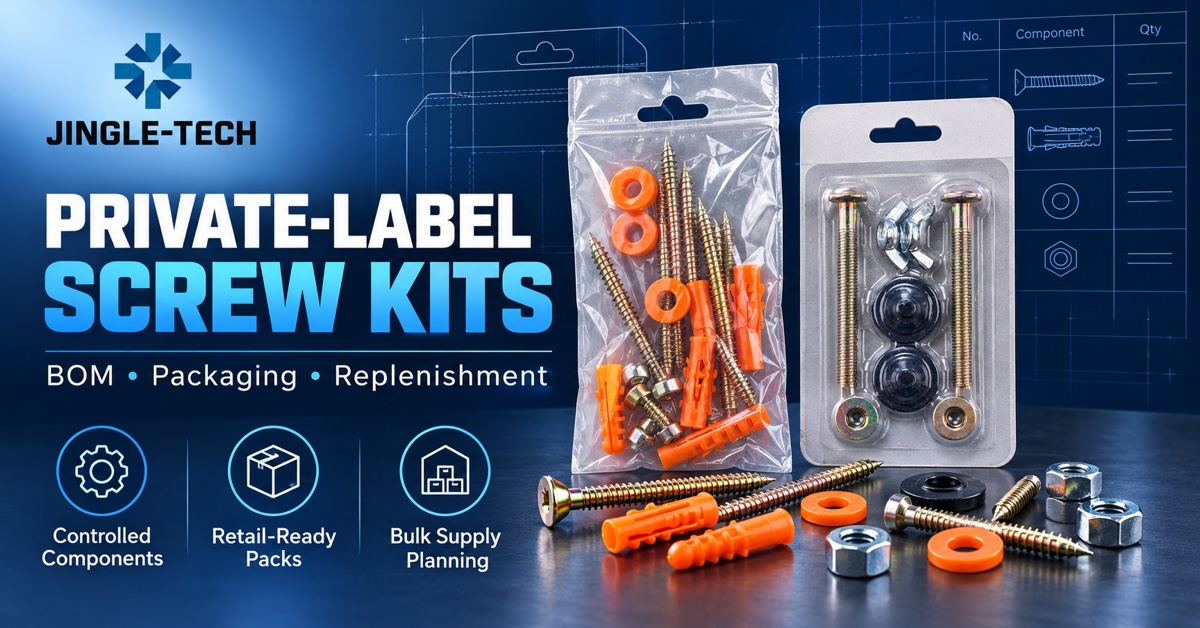
Open a private-label screw kit and the hardware is only part of what the customer bought. A U.S. distributor has also sold the promise that the right pieces are present, the pack matches the application, the label is accurate, and the same SKU can be ordered again. A retailer may care most about the shelf; a sanitary-ware brand about the install; an appliance maker about model fit; and an installation-products company about the jobsite. Even an on-time shipment can disappoint when nobody has truly owned the BOM, counts, use limits, artwork, or complaint records.
This guide follows a kit from concept to repeat order. It covers component specifications, count checks, artwork, origin marking, carton data, and the records needed when something goes wrong. Buyers can use it when comparing a screw custom kit manufacturer, a contract packer, or a supplier that coordinates several fastener families. The useful outcome is not simply one acceptable batch. It is a specification and supply routine that still makes sense when the second, fifth, and fiftieth release arrives.
Fast answer for wholesale buyers: Begin with the job the kit performs and a component-by-component BOM. Put the quantity beside every item and attach the drawing or standard that controls it. Then add substitution rules, the pack design, label and barcode data, count checks, order breaks, annual estimate, destination, Incoterm, and requested date.
Keep costs visible. Hardware, printed packaging, artwork setup, tools, inspection, outer cartons, and freight preparation should appear as included lines or options. Otherwise a cheap-looking kit can become an expensive recounting or repacking exercise.
Request a Custom Screw Kit Quote →
1. Decide what business problem the kit solves
Start with the buyer and installation task. A plumbing distributor needs an installer to recognize the set and finish a job without hunting for missing pieces. A service pack inside an appliance carton has to match one model and stay with it through shipping. On a retail hook, the pack must explain itself and survive being handled one unit at a time. An OEM line-side bag can be plain, yet the sequence, scan data, and count may be unforgiving. Contractors tend to care about quick identification, ruggedness, and a dependable jobsite count.
Write one sentence that describes the job: “This kit allows an installer to mount one wall-hung basin to an approved solid-wall condition,” or “This pack provides the screws and washers required for one service replacement.” That sentence does not replace engineering. It defines the customer outcome around which engineering, packaging, and replenishment decisions are organized.
Next, define what the kit does not cover. Wall plugs that work in one substrate may not be appropriate in another. A screw suitable for a dry interior assembly may not meet an outdoor corrosion requirement. A washer that fits one ceramic opening may not protect another. Clear limits reduce misuse, returns, and accidental promises. The supplier should receive the approved application boundaries, not invent them from a product photograph.
2. Put the kit under BOM control
The bill of materials is where a loose collection becomes a repeatable SKU. Number each item so people can name it without relying on color or position, then record changes by revision. The packer should be able to read one line and know the count; engineering should be able to follow that line to the size, material, finish, drawing or standard, and inspection note. Sourcing needs the approved-source rule on the same record. Do not stop at metal and plastic. The bag, blister, card, carton, label, instruction, divider, and pallet also change the product when they change.
| BOM field | Example content | Control question |
|---|---|---|
| Kit item | K-100, Rev C | Does the package, purchase order, and inspection record use the same revision? |
| Component | Screw S-101, 2 pieces | Is the screw controlled by a drawing or complete standard callout? |
| Mating part | PA6 wall plug P-210, 2 pieces | Has the combination been validated in the intended substrate? |
| Accessories | Washer W-310 and nut N-410 | Are dimensions, material, finish, and count defined separately? |
| Primary package | Clear bag, 90 μm, hanger hole | Does it fit the parts and distribution environment? |
| Label/artwork | L-500, Rev B, buyer-approved PDF | Are barcode data, origin, warnings, and language approved? |
Substitution rules should be explicit. “Equivalent allowed” is too open. If alternate plating colors, plug colors, washer materials, or component sources are acceptable, list the approved alternatives and the review required before use. If no substitution is allowed, say so. A kit can look correct while one component has changed in a way that affects fit, installation, corrosion, or customer perception.
Maintain an exploded kit photograph or approved layout alongside the BOM. The image helps packing operators and receiving inspectors, but the BOM remains the controlling record. Photographs cannot reliably communicate material grade, thread tolerance, coating thickness, or revision.
3. Specify each fastener as if it were purchased alone
Bundling does not make a vague component safer. Try a simple test: lift one line out of the BOM and hand it to a new supplier. Could that supplier return a comparable quotation without guessing? A machine screw usually needs a full thread callout, length, head and drive, metal, finished-part properties, surface condition, and the checks that decide acceptance. A wood or masonry screw raises different questions about its point, thread form, base material, pilot hole, and installation. For a nylon plug, identify the polymer and geometry, then connect them to evidence from the intended substrate.
Do not use the kit name as the technical specification. “Basin fixing set,” “heater kit,” and “sanitary mounting pack” are commercial descriptions. JINGLE’s public range includes a screw set, wash basin screw set, WC screw set, sanitary fixing set, and heater screw set. These pages help buyers review possible formats. The final project still needs product-specific confirmation.
A complete specification also makes cost engineering safer. The supplier can suggest a standard washer, alternate pack count, or shared finish batch while engineering can see exactly what would change. Without a baseline, “value engineering” becomes uncontrolled substitution.
4. Validate the component combination in the real application
A kit is a system. The longest or strongest-looking screw is not automatically the right screw. The screw, plug, washer, nut, fixture, substrate, hole, installation tool, and installer behavior interact. Buyers should define the intended substrate and boundary conditions, then use their responsible engineer or qualified test plan to approve the combination.
For a wash-basin kit, for example, the ceramic geometry, mounting holes, wall condition, drilling method, embedment, washer bearing surface, tightening sequence, and installation instructions all affect the result. Product information from a supplier can support the review; it does not replace site-specific design or installer responsibility.
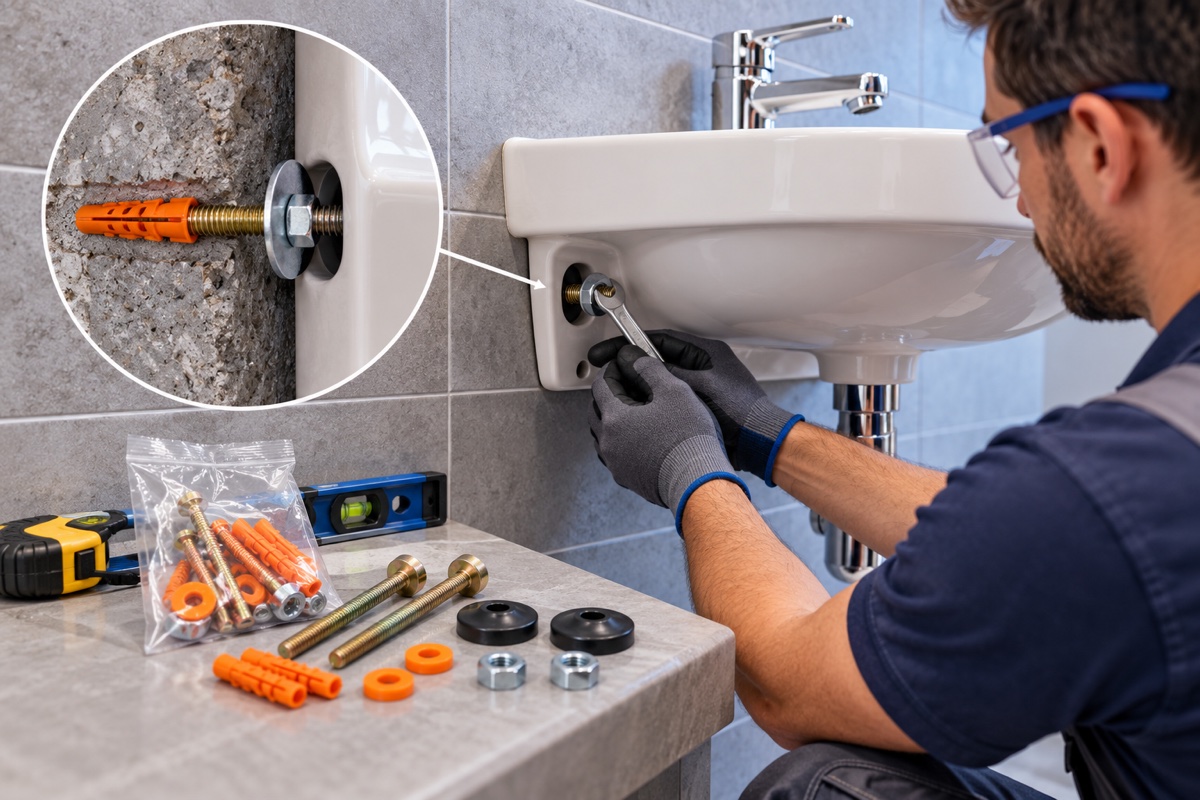
Use samples to check more than appearance. Confirm component count, fit between mating items, tool access, installation sequence, packaging opening, instruction clarity, and the experience of selecting parts from the pack. If a kit has left- and right-hand components or multiple sizes, make mistaken selection difficult. A five-minute assembly trial often reveals issues that a spreadsheet does not.
Record the approved sample status. Identify whether the sample came from production tooling and normal packaging. If it was hand assembled or used temporary materials, note what still needs approval. Store a retained sample or a controlled photo set when appropriate.
5. Choose the package for the sales channel
Packaging is part of the product. It has to contain dense metal parts, protect finishes, present the kit, carry required information, and survive the distribution route. Select it after considering the channel and handling environment.
| Format | Best fit | Points to control |
|---|---|---|
| Plain poly bag | OEM insertion, service parts, industrial distribution | Thickness, seal strength, label adhesion, puncture risk, count visibility |
| Printed or labeled bag | Private-label wholesale and simple retail | Artwork revision, ink/label durability, barcode quiet zone, origin marking |
| Blister card | Shelf display and tamper evidence | Cavity fit, seal, component movement, card warp, display hole and drop testing |
| Small color box | Premium retail, larger kits, multilingual instructions | Board grade, closure, internal divider, print color, scuff resistance, pack verification |
| Compartment case | Multi-size assortments and reusable trade packs | Migration between cells, latch life, component map, case drop performance |
Use the real production parts for the pack trial. A sharp metal point may work through a bag; a heavy screw can pull a blister open; a washer can hide behind the card or jump compartments. Coated pieces sometimes mark one another in transit, and reflective plastic can make the instructions hard to read. Put the filled pack through the handling route and learn from it. Optimistic wording on the specification will not repair a weak seal.
6. Control artwork, labels, and barcodes like engineering data
Artwork needs an owner, file name, revision, approval date, and release record. The supplier should not use an image copied from an email preview or rebuild the buyer’s logo. Send final production files with dielines, colors, fonts or outlined text, bleed, barcode data, origin statement, legal copy, warnings, and language requirements. Identify variable data separately from fixed print.
Create a label data map. For each field, state the source and format: buyer SKU, product name, quantity, lot code, purchase order, GTIN or other identifier, country of origin, date code, and distributor information. Verify every barcode with the intended scanner and receiving workflow. A technically readable symbol can still encode the wrong SKU, check digit, unit level, or quantity.
Use preproduction proofs in two forms: a digital artwork proof and a physical pack sample. The digital proof catches text and layout errors. The physical sample catches scale, contrast, seal position, curvature, glare, and component obstruction. Approval should reference the exact revision. Any later change to artwork, packaging material, printer, or barcode data needs a defined review.
7. Plan for U.S. origin and marketing claims
Release the origin statement before the package goes to print. In its Importing into the United States guidance, U.S. Customs and Border Protection describes the general country-of-origin marking duty and discusses what happens when imported articles are repacked. The importer and its broker should translate that guidance into an instruction for this article, this container, and this U.S. repacking plan.
Look at the whole front and back panel, not only the required origin line. The Federal Trade Commission summarizes its Made in USA Rule with an “all or virtually all” substantiation standard for an unqualified claim. A domestic distributor address, flag graphic, or American brand story can change the impression created by otherwise correct foreign-origin text. Review those elements together before approval.
Do not ask an overseas supplier to guess a legal statement. The buyer should provide approved copy after review by its broker or counsel. The supplier’s role is to apply the controlled artwork and verify placement, legibility, and revision during packing.
8. Build count control into the packing process
Kit shortages create a special kind of failure: the main product reaches the end user, but installation stops for a missing washer or plug. The value of the missing part may be small; the service call, return, negative review, or line interruption is not. Count control deserves its own plan.
Possible methods include calibrated counting scales, vision systems, bowl feeders with counters, compartment presence checks, weigh verification of the completed pack, and manual count with independent verification. The best method depends on component size, weight variation, kit complexity, volume, and error consequence. A completed-kit weight check can be effective only if natural component and packaging variation is narrow enough to detect the missing item.
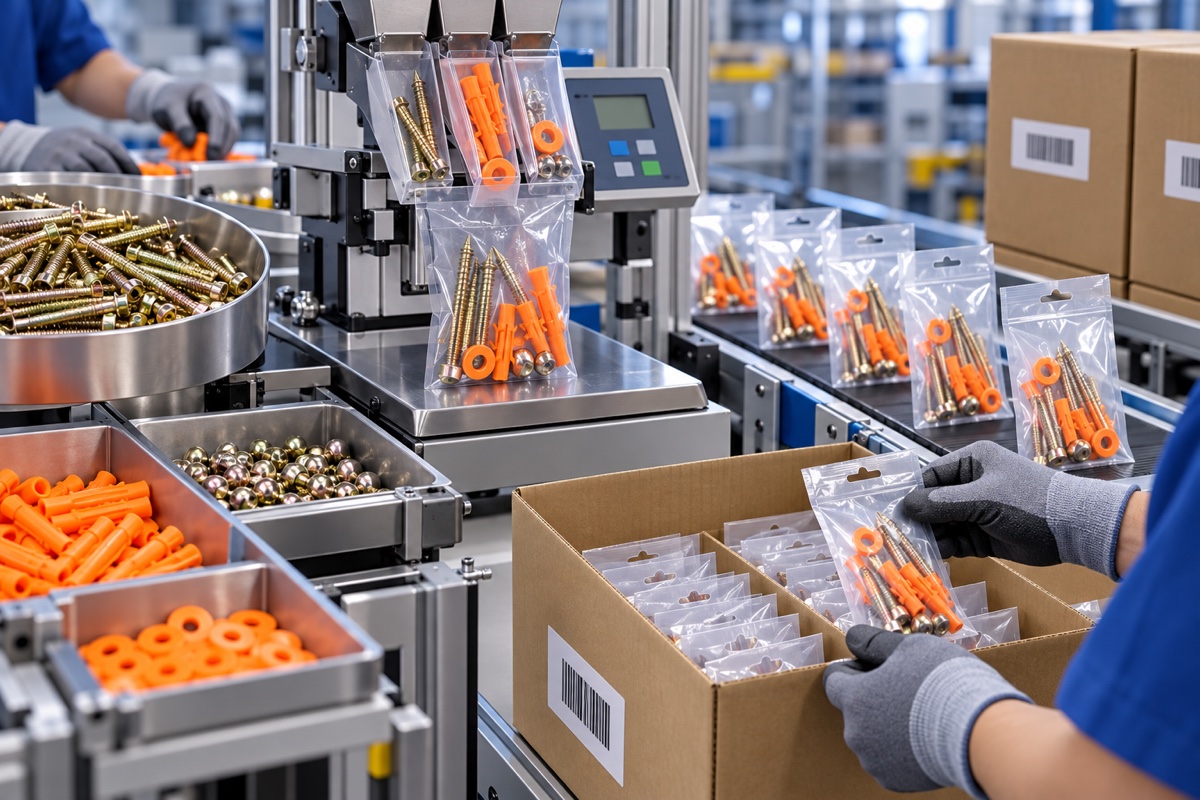
Design the station so the easiest action is the correct one. Similar parts belong in separate, clearly identified locations. On an SKU change, clear the line; do not leave yesterday’s cards or labels within reach. Scan the component and work order where volume justifies it, and give every partial container an identity before it leaves the station. When a defect appears, record what actually happened. Missing and extra pieces, a wrong component, finish damage, a bad seal, and a label error point to different causes.
At final inspection, look at the product the customer will receive. Is every component present? Is the seal sound? Does the label show the released revision, and does the barcode return the right item? Check appearance, carton quantity, and the pallet identity as applicable. Tie the record to the kit SKU, BOM revision, packing lot or date, and inspected quantity.
9. Protect the parts through ocean and domestic distribution
Fasteners can corrode in a package that looked dry at origin. Consider cleaning residue, material and finish compatibility, humidity, sea transit, warehouse temperature cycles, storage duration, and packaging permeability. Where necessary, define a suitable corrosion-protection method such as clean dry packing, compatible VCI material, desiccant, sealed inner bags, or another approved system. Confirm that any oil or inhibitor is compatible with installation, painting, sealing, and the end user’s expectations.
Set carton weight limits for safe handling and carton strength. Dense hardware can make a small box too heavy or cause bottom failure. Use inner cartons, dividers, reinforcement, or palletization as needed. Confirm whether cartons must pass a buyer-specific distribution test. Ask for actual packed dimensions and weights after the pilot, because estimates based on loose components often change.
If solid-wood pallets, crates, or dunnage enter the United States, review the current requirements. The U.S. Department of Agriculture’s APHIS guidance says regulated wood packaging material used for U.S. imports must comply with ISPM 15 treatment and marking requirements. See the official APHIS import guidance for wood packaging material. Engineered-wood exemptions and exact shipment conditions should be checked with the importer and logistics provider.
10. Understand what drives MOQ and kit cost
A kit has multiple minimums. The screw may have a production or plating minimum. A nylon component may have an injection-molding or color minimum. Printed bags, cards, boxes, and labels have their own economic quantities. Packing has a setup cost, and master-carton printing may introduce another. Ask the supplier to show which element drives the quoted MOQ.
| Cost driver | Typical buyer question | Possible controlled option |
|---|---|---|
| Custom fastener | Is tooling or a special process required? | Use a standard head, thread, or material if engineering approves. |
| Coating batch | Does the finish create the minimum? | Align finishes across SKUs or schedule releases from one controlled lot. |
| Printed packaging | What is the print MOQ and setup charge? | Use neutral packs plus approved labels for pilot quantities. |
| Packing labor | Is the kit manually or automatically assembled? | Simplify component orientation or use family packaging. |
| Inspection | Which reports and count checks are included? | Match evidence frequency to risk and order stage. |
Compare the full cost per saleable, accepted kit. Include components, packaging, artwork and plate charges, tooling, assembly, inspection, scrap allowance, inner and master cartons, pallet, documents, freight basis, and import responsibility. A lower kit price can become more expensive if the buyer must relabel, recount, rebag, or replace damaged cartons.
11. Turn the first order into a replenishment program
The second and tenth orders reveal more about a wholesale program than the launch batch. Once the pilot is accepted, freeze a reference set that people can actually use: the released BOM and drawings, the accepted samples, print files, inspection instructions, carton pack-out, label data, and rules for notifying changes. Give the kit a stable SKU and revision, and print that identity on both the purchase order and the carton.
Show the supplier the shape of demand. Monthly releases, desired stock cover, promotions, and seasonal peaks are more useful than one large annual number. Unless the contract makes it firm, a forecast remains planning information rather than a purchase commitment. Even so, it helps decide when to buy components and when to print packaging. The commercial agreement should say what may sit as raw material, finished components, blank packs, or completed kits—and whose inventory it is at each stage.
Score what the customer receives, not only the screws. Define “on time” first, then track shortages, bad components, barcodes that fail, damaged packages, document mistakes, and the speed and quality of complaint response. A perfectly acceptable washer cannot save a kit packed to the wrong revision.Keep component quality and finished-kit performance as separate lines on the scorecard.
For changes, require advance notice covering source, material, tooling, process, finish, color, pack material, artwork, inspection method, and manufacturing location where relevant. The buyer decides whether documents, samples, or revalidation are required. Repeat-order consistency comes from change control, not from the phrase “same as last time.”
12. Plan inventory at component, package, and finished-kit levels
A kit program has three inventories that move at different speeds. Hardware components may be shared across several SKUs. Printed packages may be unique to one brand, language, or sales channel. Completed kits are ready to ship but become obsolete fastest when artwork or the BOM changes. A good replenishment plan decides where inventory should sit instead of maximizing all three.
Map demand by SKU and month, then look for genuine common parts. One screw used in four kits may justify an economic production lot followed by controlled releases. A printed card unique to a slow seller may call for digital printing or a neutral pack with an approved label. Similar appearance is never enough to pool stock. The part number, specification, and approved source must match before a component is treated as common.
Build the reorder point from the actual route. Count the days for component production and outside finishing, then incoming checks, printed packaging, kitting, final review, freight booking, and transit. A first order or revised pack also needs approval time. “Thirty days” is not yet a schedule until the quote says what starts the clock: purchase order, deposit, artwork release, component approval, or sample sign-off.
For blanket orders or scheduled releases, define ownership and aging rules. Who owns custom printed packaging, plated components, work in process, and finished kits? Can components be used in another SKU? How long can corrosion protection, adhesives, labels, or polymer parts be stored? What happens when the buyer changes artwork while old packaging remains? These questions belong in the commercial agreement because they influence price and responsiveness.
Use cycle counts and reconciliation for shared components. The supplier’s system should be able to show what entered the packing area, what became accepted kits, what was scrapped, and what remained. High-volume programs may justify barcode scanning at issue and completion. Lower-volume programs can still use controlled travelers and independent reconciliation. The method can be simple; the records must be clear enough to investigate a shortage.
Forecast accuracy should be reviewed without treating every difference as supplier failure. Promotions, project wins, and retail seasonality can change demand quickly. Share upside scenarios and identify long-lead elements. Consider reserving generic components while delaying private-label print or final kitting until the release is firmer. This postponement strategy can reduce obsolete finished goods while keeping response time reasonable.
Finally, define end-of-life control. Set the last-buy date, final component disposition, packaging destruction or return, trademark protection, record retention, and treatment of remaining finished kits. Private-label materials should not remain in uncontrolled storage or appear in another channel. A professional kit program plans its ending as carefully as its launch.
13. Qualify the supplier for the commercial model you need
Different search phrases describe different capabilities. A general screw supplier may offer a broad range. A screw wholesale supplier should understand quantity breaks, distributor packs, and replenishment. A screw wholesale set manufacturer must control a multi-component BOM and pack process. A screw bulk manufacturer may be optimized for high-volume loose or industrial packaging rather than retail kits.
If the program includes threaded OEM parts, evaluate the relevant machine screw manufacturer and, when head style matters, the pan head screw manufacturer capability. A general screw manufacturer label does not prove that the supplier can manage retail artwork, mixed components, barcode data, or count verification.
Buyers searching for a screw factory supplier should identify the actual manufacturer for each critical component, the contracting or export entity, outside processes, certificate holder where relevant, and the party responsible for final kit inspection. A coordinated supply group can be effective, but the route should be transparent in the quotation.
Walk the route the order will take. At receiving, can the team identify and quarantine the components? In the packing area, are similar items separated and is the previous SKU cleared away? Watch how operators verify counts, artwork revision, barcode, and seal. Follow the lot number into the finished carton, then ask what happens to rejects, retained samples, and customer complaints. A tour that stops at a screw-forming machine has not evaluated the finished kit.
14. The RFQ package for a high-quality quotation
Send a structured RFQ rather than a product photo and target price. A complete package can include:
- Kit SKU, name, intended use, and buyer organization.
- Controlled BOM with component quantity, part number, revision, material, finish, and source rule.
- Component drawings, standards, approved samples, and critical inspection requirements.
- Packaging format, dimensions, material, seal, display method, and pack-count requirement.
- Approved artwork files or a clear statement that artwork will follow after commercial review.
- Label field map, barcode symbology and encoded data, origin marking, language, and variable data.
- Sample quantity, pilot quantity, first order, release size, and annual forecast.
- Required reports, sample approval, inspection frequency, retained-sample, and traceability needs.
- Inner-carton and master-carton requirements, carton weight limit, pallet rule, and corrosion protection.
- Destination, named Incoterm location, shipping method, target date, and required export documents.
- Quotation validity, tooling ownership, payment terms, and required change-notification period.
Ask each bidder to return the BOM line by line and identify assumptions. Require separate prices for one-time tooling or artwork, samples, recurring kit cost, special inspection, and optional packaging. If a component is not feasible, ask for a marked alternative with the technical and cost effect. That response can be reviewed rather than silently absorbed.
15. Example: improving a wash-basin kit RFQ
A distributor first asks for “one container of basin screw kits, private label, orange plugs, low price.” Suppliers return different screw lengths, different plug designs, different component counts, and several packaging types. The unit prices are not comparable. The buyer cannot tell whether a cheaper offer removed washers, used thinner bags, changed plating, or assumed a larger MOQ.
The revised RFQ assigns a kit number and BOM revision. It defines two screws, two specified plugs, two washers, two nuts, and two protective components per pack. Each component references a drawing or agreed specification. The buyer provides the approved application boundary, pack format, label fields, barcode data, artwork revision, count-verification requirement, carton quantity, maximum carton weight, pallet instruction, sample plan, and annual forecast.
Suppliers now quote the same baseline. One suggests a standard washer with a documented dimensional difference. Engineering can review it. Another explains that printed bags create the MOQ and offers a neutral pilot bag with an approved label. Purchasing can compare pilot and production economics. Quality can verify the physical sample against the BOM. Marketing can approve the pack without changing the hardware. This is the practical value of specification control.
16. Private-label screw kit checklist
- The kit has one SKU, revision, intended use, and owner.
- Every hardware and packaging component has a part number and quantity.
- Drawings or standards define material, dimensions, finish, and critical characteristics.
- Substitutions are prohibited or controlled by an approved-alternative process.
- The component combination has been reviewed in the intended application.
- Primary package, inner carton, master carton, and pallet are specified.
- Artwork, labels, barcode data, country of origin, and languages have approved revisions.
- Count-control, line-clearance, inspection, and retained-sample methods are agreed.
- Sample, pilot, order, release, and annual quantities are provided.
- Tooling, artwork setup, reports, packaging, and freight basis are visible in the quote.
- Lot traceability connects components, packing record, carton label, and shipment.
- Change notification covers component, source, process, finish, package, artwork, and location.
- The U.S. importer has reviewed marking and entry requirements with its broker.
Frequently asked questions from U.S. screw kit buyers
What is the difference between a screw assortment and a custom screw kit?
An assortment usually groups multiple fastener sizes for general selection. A custom kit is built for a defined product, installation, service task, or private-label SKU. It has a controlled BOM, exact quantity per pack, approved components, packaging, labeling, inspection, and replenishment plan. The commercial name is less important than the control system behind it.
Can I start with a low MOQ?
Often, but the feasible quantity depends on the components, finish batches, tooling, printed packaging, and packing setup. A pilot may use standard components and neutral packaging with an approved label, while production moves to printed bags or boxes. Ask the supplier to identify the real MOQ driver and quote sample, pilot, and production quantities separately.
Can JINGLE copy an existing kit from a sample?
A physical sample can support identification and measurement, but a responsible project still needs a buyer-approved BOM and specification. Material, performance, coating, tolerances, source restrictions, artwork rights, and regulatory statements may not be visible in the sample. The reverse-engineering output should be reviewed and released before the production quotation becomes final.
How do I prevent missing components?
Use a controlled packing work instruction, physical segregation, line clearance, calibrated counting or feeding equipment, completed-pack verification, label revision control, and final inspection. Validate that the chosen weight or vision check can actually detect the error. Track shortage types and link complaints to the packing lot so corrective action is evidence based.
Who should provide the private-label artwork?
The buyer should supply or approve the production artwork and legal copy. The supplier can contribute the dieline, print-feasibility advice, a physical proof, and locations for variable data. Put the owner and final approver in the project record. Before print release, read the pack as a U.S. customer would: origin, product claims, warnings, barcode, and distributor details must all suit the channel where the SKU will be sold.
What quality documents should be requested?
Let risk choose the paperwork. The basic record may be the released BOM and pack inspection. Critical components can add first-article dimensions, material or finish evidence, while retail programs may emphasize count checks and barcode verification. Traceability and final packing data connect those records to the shipment. In the RFQ, name the test basis, report format, frequency, and lot link. A generic certificate that identifies neither item nor batch offers little control.
Can one supplier consolidate several kit SKUs?
Yes, if component identity, revision, source, packaging, inventory ownership, and change control remain clear. Consolidation can improve freight and replenishment, but it also increases mix-up risk. Use family BOMs carefully, scan components and labels where practical, segregate similar items, and define how shared components are allocated across orders and lots.
What should I send for a fast, accurate quotation?
Send the kit BOM and revision, component drawings or standards, exact quantity per kit, sample and order quantities, annual forecast, packaging format, label and barcode data, destination, Incoterm, target date, and required inspection documents. State the intended application and any U.S. marking or compliance instructions. If artwork is not ready, say what is provisional and when the approved files will be released.
Build a quote-ready screw kit program
Send your BOM, component specifications, pack concept, quantities, artwork status, destination, and required documents. JINGLE will review open items and confirm the product-specific supply route before quoting.
Contact JINGLE for a Custom Kit Quote →Before ordering: Confirm the actual components, use limits, responsible manufacturing and export entities, required certificates, label copy, customs treatment, packaging rules, delivery promise, and commercial terms in the quotation for this SKU and destination. Engineering approves the application; the importer and its advisers approve customs and legal matters.