Complete Guide to Precast Concrete Lifting Systems
What Construction Buyers Really Need to Check Before Ordering Precast Accessories

Construction teams are under constant pressure to finish faster and safer. Whether the job is apartments, a commercial building, a bridge or modular units, almost every stage depends on moving precast concrete pieces without drama. As those pieces get heavier and more complicated, lifting them is no longer just “hook a crane on and go”. You need a complete system that has been designed to work together. One anchor with the wrong head size, a clutch that doesn’t lock cleanly, or a batch that varies from the last one can stop the whole production line, push the site programme back, or create a safety headache no one wants.
These accessories usually look like a small line on the budget. Anyone who has been around precast for a while knows they punch far above their cost. They affect how fast the factory can turn pieces out, how smoothly transport goes, and how safe the site crew is when the crane is swinging. So choosing a supplier is less about who quotes the lowest number and more about who can keep quality steady, answer technical questions, and actually deliver when the schedule is tight.
Here’s a practical look at how these systems work, what the main parts do, and what experienced buyers usually check before they commit.
What Actually Makes Up a Precast Lifting System
A precast concrete lifting system is simply the set of parts that let you lift, move and place the concrete elements from the mould right through to final installation. It is never one product on its own. The force from the crane has to travel safely into the concrete, so every piece has to fit the others.
Most systems use some mix of:
- Lifting anchors
- Lifting clutches
- Threaded lifting sockets
- Recess formers
- Wire loop boxes
- Cast-in channels
Take one out or replace it with something that doesn’t match and the whole arrangement can become unreliable. Plants that cast hundreds or thousands of pieces every month usually stick with suppliers who can supply matching sets. It cuts the constant small problems that slow everything down.
The Main Components
Lifting Anchors These carry the real load. A forged steel anchor is cast into the concrete. Once the concrete is strong enough, the clutch locks onto the head and the crane can pick the piece up.
Different regions call them different things, but they are basically the same family of product:
| Name people use | Where you mostly hear it |
|---|---|
| Lifting Anchor | Most international work |
| Dog Bone Anchor | Australia and Asia |
| Dog Bone Lifting Anchor | Global trade |
| Spherical Head Lifting Anchor | Europe |
| Transport Anchor | Europe |
| Concrete Lifting Anchor | North America |
| Precast Lifting Anchor | Engineering drawings |
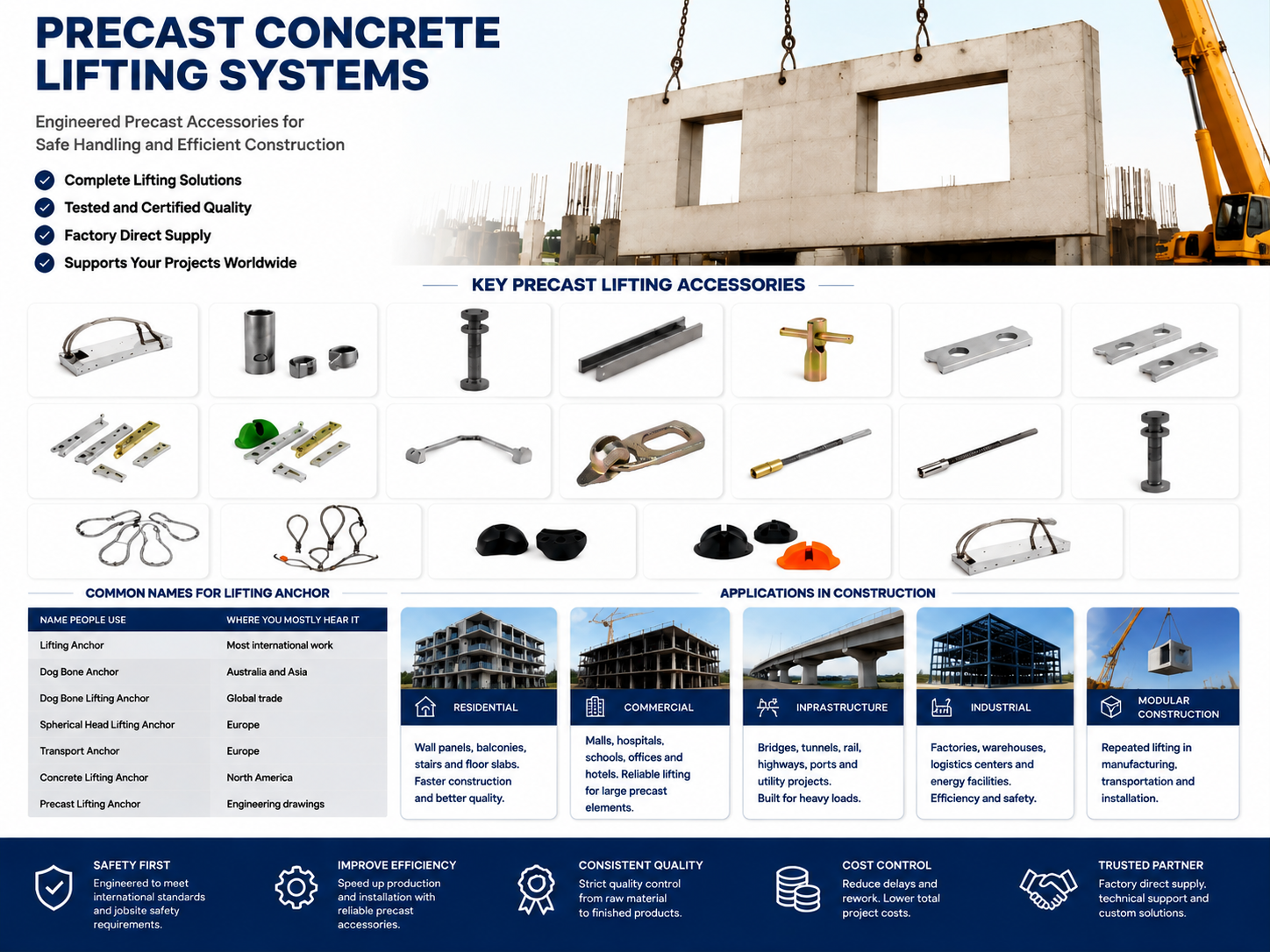
Good makers keep the head dimensions tight so the clutch always seats properly. Consistent forging also means the load rating stays predictable from one batch to the next.
Lifting Clutches The clutch is the part that gets used over and over. It doesn’t support the concrete itself – it locks around the anchor head and passes the force through its mechanism.
Because the same clutches stay on site for years, buyers usually look at:
- How accurately they are made
- The Safe Working Load rating
- Surface protection
- How they hold up to wear
- Whether the locking action stays positive
- Whether they fit the anchors you already use
Buying both anchors and clutches from the same production standard removes a lot of the usual site arguments.
Threaded Lifting Sockets These give another way to lift. After the concrete has cured you screw a lifting eye or loop into the socket. You see them a lot on architectural panels, pipes, stairs, beams and smaller structural pieces. Thread quality matters more than most people realise – poor threads slow the crew down and reduce confidence in the lift.
Recess Formers These temporary pieces hold the anchor in the right place while the concrete is poured. They also leave a clean recess after stripping and protect the head during production. Lightweight reusable plastic ones are still the everyday choice for high-volume work.
Wire Loop Boxes They are not lifting gear, but they sit in many of the same product ranges. They create quick structural connections between wall panels and turn up regularly in modular work, retaining walls, industrial buildings and infrastructure. Being able to buy lifting hardware and connection systems from the same place makes purchasing and quality control simpler.
Why Compatibility Matters More Than Most People Think
Plenty of buyers still pick products one by one. That is where trouble starts. An anchor head that is only slightly outside tolerance can refuse to engage a clutch from another maker. Threads from different factories rarely match perfectly. Inspection routines and long-term reliability suffer.
When one manufacturer supplies a full matched range you usually get:
- Parts that actually fit each other
- Simpler purchasing
- More consistent quality
- Easier technical support
- Lower risk on site
- Cleaner inventory
Standard systems also make training operators and looking after the equipment easier when you have several projects running at once.
Where These Systems Get Used
Residential work – wall panels, balconies, stairs and floor slabs all need reliable lifting so the factory can keep output high and the site can install without delay.
Commercial buildings – shopping centres, hospitals, schools, offices and hotels often specify large structural precast. Consistent accessories reduce handling risk during transport and erection.
Infrastructure – bridges, tunnels, rail, highways, ports and utility jobs frequently involve oversized pieces and high loads. Quality anchors and clutches are not optional.
Industrial projects – factories, warehouses, logistics centres and energy plants keep turning to precast for speed. Reliable lifting systems help keep the programme on track.
Modular construction – the same pieces get lifted repeatedly during manufacture, transport and final placement, so matched systems pay for themselves quickly.
How Experienced Buyers Choose
Price is only one part of the decision. The cheapest quote often ends up costing more once you factor in quality problems, late deliveries or extra site time. A supplier that keeps quality steady, hits delivery dates and can answer engineering questions usually saves money in the long run.
Manufacturing capability Look for companies that run dedicated production rather than general fabrication shops. Forged anchors need controlled temperatures, proper dies, accurate machining and the right heat treatment. Useful questions include:
- Do you make these in your own factory?
- How long have you specialised in precast accessories?
- Can you show production photos or arrange an audit?
- Do you handle OEM and custom work?
Specialised lines almost always give more consistent results than mixed subcontracting.
Material quality and traceability Everything starts with the steel. Serious manufacturers keep full traceability from the mill certificate through to the finished piece. This becomes important on infrastructure, government, commercial and international jobs where the paperwork has to be there when asked for.
Dimensional consistency The clutch has to fit the anchor cleanly. Even small variations outside tolerance slow the crew and reduce safety. Tight control also speeds inspection, improves interchangeability and cuts the number of parts that get rejected. Calibrated measuring equipment is a practical sign that the factory takes it seriously.
Engineering support Many projects need more than catalogue items. The better suppliers help with selection, load advice, surface treatments, custom sizes, OEM runs, packaging and documentation. Being able to talk directly to the engineers cuts a lot of time.
Factory versus trading company
| Direct Manufacturer | Trading Company |
|---|---|
| Owns the production | Buys from partner factories |
| You can see how it is made | Limited visibility |
| Direct engineering contact | Messages go through middlemen |
| Easier to develop OEM items | Depends on the factory’s goodwill |
| Quality stays more stable | Can vary between sources |
| Better long-term cost control | Extra margin built in |
Trading companies can be useful for a first order that covers many different product types. Once you are buying lifting anchors, clutches and related accessories regularly, most people prefer factories that control production, inspection and engineering themselves.
Quality Control on the Factory Floor
Quality has to be built in at every stage, not just checked at the end. A typical process looks like this:
| Stage | What is checked |
|---|---|
| Incoming material | Certificates and chemistry |
| Forging | Shape and internal integrity |
| Machining | Dimensions and threads |
| Heat treatment | Mechanical properties |
| Surface treatment | Corrosion protection and appearance |
| Final inspection | Dimensions, marking, packaging |
| Packing | Protection for shipping |
This approach keeps batches consistent and reduces the chance of defective parts reaching the site.
Mistakes That Still Happen Too Often
- Buying only on price – cheap parts often bring inconsistent quality, late deliveries or higher replacement costs later.
- Ignoring compatibility – mixing anchors and clutches from different sources without checking fit creates unnecessary site problems.
- Skipping documentation – inspection reports, material certificates and technical data should be available when needed.
- Underestimating delivery reliability – late shipments disrupt programmes more than a modest price difference.
- Choosing a supplier with no real technical support – many jobs need custom solutions; engineering help makes long-term work smoother.
Why Long-Term Relationships Usually Win
A lot of contractors and precast producers eventually cut their supplier list down. Stable quality, predictable lead times and someone who answers the phone when there is a problem matter more than constantly chasing the next low quote. Long-term partnerships tend to deliver better planning, faster quotations, simpler quality management, cleaner inventory, lower risk and smoother project execution. For OEM work they also make custom development easier while keeping the manufacturing standards the same.
Quick Answers to Common Questions
What is a lifting anchor? A forged steel component cast into the concrete to give a secure lifting point for transport and installation.
What does the lifting clutch do? It connects the crane to the matching anchor and transfers the lifting force safely.
Can anchors be made to order? Yes. Many factories offer OEM versions in different capacities, sizes and finishes.
Why does material traceability matter? It links every finished piece back to its original steel batch, which supports quality assurance and project paperwork.
Can any clutch be used with any anchor? Not always. Fit depends on the dimensions and the manufacturer’s specifications. Always check before use.
Which sectors use these accessories? Residential and commercial buildings, bridges, tunnels, industrial facilities, utility work and modular construction.
What should you look for in a manufacturer? Real manufacturing capability, proper quality systems, engineering support, material traceability, consistent production and reliable delivery.
Is buying direct from the factory better? For ongoing programmes, yes. You usually get clearer visibility, better technical support, easier customisation and more stable costs.
Final Thoughts
Reliable precast accessories are essential if you want to handle concrete elements safely and efficiently. Lifting anchors and clutches may be a small part of the budget, yet they affect safety, factory output, transport and site installation far more than their price suggests.
Choosing the right manufacturer is not about finding the cheapest quote. It means checking whether they can actually make the parts properly, keep quality consistent, support the engineering side and deliver when needed. As precast work keeps growing across residential, commercial, industrial and infrastructure projects, an experienced manufacturing partner reduces risk and helps keep productivity high from the factory floor all the way to final installation. Whether you need standard components or custom OEM solutions, proven manufacturing experience and thorough quality control remain the best investment you can make.