How to Prepare a Custom Fastener RFQ: Drawings, Grades, Tolerances, Coatings and Quote Comparison
Quick answer: a quote-ready custom fastener RFQ is one controlled package, not a drawing attached to a short email. It identifies the part and revision, states which file controls when documents conflict, defines the thread, material or property requirement, functional tolerances, coating system, verification deliverables, demand stages, packaging and commercial basis, and gives every bidder the same return template. Require suppliers to mark compliance, assumptions, exclusions and alternatives against that baseline.Compare only quotations that close the same technical and commercial scope; otherwise the lowest visible unit price may represent a different part, a different evidence package or an unpriced risk.
A weak request for quotation often looks complete because it contains a CAD file, a PDF and an annual quantity. The gaps emerge only after bids arrive. One supplier assumes rolled threads and another assumes cut threads. One includes an electroplated coating with a named system; another writes only “zinc.” One prices routine dimensional inspection; another includes a project-specific first-article package. A third has quietly excluded tooling, packaging, special-process reports or delivery to the named destination. The spreadsheet may show three unit prices, but it does not yet show three offers for the same deliverable.
This guide is intentionally narrower than a general article about choosing a manufacturer, calculating custom fastener cost or deciding between a manufacturer and a distributor. Its subject is the transaction record between those decisions: how a buyer builds a controlled RFQ issue, how a bidder returns a technically explicit offer, and how the buyer levels the responses before nomination. The output is not merely “a price.” It is a traceable statement of what will be supplied, what remains open and which commercial number belongs to which technical baseline.
Discuss a controlled custom fastener RFQ
1. Treat the RFQ as a controlled dataset, not an email attachment
The RFQ should have an identity of its own: an RFQ number, issue date, issue revision, buyer owner, response deadline and document index. Every referenced file should carry a filename, document number, revision or date and status. The supplier should be able to state exactly which package it quoted without relying on an employee's inbox. If a drawing is replaced during the bid, the buyer should issue a controlled amendment and identify which earlier file is superseded.
That discipline protects both sides. The buyer can compare responses against one baseline.The supplier can separate a firm offer from a budgetary estimate based on incomplete information. Engineering can see which assumptions need closure. Quality can identify which reports are included at sample, approval and recurring shipment stages. Purchasing can avoid awarding a quotation that appears complete only because the exclusions were never put in the same place.
A practical package usually contains a cover sheet, document index, controlled drawing or product-definition dataset, any applicable 3D model, specifications, requirement matrix, forecast or quantity table, evidence schedule, packaging and label instructions, commercial terms, supplier return workbook and clarification log. Not every part needs every file. The rule is simpler: if an item changes feasibility, route, evidence, price or timing, make it visible in the controlled package or require the bidder to identify it as an open assumption.
| Controlled item | Buyer records | Supplier returns | Why it matters |
|---|---|---|---|
| RFQ cover sheet | RFQ ID, issue revision/date, owner, due date and confidentiality route. | Acknowledged RFQ ID and response revision. | Prevents a quotation from drifting away from the issued package. |
| Product definition | Part number, drawing/model numbers, revisions and precedence. | Compliance, interpretation questions and deviations. | Fixes the geometry and requirement baseline. |
| Referenced specifications | Document number, edition, amendment and buyer-supplied access where permitted. | Edition used, exceptions and sub-tier applicability. | A standard number without an edition can hide different work. |
| Demand schedule | Prototype, validation, launch and repeat quantities plus release pattern. | Price breaks, capacity assumptions and validity. | Separates one-time samples from production economics. |
| Evidence schedule | Required record, stage, format, lot link and approval owner. | Included/excluded status, source, timing and cost. | Stops inspection scope from becoming an after-award surprise. |
| Commercial return | Required currency, Incoterm, destination, tooling and price fields. | Completed return template with assumptions and exclusions. | Makes landed and lifecycle comparison possible. |
2. Put five control decisions on the RFQ cover sheet
The cover sheet is not decoration. It decides which package is being priced and who can change it. First, name the RFQ and response identifiers. Second, state the intended quotation status: request for budgetary feedback, feasibility response, production quotation or another defined stage. Third, identify the authorized buyer contact for technical, quality and commercial questions. Fourth, state how clarifications will be distributed so one bidder does not receive a different controlling answer. Fifth, state the precedence and amendment rule.
Do not use “latest drawing” as a revision. The phrase can point to different files on different servers. Do not use “standard finish” unless the buyer has identified the standard and designation. Avoid writing “all dimensions critical,” because it does not tell a bidder which characteristics drive process selection, measurement planning or escalation. The cover sheet should not carry every technical detail; it should tell users where the detail lives and how to recognize the approved version.
The package also needs an explicit validity boundary.If the supplier lacks a controlled item, it should mark the quotation provisional, name the missing input and state the effect that closing it may have. A professional “cannot confirm until X is resolved” is more valuable than an unconditional yes based on a silent assumption. The buyer's return template should make that answer easy to give.
| Control | Good buyer entry | Required bidder acknowledgement |
|---|---|---|
| Issue identity | Unique RFQ ID plus issue revision and date. | Quote number, quote revision and exact RFQ issue quoted. |
| Quotation purpose | Defined stage and intended decision. | Firm, conditional or budgetary status and its limits. |
| Question route | Named technical, quality and commercial owners. | Questions submitted through the stated clarification process. |
| Precedence | Order among drawing, model, specifications, notes and written amendments. | Conflicts listed rather than silently resolved. |
| Amendment control | Superseded files and required re-acknowledgement. | Impact on feasibility, price, timing and evidence returned by line item. |
3. Freeze revision, file precedence and the source of truth
Custom fastener RFQs often contain both a 2D drawing and a 3D model. The drawing may carry material, thread, finish and inspection notes while the model defines part of the geometry. A supplier cannot safely decide which one wins when values conflict.The RFQ must name the controlling dataset, the role of each supporting file, and the approved method for reporting a conflict. If model-based definition is used, define the model, view or annotation status and the neutral/native file expectations that matter to the project.
The official ASME Y14.35-2025 page describes practices for identifying and recording revisions to engineering product-definition datasets and associated documents. It does not set the buyer's contract hierarchy. It supports the reason for controlling revision identity: the quotation needs an auditable connection to the exact definition that the bidder reviewed.
Create a conflict register during the bid. Each entry should include the requirement or feature, the two conflicting sources, the bidder's question, interim quotation assumption, responsible buyer owner, final disposition, amendment reference and price or schedule impact. Do not close the item only in a call. Put the answer into a controlled clarification or revised package distributed to all affected bidders.
A filename is not enough
Files named FINAL, FINAL2 or NEW are easy to confuse. Use a document number and revision visible inside the file as well as in the index. When a neutral CAD export is provided, record its export date or source revision and explain whether it is controlling or supplied only for convenience.If the buyer cannot share a referenced specification because of licensing or confidentiality, do not ask the supplier to guess. Arrange authorized access, quote a permitted requirement summary, or mark the item open and conditional.
4. Make the drawing quotable before asking for a firm price
A drawing is quote-ready when a competent bidder can identify what the part must be, which features control fit and function, which standards and revisions apply, and which requirements need a buyer decision. That does not mean the drawing must prescribe the manufacturing route. In fact, unnecessary process commands can prevent a useful alternative. It means the product definition is sufficiently complete for the bidder to propose a route without inventing the product.
Start with units, projection method where relevant, scale statement, part number, title, revision, material or property requirement, finish, mass if it is controlled, general tolerances, thread callouts, special characteristics, marking, cleanliness, packaging references and applicable notes. Define every dimension or requirement needed to accept the part. Remove duplicate notes that express the same requirement differently. A bidder should not have to decide whether an old title-block note overrides a new local callout.
The official page for ASME Y14.5-2018 (R2024) says the standard establishes symbols, rules, definitions and practices for stating and interpreting geometric dimensioning and tolerancing on drawings, digital models and related documents. Citing it can establish a common drawing language when contractually adopted. It does not choose datums or tolerance values for the buyer. Those remain design decisions tied to the joint and verification strategy.
Describe the interface the supplier cannot infer
A fastener drawing can define a part while still hiding assembly facts that change the proposal. Add a short application-information sheet when relevant: mating thread or hole, clamp stack, bearing surface, installation tool, access envelope, expected reuse, temperature range, fluid or chemical exposure, electrical considerations, appearance zone, sealing role and regulatory or customer-controlled constraints. Label these facts as design inputs, not as proof that a particular supplier solution is approved.
Separate “must meet” requirements from “supplier may propose” opportunities. For example, the geometry and joint function may be fixed while head-forming method, blank preparation or inspection fixture concept remains open. A bidder can then return a compliant base offer and an identified alternative without mixing the alternative into the base price.
5.Separate a familiar fastener name from the custom requirement
Calling a part a “hex bolt,” “shoulder screw” or “stud” helps orientation, but the name does not establish all geometry, mechanical properties, thread, finish, test or marking requirements. If the part starts from a standardized product, identify the adopted product standard and list every departure. If it is fully special, avoid phrases such as “DIN-style” unless the exact borrowed feature is defined.
ISO 8992:2005 is published, was confirmed in 2023 and is marked for revision by ISO. Its official scope covers general requirements for standardized bolts, screws, studs and nuts and recommends them for certain non-standardized fasteners. The sourcing lesson is not that ISO 8992 automatically governs every custom part. It is that the RFQ should state which common requirements are adopted and where the custom drawing changes them.
Use a departures table for a modified standard part. Columns can include the standard feature, standard requirement, custom requirement, controlling drawing zone, reason or function, verification method and supplier response. This is especially useful when only one or two features are special. It keeps a bidder from pricing a standard catalog item while the buyer expects a custom shoulder, point, thread length, marking or coating.
6.Specify the thread system without shorthand traps
Thread information affects forming, gauging, plating allowance, assembly and test. A complete callout needs the thread system, nominal size, pitch or threads per inch as applicable, tolerance class or fit, handedness if not standard, thread length, start and runout requirements where functional, and any after-coating or before-coating acceptance rule required by the adopted specification. Define special locking, sealing or thread-forming behavior separately. Do not assume “M8” communicates pitch, tolerance class and coating condition.
Check the current ISO record before carrying a thread note into a new RFQ. The catalog identifies ISO 965-1:2026 as the fifth edition and lists the 2013 edition as withdrawn. The new edition sets out the tolerance system for ISO general-purpose metric screw threads that conform to ISO 261 and use profiles related to ISO 68-1. If the RFQ adopts that system, name the edition and the relevant companion standards; do not let an old drawing select them by accident.
Keep unit systems explicit. ASTM standards frequently state that SI and inch-pound values are independent systems rather than exact conversions. The same practical warning belongs in an RFQ: do not mix a metric thread, inch-based tolerance table and rounded converted acceptance values unless engineering has deliberately defined the result. Use one controlling unit system and state how reference conversions are treated.
| Question | Buyer baseline | Supplier return | Risk if omitted |
|---|---|---|---|
| Which system and size? | Complete controlled thread designation. | Acknowledged designation and cited edition. | Wrong pitch, profile or gauge basis. |
| Where is the usable thread? | Thread length, incomplete-thread zone and functional start/end. | Proposed route and any geometry question. | Assembly interference or insufficient engagement. |
| When is fit assessed? | Before/after coating rule from the adopted requirement. | Allowance interpretation and verification point. | Coating consumes clearance or inconsistent gauging. |
| Is function more than fit? | Locking, sealing, forming or drive-performance requirement. | Proposed test conditions and open inputs. | A passing thread gauge does not prove the intended function. |
7. Translate “grade” into a complete material and property requirement
A grade label can be useful, but it is not a substitute for checking scope. The RFQ should distinguish raw-material designation, fastener property class or grade, heat-treatment condition, required product properties, applicable product and test standards, marking, lot definition and evidence. Avoid combining values from unrelated systems into a homemade hybrid grade.If a customer specification modifies a standard grade, identify the modification rather than expecting the supplier to discover it later.
The official scope of ISO 898-1:2013 with Corrigendum 1:2013 applies to defined carbon- and alloy-steel bolts, screws and studs with specified property classes, geometries, ISO metric threads and stated ambient test conditions. ISO marks the edition for revision. Its page also states that it does not specify corrosion resistance, weldability, torque/clamp-force performance, fatigue or several other properties. A familiar property class therefore cannot carry every joint requirement.
Likewise, a test-method citation does not define the required product property. ASTM's official page for ASTM F606/F606M-26a describes procedures for determining mechanical properties of externally and internally threaded fasteners, washers, direct tension indicators and rivets. Its scope explains that property requirements come from the applicable product standard. In the RFQ, state both the governing product requirement and the test/report expected; do not write “per F606” as if the method selected the grade.
Ask the supplier to map the requirement, not simply repeat it
The bidder should return the proposed material designation and condition, governing property standard and edition, manufacturing or heat-treatment route at a useful high level, planned material and product evidence, marking interpretation, outsourced operations and any scope gap. This is not a request for proprietary recipes. It is enough information for engineering and quality to test whether the proposed chain can deliver the specified product.
| Layer | RFQ entry | Quote return | Closure owner |
|---|---|---|---|
| Material | Designation, edition and required condition. | Proposed source basis, equivalence request or deviation. | Buyer engineering/materials authority. |
| Product grade or class | Applicable product standard, scope and edition. | Compliance by product form and size. | Buyer engineering and quality. |
| Required properties | Property list, acceptance source and applicable condition. | Test method, specimen/product basis and report source. | Buyer quality with engineering approval. |
| Heat treatment | Only process restrictions needed by design or specification. | Proposed site/sub-tier and evidence path. | Buyer quality and authorized technical owner. |
| Identification | Part marking, trace code and packaging label. | Proposed method, location and legibility constraints. | Buyer quality/logistics. |
8. Use tolerances to communicate function, not anxiety
Over-tight tolerances can force a more expensive process, more inspection and lower yield without improving the joint. Under-defined tolerances can move interpretation risk into the supplier's quote. The buyer's job is not to make every number tight; it is to place an acceptance boundary around the functional product and give the bidder enough information to propose a capable route and verification plan.
Review dimensions by interface. Head and drive features influence tooling, installation and bearing. Shank and shoulder features influence location, motion or clamp stack. Thread geometry affects engagement and fit. Underhead radii, runouts, points and ends may affect seating or assembly clearance. Do not add straightness, coaxiality, position, perpendicularity, profile or surface texture as a catch-all. Use each control only when function calls for it and the drawing gives the supplier an intelligible datum or reference system.
Require the bidder to identify tolerance-driven process or measurement risks. A useful return does not say merely “drawing accepted.” It lists features that may require special tooling, secondary machining, sorting, dedicated gauging, non-contact measurement, destructive sectioning or buyer clarification. The supplier may propose a tolerance relaxation, datum change or inspection alternative, but that proposal must stay outside the compliant base offer until the buyer approves it.
| Feature group | Functional question | Bidder must return | Buyer decision before award |
|---|---|---|---|
| Head and drive | What tool, access and seating interface control? | Forming/tooling assumption and verification method. | Acceptable interface and any appearance boundary. |
| Shoulder or shank | Does it locate, guide, rotate or carry bearing load? | Process step creating size/form and measurement proposal. | Functional size/form relationship. |
| Thread relationship | Which datum or feature controls alignment? | Interpretation, process route and gauging boundary. | Datum logic and after-finish condition. |
| Runout and transition | What clearance, fatigue or seating issue is controlled? | Tool/process limit and proposed inspection access. | Unambiguous boundary and acceptance method. |
| Surface texture or appearance | Is the requirement functional, sealing, cosmetic or process-related? | Surface creation and evaluation proposal. | Zone, comparator/method and defect limits. |
Link each critical characteristic to an evidence decision
For every characteristic that drives safety, regulatory compliance, fit, performance or high containment cost, identify the drawing source, manufacturing step, proposed control, measurement or test method, record, sampling or monitoring agreement, reaction plan and approval stage. Do not invent a universal capability index or sample size. The buyer's authorized quality and engineering teams should set those requirements based on product and process risk.
NIST's official metrological traceability policy and FAQ explains that traceability is a property of a measurement result, supported by a documented unbroken calibration chain in which each calibration contributes to uncertainty. It is not a property of an organization, instrument or sticker. In an RFQ, ask how the reported result for the defined characteristic will be supported, rather than asking only whether the gauge is “NIST traceable.”
9. Specify the coating as a system, process route and evidence package
A finish note that says only “zinc,” “black,” “silver” or “corrosion-resistant” leaves the supplier to fill in commercially important blanks.Close those blanks in the RFQ. Name the coating or finish standard and edition, the selected designation or system, and the substrate and hardness context where it matters. Then define the conversion layer, sealant or topcoat, controlled friction or lubricant requirement, appearance zone, thickness rule, corrosion test and conditions, applicable hydrogen-embrittlement controls, thread-fit condition, restricted substances, process source, records and approval route.
For an ISO-based route, start with the published record for ISO 4042:2022. The same catalog lists Amendment 1:2026 as published in April 2026. Read the scope before treating that citation as a complete finish note: it covers electroplated systems for steel fasteners, certain dimensional requirements and recommendations aimed at reducing hydrogen-embrittlement risk, but leaves properties such as weldability and paintability outside its definition. The buyer must still select the system and add the project's own requirements.
ASTM provides another route through ASTM F1941/F1941M-16(2025), which its official catalog marks active for electrodeposited coatings on mechanical fasteners. The listed scope reaches application, performance and dimensional requirements as well as designation, conversion finishes, corrosion resistance and hydrogen-embrittlement precautions.Even so, the standard number does not tell a bidder which coating designation, thickness, supplementary finish or evidence the buyer wants. Put those choices in the RFQ.
| Field | Buyer specifies | Supplier confirms | Common hidden difference |
|---|---|---|---|
| System identity | Standard, edition, designation and project additions. | Exact offered system and sub-tier/site. | Two “zinc” offers use different deposits or finishes. |
| Functional layers | Conversion coating, sealant, topcoat and lubricant needs. | Included layers and proprietary designation explanation. | Color matches while friction or protection differs. |
| Dimension and thread fit | Thickness/measurement location and acceptance condition. | Allowance, masking or process proposal and gauging stage. | Coating consumes functional clearance. |
| Performance evidence | Test method, specimen, conditioning, acceptance rule and report stage. | Laboratory/source, frequency, report and exclusions. | A headline hour value uses different conditions. |
| Embrittlement controls | Applicable risk decision and adopted requirements. | Process route, required relief/test evidence and open gap. | High-strength substrate is quoted without the required control chain. |
| Appearance/compliance | Color range, visible zone, prohibited substances and document source. | Limit sample/proposal, declaration source and validity. | Aesthetic or regulatory scope is assumed rather than priced. |
10. Request performance evidence only when the joint requires it
Dimensional and material conformity do not automatically prove assembly performance. A joint may also depend on torque/clamp-force behavior, prevailing torque, drive performance, installation into a specific mating material, sealing, electrical continuity, fatigue, temperature response or another application-defined result. The RFQ should identify the required function, test configuration, mating components, conditioning, sample or stage agreement, acceptance source and report. It should not ask the bidder to invent an acceptance value after seeing the part.
The official page for ISO 16047:2005 with Amendment 1:2012 says it specifies conditions for torque/clamp-force testing of threaded fasteners and related parts within a defined scope.A citation to ISO 16047 can establish a method basis when applicable, but it does not identify the buyer's actual mating components, finish state, lubrication, tightening conditions, data treatment or acceptance boundary. Those project inputs belong in the RFQ evidence matrix.
Separate three questions. What must the product do? Which controlled method will evaluate that function? At what stage and frequency is evidence required? This stops a one-time development test from being mistaken for a recurring shipment report, and it stops routine inspection from being priced as though a full validation program were included. If the required test depends on a buyer-supplied component or fixture, identify ownership, availability, revision, replacement and return conditions before requesting a firm timeline.
Do not convert a method into a product claim
A bidder can follow a named method and still produce a result that does not answer the intended joint question because the specimen, mating part or condition was wrong. Conversely, a supplier may propose a technically useful alternative method. Keep the base requirement and the alternative separate. The base quotation should state compliance or a deviation; the alternative should state why it is proposed, what decision it supports, what evidence it produces and what buyer approval it needs.
11. Build an evidence schedule by project stage
An RFQ that asks for “full certificates” has not yet defined an evidence package.Name the document or record, its source, the product or lot link, the stage at which it is due, whether it is for review or approval, the required format, any retention or access expectation and whether it repeats with shipments. Typical categories include material declarations or reports, process certificates, dimensional results, mechanical or functional test reports, coating reports, first-article or customer-specific submissions, control plans, gauge or measurement-method reviews, sample identification, traceability records, packaging approval and conformity declarations.
ISO 16228:2017 is published and confirmed. ISO's official scope describes types and content of fastener inspection documents requested at the time of order and notes that “test report” is the applicable terminology for its fastener documents. The same scope excludes special-purpose or specially engineered applications requiring other procedures, such as initial samples. Therefore an ISO 16228 report can be a defined order deliverable, but it cannot silently replace a project-specific first-article or approval package.
ISO 3269:2019 specifies a purchaser inspection procedure where no prior agreement exists and a reference procedure for disputed conformance. ISO marks it for revision and shows a draft successor under development.Its official scope excludes high-volume machine assembly, special-purpose applications and specially engineered applications requiring more advanced in-process control and lot traceability. A custom fastener buyer should make the inspection agreement explicit rather than assuming the default scope covers the program.
| Evidence item | Feasibility / quote | Sample / approval | Recurring shipment | Supplier return field |
|---|---|---|---|---|
| Requirement review | Compliance, questions, assumptions and proposed route. | Closed deviations and approved definition. | Current revision acknowledgement when changed. | Included owner and open date. |
| Material evidence | Proposed designation/source basis. | Report linked to sample lot as required. | Defined report/declaration frequency and lot link. | Source, format, frequency and price treatment. |
| Dimensional evidence | Measurement feasibility and method risks. | Ballooned or characteristic-linked results per project agreement. | Defined report or control record, if required. | Characteristics, method, stage and exclusions. |
| Coating/process evidence | Proposed system and outside-process route. | Process and performance evidence linked to sample. | Certificate/report and trace rule as agreed. | Sub-tier, document, frequency and cost. |
| Functional evidence | Method, fixture and open buyer inputs. | Results under approved configuration. | Only if the control plan or order requires it. | Test source, conditions, sample basis and timing. |
| Trace/pack record | Proposed lot hierarchy and label concept. | Sample identification and packaging approval. | Lot, label and shipment records. | Included detail, retention/access and exception. |
Review your RFQ evidence schedule
12.Use a quantity ladder instead of one annual number
One annual usage figure hides the shape of the program. A supplier needs to understand prototype quantity, engineering or validation samples, pilot or launch demand, production batch quantities, expected release cadence, annual planning volume, demand variability and any service or spare requirement. The buyer also needs price breaks on identical technical and commercial terms, not a collection of different assumptions about packaging, freight, tooling or evidence.
Build a quantity ladder with rows for each stage and columns for quantity, requested ship window, release pattern, packaging, evidence, destination and quote validity. Mark forecasts as forecasts. Do not present an uncertain annual estimate as a guaranteed order. Ask the supplier to identify the minimum economic run it used, its capacity or batching assumption, and the effect of a release below that basis. This produces a more honest comparison than forcing every bidder into an unexplained “MOQ” box.
Separate prototype and production routes where necessary. A machined prototype may provide form and fit feedback while the proposed production route is cold formed, forged or otherwise different. The quotation should identify the route for each stage, what the prototype can and cannot validate, whether production-intent samples follow, and which tooling or process investment is tied to the production path. No route should be assumed approved merely because it appears in the price table.
Ask for price breaks on the same package
Every quantity row should point to the same part revision, coating system, evidence schedule, pack quantity, delivery term and currency unless a difference is deliberately stated. If a supplier changes the route at a higher volume, it should identify the change, new tooling, sample or approval need, timing and price impact. This prevents a buyer from comparing a machined low-volume offer with a formed high-volume offer as though quantity were the only variable.
13. Require a proposed process route and outside-process map
The buyer does not need a proprietary process recipe to judge quotation scope. A high-level route is enough to expose whether a bidder has priced the relevant operations and sub-tiers. Depending on the part, the map may include material receipt, cutting, cold or hot forming, machining, thread rolling or cutting, heat treatment, cleaning, coating, locking feature application, sorting, marking, inspection, packaging and release. The supplier should name which steps are internal, which are outsourced and where the key lot identity changes.
This route is a proposal, not a claim of capability or automatic approval. Engineering checks whether it can create the defined product. Quality checks where critical characteristics are generated and verified. Procurement checks which costs, tools and sub-tier risks are included.If the quoted organization is a distributor or integrator, the return should identify the actual product-realization and special-process sources to the degree required by the buyer's risk and confidentiality arrangements.
The confirmed official scope of ISO 16426:2002 describes a fastener quality-assurance system from receipt of raw material through manufacture and delivery, applicable to manufacturers and distributors. Its citation does not qualify a supplier. It reinforces the RFQ need to connect source, process, evidence and delivery rather than treating the party issuing the quote as the only relevant node.
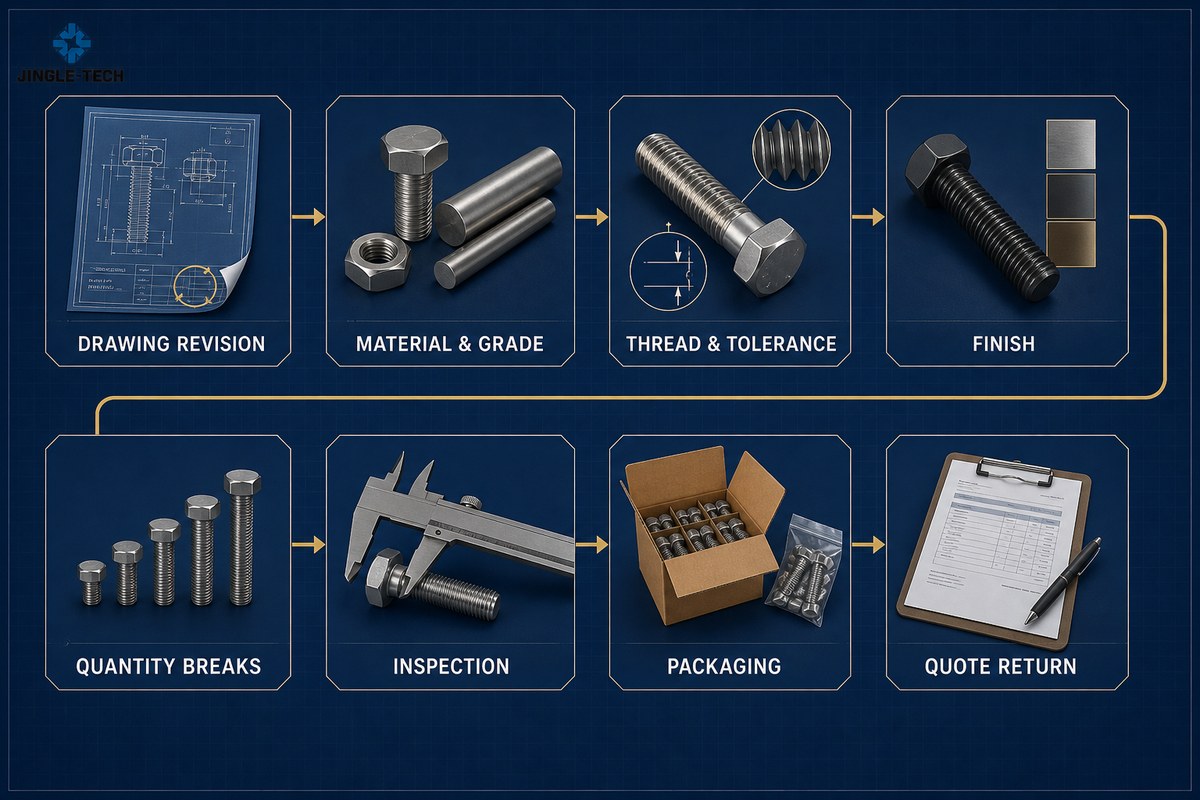
14. Define traceability, packaging and labels before quote comparison
Traceability language such as “full traceability” is too vague for pricing. Define the trace object and the decision it must support.The relevant chain may connect raw-material heat or source lot, internal manufacturing lot, heat-treatment load, coating batch, inspection record, packaging lot and shipment. State how split and merged lots are handled, which identifier appears on the product or pack, what information the shipment document carries, what records are supplied versus retained, and who can authorize a deviation.
Packaging also changes cost and quality risk. Specify pack quantity or weight limit, bag/box/pallet arrangement, separator or protective needs, corrosion protection, cleanliness, mixed-lot rule, label format, barcode or data fields, country-of-origin and regulatory labels where applicable, pallet dimensions or restrictions, returnable packaging responsibilities and destination. If the final pack is not yet designed, give the bidder a common provisional basis and request a separately priced alternative.
Ask each supplier to return the same packaging data: units per inner and outer pack, estimated gross/net weight, pack dimensions, pallet pattern or limitation, material type, moisture/corrosion-control method, label sample status and exceptional handling. A low unit price that assumes bulk loose shipment is not comparable with an offer that includes small line-side packs, lot separation and serialized labels.
| RFQ field | Supplier response | Evidence or sample | Comparison test |
|---|---|---|---|
| Lot boundary | Proposed material/process/pack lot hierarchy. | Redacted flow or sample traveler/label. | Can a suspect outside-process batch be bounded? |
| Pack quantity | Units or weight by inner/outer pack. | Pack specification or concept. | Does it match the same line-side basis? |
| Protection | Method and stated storage/shipping assumptions. | Packaging material/data where required. | Are climate and transport assumptions aligned? |
| Label/data | Fields, barcode format, lot and revision links. | Mock-up subject to buyer approval. | Do all offers include the required data work? |
| Destination basis | Pack dimensions/weights and delivery handoff. | Logistics return fields. | Can freight and handling be normalized? |
15. Put tooling ownership, maintenance and exit rights in the RFQ
“Tooling included” can mean absorbed into the unit price, paid separately but owned by the supplier, paid by the buyer but stored at the supplier, or a mix of general and part-specific tools. The RFQ should distinguish dies, punches, heading tools, rolling dies, machining fixtures, checking fixtures, gauges, sample or test fixtures and packaging tools.For each category, ask whether it is required, who designs and approves it, who pays, who owns it, where it is stored, what it may be used for, how it is identified, who maintains it, what capacity or life assumption underlies the quote, and what happens if supply moves.
A tooling charge is not automatically a complete tool-transfer right. If the buyer requires ownership or transfer, put the conditions in the RFQ and contract: payment milestone, acceptance evidence, identification, maintenance records, storage, access, insurance, refurbishment, duplicate tooling, disposal authorization and transfer assistance. If the supplier regards part of the route as proprietary general tooling, that boundary should be clear before award.
Keep tooling economics separate in the quote return. Request nonrecurring engineering, part-specific production tooling, gauges/fixtures, sampling or validation work, packaging tooling and any optional capacity investment as separate lines. Ask for currency, tax treatment, payment milestone, ownership assumption and whether replacement or normal maintenance is included. This gives the buyer a lifecycle view without demanding a supplier's confidential cost breakdown.
16. State the commercial basis with the same care as the drawing
A technically complete package can still produce incomparable bids if commercial fields are open.Define quotation currency, tax basis, Incoterm and named place under the adopted edition, freight inclusion, destination, payment assumption, quote validity, quantity breaks, packaging basis, standard order multiple if relevant, lead-time definition, production stage, sample and approval timing assumptions, cancellation exposure, raw-material surcharge mechanism if used and any buyer-supplied material or component.
Ask the bidder to define each time interval rather than returning one number called “lead time.” Separate time to technical closure, tool design/build, material procurement, sample production, outside processing, inspection/reporting, buyer approval hold and repeat production after release. Request calendar or working-day convention and identify which clock starts after drawing approval, purchase order, deposit, material authorization or another event. This is a quotation structure, not a promise that any standard duration applies.
For price, require the basis rather than confidential manufacturing arithmetic. Useful fields include unit price by quantity, nonrecurring lines, packaging, evidence/report charges, freight, duties/taxes if in scope, tooling, minimum batch or order assumption, quote validity and escalation or reset mechanism. A supplier may legitimately decline to reveal proprietary margins. The buyer still needs enough separation to compare scope and model the landed decision.
17.Make the supplier return template mandatory
A supplier should be free to attach its formal quotation, but the buyer's return template should control comparison. Require one row per part, quantity break, nonrecurring item, optional alternative and recurring service. Add fields for the RFQ issue quoted, offered revision, compliance status, material/property basis, finish, proposed route, outside processes, evidence included, packaging, Incoterm/named place, currency, unit price, tooling and other nonrecurring charges, lead-time stages, validity, capacity or batching assumption, deviation reference and open-question reference.
Use controlled response codes. “C” can mean compliant without exception; “D” can mean deviation described in the deviation log; “A” can mean assumption requiring buyer confirmation; “O” can mean optional alternative outside the compliant base; and “NQ” can mean not quoted. Define the codes in the RFQ. Do not allow a blank cell to mean all of them. The bidder should identify the responsible contact and date for every open item.
The return template should also prevent scope blending. A compliant base offer occupies its own rows. A value-engineering proposal, substitute material, alternative coating or changed tolerance appears separately with its technical rationale, required approvals, price difference and schedule effect. The buyer can consider the idea without accidentally treating it as the offered baseline.
| Column group | Required fields | Buyer test |
|---|---|---|
| Identity | RFQ issue, part/revision, quote/revision and response date. | Does the line point to the current baseline? |
| Technical response | Compliance code, route, material/property basis, finish and outside processes. | Is any technical difference priced as though compliant? |
| Evidence response | Document/test, stage, source, frequency, format, included price and exception. | Do all bidders include the same records? |
| Recurring commercial | Quantity, unit price, currency, pack, Incoterm/place, freight/tax basis and validity. | Can the unit price be converted to the same landed basis? |
| Nonrecurring commercial | Engineering, tooling, gauges, samples, validation, packaging tool and options. | Are ownership and payment milestones aligned? |
| Timing | Closure, tooling, material, sample, evidence, buyer hold and repeat production stages. | Do all clocks start at the same event? |
| Open items | Deviation, assumption, clarification and alternative reference numbers. | Can every open condition be found and owned? |
18.Control assumptions, deviations and alternatives in separate logs
An assumption fills a missing input temporarily. A deviation states that the offered base does not meet a requirement. An alternative proposes a different solution for buyer evaluation. A clarification asks what the requirement means without yet changing the offer. Combining those categories in free-form quotation notes makes risk difficult to find. Give each its own code, description, requirement reference, reason, interim commercial basis, technical impact, evidence impact, schedule impact, responsible owners and disposition.
Require the supplier to write assumptions positively and specifically. “Standard packaging assumed” is weak. “Price assumes 500 pieces per sealed inner bag, four bags per carton, no mixed manufacturing lots, buyer label fields A–F and delivery on the stated Incoterm; revised packaging may change price and pack dimensions” is reviewable. The buyer can accept it, replace it or issue a common provisional basis.
Deviations should never disappear into the formal quotation's small print. Link each one to the drawing zone, note, specification clause or commercial field. State whether the offer remains valid if the deviation is rejected. If a supplier cannot quote the compliant baseline, it should say so. A technically attractive alternative can be retained as an option, but it cannot be compared in the same unit-price column until engineering, quality and commercial owners approve the new basis.
| Type | What it means | Minimum return fields | Award rule |
|---|---|---|---|
| Assumption | Temporary basis where the buyer input is incomplete. | Missing input, assumed value, effect and owner/date. | Close or carry explicitly into the purchase contract. |
| Deviation | Offered condition differs from the RFQ requirement. | Requirement reference, offered condition, rationale and impacts. | Authorized disposition required before treating quote as compliant. |
| Alternative | Optional proposed solution outside the compliant base. | Technical change, benefit, risk, evidence, price and timing. | Evaluate separately; revise baseline if accepted. |
| Clarification | Question about interpretation or missing context. | Question, document reference, interim quote basis and due date. | Answer through the controlled common clarification route. |
19. Normalize quotations before ranking suppliers
Bid leveling is not the act of putting unit prices in ascending order. It is the controlled conversion of each response to one comparable scope. Preserve the supplier's original quotation, then create a buyer normalization copy with every adjustment traced to a source. Never overwrite a supplier number to make the sheet look clean. If the adjustment cannot be supported, mark it open rather than inventing a value.
Start with technical equivalence.Confirm that each base offer uses the same part and drawing revision, thread, grade or property requirement, tolerance interpretation, coating system, evidence schedule and packaging. Next align commercial variables: quantity, currency and conversion date or rule, Incoterm and named place, freight, duty/tax treatment, payment assumption, pack quantity, tooling ownership and recurring versus nonrecurring lines. Then align timing definitions and identify approvals or buyer-supplied inputs on the critical path.
Use three states for each comparison row: aligned, normalized with a documented adjustment, or not comparable/open. Do not assign a technical score to a row that has not passed engineering review. Do not assign a quality score merely because a certificate was attached. Do not score an assumed capability, unverified case claim or sales promise as evidence. The quote comparison record should show the source file, reviewer, date, disposition and unresolved risk.
| Gate | Alignment question | Acceptable evidence | If not aligned |
|---|---|---|---|
| Definition | Same controlled part, revision and precedence? | Signed/acknowledged document index and compliance return. | Requote or hold ranking. |
| Technical scope | Same thread, material/property, tolerance and finish basis? | Requirement matrix plus closed deviation log. | Separate alternative or seek authorized disposition. |
| Evidence | Same sample, approval and recurring records? | Completed evidence schedule with price treatment. | Obtain priced inclusion or normalize visibly. |
| Quantity/pack | Same batch, release and packaging basis? | Quantity ladder and packaging return. | Reprice on common basis or mark open. |
| Delivery basis | Same currency, Incoterm, named place and freight scope? | Formal quote and logistics fields. | Document conversion and landed-cost assumptions. |
| Nonrecurring scope | Same tooling, gauges, samples, approvals and ownership? | Separated NRE schedule and terms. | Build lifecycle scenarios without hiding the difference. |
| Timing | Same start event, buyer holds and deliverable? | Stage timeline with assumptions. | Rebase milestones; do not compare headline weeks. |
A practical leveling sequence
- Lock the bid set. Record quotation and attachment revisions before analysis.
- Run the compliance gate. Separate compliant bases, deviations, alternatives and no-bids.
- Close factual gaps. Use the controlled clarification log; distribute buyer corrections consistently.
- Normalize recurring scope. Align quantity, packaging, evidence and delivery basis.
- Normalize nonrecurring scope. Separate tooling, gauges, samples and approval activities.
- Model defined demand cases. Apply the same horizon and releases without pretending the forecast is guaranteed.
- Record residual risk. Keep unresolved technical, quality, capacity and commercial items beside the result.
Compare your custom fastener quotations
20. Run one controlled clarification round before final bids
When several bidders ask the same question, the RFQ probably needs a correction. Maintain one clarification log with sequential IDs, question date, bidder or anonymous topic, affected document, buyer owner, answer, controlling status and amendment impact. Distribute requirement-changing answers to every affected bidder. Preserve bidder-specific commercial or proprietary questions separately where confidentiality requires it, but do not allow one bidder to quote a different buyer requirement because an answer was given only in a private call.
After the clarification deadline, issue a clean amendment package: revised cover, updated document index, changed files, consolidated controlling answers and a change summary. Ask suppliers to return a final quotation revision that supersedes the earlier bid. The response should state which price, timing, route, evidence or deviation rows changed. This makes round-two comparison faster and protects the audit trail.
Do not keep negotiating against a moving technical target.If engineering changes a tolerance, material, coating or test after final bids, reopen the relevant scope and give bidders enough information to assess it. A supplier may be able to absorb the change, but the buyer should not assume zero impact. Likewise, if a supplier proposes a change after nomination, route it through the contract's notification and approval process rather than accepting it in routine email.
21. Three controlled examples show why quote return matters
The following examples are hypothetical buyer exercises. They do not describe a JINGLE-TECH project, customer, plant, test result, saving or lead time. Their purpose is to show how an apparently small RFQ ambiguity changes comparison.
Example A: two zinc quotations are not the same coating offer
The drawing says “zinc plate, silver,” and both suppliers mark the note accepted. Supplier A's attachment identifies an electroplated system, thickness range, supplementary finish, lubricant status, thread-fit interpretation, outside processor and reports. Supplier B returns only the color and a salt-spray headline. The commercial sheet shows B at a lower unit price. The RFQ owner should not rank yet. Engineering and quality must define the missing coating system and evidence, then both suppliers should quote the same designation and conditions. The first price difference was partly an information difference.
Example B: one “annual quantity” hides two manufacturing routes
The buyer requests a price for a large annual usage but needs a small validation batch first. Supplier A prices machining for validation and a separate forming route with part-specific tools for repeat production. Supplier B gives one blended price without identifying route or tooling. A quantity ladder exposes the issue. The buyer asks both bidders to return stage-specific routes, samples, nonrecurring charges, price breaks and the approval event that permits a route change. The comparison then distinguishes early learning cost from repeat-production economics.
Example C: a lower price excludes the required inspection return
Both bidders can make the drawing. The evidence schedule requires a characteristic-linked dimensional report and coating report for the approval lot, plus defined recurring documents. Supplier A includes them. Supplier B's quotation says “certificate extra” without identifying which record or price. The buyer returns the incomplete evidence matrix rather than estimating the missing cost. Supplier B either prices the same package, records a deviation or declines. Only then can the sourcing team evaluate the recurring and nonrecurring commercial result.
22. Buyer pre-issue checklist for a custom fastener RFQ
Use this gate before sending the package.A “no” does not always stop an early feasibility discussion, but the RFQ must identify the gap and the provisional basis. A firm production quotation should not depend on invisible answers.
| Gate | Pass condition | If open |
|---|---|---|
| 1. RFQ identity | Unique ID, issue revision/date and response owner. | Create the controlled cover. |
| 2. Document index | Every file has an identifier, revision/date and status. | Remove obsolete or duplicate files. |
| 3.Precedence | Drawing/model/specification conflicts have a stated route. | Name the temporary quote assumption. |
| 4. Part definition | Geometry, thread, material/property, finish and acceptance are defined. | Request feasibility only or close engineering input. |
| 5. Standards | Adopted documents and editions are verified and accessible. | Resolve obsolete or ambiguous references. |
| 6. Joint context | Relevant mating, assembly and environment inputs are shared. | Flag unknowns and proposed validation. |
| 7. Critical features | Risk-driving characteristics and evidence decisions are identified. | Hold universal sampling or capability demands. |
| 8. Evidence schedule | Record, source, stage, frequency and format are stated. | Create a provisional common package. |
| 9. Quantity ladder | Prototype, approval and repeat demand bases are separated. | Label forecast and request quantity options. |
| 10. Pack/logistics | Pack, label, lot and delivery basis are common. | Issue a shared provisional basis. |
| 11. Tooling/commercial | Ownership, nonrecurring lines, currency and terms are defined. | Require separated assumptions. |
| 12. Return and questions | Mandatory template and controlled clarification route are ready. | Do not compare free-form quotes yet. |
23. Supplier response checklist before the bid is accepted
A complete response should let the buyer reproduce the supplier's commercial basis without a detective exercise. Before accepting the bid into the comparison set, confirm the following:
- The quotation names the RFQ issue, part revision, quote revision and attached return files.
- Every requirement group carries a compliance, deviation, assumption, alternative or not-quoted status.
- The proposed high-level route distinguishes internal and outside processes without unsupported capability claims.
- Material/property, thread, tolerance interpretation and coating system match the compliant base or have a logged exception.
- Prototype and repeat-production routes, quantities and evidence are not blended.
- Tooling, gauges, samples, validation, packaging and other nonrecurring lines are separated with ownership assumptions.
- Recurring price rows share the required quantity, pack, currency, delivery and evidence basis.
- Timing is broken into defined stages and identifies buyer approval holds or missing inputs.
- Quote validity, tax/freight scope and any surcharge or reset mechanism are explicit.
- All open questions have an owner, interim quotation basis and closure date.
If any of these items is missing, the buyer can still preserve the response as a preliminary bid. It should not be promoted to “comparable final quotation” until the gap is closed or transparently carried as a decision risk.
24. Related Manufacturing Capabilities
A custom fastener RFQ may sit inside a wider sourcing package. Use the relevant cluster page for product-specific questions, then return to this RFQ framework to keep every bid on one controlled basis:
- custom fastener manufacturer
- custom screw manufacturer
- structural bolt manufacturer
- concrete anchor manufacturer
- custom nut manufacturer
- hose clamp manufacturer
- lifting anchor manufacturer
- precast concrete accessories manufacturer
- precision CNC machining parts manufacturer
- OEM fastener and machined parts supplier
25. Custom Fastener RFQ FAQ
What should I send for a custom fastener RFQ?
Send a controlled RFQ cover and document index, the current drawing or product-definition dataset, relevant model and specifications, application inputs that change the proposal, quantity ladder, evidence schedule, packaging/logistics basis, commercial fields, supplier return template and clarification log. If something is unknown, identify it and supply one common provisional basis rather than leaving each bidder to assume differently.
Can a supplier quote from a 3D model without a drawing?
A supplier can sometimes provide preliminary feasibility or budgetary feedback from a model, but a firm quotation needs a controlled definition of all acceptance requirements.The RFQ must state whether the model is controlling and where material, threads, tolerances, finish, properties, notes, marking and evidence requirements are defined. Ask the bidder to list every missing input and the interim basis used.
Can I request a quote from a physical sample?
A sample can support identification and discussion, but it may be worn, coated, distorted or dimensionally unrepresentative, and it does not reveal all material or processing requirements. Define whether the supplier is quoting reverse engineering, a replacement to a released drawing, or a new design activity. Record sample identity, measurement responsibility, destructive-test permission and who approves the resulting definition.
How do I specify a fastener grade correctly?
Identify the governing product standard and edition, confirm that the part form, size, thread and application fall inside its scope, state material or condition requirements and list any project additions. Pair required properties with the applicable test method and evidence. Do not assume that a grade or property class automatically defines corrosion, torque/clamp behavior, fatigue or every coating decision.
Should every dimension be marked critical?
No. Every acceptance requirement matters, but “critical” should identify characteristics whose control or failure consequence justifies special planning, escalation or evidence.Engineering and quality should connect those characteristics to function, process, measurement and reaction. Marking everything critical hides the actual risk and can produce unnecessary inspection or quoting uncertainty.
What coating information belongs in an RFQ?
State the standard and edition, system/designation, substrate context, required layers, thickness rule, finish/color, lubricant or friction requirement if controlled, corrosion and other performance conditions, thread-fit condition, hydrogen-embrittlement controls where applicable, restricted-substance needs, evidence and approved process route. A color or generic metal name is not enough.
How many quantity breaks should I request?
Use the quantity ladder that represents the decision: prototype or validation quantities, launch or pilot demand, expected repeat batches and useful alternative release sizes. Give the same packaging, evidence and delivery basis for each row. Ask suppliers to identify route changes and economic-run assumptions rather than forcing a universal number of breaks.
How do I compare tooling charges?
Separate engineering, production tools, gauges, test fixtures, sample work, packaging tools and optional capacity investment. Compare ownership, payment milestone, acceptance, maintenance, replacement, storage, permitted use and transfer rights as well as price. Tooling that the buyer pays for does not automatically carry the same ownership or exit conditions.
What is the difference between an assumption and a deviation?
An assumption temporarily fills a missing buyer input and may be replaced without changing the intended requirement. A deviation means the offered condition does not meet the stated requirement. Both need requirement references, impacts, owner and disposition. An alternative is separate again: it proposes a different solution outside the compliant base.
Why are two custom fastener quotations so different?
The offers may use different revisions, routes, quantity assumptions, tooling, material or coating interpretations, evidence packages, packaging, delivery terms or risk allowances. First level the technical and commercial scope. A real price difference remains meaningful only after those hidden variables are aligned or explicitly valued.
Should I ask every bidder for the same manufacturing process?
Specify the product and any process restriction required by design, law or customer control, then invite a proposed route. Different routes can be legitimate. Require each bidder to identify its route, outside processes, evidence and approval needs, and keep noncompliant alternatives separate. Engineering must approve the product and process implications before award.
Which inspection documents should be recurring?
There is no universal set.Define the records needed for the product, process and customer risk, then state whether each is due at feasibility, sample/approval or every shipment. Distinguish documents supplied with the order from records retained for access. Verify that the selected document type and standard scope fit a specially engineered part.
How should lead time be requested?
Ask for stages: technical closure, tooling, material, sample manufacture, outside processing, inspection/reporting, buyer approval hold and repeat production. Define the event that starts each clock and whether durations use calendar or working days. This avoids comparing one bidder's time to sample with another bidder's time to production shipment.
What if a standard is revised during the RFQ?
The controlled RFQ edition remains the quotation baseline unless the buyer issues an amendment. Engineering and quality should review the new edition and decide whether to adopt it. If adopted, distribute the updated requirement to affected bidders and request price, evidence and schedule impacts. Do not let “latest edition” change silently during comparison.
When is a custom fastener quote ready for award?
It is ready for a sourcing decision when the offered revision is identified, technical compliance and approved deviations are clear, evidence and packaging are defined, recurring and nonrecurring commercial scope is aligned, timing assumptions are understood and residual risks have named owners. Award authorization still follows the buyer's engineering, quality, legal and procurement process.
26. Turn the RFQ into a decision record
The best custom fastener RFQ does not try to predict every supplier detail. It creates a disciplined boundary between the released requirement, the supplier's proposed realization route, the evidence needed for approval and release, and the commercial basis being compared. It makes uncertainty visible early, gives bidders a fair common baseline and preserves alternatives without allowing them to contaminate the compliant offer.
Before requesting the final bid, walk from the part number to the drawing/model revision, thread, grade or property requirement, tolerance strategy, coating system, process map, evidence schedule, quantity ladder, packaging, tooling and delivery basis. Then walk backward from every quoted price to its assumption, deviation and document source. If either path breaks, the comparison is not finished.
Request a custom fastener RFQ discussion
Editorial standards check: official ASME, ISO, ASTM and NIST source pages were reviewed on 27 August 2026. Recheck standards, amendments and project requirements at the date of RFQ issue.