Bolt Anchor With Plate Manufacturer Guide: Drawing, Plate Welds, Samples and RFQ

When an enquiry only says “send price,” the replies often look fast but are hard to use. For a bolt anchor with plate, send the element drawing, what the anchor will do, where the plate sits, the bolt or thread interface, nearby concrete edges, handling or fixing stage, finish, sample plan and document list. Then the quotations can be compared on things that matter: drawing control, material route, plate flatness, weld or forming control, thread fit, marking, packing and change history.
This guide is for B2B buyers, precast factories and distributors. It is not a structural design note, a lifting instruction, a capacity table or permission to copy another system. The responsible engineer must approve anchor selection, reinforcement, concrete strength, edge distances, load direction, installation method and site use.
Start by defining the function
The name “bolt anchor with plate” sounds clear until two factories quote two different parts. One buyer may mean a cast-in lifting anchor with a plate foot. Another may mean a fixing insert with a plate washer or a welded plate assembly for a connection. Start with the job the part must do, not with a photo.
JINGLE's precast accessories page lists both Bolt Anchor and Bolt Anchor With Plate. The exact JINGLE product drawing, load class, plate size, thread, material, finish, testing method and certificate package are [NEEDS JINGLE CONFIRMATION].
Use plain wording in the RFQ. If it is for temporary handling, say “bolt anchor with plate for precast lifting application.” If it is a permanent fixing point, say “cast-in fixing anchor with plate.” If it is a connection item, say “plate anchor assembly for structural connection.” For OEM work, write “custom bolt anchor with plate to buyer drawing.”
If the function is still open, write that in the RFQ. A quote should not quietly harden an unfinished lifting or fixing idea into a finished specification.
Buy the system around the anchor
A plate helps with load transfer or positioning only when the rest of the application supports it. Plate geometry, bolt or thread, embedment length, concrete cover, reinforcement, formwork fixing and mating hardware all matter.
PFEIFER's official thread-system anchor page presents anchors together with matching lifting keys and documents. HALFEN's socket lifting anchor page does the same kind of thing for its own socket-anchor system, including lifting links, nail plates and identification. Those pages are useful reminders to treat the anchor as part of a named arrangement. They do not provide JINGLE dimensions, compatibility or load values.
For JINGLE purchases, confirm the matching accessories and application boundaries directly with JINGLE or the project engineer.
Ask for a drawing that controls the assembly
A bolt anchor with plate is not just a round bar with a flat piece added to it. The plate position, thread, mating hardware and embedded length all have to follow the approved arrangement. A photo is useful for recognition, but it cannot be the production standard.
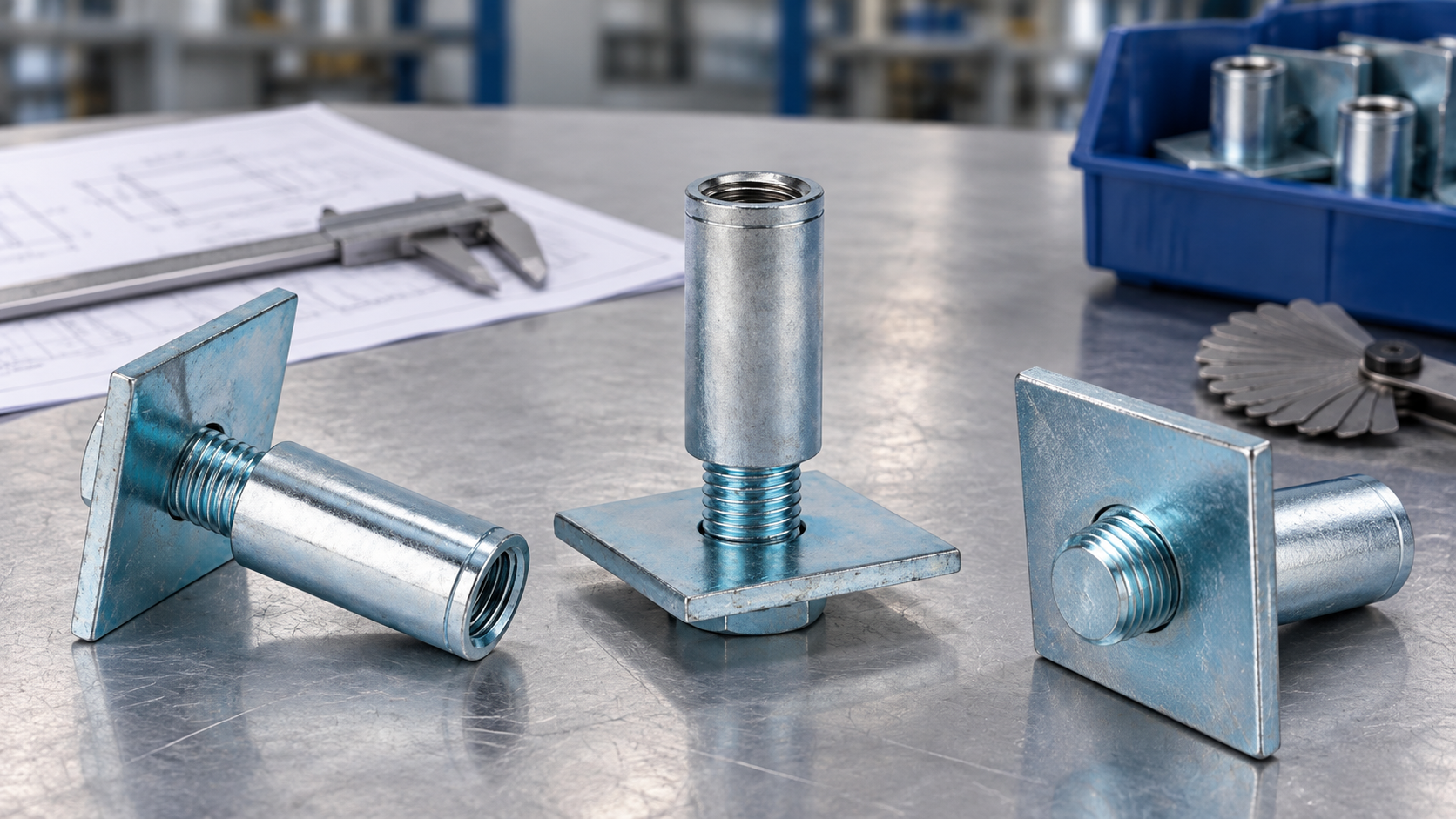
Ask the manufacturer to provide a revision-controlled drawing. It should show the bolt or body diameter, thread type, thread length, plate thickness, plate size, plate position, attachment detail, overall length, finish and tolerances. Mark which dimensions are critical for incoming inspection. Otherwise, the buyer may inspect the easy dimensions and miss the dimensions that actually matter.
For custom orders, state whether the buyer drawing or JINGLE drawing controls the final product. If both drawings exist, one should be marked as the master revision.
Plate flatness and hole quality are practical issues
Buyers often focus on thread size and barely look at the plate. That is where small problems hide. A warped plate can sit badly in a mold, push reinforcement out of position or create inconsistent cover. A rough hole can damage a thread, interfere with welding or leave burrs that cut gloves and packing.
Do not leave the plate process as “standard.” Ask whether the factory cuts, punches, drills or machines it, and ask what they regard as an unacceptable burr, hole shift or bend. For welded assemblies, judge the sample in its finished state.
Incoming inspection can stay simple. Measure plate length, width and thickness. Compare hole position to the drawing datum. Check flatness on an agreed surface or gauge. Look for burrs, rust, oil, sharp edges and coating damage before the parts go into storage.
JINGLE's plate manufacturing route, flatness tolerance and burr criteria are [NEEDS JINGLE CONFIRMATION].
Welds or forming must be part of the quote
If the plate is welded to the anchor, the weld is not a vague shop detail. If the plate is mechanically formed, upset, swaged or otherwise retained, that method needs control too. The buyer should know how the factory prevents loose plates, misalignment, cracks, undercut, excessive spatter or poor surface finish.
Ask for the process route before bulk order. The answer should name how the plate is attached, who approves the first piece, what is checked during production and what happens to rejected parts. A work instruction for this part is better than a general statement that “our welders are experienced.”
For a lifting or structural use, the weld and assembly route must match the approved design documents. Do not accept a cheaper attachment method unless the engineer has approved the change in writing.
Thread fit should be checked with real mating parts
Thread problems are annoying because they are often discovered late. A thread that looks fine in a photo may still bind with the customer's nut, socket, key or lifting device. Pitch, class, coating build-up and packing damage can all affect fit.
Ask the factory to confirm the exact thread designation. Do not write only “M thread” or “Rd thread” if the order depends on a specific standard. For coated parts, ask whether the thread is checked before or after coating.
Sample review should use the real mating item. Record the thread gauge, the nut or device reference, whether hand assembly works without forcing, the projection length after assembly and whether the coating has clogged the thread or left bare damage.
JINGLE's thread options, gauge plan and coating effect on thread fit are [NEEDS JINGLE CONFIRMATION].
Material traceability should cover both bolt and plate
A plated assembly may have more than one material trail. The bolt body, plate, weld consumable and coating supplier may each bring separate records. A useful manufacturer can connect the shipped lot to those inputs without making the buyer chase every workshop note.
Request a practical traceability package: material certificate route, incoming inspection record, lot number, weld or assembly record, coating record if used, and final inspection report. The point is not to collect paper for decoration. The point is to let the buyer trace a shipped carton back to a real production batch.
JINGLE's material grades, weld consumables, coating options and document format are [NEEDS JINGLE CONFIRMATION].
Surface finish affects storage and thread use
Finish is a purchasing decision and a technical decision at the same time. Plain steel, zinc plating, hot dip galvanizing, stainless steel or another coating can change thread fit, weldability, corrosion resistance, cost and lead time.
Do not borrow finish requirements from another supplier's catalogue. HALFEN and PFEIFER describe their own systems and documents. JINGLE finish availability for bolt anchor with plate products is [NEEDS JINGLE CONFIRMATION].
Add the finish notes early: indoor or outdoor storage, post-coating thread use, any later welding, any stainless requirement, and whether a finish certificate has to ship with the goods. These small notes change both cost and lead time.
Marking and packing prevent mix-ups
Parts that look almost identical may have different lengths, plate sizes or threads. Once they are stacked in the warehouse, mistakes become easy. A good bolt anchor with plate manufacturer helps the buyer keep sizes apart.
Agree the marking and packing method before production. The label should show the part number, drawing revision, quantity, batch number and production date. Similar lengths or threads should not be mixed. Threads may need caps, wrapping or another agreed protection method. Export packing should match the weight and handling route.
JINGLE's standard marking, thread protection, carton method and pallet method are [NEEDS JINGLE CONFIRMATION].
Sample approval should happen before bulk order
For a new buyer, a sample order is not only a beauty check. It is a rehearsal for the production order. The sample should test communication, drawing control, packing, document response and real fit with the buyer's mating part.
Use the sample to check drawing match, plate position, thread fit, finish, marking, packing and document response. The plant should be able to identify the part quickly, and the mating item should assemble without forcing.
Keep one approved sample with the purchasing file. It supports visual comparison, but the drawing still controls future production.
How to compare manufacturers
A low price is useful only when the quoted product is truly the same. Compare the suppliers by risk, not only by unit cost.
| Supplier question | Strong answer | Risky answer |
|---|---|---|
| Drawing control | Revision and tolerances are clear | Photo quotation only |
| Plate process | Cutting, hole and flatness checks are named | Plate details ignored |
| Weld or forming | Attachment method and inspection are stated | “Normal welding” only |
| Thread control | Gauge and mating check are available | Thread named too loosely |
| Traceability | Bolt and plate lots are linked | No lot records |
| Change control | Notice before material or process change | Silent substitution |
For repeat orders, ask the manufacturer to notify you before changing material source, plate process, weld route, coating supplier, packing or any critical dimension.
RFQ checklist for a bolt anchor with plate manufacturer
When sending the enquiry, include the product name, function, drawing, thread designation, plate size, material, finish, quantity, required documents, packing method and unresolved engineering points. Thread details should name the designation, length and mating part. Plate details should name the size, thickness, hole and position.
Open values should stay open in the RFQ. Write [NEEDS ENGINEER CONFIRMATION] beside them, so nobody has to untangle a supplier's guess after samples arrive.
Where JINGLE can fit
JINGLE can be considered as a bolt anchor with plate manufacturer for buyers who need precast accessories, OEM drawings or project-based sourcing. A controlled RFQ with drawings, application, mating parts and document expectations will get a better answer than a one-line price request.
Before ordering, ask JINGLE to confirm the available standard models, custom drawing support, material grades, finish choices, thread options, plate sizes, weld or forming route, inspection plan, certificates, MOQ, sample lead time, bulk lead time and export packing. Treat each item as [NEEDS JINGLE CONFIRMATION] until JINGLE confirms it.
For current product details, send the drawing, quantity and intended use through the JINGLE contact page.
FAQs
Is a bolt anchor with plate always a lifting anchor?
No. It may be used for lifting, fixing, connection or another custom precast function. The RFQ should state the function clearly before price comparison.
Can buyers choose the product only by thread size?
No. Thread size is only one detail. The engineer still has to review plate geometry, embedment, material, finish, concrete conditions, reinforcement and load direction.
Should the plate be welded or formed?
That depends on the approved product design. Buyers should ask the manufacturer to state the attachment method and inspection route, then confirm it matches the project requirement.
What should be checked on samples?
Check drawing match, plate position, thread fit, surface finish, marking, packing and document response. Use the real mating nut, socket or device when possible.
Can JINGLE provide custom bolt anchor with plate products?
JINGLE lists Bolt Anchor With Plate in its precast accessories range, but custom size, material, finish, MOQ, lead time and certificates are [NEEDS JINGLE CONFIRMATION].
What documents should be requested before shipment?
Ask for the approved drawing, material certificate route, inspection report, packing list and shipment photos. Any product approval or lifting document must match the exact item supplied.