Choosing a Sandwich Panel Anchor Supplier: What Actually Matters on the Shop Floor
If you are sourcing from a sandwich panel anchor supplier, the real question is not simply who can ship hardware fastest. It is whether the anchor design, material choice, and manufacturing consistency fit the panel system you are building or installing. For engineers and procurement teams, that difference affects handling safety, panel integrity, and how much rework shows up later at the jobsite.
Sandwich panels are unforgiving in one respect: they look simple, but the load path is often doing more work than people assume. A poor anchor choice can damage the facings, create uneven lifting, or force installers to improvise. That is why buyers usually end up comparing not just price, but the supplier’s ability to produce the right anchor geometry and support the application with practical guidance.
Anchor Types: Similar on Paper, Not Always in Use
Most buyers first compare basic lifting and fixing concepts before they compare vendors. In that conversation, the names may vary by region or plant, but the functional categories tend to be familiar.
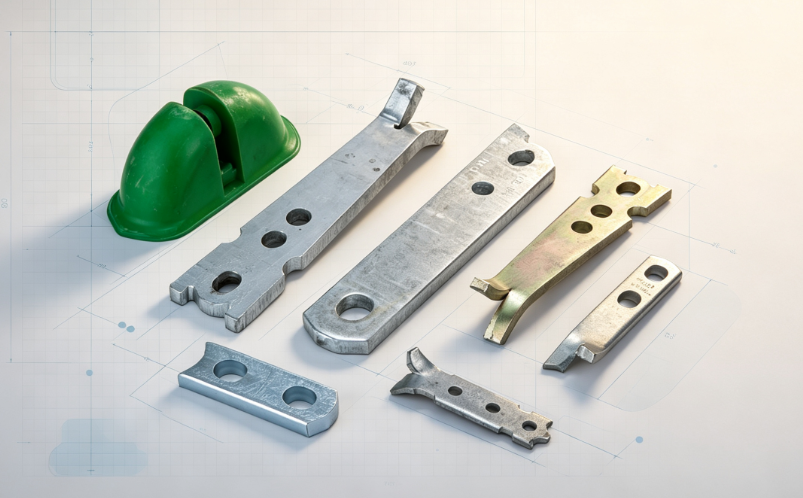
Two-hole anchor vs. spread anchor
A two-hole anchor is often selected when the design calls for straightforward attachment and predictable installation. The geometry is usually simple, which can be helpful for repeat production, but the details still matter: hole placement, plate thickness, edge finish, and how the anchor interfaces with the panel.
A spread anchor, by contrast, is generally chosen when load distribution is the priority. In practice, that can mean better force dispersion across a larger contact area. For some panel designs, that extra spread is worth the added complexity. For others, it is unnecessary overhead. This is where a spread anchor manufacture capability becomes relevant, because making the part is only half the story; reproducing it consistently across batches is the other half.
When a supplier’s range matters
A sandwich panel anchor supplier with a narrow catalog may still be fine if your specification is stable and the application never changes. But if you are supporting several panel thicknesses, different lifting conditions, or multiple assembly lines, a broader manufacturing base is easier to work with. It reduces the temptation to force a near-match part into service, which is rarely a good idea on structural or semi-structural hardware.
Quick Comparison: What Buyers Should Weigh First
Before you get lost in drawings and quotations, compare the supplier on a few practical points.
Design fit: Does the anchor suit the panel construction, or is it being adapted after the fact?
Manufacturing repeatability: Can the supplier hold the same geometry from batch to batch?
Material suitability: Is the material appropriate for the intended environment and load condition?
Installation reality: Will the anchor be easy for the plant or field crew to use without special workarounds?
Communication: Can the supplier explain the difference between similar anchor styles without hiding behind part numbers?
That last one is underrated. A vendor who can discuss use cases clearly is usually easier to work with when a drawing revision shows up or when a project changes direction halfway through procurement.
Common Buying Mistakes
The most common mistake is treating all anchors as interchangeable. They are not. A part that looks close enough on a screen may behave differently once it is fixed into a sandwich panel and exposed to actual handling loads.
Another mistake is overvaluing price while ignoring fabrication quality. If the edges are rough, hole alignment is inconsistent, or the profile varies, the savings can disappear quickly in scrap and labor. A third issue is under-specifying the application. Buyers sometimes ask for a generic anchor and expect the supplier to read between the lines. That works until the first production run reveals a mismatch.
A smaller but still important caution: do not assume a supplier that produces one anchor style will automatically handle another just as well. Two-hole anchor supplie capability, for example, does not automatically tell you much about their spread anchor manufacture process. Those are related, but not identical, skills.
How to Evaluate a Supplier Without Wasting Time
Start with the drawing, then move to process questions. Ask how the part is formed, what controls are used to keep dimensions consistent, and how the supplier verifies that the anchor matches the intended panel application. If they cannot answer those points clearly, the quotation is not the whole story.
It also helps to request a side-by-side comparison of the anchor types you are considering. In a lot of sourcing projects, the best decision is not the strongest-looking part or the cheapest one. It is the part that aligns with the panel system, the installation method, and the risk level you can accept.
Practical Buyer Advice
For production buyers, the safest route is usually to standardize around the minimum number of anchor variants that still covers the real use cases. That makes inventory simpler and reduces operator confusion. For engineers, the priority is load path and interface behavior. For sourcing managers, it is supplier consistency and documentation. Those goals overlap, but they are not the same.
If you are comparing a sandwich panel anchor supplier against other vendors, ask for enough technical detail to separate marketing language from actual manufacturing capability. The right partner should be able to discuss two-hole anchor options, spread anchor manufacture, and the tradeoffs between them without making every answer sound identical.
What to Ask Before You Place the Order
What panel type is the anchor intended for? How is the anchor attached or embedded? Which anchor style is more appropriate for your handling and installation method? Can the supplier support repeat orders without drifting from the approved sample? Those are the questions that save time later.
If you are still narrowing the field, build your shortlist around fit, consistency, and responsiveness rather than the first low quote. That usually leads to fewer surprises once the product moves from paper to production.
Next Step
Prepare your panel drawing, expected use conditions, and preferred anchor style before you request pricing. A focused inquiry gives suppliers a better chance to quote accurately, and it gives you a cleaner comparison between two-hole anchor and spread anchor options. If your project is still at the specification stage, that is the right time to pressure-test the design, not after the first batch is already committed.