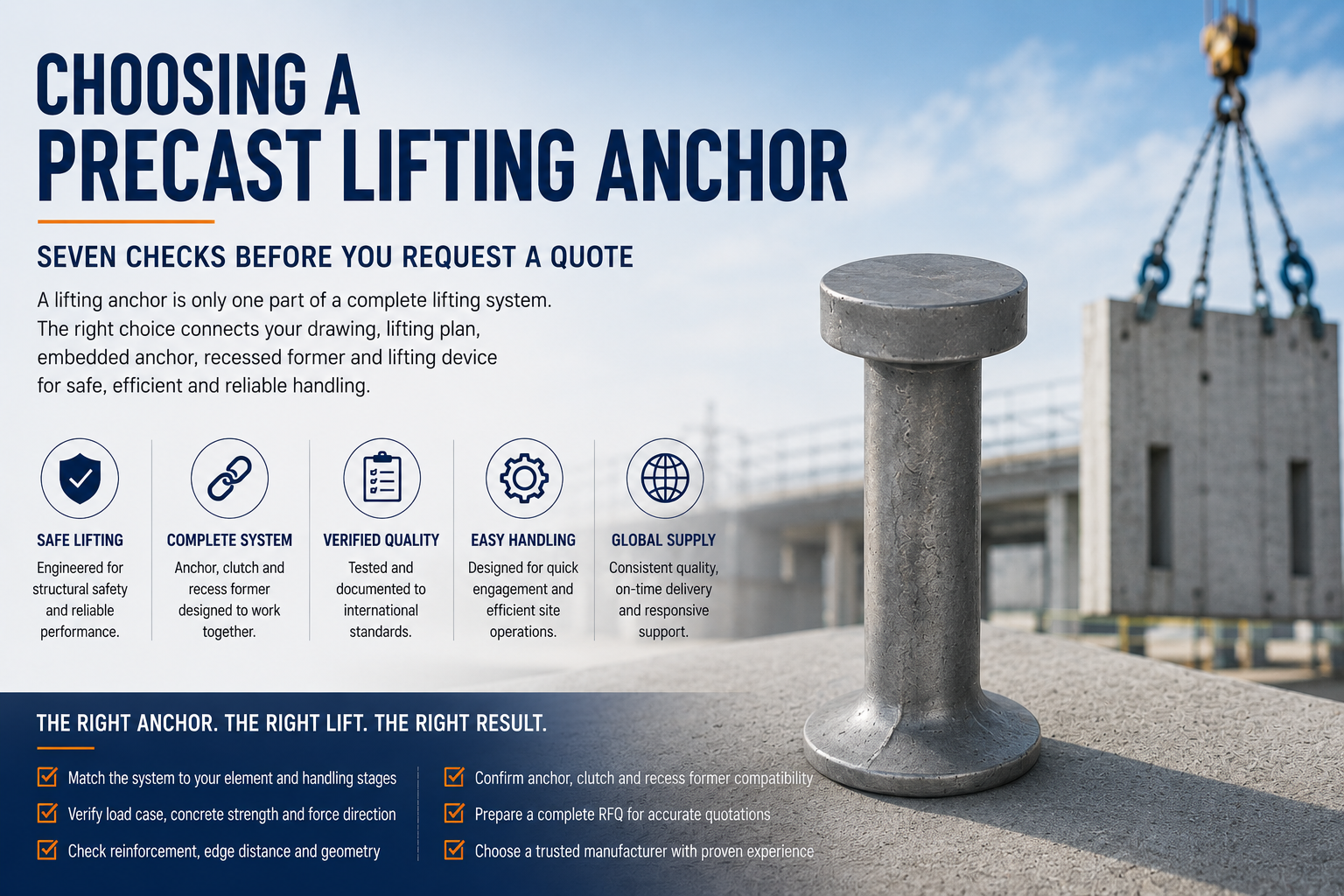
What Information Should You Provide for a Lifting Anchor Quote?

A useful lifting anchor quote starts with more than an anchor name and a quantity. Send the precast element drawing, the handling sequence, the proposed lifting arrangement, the concrete condition at each lift, and any existing anchor, clutch, or recess-former references. Then add the commercial details: material and finish requirements, quantities, required documents, packaging, destination, and requested delivery terms.
If part of the lifting design is not settled, label it as open. Do not turn an assumption into a specification just to complete the RFQ. The supplier can then separate what is ready to quote from what still needs review by the responsible project engineer.
Why a one-line request rarely produces a comparable quote
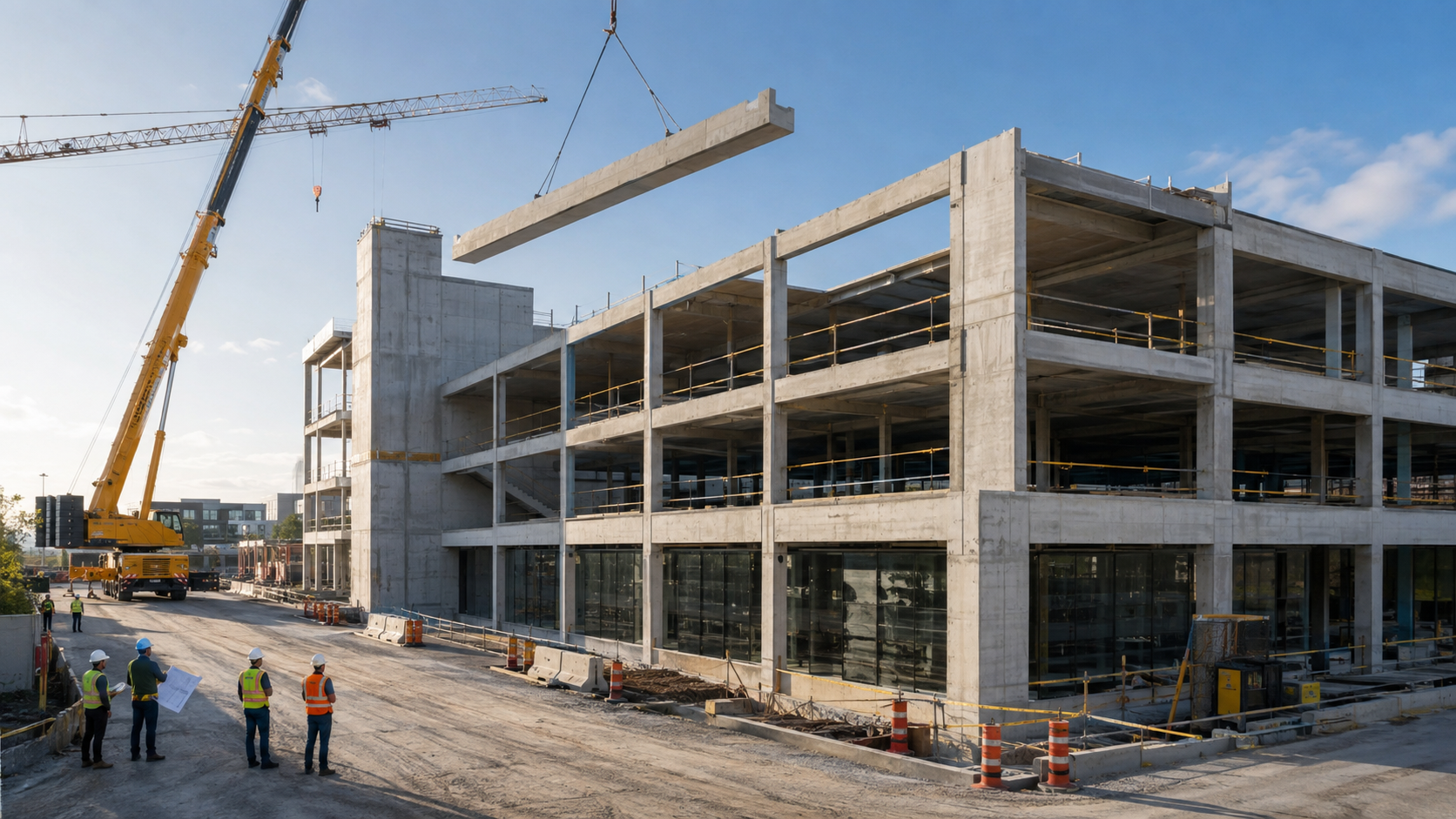
“Please quote 5-ton lifting anchors” sounds direct, but it leaves the system, stated-load basis, lift direction, clutch, concrete condition, finish, and evidence undefined. One supplier may price anchors only; another may include formers, clutches, inspection records, and export packing. A controlled RFQ gives every bidder the same technical definition and supply boundary.
Begin with the precast element and the lift sequence
Send a readable, revision-controlled element drawing with units. It should show the element type, principal dimensions, thickness, openings, edges, and the proposed lifting regions. Include the local reinforcement drawing when available.
Add a short description of how the element will be handled. Do not limit the note to final erection. The sequence may include:
- release from the mould;
- rotation or tilting;
- movement through the factory;
- storage-yard handling;
- loading and unloading;
- transport-related handling; and
- final positioning on site.
Force direction and concrete condition can change between those stages, so the RFQ should make each lift visible to the engineering review.
If the centre of gravity is offset by openings, corbels, embedded items, or uneven geometry, identify it on the drawing when known. If it has not been established, write “centre of gravity to be confirmed” instead of allowing a supplier to assume that it sits at the geometric centre.
State the load information without hiding the assumptions
Element weight is important, but it is not a complete load case. The responsible engineer may also need to consider form adhesion, dynamic effects, sling angle, rotation, unequal load sharing, the number of effective lifting points, and the direction of force at each anchor.
For quotation purposes, send the known inputs and their status:
- element self-weight and how it was obtained;
- proposed number and location of lifting points;
- rigging sketch or sling arrangement;
- planned sling angles or lifting directions, when confirmed;
- concrete strength at each handling stage, when confirmed;
- expected rotation or tilt sequence; and
- any governing design output already approved for the lifting points.
Do not ask the supplier to infer a working load from element weight alone. If the required WLL is open, mark it for engineering confirmation and ask what other inputs are needed.
This article is a procurement guide, not a lifting design or installation instruction. Product selection and the lift plan must be approved by the responsible engineer using the applicable project requirements and the current technical documentation for the exact system.
Identify the lifting system, not just the visible part
Lifting anchors are supplied as parts of defined systems. The embedded anchor, recess former, and reusable clutch or lifting key have mating geometries and documented limits. A quote should therefore name the intended system family and the components that must work together.
Where the plant already owns lifting clutches, send the manufacturer or system reference, load-class marking, clear photographs, drawing, and critical dimensions. A physical sample can be useful for comparison when the reference is uncertain. It does not, by itself, prove that a proposed anchor is compatible.
The same caution applies to requests for an alternative. “DEHA type” or “similar to our current anchor” is not enough for approval. Record the exact existing part reference and the verification route expected by the buyer. Photographs help identify a starting point; controlled dimensions and technical evidence are needed to finish the comparison.
PFEIFER's lifting-anchor systems page presents distinct system families with associated components. Leviat takes a similar approach on its Halfen DEHA KKT page: the anchor is presented with the clutch intended to engage it. That is the point of citing these pages here. A system name narrows the RFQ; neither source validates an untested mixed-brand combination.
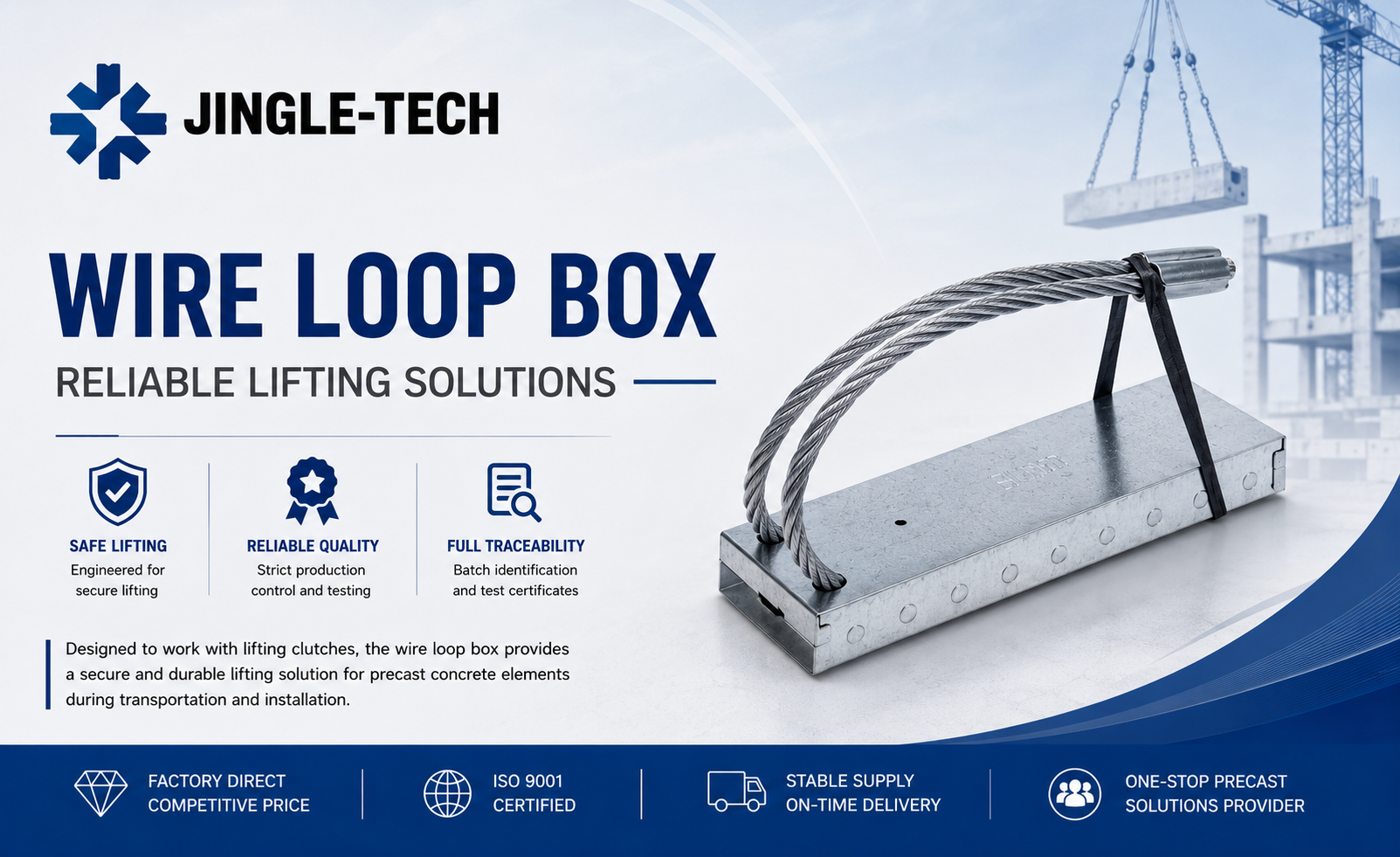
If the enquiry concerns JINGLE supply, the lifting foot anchor page gives the buyer a concrete product reference. Attach details of the system already in the plant.
Provide the product definition and revision
When the buyer already has an approved anchor drawing, attach it to the RFQ. The file should carry a part number, revision, units, and date. Identify the dimensions that are critical to clutch engagement, recess-former fit, anchor placement, and product identification.
For a drawing-based or sample-based request, also state:
- whether the drawing is buyer-controlled or proposed for supplier review;
- material requirement, if specified;
- surface finish and any project coating requirement;
- marking content and location;
- dimensional tolerances that are actually critical;
- whether a sample is for reference, approval, or destructive evaluation; and
- who will approve the final production drawing.
Avoid sending several drawings with different revisions and no explanation. If an older sample differs from the current drawing, say which one governs. That single note can prevent a long argument after first-article inspection.
Use one RFQ table for the technical and commercial scope
| RFQ section | Information to provide | Why it changes the quote |
|---|---|---|
| Precast element | Drawing revision, dimensions, thickness, weight, openings, edges | Defines the application context and available anchor zone |
| Handling | Complete lift sequence, rotation, yard and erection stages | Shows where force direction or concrete condition may change |
| Rigging inputs | Lifting points, sling arrangement, known angles, centre of gravity | Prevents the supplier from pricing against an assumed arrangement |
| Existing system | Anchor, clutch and former references; markings; photos; drawings; sample status | Establishes the compatibility review scope |
| Product definition | Part number, drawing revision, critical dimensions, material, finish | Tells the supplier exactly what is being manufactured and inspected |
| Evidence | Drawing approval, inspection, testing, traceability and document list | Makes document cost and timing visible before order placement |
| Quantity | Sample, pilot and production quantities; expected size mix | Separates development work from repeat production pricing |
| Logistics | Packaging, lot separation, destination, requested trade and delivery terms | Defines what the commercial total includes |
Say which documents are required, and when
“All certificates required” is difficult to price and harder to administer. Write the document request as a schedule, not a catch-all sentence.
A controlled product drawing is often the first item. An order might also call for material records, dimensional results, coating or process records, traceability, test evidence, packing details, or instructions. What belongs on the list depends on the contract and project, and the responsible project team must decide.
Timing matters. A drawing may be needed before samples are made. A material record may be required with the shipment. A test plan may need approval before testing begins. Put those milestones into the RFQ rather than asking for the whole document package after production is complete.
Ask the supplier to identify any exclusions. If a report applies to a different size, material, revision, or manufacturing route, it should not be silently treated as evidence for the quoted anchor.
Separate sample, pilot, and production quantities
Do not place one total quantity on the RFQ when the purchasing path has several stages. State how many pieces are needed for dimensional review, fit checks, internal evaluation, project testing, a controlled pilot order, and normal production.
This distinction keeps tooling, setup, inspection, and documentation assumptions out of the production unit price. A sample can confirm dimensions, finish, marking, and fit; it does not replace engineering review or product-specific validation.
For repeat orders, add the expected size mix and forecast if known. Make clear that the number is for planning only; treat it as firm quantity only when purchasing intends that commitment.
Explain the packaging and identification needed at the plant
Similar-looking anchors may belong to different load classes, finishes, or revisions. State how they must be separated and identified.
Useful packaging instructions can cover:
- quantity per carton, bag, crate, or pallet;
- separation by part number, load class, finish, and lot;
- product and package labels;
- protection of critical surfaces or interfaces;
- export packaging requirements; and
- the documents that must accompany each shipment.
Packaging is not decoration. If different anchors arrive mixed or the identification disappears in the precast yard, inspection and safe issue to production become much harder.
Lifting anchor quotation checklist
Before sending the enquiry, check that the RFQ contains:
- buyer and project reference;
- precast element drawing with revision and units;
- element type, dimensions, thickness, weight, and centre of gravity status;
- full handling and rotation sequence;
- proposed lifting points and rigging information;
- concrete strength information for each lift, where confirmed;
- existing anchor, clutch, and recess-former references;
- product drawing or required anchor family;
- material, finish, marking, and critical inspection requirements;
- exact document and approval milestones;
- sample, pilot, and production quantities;
- packaging and lot-identification requirements;
- destination country and requested commercial terms; and
- a visible list of open engineering questions.
Give the RFQ a revision number. When an input changes, issue a revised package rather than correcting one sentence in a long email chain.
Common RFQ mistakes that slow the quotation
A blurred product photograph without a scale is useful only as a first clue. A catalogue screenshot with no part number creates the same problem. Another common mistake is mixing the element weight, anchor load class, and desired safety margin in one unlabelled number.
Commercial gaps cause delays too. Buyers sometimes request a production price but provide only a sample quantity. Others ask for an alternative product without saying whether the existing clutch must be retained. Occasionally, the drawing is complete but the destination and required document language are missing.
None of these issues is difficult to correct. Put the uncertain item in an “open points” list and let every bidder respond to the same list.
For more purchasing context, see:
- What buyers should check before ordering a lifting anchor
- Precast lifting hardware checks for buyers and plant teams
- Lifting ring clutch guidance for precast handling
The wider product range is available on JINGLE's precast accessories page.
Frequently asked questions
Can a supplier quote a lifting anchor from a photograph?
A photograph can help identify the likely product family, but it rarely defines the exact part. Add a part reference, dimensions, markings, drawing, clutch information, and sample status. Compatibility and project suitability still require verification.
Do I need to send the full precast element drawing?
Send enough controlled information for the supplier and responsible engineer to understand the anchor zone and handling context. That normally includes element geometry, thickness, edges, openings, lifting-point locations, and relevant reinforcement details. Commercially sensitive information can be handled under the buyer's normal document-control process.
What if the required lifting anchor WLL has not been confirmed?
Do not guess. Provide the element and handling inputs that are known, mark the required anchor load class as an open engineering item, and request clarification on the information needed for review.
Can I keep my existing lifting clutches when changing anchor suppliers?
Only after the exact interface and system compatibility have been checked and approved. Send the clutch reference, markings, drawing, photos, dimensions, and a sample when practical. Similar appearance is not sufficient.
How should I request MOQ and lead-time information?
Ask separately for sample, pilot, and production quantities. State the size mix, document scope, packaging, destination, and requested delivery basis. MOQ and lead time must be confirmed by JINGLE for the exact product and order.
Should a sample be sent with the RFQ?
A sample is helpful when the product reference is uncertain or an alternative must be compared with an existing component. Identify whether the sample is a dimensional reference, an approved master, or an item available for testing. Record any difference between the sample and the current drawing.
Send one controlled package for a clearer factory quote
Put the element drawing, handling facts, system references, product requirements, quantities, documents, and destination into one RFQ package. JINGLE can then review the requested lifting-anchor category, identify missing information, and prepare a quotation against a defined scope.
Send your lifting anchor RFQ to JINGLE. Include the RFQ revision, current drawings, existing clutch or former information, expected quantities, and the open points that still need technical confirmation.