Double Head Lifting Anchor Manufacturer Guide: Factory Audit, Samples and RFQ

A double head lifting anchor manufacturer should be assessed against one defined lifting system and one approved precast application. Before comparing prices, give each factory the anchor drawing, mating lifting device, recess former, marked load class, concrete element and lift sequence. Then compare head geometry, material identity, forming route, inspection records, sample fit, marking, packaging and change control.
This is a purchasing and supplier-audit guide. It is not a lifting design, capacity table, installation instruction or permission to combine products from different systems. The responsible engineer and project lifting team must approve the anchor selection, reinforcement, concrete conditions, rigging arrangement, load directions and lifting procedure.
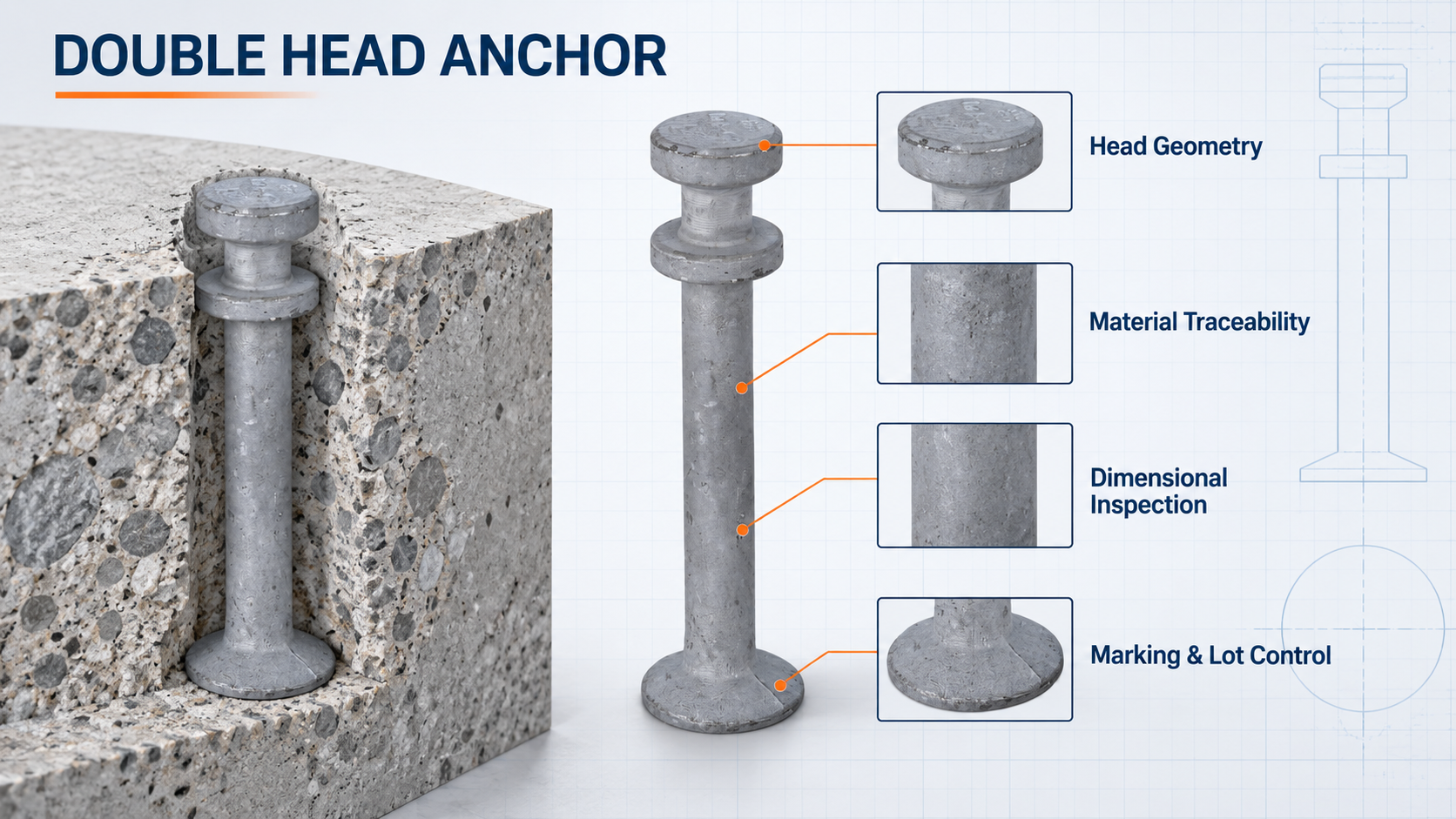
First confirm which “double head anchor” the enquiry means
The name is used for more than one kind of construction product. In precast handling, it can describe a cast-in transport anchor intended to engage a system-specific lifting device. Elsewhere on a concrete drawing, a two-headed stud may be punching-shear reinforcement. The two purchases follow different documents and acceptance routes.
Official catalogues show the distinction. The HALFEN FRIMEDA lifting-anchor portfolio lists a TPA-FD double-head transport anchor among its lifting-system components. Peikko describes the KKD as the double-head version within its KK lifting system. Separately, Peikko's PSB Double headed anchor is presented as concrete reinforcement with forged heads at both ends. The repeated words do not make the products interchangeable.
Write the function in the first line of the RFQ: “cast-in lifting anchor for temporary handling of precast concrete,” followed by the exact project and system reference. If the requirement is punching-shear reinforcement, column connection hardware or another permanent structural component, use a separate enquiry.
Buy the lifting system, not an isolated steel shape
A head only works when the lifting device can engage, lock, rotate and release as approved. The recess former sets the anchor position and working space. The concrete element, reinforcement and lifting arrangement complete the application.
The Dayton Superior P52 technical sheet gives a useful product-specific example: its formed head seats the named lifting eye while its foot is embedded in concrete. That description applies to the P52 system. It does not establish the shape, capacity or compatibility of a JINGLE anchor.
Use this system boundary when sending enquiries:
| Interface | Buyer must identify | Manufacturer must return |
|---|---|---|
| Cast-in anchor | Approved reference, drawing revision and class | Proposed part number, controlled drawing and deviations |
| Lifting device | Exact clutch, link or key reference | Written mating statement and fit-control method |
| Recess former | Material, reference and fixing method | Compatible former reference and resulting recess geometry |
| Concrete element | Element type, thickness, edges and reinforcement context | Product limitations and documents required for engineering review |
| Lift | Demoulding, rotation, transport and erection stages | Permitted use only from current product-specific evidence |
| Identification | Marking and traceability requirement | Marking layout, lot code and record link |
Any field that is still under engineering review should be marked open. A supplier quotation must not quietly turn an assumption into an approved value.
Audit the head geometry as a functional interface
The head is not decorative. Its profile governs how the lifting device approaches and captures the anchor. Small changes to width, thickness, radii, transition shape, symmetry or burr condition may affect engagement even when the overall length appears correct.
Ask the manufacturer to place every functional dimension and datum on a revision-controlled drawing. The factory should explain which dimensions are controlled by tooling, which are checked during production and which are verified on finished parts. A photograph beside a ruler is not a dimensional report.
Use the actual mating hardware during sample review
Fit checks should use the exact approved lifting device and recess former, not a convenient generic gauge. Record both references before the trial. Check seating, locking, permitted movement and release without forcing. A test outside concrete confirms mechanical fit only, not anchorage or lifting performance.
For repeat orders, keep an approved master sample under controlled storage. The sample supplements the drawing but never replaces it. Wear, corrosion, handling damage and undocumented shop adjustment can make an old sample a poor authority.
Review the body and second head, not only the visible end
The visible upper head attracts attention after casting, but procurement must also control the embedded body and lower head. Their geometry belongs to the assessed load-transfer arrangement. Diameter, length, head location, transitions, straightness and surface condition need drawing references and inspection points.
Peikko states that its KKD is a double-head version within the KK family and describes a particular application context on the official page. HALFEN identifies its TPA-FD inside the FRIMEDA portfolio. These examples show why the model name and family matter. They do not supply design values for another manufacturer.
JINGLE's precast accessories range lists a Double Head Anchor. Its available geometries, load classes, materials, finishes, compatible lifting devices, recess formers and approved applications are [NEEDS JINGLE CONFIRMATION].
Ask how the anchor is made and how variation is contained
“Forged,” “formed” and “machined” describe processes, not an automatic quality level. The useful question is whether the selected route produces the controlled geometry and material condition required by the approved specification. Ask the factory to map the manufacturing flow from incoming stock to packed lot.
A practical audit can follow these points:
| Process point | Evidence to review | Buyer risk if unclear |
|---|---|---|
| Incoming material | Purchase specification, receipt identity and lot link | Unknown grade or mixed stock |
| Cutting or blanking | Length control and first-off check | Wrong body length or poor end condition |
| Head forming | Tool reference, setup approval and head-dimension checks | Mating variation or uneven transition |
| Heat treatment, if specified | Approved route, batch identity and required records | Unverified material condition |
| Surface treatment, if specified | Finish specification, process source and lot record | Wrong coating or loss of traceability |
| Final inspection | Sampling plan, gauges and acceptance record | Defects discovered after delivery |
| Marking and packing | Legibility check, lot segregation and label reconciliation | Mix-up at the precast plant |
JINGLE's material grades, manufacturing route, heat-treatment scope, coating options, inspection plan and process records for this product are [NEEDS JINGLE CONFIRMATION].
Challenge subcontracted operations
A factory may send heat treatment, plating or other work to a specialist. Ask how that processor is approved, how parts remain tied to the original lot, what certificate returns and who reviews it. State whether a processor change requires buyer notice.
Make marking part of the acceptance plan
Marking allows the plant to distinguish a delivered anchor after it leaves the carton and, where the system requires it, after casting. HALFEN says its named anchors carry visible system information such as class, length and manufacturer identification. Treat that as an example of model-specific identification, not a universal marking specification.
Agree the JINGLE marking content, location, method, legibility criteria and lot relationship before production. All are [NEEDS JINGLE CONFIRMATION]. Check that marking does not damage the functional head surface or create ambiguity between nearby sizes.
Carton labels should repeat enough information for receiving staff to reconcile the goods with the purchase order and inspection record. If several variants share one shipment, demand physical segregation and a packing list that shows quantity by part number and lot.
Approve samples in stages
One sample cannot answer every question. Review the drawing, inspect first-off pieces, complete required validation under the approved plan, then review a production-representative lot and its records. Agree who releases each stage.
Use a signed sample report with photographs, measured results, equipment references, nonconformities and disposition. Write down what the approval covers. “Sample accepted” is too vague if tooling, material, process or marking can later change.
The availability, quantity, cost and timing of JINGLE samples are [NEEDS JINGLE CONFIRMATION].
Control documents by product and revision
A large certificate bundle can still fail to prove that the delivered anchor matches the approved system. Build a compliance matrix that ties every requirement to a document, drawing clause, inspection result or declared deviation.
Request only records relevant to the order, which may include:
- Controlled product drawing and revision history
- Material evidence linked to the production lot
- Manufacturing and subcontract-process records required by the specification
- Dimensional and visual inspection results
- Marking and packaging approval
- Product-specific instructions and compatibility statement
- Test or conformity documents required for the destination market
- Nonconformity, concession and change-control procedure
Do not assume that a general ISO certificate, a report for a neighbouring size or another brand's technical manual proves the ordered product. JINGLE certifications, product tests, declarations and destination-market documents are [NEEDS JINGLE CONFIRMATION].
Compare quotations on the same compliance basis
Normalize the technical response before ranking price. A low unit price may exclude tooling, samples, inspection, certificates, special packing or delivery terms included elsewhere. Put every exclusion and deviation beside the corresponding RFQ line.
The commercial comparison should show currency, Incoterm, quantity break, tooling ownership, sample charge, production basis, packing, document cost, freight assumptions and quotation validity. JINGLE MOQ, pricing, tooling terms, lead time, capacity, Incoterms and payment terms are [NEEDS JINGLE CONFIRMATION].
If a bidder proposes an “equivalent,” send it back through engineering review. Procurement should not approve equivalence from a dimensional table alone.
Double head lifting anchor manufacturer RFQ checklist
Before issuing the enquiry, confirm that it contains:
- Temporary lifting function and project destination
- Approved system, anchor reference and drawing revision
- Exact mating lifting device and recess former
- Element drawings, lift stages and engineering inputs needed by the supplier
- Anchor dimensions, tolerances, marking and finish requirements
- Material and manufacturing specification
- Sample stages and fit-check method
- Inspection, testing, certificates and traceability requirements
- Quantity by variant, delivery schedule and packing rules
- Change-notification, deviation and concession process
- Commercial comparison sheet and Incoterm
- Named owners for engineering approval, purchasing release and receiving inspection
For a reusable quotation structure, see what buyers should provide for a lifting anchor quote. The guide on matching a lifting anchor with the correct lifting clutch explains why a physical fit alone is insufficient.
FAQs for industrial buyers
Is every double head anchor a lifting anchor?
No. The same wording is also used for structural reinforcement products. Confirm the function, product family and governing documents before requesting a price.
Can a double head lifting anchor use any clutch in the same nominal class?
No assumption should be made from nominal class or appearance. Use the lifting device named in the approved system documents and obtain a written product-specific statement.
Does a successful loose-part fit check approve the anchor?
No. It can reveal obvious interface problems, but it does not prove concrete anchorage, capacity, reinforcement, edge behavior or suitability for the lift.
What should a factory sample report contain?
It should identify the drawing revision, sample lot, measured characteristics, gauges or equipment, mating components, observations, nonconformities and approval scope.
Which factory changes need advance notice?
Before changing any controlled material, geometry, tool, manufacturing route, outside processor, finish, marking, inspection method or production location covered by the approval.
How can buyers make quotations easier to compare?
Issue the same controlled enquiry pack to all bidders. Ask each one to complete the identical compliance sheet, keeping confirmed requirements, open engineering points, deviations and commercial assumptions in separate columns.
Send JINGLE a controlled enquiry
When you are ready to evaluate a double head lifting anchor manufacturer, send JINGLE the approved product or system reference, drawings, mating lifting device, recess former, element and lift information, material and finish specification, sample plan, inspection documents, quantities, destination and requested delivery. Use the JINGLE contact page to submit the package. JINGLE can then confirm its manufacturing scope and list every item that still needs technical or commercial agreement.