What Fasteners Work Best for Machinery Subject to Constant Vibration?
Why Vibration Is the Most Persistent Enemy of Mechanical Joints
In rotating equipment, heavy machinery, and industrial automation systems, vibration isn’t a side effect—it is a constant structural force.
Unlike static loads, vibration introduces:
-
cyclic shear,
-
micro-slip between joined surfaces,
-
gradual preload loss,
-
and ultimately, joint separation.
Even well-designed assemblies fail when bolts gradually lose clamping force.
And once preload deteriorates, it rarely stops there—looseness accelerates wear, misalignment, and catastrophic machine downtime.
Understanding which fasteners maintain stability under vibration is therefore not just a design decision—it’s a reliability strategy.
The Engineering Mechanics Behind Vibration-Induced Loosening
To choose the right fastener, we must understand the physics.
The real causes include:
-
Transverse vibration: micro-movement perpendicular to the bolt axis initiates slip.
-
Insufficient preload: too low (or too high) torque reduces frictional clamping.
-
Surface irregularities: roughness causes settling (“embedment relaxation”).
-
Material mismatch: different expansion rates generate gaps under heat cycles.
Research from the Kirchhoff Institute for Materials shows that even small transverse loads can reduce bolt preload by up to 30% after several thousand cycles.
The challenge isn’t preventing vibration—it’s preventing loosening.
Fastener Designs That Perform Best Under Continuous Vibration
Locking Mechanisms That Actively Maintain Preload
Some fasteners resist loosening because their geometry interferes with rotation; others absorb vibration energy before it reaches the thread.
1. Nyloc Lock Nuts (Nylon Insert Lock Nuts)
The nylon ring adds frictional resistance to rotation. Excellent for medium vibration but avoid high-temperature zones (>120°C).
2. All-Metal Lock Nuts
Deformed threads provide secure engagement even under thermal cycling.
Best for:
-
engines,
-
compressors,
-
outdoor equipment.
3. Prevailing-Torque Nuts
Elliptical deformation creates constant torque resistance. Reliable in repeating vibration.
Thread-Locking Solutions That Prevent Back-Out
4. Serrated Flange Bolts
Teeth cut into mating surfaces, increasing friction.
Benefits:
-
faster assembly,
-
uniform load distribution,
-
strong resistance to slip.
5. Split Lock Washers (although limited)
Provide some resistance but can lose effectiveness under high dynamic load.
Only suitable for light machinery.
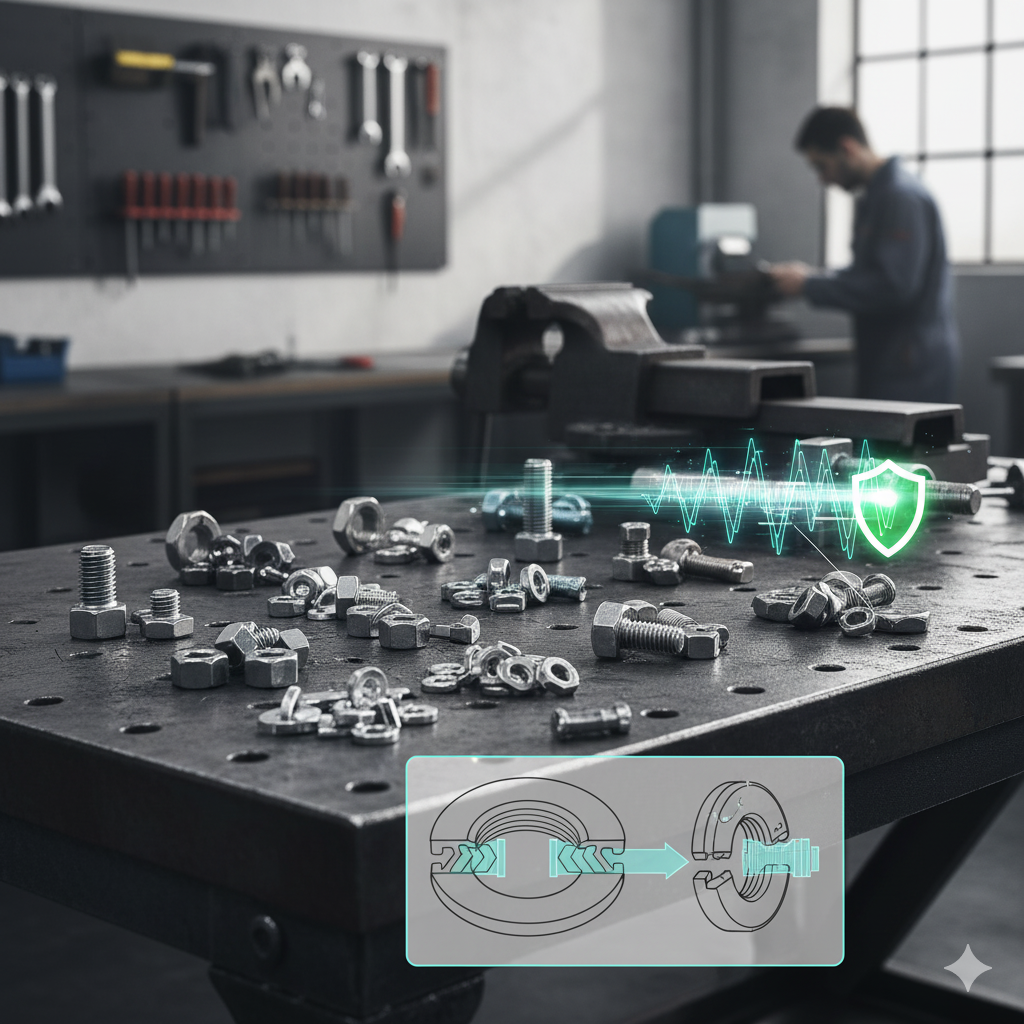
6. Wedge-Lock Washers (e.g., Nord-Lock principle)
One of the most reliable anti-vibration solutions.
Dual cams create tension under loosening attempts, increasing clamp force instead of reducing it.
Perfect for:
-
heavy vibration,
-
construction machinery,
-
mining equipment,
-
rail systems.
Fasteners Engineered for High-Frequency or Heavy-Duty Shock
7. Double-Nut Systems
A classic method—secondary nut locks the first nut into position.
Effective but increases assembly time.
8. Thread-Forming Screws
Create mating threads with strong frictional resistance.
Ideal for softer materials like aluminum housings.
9. Chemical Thread Lockers
Medium-strength for serviceable joints; high-strength for permanent applications.
Useful for electronics, tool housings, and small machinery.
Comparison: Which Fastener Type Fits Which Vibration Scenario?
| Machinery Type | Vibration Level | Recommended Fastener | Notes |
|---|---|---|---|
| Rotating pumps | Medium | Nyloc / Serrated flange bolts | Resists micro-slip |
| Industrial motors | High | All-metal lock nuts | Handles heat + vibration |
| Construction equipment | Very high | Wedge-lock washers | Exceptional preload retention |
| Conveyors | Continuous low-frequency | Prevailing torque nuts | Good long-term stability |
| Precision equipment | Medium–high | Chemical threadlocker | Avoids rotational back-out |
| Heavy vehicles & trailers | Impact vibration | Double-nut systems | Simple, reliable |
This gives engineers a clear decision path based on operating conditions.
Application Lessons From Real-World Machinery
In most industries, vibration failures originate from overlooked details—not defective fasteners.
Case Example: Vibration Loosening in an Industrial Press
A sheet-metal press experienced bolt loosening every 3–4 weeks.
After investigation:
-
preload was insufficient,
-
misalignment created uneven shear,
-
and zinc-plated grade 5 bolts lacked the tensile strength needed.
Replacing them with:
-
grade 10.9 bolts,
-
wedge-lock washers,
-
and controlled torque sequence
extended service intervals from weeks → 14 months.
This is typical: the right fastener multiplies operational uptime.
Pre-Selection Guidance for Engineers and Procurement Teams
To avoid future downtime, selection should start with the machinery’s vibration profile.
Key questions before choosing fasteners:
-
What is the vibration frequency (Hz)?
-
What is the amplitude or shock load profile?
-
Are there thermal cycles that affect preload?
-
Is the joint subject to shear or tension dominance?
-
Are surfaces smooth, coated, or uneven?
-
How critical is serviceability vs. permanent locking?
General Selection Rules:
-
Use all-metal locking nuts for high-heat zones.
-
Use wedge-lock washers for heavy vibration.
-
Use fine-thread fasteners when precise preload control is needed.
-
Use higher-grade bolts (8.8/10.9/12.9) for dynamic loads.
-
Avoid standard washers unless preload stability is guaranteed.
Good selection is less about the bolt itself and more about the energy it must resist.
Frequently Asked Questions
Q1: Are lock washers enough for high-vibration machinery?
No. Traditional split washers often flatten over time and provide limited suppression of transverse slip.
Q2: Do fine threads perform better under vibration?
Yes—fine threads offer greater engagement area, improving preload stability.
Q3: When should wedge-lock washers be used?
Any time the machinery operates under heavy or unpredictable vibration.
Q4: Does bolt grade matter?
Absolutely. Higher grades handle dynamic load without yield deformation.
Reliable Vibration-Resistant Fastening Starts With the Right Design
In high-vibration machinery, a fastener is not merely a connector—it is part of the machine’s energy-management system.
Choosing the proper locking mechanism, material grade, and preload strategy directly determines how long the machinery runs without interruption.
At Jingle, we supply engineered fasteners, precast components, and CNC-machined hardware designed to withstand continuous vibration across industrial, construction, and automotive equipment.
Explore our full range of solutions at the homepage
or request project-specific guidance through our contact page.