Machining Costs Explained: What Drives Price in Custom CNC Work
Two suppliers quote the same drawing and the machining costs come back far apart. The drawing did not change. What changed is how each shop counted setup, stock removal, inspection and scrap, and which of those lines it folded into the piece price where you cannot see it.
This page takes a CNC quotation apart line by line: material, setup, tolerance, surface finish, part features, quantity breaks, finishing, inspection and freight. It is written from the supply side, by people who quote turned and milled parts every week. The aim is narrow and practical. After reading it, you can look at a quotation, point at the line that is high, and ask a question that gets an answer instead of a discount.
One limit up front. There is no universal hourly rate. A three-axis job shop and a five-axis plant are not comparable on rate, and a price built on rate alone is a price you cannot defend when the part changes. What is comparable is structure: hours, setups, operations, material and evidence. That structure is what follows.
The five lines inside every CNC machining quote
Strip the format away and a machined part price is five numbers added together. Material. Setup. Run time. Secondary operations. Inspection and packaging. Everything else is a margin decision applied to those five.
Most arguments about price are really arguments about which line each side is looking at. A buyer compares piece price. A shop compares hours per order. When the order is 50 pieces, those two views diverge sharply, because the setup is spread over 50 pieces instead of 500.
| Cost line | What it pays for | Scales with quantity? | What to ask about it |
|---|---|---|---|
| Material | Bar, plate or billet plus the kerf and stock left on the part | Yes, but not linearly | Which grade and mill form is quoted, and what is the cut allowance |
| Setup | Fixtures, tooling, first-article proving, programme prove-out | No — fixed per order and per operation | How many setups are counted, and whether a fixture already exists |
| Run time | Spindle hours at the quoted feeds and speeds | Yes, this is the part that should fall | Cycle time per piece, and what limits it |
| Secondary operations | Deburr, thread, broach, grind, heat treat, plate, passivate | Partly — often priced per lot, not per piece | Which operations are outside the shop and on what lead time |
| Inspection and packing | Sampling plan, records, CMM time, cleaning, bagging, labelling | Partly — documents are per lot | What the report contains and whether it is dimensional or only visual |
The useful consequence: when a quote looks expensive, do not ask for a discount first. Ask which of the five lines is carrying the weight. A quote that is heavy on setup is a quantity problem. A quote that is heavy on run time is a toolpath, material or tolerance problem. The two have completely different fixes, and a discount applied to the wrong one just moves the loss to the supplier and returns as a quality problem two orders later.
Material: the decision you make before the first cut
Material is usually the largest single line on a machined part, and it is the one buyers most often fix before they know what it costs. The grade on the drawing drives three things at once: the bar price, the machinability, and the tooling. Change 304 to 303 and the part may get cheaper without losing function. Change 303 to 316 and it gets more expensive and slower, but it may be the only grade that survives the environment.
Free-machining grades exist because they break chips. Sulfur or selenium additions in austenitic stainless let the tool cut continuously instead of tearing, and the difference in cycle time is large enough that the material cost is not the deciding number. That is the trade: a slightly more expensive bar that runs visibly faster. For high-volume turned parts, the free-machining grade normally wins. For welded assemblies, it normally loses, because the same additions that help the chip break hurt the weld.
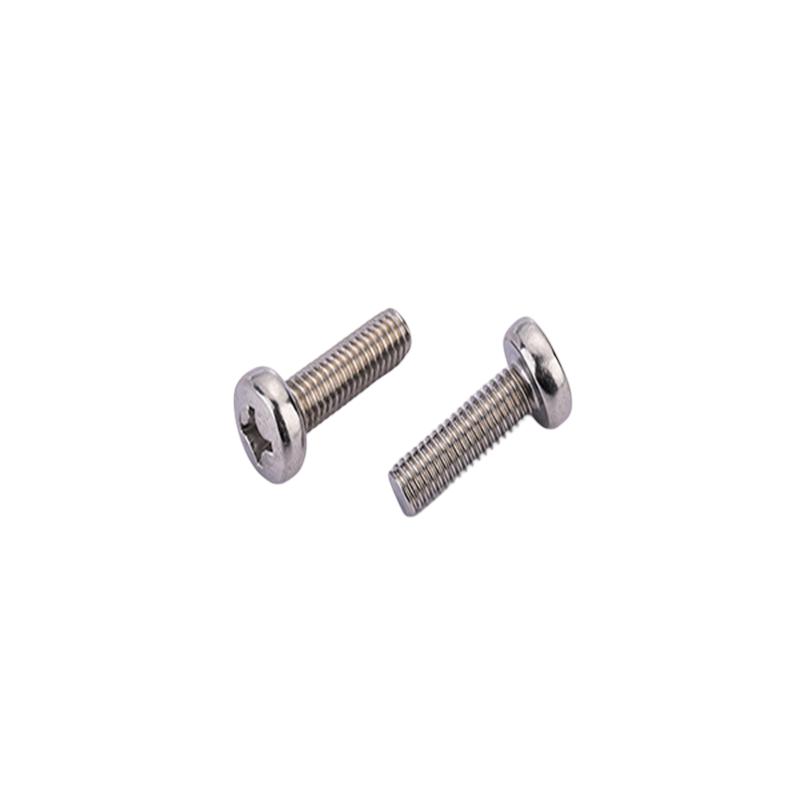
A pan-head machine screw in stainless: the thread is rolled rather than cut, the head radius is formed, and both choices are made to keep cost out of the part.
Three material questions decide most of the price before a machine moves. What is the mill form — bar, plate or near-net forging? How much stock has to come off? And does the grade have to be certified to a standard that narrows the supplier pool?
| Material choice | Effect on machining cost | Where it is worth it | Where it is not |
|---|---|---|---|
| Free-machining stainless (303 type) | Fastest cutting of the austenitic family, good finish off the tool | High-volume turned parts, internal parts, non-welded | Anything welded, formed cold after machining, or in a chloride environment |
| 304 / 1.4301 | Work-hardens under the tool, so feeds must stay aggressive | General industrial parts, food-adjacent equipment, welded frames | Coastal or de-icing salt exposure |
| 316 / 1.4401 | Higher bar price, shorter tool life, slower cycle | Marine, chemical, medical-adjacent, washdown | Dry indoor assemblies where corrosion is not the failure mode |
| Aluminium 6061-T6 | Fast to cut, but soft enough to mark and to distort when thin | Brackets, housings, fixtures, prototypes | Wear surfaces, high-load threads |
| Carbon steel with plating | Cheapest bar, adds a plating line and a lot charge | High-volume parts in dry service, indoor mechanisms | Cut edges and thread roots that will be exposed after plating |
Stock removal is the second half of the material line, and it is invisible on most drawings. A part machined from a bar close to the finished diameter needs a few passes. The same part hogged out of plate may spend three times as long removing metal that ends up as chips. When a supplier asks whether the part can be made from bar instead of plate, that question is about cost, not convenience.
Setup: the charge that refuses to shrink
Setup is where small orders die. Every new part needs a fixture, a proven programme, a first article and a decision about where to hold it. None of that work repeats when the quantity doubles, and all of it repeats when the drawing changes.
The number of setups is usually more important than the number of hours. A part that can be completed in one op on a five-axis machine may need three ops on a three-axis machine, each with its own fixture and its own re-datum. Three setups on 100 pieces is a different business from one setup on 100 pieces, and the difference shows up as price, not as a line item.

A long pin with a mid-body flange and thread at both ends: two ends to hold, one datum to repeat, and a slender shaft that will deflect if the support is wrong.
Long slender parts carry a setup penalty that is easy to underestimate. The shaft deflects away from the tool, so the shop either takes lighter passes or adds a steady rest or tailstock support. Both add time that does not appear on the drawing. Surface finish suffers first, dimension second, and the customer sees neither until the parts arrive with taper.
Fixtures are also a real cost, and a reusable one. If a supplier already holds a fixture for a similar family, the setup for a new size in that family can be a fraction of a new one. That is the practical reason to keep part families with the same supplier instead of spreading them across three. The second supplier has to buy the same knowledge again. We take the same view when quoting custom CNC machining service work: the fixture is the first question, not the last.
Tolerance: where the cost stops being linear
A general tolerance is close to free. A tight one is not. The step change happens when the tolerance moves from what the machine holds comfortably to what the machine has to be coaxed into holding.
Three things change at that point. The process may need a finishing pass, which means removing the part from roughing and cutting it again. Inspection moves from sampling with calipers to measuring every critical feature. And scrap rate rises, because a process running near its capability limit produces outliers. All three are charged, and only one of them is visible as a line on the quote.
| Tolerance band | Typical route | Cost behaviour | Risk if over-specified |
|---|---|---|---|
| General tolerance per ISO 2768-1, medium class | Single op, standard tooling, sample inspection | Baseline — this is the cheap part of the curve | None; the risk is specifying tighter than the function needs |
| Tight but conventional (turned diameters, bores, positions) | Rough and finish, controlled tool wear, gauged inspection | Moderate increase; mostly inspection time | Price rises for a feature nobody measures on the assembly |
| Close tolerance, small bores and thin walls | Special tooling, temperature awareness, slower feeds, CMM | Steep — yield loss becomes a cost line | Supplier declines, or quotes high to protect itself |
| Grind-only tolerance and geometric callouts | Adds a separate process, separate setup, separate lead time | Highest, and often the longest lead time item | A part designed for grinding that never needed it |
Geometric dimensioning and tolerancing deserves its own note. A position callout with a datum reference frame per ASME Y14.5 tells the shop exactly what to control and how to fixture it. A stack of plus/minus tolerances on the same features tells the shop nothing and forces it to guess. Well-applied GD&T often lowers cost, because it removes ambiguity that a cautious supplier would otherwise price as risk.
The other side of the same coin: tolerances that do not matter should be loose. If a hole only clears a bolt, a generous positional tolerance costs nothing in function and saves real money. Buyers who tighten everything to look rigorous pay for rigour on features that never needed it, and the parts do not fit any better.
Surface finish: the Ra number and the operations behind it
Surface texture is specified as Ra, and Ra is a result, not an instruction. Asking for a finer Ra means asking for a different process, not for the operator to try harder.
| Finish requirement | What produces it | Cost effect |
|---|---|---|
| As-machined, standard turning or milling finish | Normal cutting parameters, no extra pass | Included in run time |
| Finer than standard, on selected faces only | Finish pass, sharper tool, lower feed | Added cycle time on those faces only |
| Sealing or bearing-grade finish | Grinding, honing or lapping added as a separate operation | New process, new setup, new lead time |
| Cosmetic finish on visible faces | Careful fixturing to avoid marks, protective film, handling discipline | Hidden labour and higher reject rate, not a machine cost |
Measurement matters as much as production. ISO 4287 defines the profile parameters that the Ra number refers to, and a supplier and a customer who measure to different cut-off conventions will argue about a surface that is fine. Agree the parameter, the cut-off and the instrument before the first batch, not after.
The toolpath matters as much as the parameters. Whether the cut is climb or conventional changes the direction of the tool marks, and on a visible face that is the difference the eye sees — the same point covered in CNC milling versus conventional milling, where the finish argument is usually decided.
Cosmetic requirements are the most under-priced item on many drawings. A machined aluminium front panel with no visible tool marks needs soft jaws, clean handling, protective film, and a reject rate that a purely functional part does not carry. If the part is visible, say so on the drawing. If it is not, say that too, because a supplier who assumes cosmetic will price it in.
Part features that quietly add operations
Features are priced by the operation they demand, not by how small they are on the drawing. A cross-hole through a pin is a few millimetres of drilling. It is also a second setup, because the part has to be held at 90 degrees and re-datumed, and depending on the burr it may need a deburring step afterwards.

A clevis pin with a flange head and a drilled cross-hole: four features, three of which exist only to be drilled, chamfered or inspected from a second direction.
The list of features that change price most often is short and predictable.
Cross-holes and intersecting bores. Each one breaks the surface at an angle, burrs internally, and needs a second orientation. Deep cross-holes need a longer drill and a peck cycle, which adds time and risk of drift.
Threads specified by fit class rather than by standard. A standard thread is cut or rolled with a die or a tap and checked with a gauge. A special fit class, or a thread that must be concentric to a bearing journal, may need a single-point boring bar and a dedicated gauge.
Thin walls and deep pockets. Both invite chatter and distortion. The shop reduces depth of cut, which lengthens the cycle, and may rough, stress-relieve and finish in separate operations. Aluminium brackets with tall thin ribs are the classic case.
Sharp internal corners. A rotating tool leaves a radius equal to its own radius. If the drawing calls for a square internal corner, someone has to remove the rest by EDM or hand work, and that is a different supplier with a different lead time.
Features that must be concentric or perpendicular to each other. These dictate the fixturing. A single true position callout on a bolt circle can force a single-setup process where two setups would otherwise be cheaper.
There is a design habit behind all of this: features that can be produced in the same orientation are close to free, and features that require turning the part over are not. A drawing review that asks "can this be done in one hold" before release is worth more than any negotiation after the quote.
Quantity, lot size and the crossover point
Quantity changes the price through the fixed lines, not the variable ones. Run time per piece barely moves at 500 pieces. Setup per piece collapses. That is why the second order is almost always cheaper than the first, and why a supplier who quotes 50 and 5,000 at the same piece price is telling you something about the 5,000.
The break points that matter in practice are not tidy round numbers.
The first break is the setup break: the quantity at which setup per piece stops dominating. Below it, the buyer is paying for a fixture. Above it, the buyer is paying for metal and time.
The second break is the process break. At some volume it becomes cheaper to invest in a fixture, a multi-cavity arrangement, a bar feeder or a different machine class than to keep paying cycle time. This is where a shop starts suggesting changes to the drawing, and it is worth listening, because those suggestions are usually funded by the volume.
The third break is the material break. Bar stock is bought in mill lengths, and a part length that wastes the end of every bar costs more than the price list suggests. Adjusting a part length by a few millimetres sometimes improves yield across the whole order.
There is also a break in the other direction. Below a certain quantity, the cost of setting up, inspecting and documenting is not worth the disruption to a production cell, and the honest answer is a higher price rather than a lower one. A supplier who says this plainly is easier to work with than one who quotes low and delivers late.
Two practical requests follow. Ask for a price at the trial quantity and at the annual volume in the same document, so the structure is visible. And ask what quantity would change the process, because that answer tells you whether the current price is a volume problem or a design problem.
Finishing: plating, passivation and the lot charge
Finishing is the line most often quoted as a lump sum, and the lump sum is usually a lot charge. That means the cost of a 200-piece lot and a 2,000-piece lot can look similar on the quote, and the per-piece difference is dramatic.
For stainless parts, passivation is the standard post-machining step. ASTM A967 covers the chemical passivation treatments for stainless steel parts, and it exists because machining leaves free iron on the surface that will rust even on a 316 part. A passivated part and an unpassivated part look identical on the day of delivery and behave differently three months later in a damp store. Ask which treatment is applied and whether a test certificate comes with the lot.
For carbon steel, plating is the common route, and the cost depends on the coating, the thickness, the lot size and the handling. Two things regularly go wrong. First, threaded parts lose thread fit after coating, so the thread has to be cut to allow for the coating thickness, which is a machining decision made before plating. Second, hydrogen embrittlement risk rises with hardness and coating process, so high-strength parts need a bake that the plating supplier has to know about in advance.
Anodising on aluminium is priced by surface area and by the number of colours and batches. A part that needs two colours is two lots even if it is one part number. Laser marking, silk screening and assembly each add a step and a queue.
The rule that saves the most money here is to specify the finish that the service condition requires and no more. A fully buried part does not need a decorative coating. A visible stainless cover does not need the same treatment on its hidden face. Finishing is charged by area, by lot and by handling, and every one of those can be reduced by design.
Inspection, documentation and the paperwork cost
Inspection is a real cost, and it is the one buyers most often ask for without knowing the price. A dimensional report for a 20-feature part measured on a CMM is not free, and it is not the same product as a visual check with a sample of five.
The cost scales with three variables: how many features are reported, how many pieces are measured, and whether the measurement is done on a bench with hand tools or on a coordinate machine under a temperature-controlled routine. A first article inspection report on the first piece of a new part is expensive once. A full dimensional report on every piece is expensive forever.
Material certification is a separate line. A mill certificate for the bar is a document the mill issues, and a supplier can pass it on. A certificate that names the part and the heat number, traces the heat to the parts and states the mechanical properties is a different level of work, and the phrase "3.1 certificate" in a purchase order means something specific under EN 10204. Ask for exactly the level you need, because supplying a higher level than required costs money that nobody recovers.
Hardness checks, per ISO 6507-1 for Vickers testing, are relevant when a part is heat treated or when the process is suspected of work hardening. A hardness check on a small part is cheap per reading and slow to set up, so it is normally a lot-based cost.
There is one more document that is nearly free and worth asking for: the setup sheet with the actual fixture and datum scheme. It explains future price changes, and it shortens the argument when a feature is judged out of tolerance.
Freight, packaging and landed cost
The piece price is not the cost. Machined parts are dense and heavy relative to their value in some cases and light and high-value in others, and the shipping decision follows from which one you have.
Steel and stainless parts are usually shipped by sea for volume orders, which means the price has to survive 30 to 45 days of transit plus customs. Aluminium housings and small precision parts often justify air freight, because the value per kilogram supports it. The choice changes the packaging requirement as much as the freight line.
Packaging is quoted cheaply and matters late. Machined surfaces that arrive with handling marks are a quality claim, and the cost of that claim sits with whoever specified the packaging. Vapour barrier bags, desiccant, individual bagging, edge protection and pallet specification are all real line items, and a supplier that ships precision parts loose in a carton is not saving you money.
Duties and taxes are country-specific and change. Rather than quote a rate that will be wrong next quarter, the useful practice is to agree the Incoterms clearly, state the HS code on the commercial invoice, and confirm which side arranges the import clearance. Most landed cost surprises come from an unclear Incoterm, not from the machining price.
How to read a machining quote line by line
A comparable quote has a shape. If a quotation is a single number with a lead time, you are comparing a price, not a cost, and the comparison will not survive the first change order. The same structure applies whether the part is a bracket, a housing or a turned pin of the kind listed on the CNC machining parts range.
| Line in a good quote | Why it matters to the buyer | Red flag if missing |
|---|---|---|
| Material grade and mill form | Lets you compare two quotes on the same metal | "Stainless steel" with no grade is not a quote |
| Process route and number of setups | Explains the price and predicts change-order cost | No route means no basis for a revision price |
| Tolerance and inspection plan | Shows whether the tight features were priced or ignored | A quote that ignores your tightest callout is a claim waiting to fail |
| Finish and its standard | Passivation, plating thickness and bake are cost and function | "As required" is not a specification |
| Quantity breaks and tooling charge | Separates one-time cost from repeat cost | Tooling buried in piece price is tooling you pay for twice |
| Lead time broken into machining and finishing | Exposes the outside process that actually controls delivery | One lead time for a plated part means the plating queue is invisible |
| Incoterm and packaging | Converts piece price into landed cost | Unstated Incoterm is the most common hidden cost |
When two quotes differ, put them side by side on these seven lines before discussing the total. In most cases the gap resolves into one of three explanations: a different material form, a different number of setups, or a different inspection level. Occasionally the explanation is that one supplier has not understood the drawing, which is the most expensive outcome of all, because it looks like the cheapest quote.
Reducing machining cost without losing function
Most of the machining costs in a part are decided at the drawing stage, not at the negotiation. Cost reduction works best before the drawing is released and poorly after. The changes below are the ones that consistently move a price, in rough order of size of effect, and each is an engineering decision rather than a purchasing tactic — which is why CNC machining cost reduction work belongs with the people who own the drawing.
Loosen what does not function. General tolerances on non-critical features, standard threads instead of special ones, and a surface finish specified only where it seals or slides. This is free money and it is routinely left on the table.
Reduce the number of orientations. Consolidating features onto fewer faces can remove a setup entirely. Sometimes this means accepting a small design compromise, such as moving a port 15 degrees, which is worth doing if the assembly allows it.
Choose the material for the process, not the catalogue. A free-machining grade for a high-volume turned part, a standard plate thickness for a milled housing instead of a custom thickness that has to be faced off on both sides.
Design for the stock you can buy. A part dimension that matches a standard bar diameter avoids turning away metal that was paid for. This is the single most effective change on turned parts at volume.
Combine parts. Two machined parts bolted together often cost more than one machined part with the features integrated, because the second part brings its own setup, its own inspection and its own assembly labour.
Ask about the process break. At a certain volume, casting, forging, stamping or extrusion plus a light machining pass beats cutting from solid. A supplier that only machines will not raise this, so the buyer has to.
There is a boundary to this list. Cost reduction that removes the feature the part exists for is not cost reduction, it is a defect with a lower price. The useful discipline is to be generous on tolerances that do not matter and stubborn on the two or three that do.
Questions buyers actually ask
What does a CNC machining quote usually include?
A complete quote covers five things: material with its grade and mill form, setup and tooling, run time per piece, secondary operations such as thread, deburr, heat treat, plating or passivation, and inspection with packaging. It should also state the quantity basis and the lead time split between machining and outside processes. What it should not do is hide the tooling charge inside the piece price, because that makes a small order look cheap and a repeat order look expensive. If a supplier sends one number and a delivery date, ask for the breakdown before you compare it with anyone else. A price without a structure cannot be defended when the drawing changes, and the change will come.
Why is the second order cheaper than the first?
Because the fixed work is already done. The fixture exists, the programme is proven, the first article has been approved and the inspection plan is written. On the second order the supplier is charging for material and run time plus a smaller share of setup, and the price should fall noticeably. A supplier who keeps the same piece price on a repeat order is usually either carrying the setup differently or has not updated the quote. Ask what the repeat price is before you place the first order. Getting both numbers on one page is the cheapest piece of procurement work available, and it tells you whether the first price was a learning cost or a margin decision.
How much does tolerance really add to machining costs?
It depends on whether the tolerance crosses a process boundary. A callout the machine holds in a normal pass costs almost nothing. A callout that requires a separate finishing operation, a temperature-controlled environment, a dedicated gauge or a CMM report on every piece costs real money, and the increase is not proportional to the number on the drawing. The practical way to price tolerance is to ask which features are critical and why. If two features out of twenty decide whether the assembly works, specify those tightly and let the rest sit at general tolerance. That single change often removes more cost than any negotiation, and it usually improves the parts, because the shop concentrates attention where it matters.
What is the minimum order for a custom machined part?
There is no fixed policy, because the minimum is set by the process rather than by a rule. A part that fits an existing fixture and a proven programme can run in small quantities. A new part with a new fixture, a new programme and a new gauge needs a setup that only makes sense at a higher volume, and quoting it at five pieces produces a piece price that frightens buyers away from a part that would be cheap at five hundred. The honest approach is to quote the trial quantity and the annual quantity together and say which one carries the setup. Trial orders are normal and are how most machined parts start, but the trial price is not the production price.
How long does a first article take, and what does it cost?
Plan for the first article to take longer than the production run, not shorter. It includes fixture build, programme prove-out, the first parts, measurement of every reported feature, and the paperwork that goes with it. On a simple turned part that can be a few working days. On a multi-setup milled housing with a plating step it is a sequence of queues, and the plating queue is usually the longest. The cost is one-time and should be visible as tooling or first-article charge. If it is not quoted, it is inside the piece price and you will pay it again on every reorder.
Do you need a 3D model to quote, or is a drawing enough?
A dimensioned 2D drawing is enough to quote most turned parts and many milled ones, provided the tolerances, material, finish and thread callouts are on it. A 3D model helps on complex geometry, on parts with freeform surfaces, and wherever the drawing leaves a feature ambiguous. The best package is both: the model defines the shape, the drawing defines the acceptance criteria. A model alone is a poor basis for a quote because it carries no tolerance, and a supplier forced to guess tolerance will guess conservatively and price the guess. STEP is the usual exchange format for machined parts, defined under ISO 10303.
How is a customer's design protected during quoting?
By agreeing the terms before the files move. A mutual non-disclosure agreement signed before drawings are sent is normal practice, and it should cover the drawing, the process route discussed during quotation and any fixture designs developed for the part. Practically, ask who inside the supplier sees the files, whether the part will be shown in any portfolio or sample wall, and whether the fixture remains the supplier's property or becomes yours. Fixture ownership matters more than most buyers expect, because a fixture you own is a fixture you can move. Get the answer in writing at quotation stage, when it is a commercial detail rather than a dispute.
Why did the price change after the drawing revision?
Because a revision usually changes one of the five cost lines, and often more than one. A new hole adds an orientation. A tighter callout adds a finishing pass and inspection time. A material change alters bar price, tool life and possibly the finishing route. A quantity change moves the setup across a different number of pieces. None of that is arbitrary, and a supplier who cannot explain the change on those lines has not costed the revision properly. Ask for the revised quote with the route stated, and compare it against the original on the same seven lines. If the only difference is the total, the number is a negotiation position rather than a cost.
What to send for a quote you can compare
The shortest path to a defensible price is a complete enquiry. Send the drawing with tolerances, material grade and finish callout, the 3D model in STEP if one exists, the annual quantity and the trial quantity, the destination market and the Incoterm, and a note on which features are functional and which are cosmetic. That package lets a supplier quote the same part you are asking three other people to quote.
Where the requirement spans more than one process, it usually pays to keep the package with one supplier rather than split it. A OEM fastener and machined parts supplier that also runs custom fastener manufacturer lines, custom screw manufacturer work and structural bolt manufacturer supply can hold one inspection standard across the whole bill of materials instead of four. The same argument applies on the concrete side, where concrete anchor manufacturer items, custom nut manufacturer supply, hose clamp manufacturer ranges, lifting anchor manufacturer hardware and precast concrete machining parts manufacturer work all arrive on the same documentation. Fewer interfaces means fewer places for a tolerance argument to start.
One boundary worth stating plainly. A third-party assessed supplier profile shows 12 years of export history behind this range, and that is a signal about continuity, not a substitute for a drawing review. No profile, certificate or sample pack tells you whether your specific part can be held to your specific tolerance at your specific volume. Only the first article does that, and the first article is worth paying for.
Get a quotation you can actually compare
Send your drawing, quantity and destination market. We reply with material, grade, coating options and the evidence we can provide for that specific part.
Send Your Inquiry Now →Or email sales@jinglefix.com · WhatsApp +86 13958236696